
Buyer personas specific enough to name the neighborhood.
Not "suburban homeowners, 35–55." An ideal customer profile that knows the master-planned communities they live in, the price band they'll actually spend, the month urgency peaks, and the sentence going through their head the day they start searching.
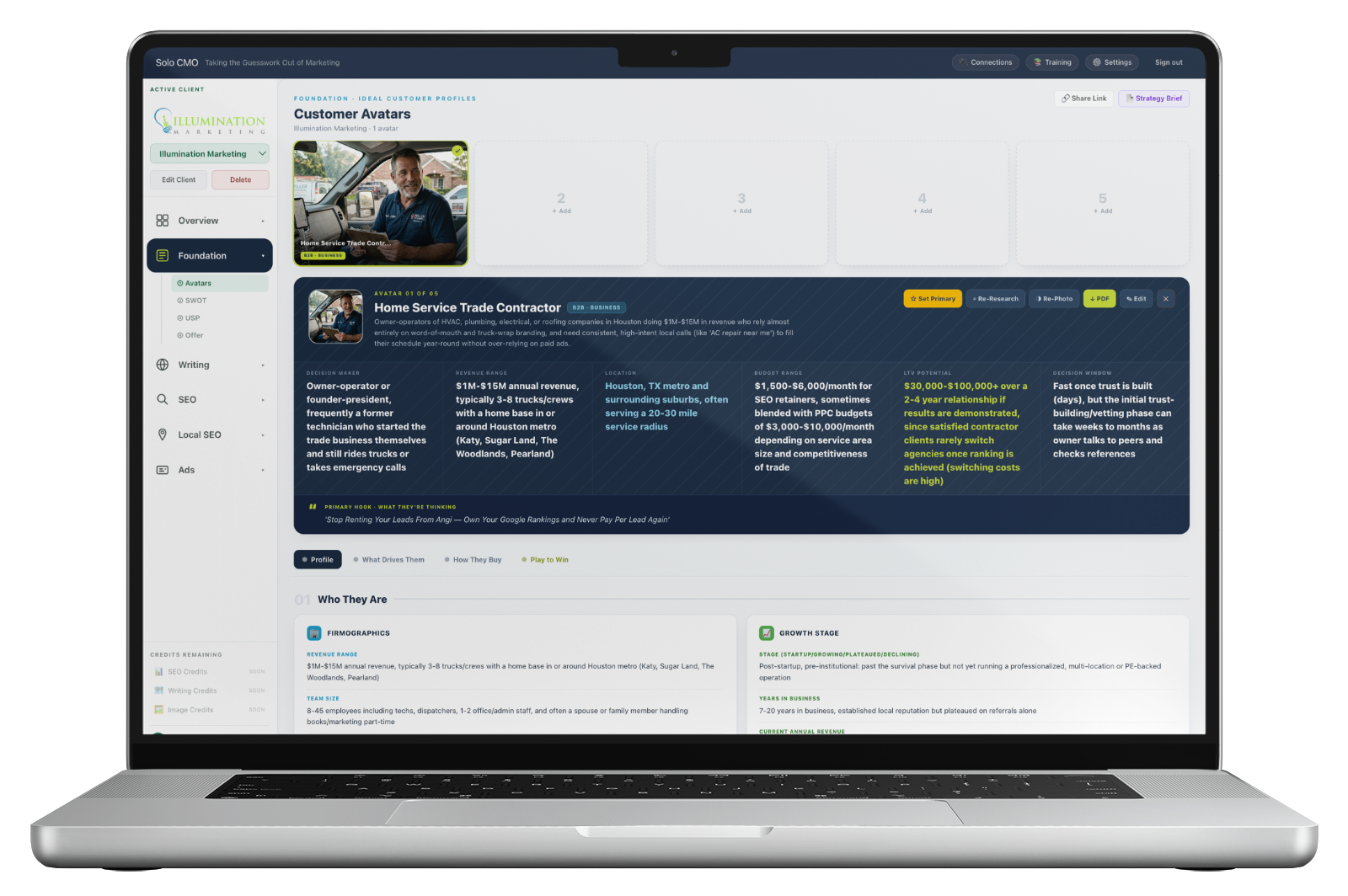
Most personas are a paragraph nobody reads twice.
You've seen the format. A stock photo, a first name, an age range, three adjectives, and a line about valuing quality and convenience. It gets built during onboarding, saved to a folder, and never opened again — because there is nothing in it you could actually write an ad from.
The test for a persona isn't whether it's accurate. It's whether it changes what you do next. A profile that doesn't tell you which channel to spend on, which objection to answer first, or which prospects to turn away hasn't earned the hour it took.
Four sections, built to be used rather than filed.
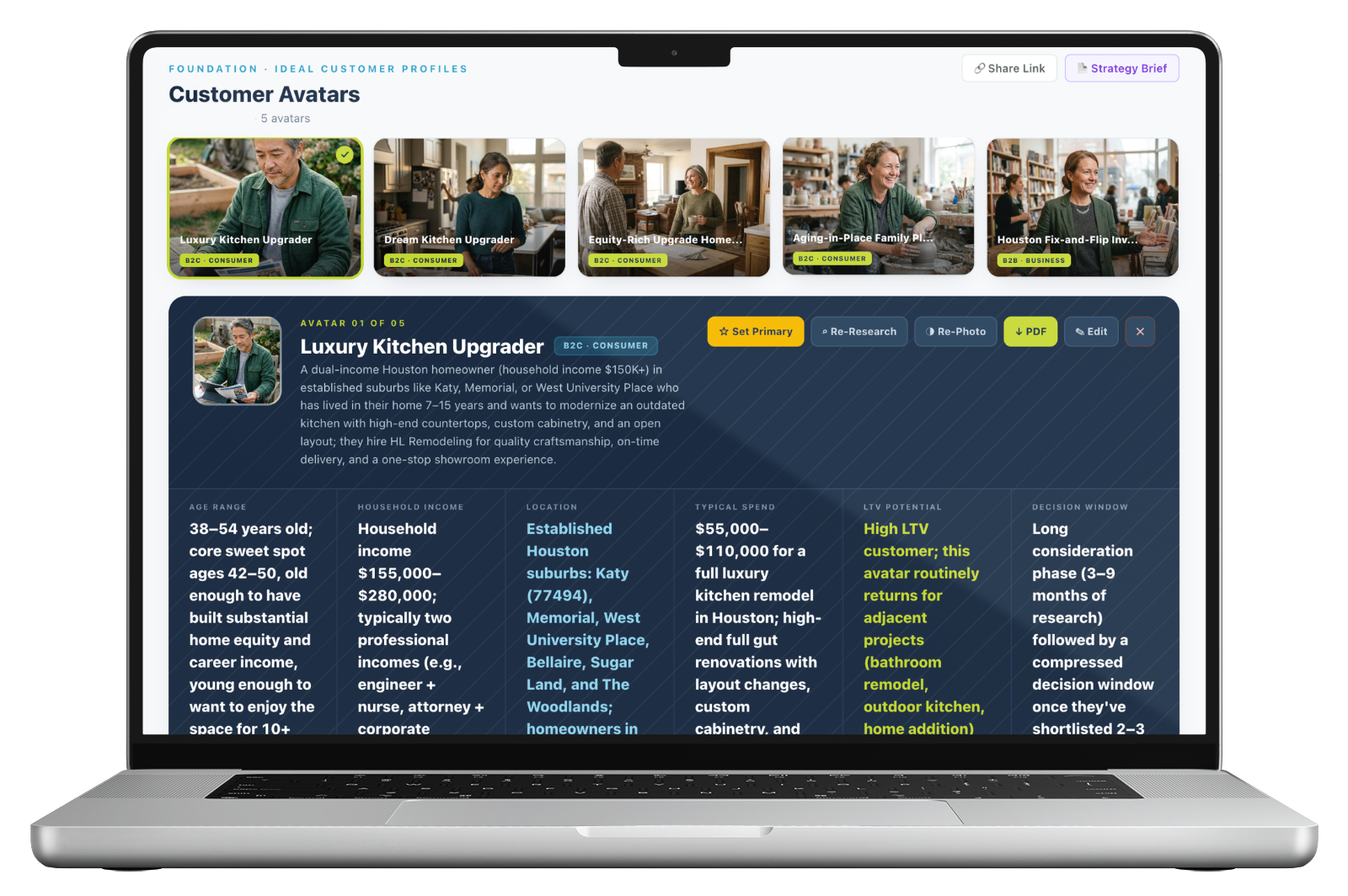
Each avatar carries a full profile: who they are, what's driving them to search today, how they make the decision, and what it takes to win them. Every section exists because something downstream reads it.
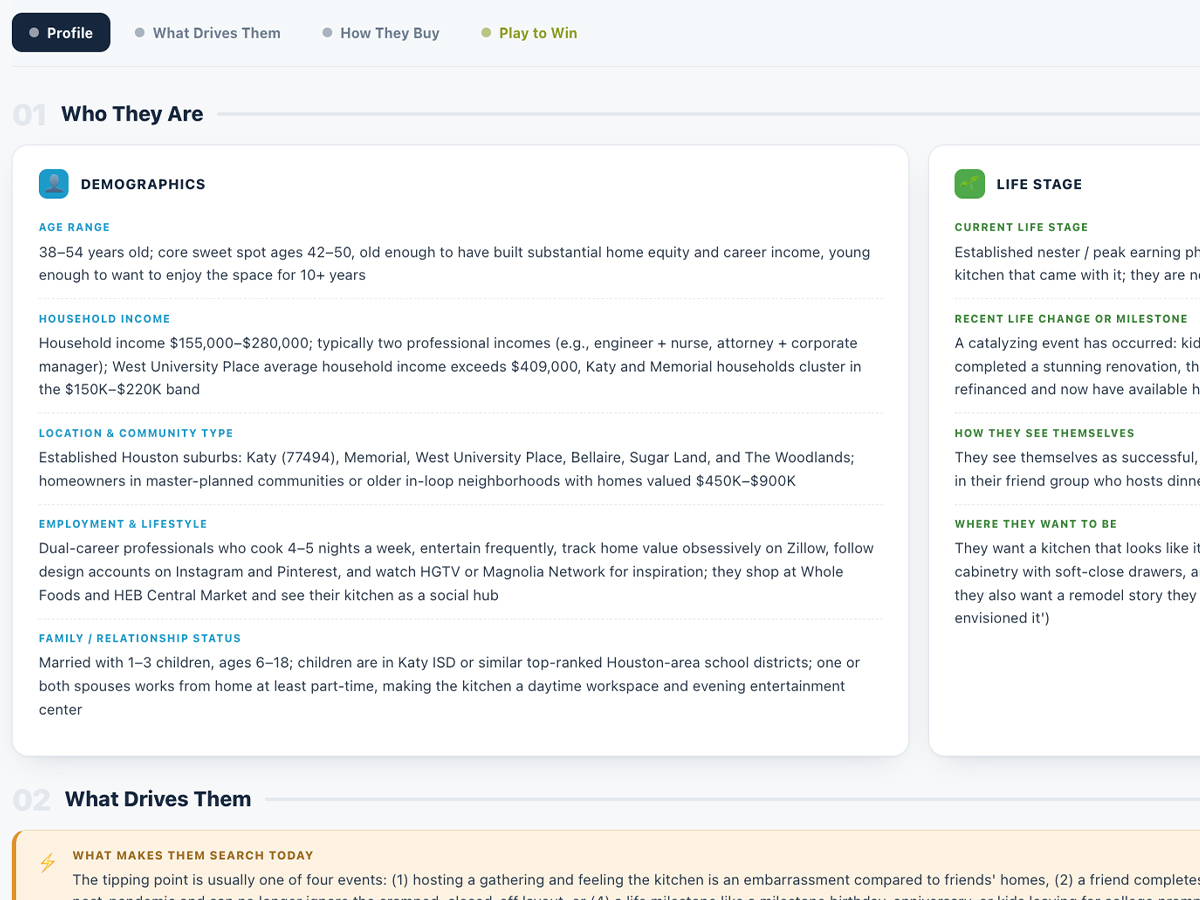
Section 01
Who they are
Age, household income and equity, the communities they live in, employment and family status — plus life stage: what recently changed, how they see themselves, and where they want to be.
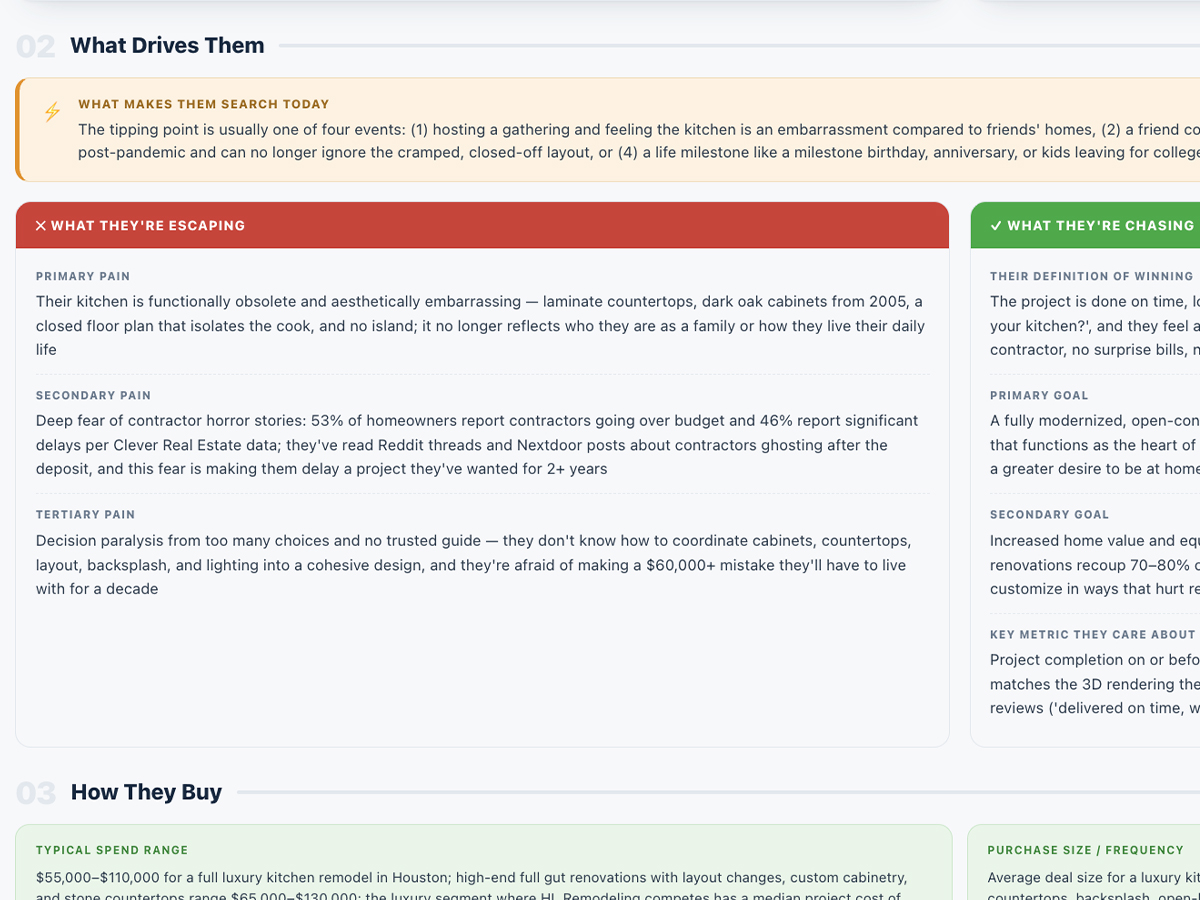
Section 02
What drives them
What made them search today, split into what they're escaping and what they're chasing — primary, secondary and tertiary pains against their own definition of winning.
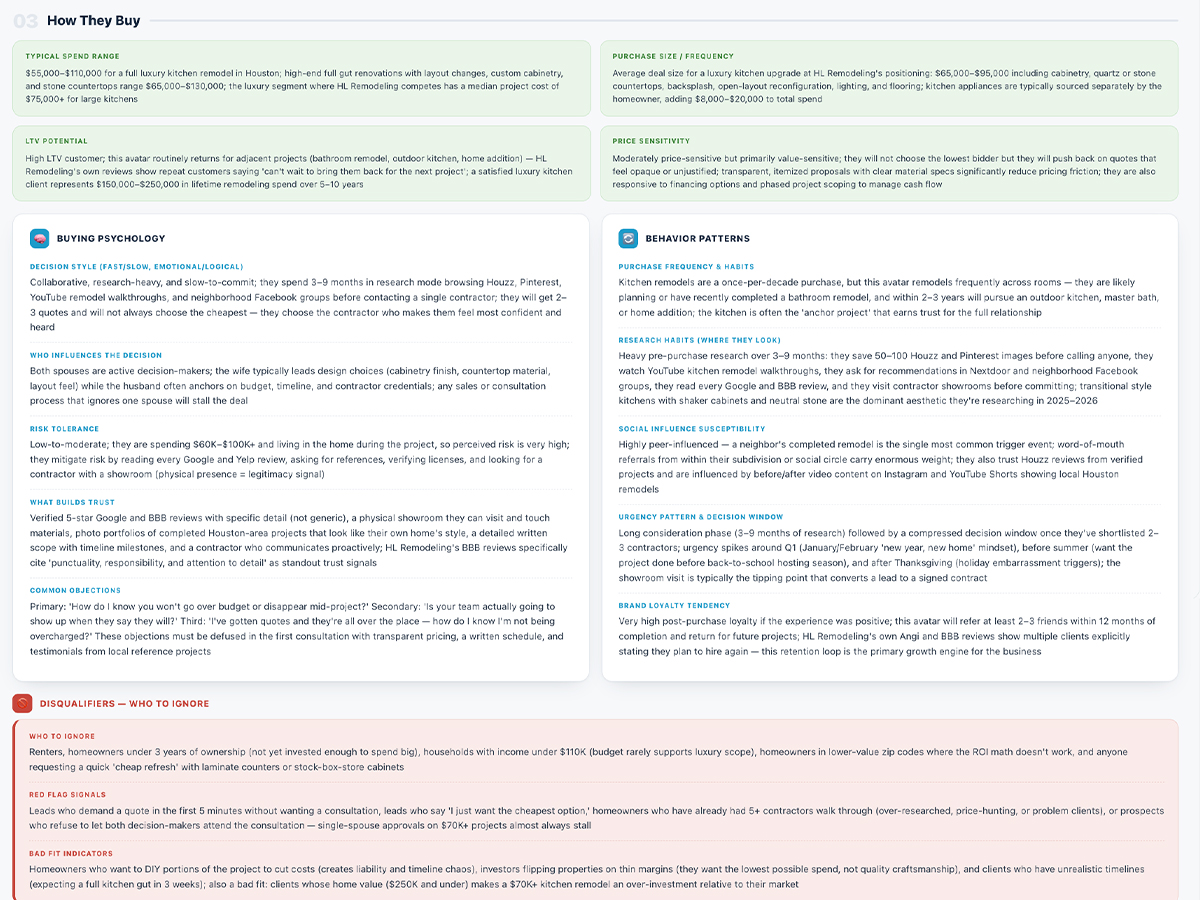
Section 03
How they buy
Spend range, purchase frequency and lifetime value. Then the mechanics: decision style, who else is in the room, risk tolerance, what builds trust, the objections you'll hear, and where they research.
- Age & household income
- 01
- Location & community type
- 01
- Employment & lifestyle
- 01
- Life stage & recent change
- 01
- What makes them search today
- 02
- Primary / secondary / tertiary pain
- 02
- Definition of winning
- 02
Fields, section 01–02
- Typical spend & LTV potential
- 03
- Price sensitivity
- 03
- Decision style & influencers
- 03
- Common objections
- 03
- Research habits & urgency window
- 03
- Messaging hooks
- 04
- Offer strategy & ranked channels
- 04
Fields, section 03–04
It ends with instructions, not a summary.
The last section is the one that makes the other three worth building. Messaging hooks written in the customer's own words, the emotional versus logical framing to lead with, an offer strategy, a funnel recommendation, and the channels ranked in the order worth spending on.
- Primary and secondary messaging hooks, quoted as the customer would say it
- Emotional versus logical framing for this specific buyer
- Offer strategy — what to lead with and what reduces the risk
- Funnel recommendation across search, social and referral
- Top channels, ranked one to five
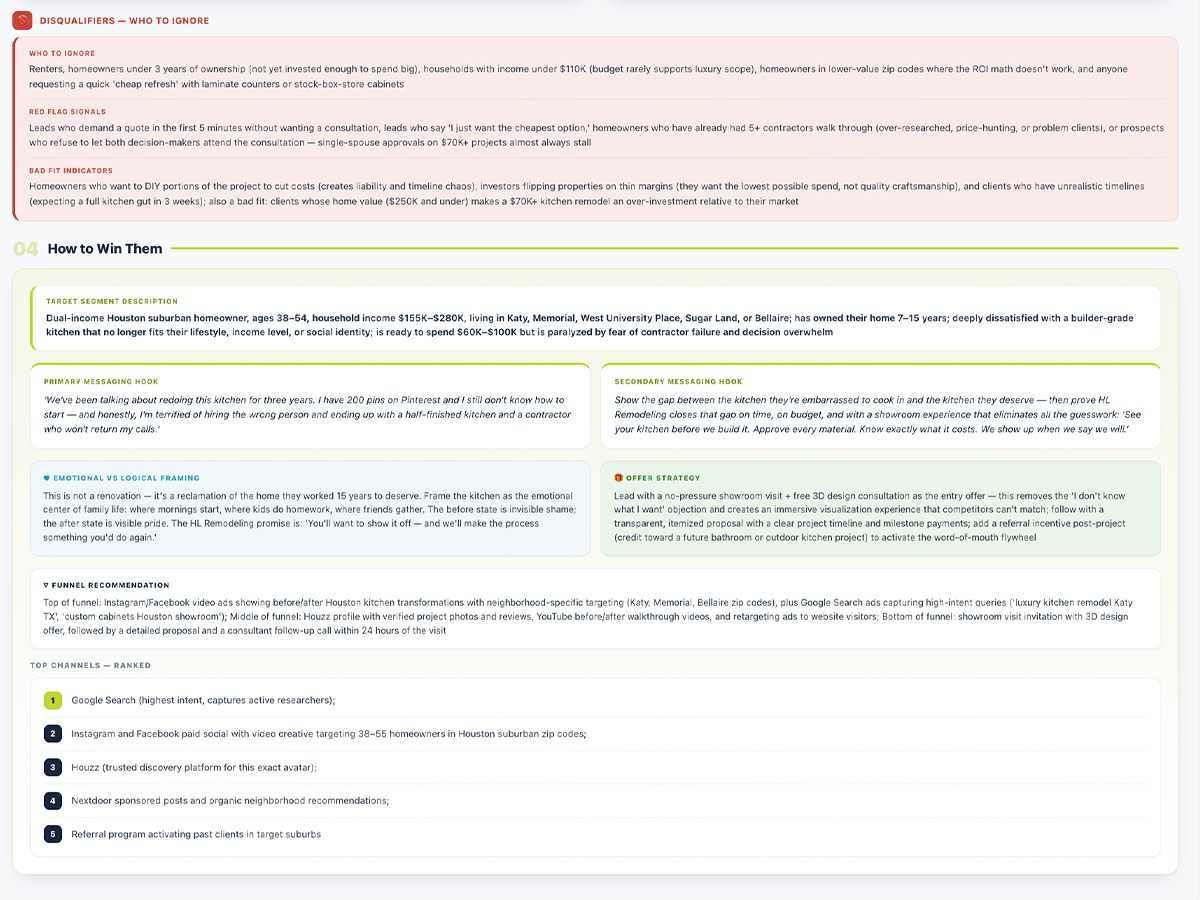
It also tells you who to turn away.
Every avatar carries a disqualifiers block: who to ignore, the red flags in an enquiry, and the bad-fit indicators. Almost nothing else in this category does that, because it's easier to sell a persona that says yes to everyone.
Targeting without disqualifiers isn't targeting. For a local service client, the difference between a good month and a bad one is usually not the leads they won — it's the three quotes they spent a week on for people who were never going to buy.
- Who to ignore, named explicitly
- Red flag signals in an enquiry
- Bad-fit indicators worth walking away from
Three inputs you already have, then it researches.
Step 01
The client profile does the work
Market, services and target geography are already on the client record. That's the whole brief — the specificity comes from research, not from a longer form.
Step 02
Build up to five
Most local businesses serve two or three genuinely different buyers. Build each one, set the primary, and re-run the research whenever the market shifts.
Step 03
Edit, then send
Correct anything you know better than the research does. Then export as a PDF, a share link, or roll the set into a strategy brief.
Nothing downstream sounds generic, because nothing downstream starts generic.
The avatar isn't a document that sits beside the work. It's the input every generator reads before it writes a word.
- Client market
- Profile
- Services offered
- Profile
- Target geography
- Profile
- Live research
- Re-runnable
Avatars read
What comes next in the sequence.
Strengths and weaknesses judged against this customer, not in the abstract.
USPThe one reason this buyer should choose them over the firm down the road.
OfferThe reason to act now, aimed at the urgency window the avatar names.
Meta Ads GeneratorAd sets written from the avatar's own hooks and objections.
Avatars, answered straight.
How many avatars can a client have?
Where do the details come from?
Can I send an avatar to a client?
Can I edit what it produces?
Why does it list people to ignore?
Every plan includes every module.
There are no feature gates. Plans differ only in how many clients you run and how much you generate for them.