
Stop selling a service. Start selling a system.
Five stages that turn a client's objections into a structured offer — components with named delivery vehicles, a value stack checked against the price, scarcity that comes from a real constraint, and a conditional guarantee. Output is a one-page offer document you can hand over.
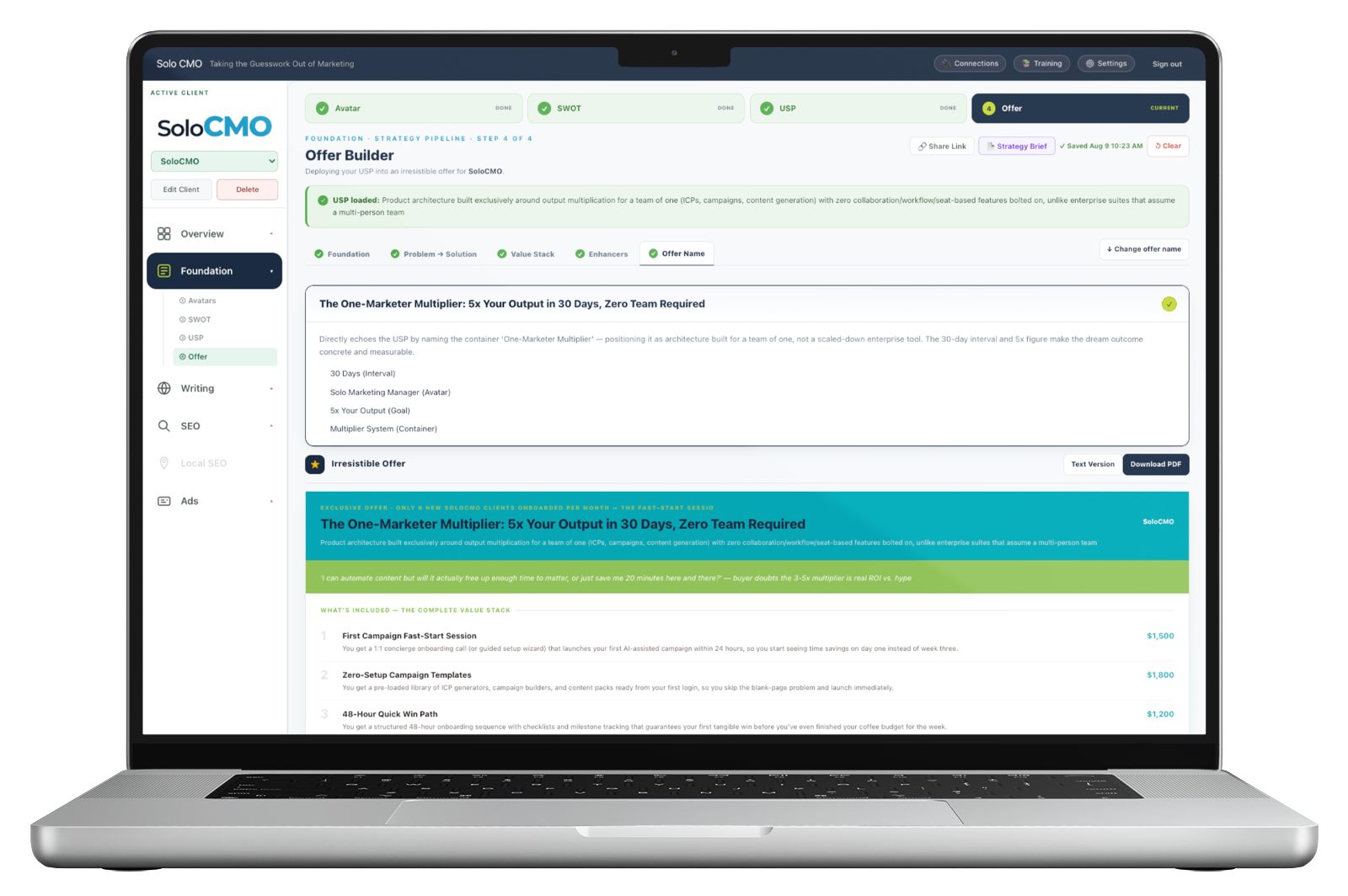
An hourly rate next to another hourly rate is just a number.
When a local business sells an undifferentiated service, the prospect has nothing to compare except price — so the cheapest quote wins, margins compress, and the owner concludes that their market "only cares about cost."
It usually isn't true. It's that nobody gave the buyer anything else to weigh. An offer is what turns a rate into a decision, and building one properly is the highest-leverage hour you can spend on a client. It's also the hour most solo operators never get to, because there's no structure for it.
Every field maps to a lever.
The builder is organised around one equation, so nothing you add is decoration — each component either raises the dream outcome, raises the perceived likelihood of getting it, cuts the time to get it, or cuts the effort it takes.
Stage one captures the dream outcome, the target avatar, the current price, the price the business wants to reach, and how the service is delivered. Everything after that is generated against those five inputs.
Every objection becomes a component with a name.
This is the part that's hard to do on a blank page. Each thing the prospect doesn't believe gets turned into three concrete things: what the business will actually do, how it gets delivered, and what it's called when it's sold.
Offer component
Guarantee a named primary caregiver plus a named backup who has already met the family and reviewed the plan.
Delivery vehicle
A written consistency commitment signed at intake, with photos and bios in the welcome packet and a paid shadow shift in week one.
Bundle name
Your Person Guarantee — Same Face, Same Schedule, Every Week
Offer component
Collapse onboarding into a single fast-start track — one call, one assessment, a match presented inside 48 hours.
Delivery vehicle
One 15-minute digital intake form; every remaining coordination handled internally before the first shift.
Bundle name
Done-For-You Launch — From First Call to First Covered Shift in 48 Hours
Each row is tagged with the lever it moves, so the finished offer covers all four rather than piling everything onto the one that's easiest to write.
Then it prices what you're giving away.
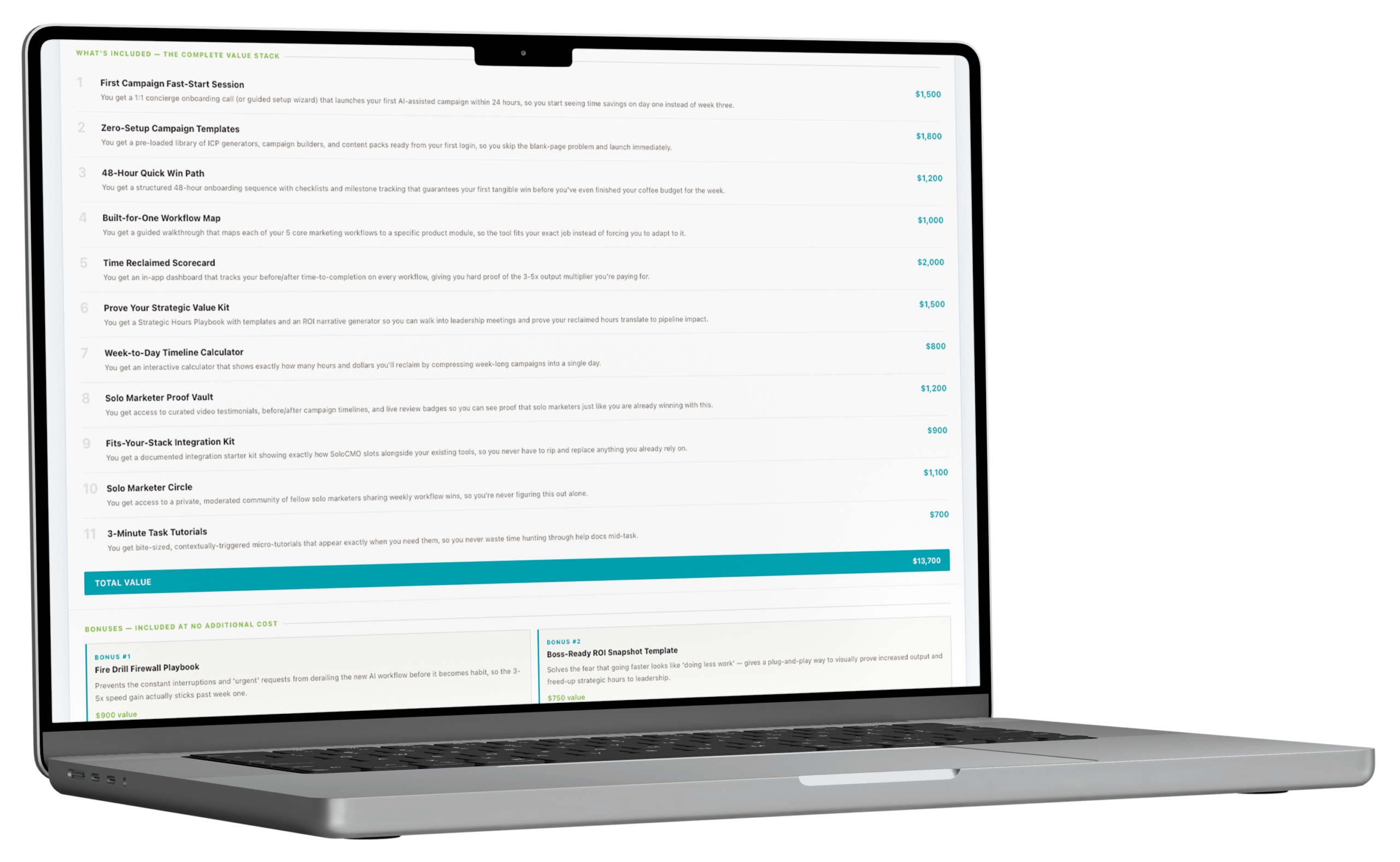
Every component from stage two gets a perceived value — what a buyer would reasonably pay for that piece on its own — and the stack totals against the actual price with a ratio check. Ten to one is the working minimum.
The discipline isn't the arithmetic. It's that assigning a number to each component forces you to notice which ones you can't justify, and those are the ones to cut or strengthen before a prospect finds them.
- Perceived value per component, editable
- Running total against the price
- Value-to-price ratio with a stated minimum
Scarcity you can say out loud.
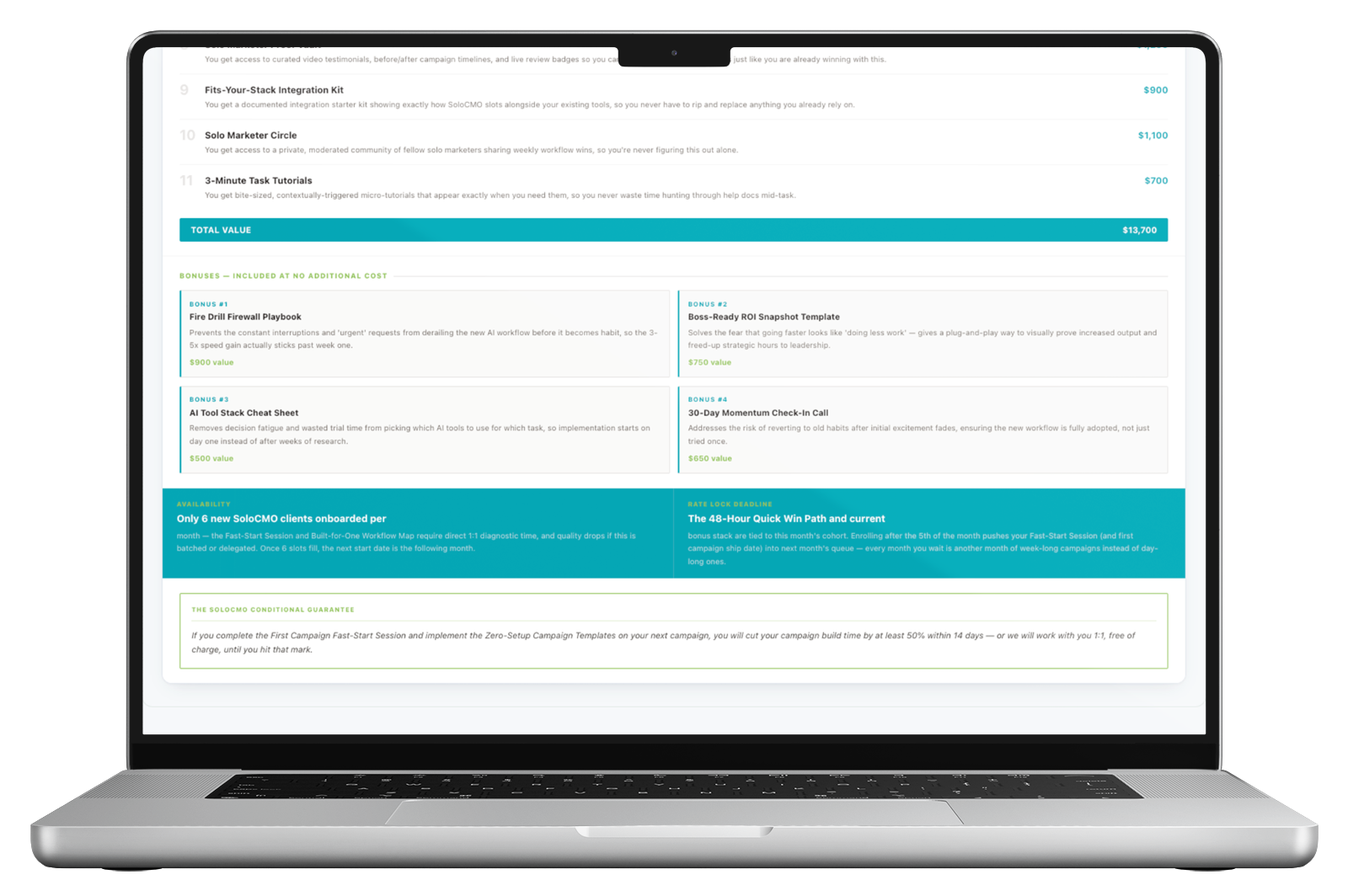
Fake urgency is the fastest way to lose a local business its reputation, in a market where the buyer probably knows someone who used them. So the scarcity has to come from a real operational limit — a capped roster because the consistency guarantee stops holding beyond it, a rate change already scheduled, an onboarding slot that genuinely only opens twice a week.
If a business has no real constraint, it shouldn't claim one. The test is whether the owner could explain the limit to a prospect's face without flinching.
Scarcity & urgency
Tied to a real constraint
The cap, the deadline and the reason each exists — written so the reason is stated rather than implied.
Bonuses
Each one solves something
Bonuses carry the specific obstacle they remove and a value, rather than being padding to make the list longer.
Guarantee
Conditional and specific
A guarantee naming exactly what has to fail for it to trigger, and exactly what happens then — which is what makes it believable.
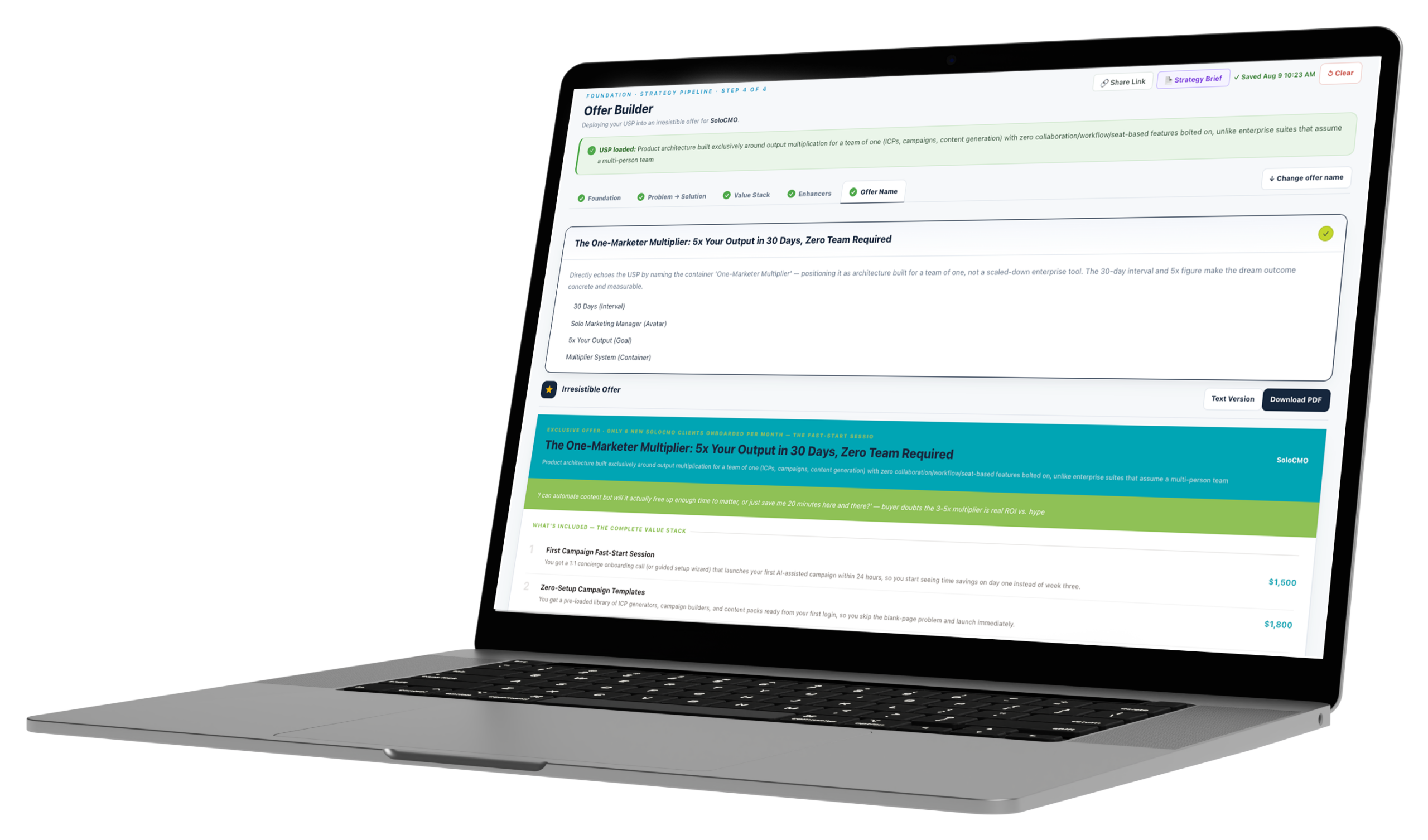
A name that promises a system, and a document you can hand over.
The offer gets named from four parts — the interval it runs on, the avatar it's for, the goal it delivers and the container it comes in — with the reasoning stated, so you can defend the name rather than just like it.
Then the whole thing renders as a one-page offer: headline, the objection it answers, the full stack with values, the bonuses, availability, the guarantee and the price. Text or PDF.
- Interval — the rhythm the promise runs on
- Avatar — who it's built for, named
- Goal — what it eliminates or delivers
- Container — what the buyer actually receives
The last step of Foundation, and the first input to everything paid.
The offer is what ads point at, what landing pages ask for, and what the bottom of every funnel closes on. Nothing downstream has to invent a reason to act, because this made one.
- Avatars
- Objections
- SWOT
- What's true
- USP
- The claim
Feeds the offer
What comes before, and what spends it.
Offer Builder, answered straight.
What framework is the offer built on?
Isn't manufactured scarcity dishonest?
Where do the dollar values in the stack come from?
Can I give the finished offer to the client?
Does this actually change what a client can charge?
Every plan includes every module.
There are no feature gates. Plans differ only in how many clients you run and how much you generate for them.