
A SWOT analysis that ends in a plan, not a grid.
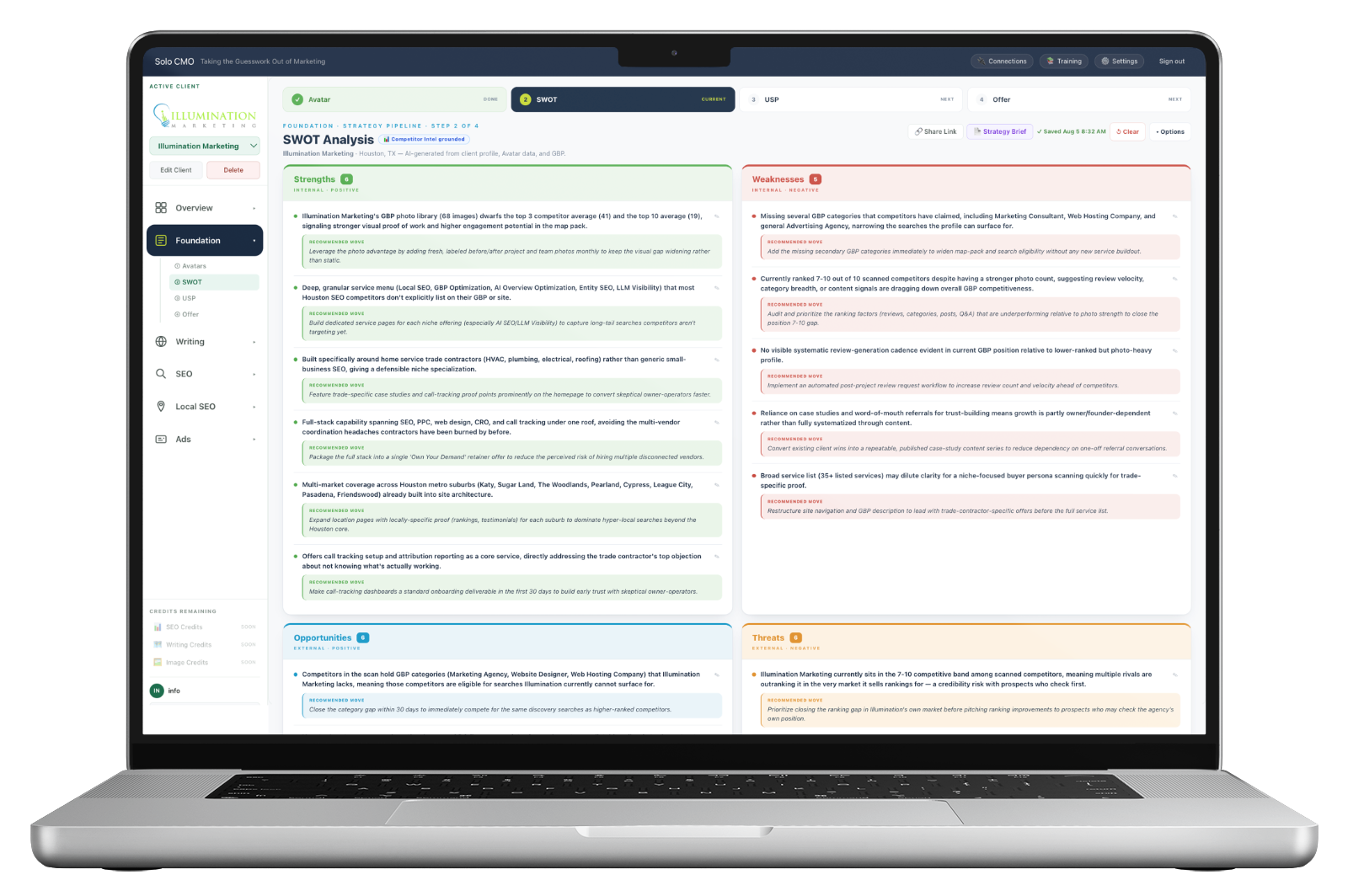
Twenty-eight findings across four quadrants, every one carrying the specific move that acts on it — then synthesised into five ranked priorities with an impact rating and a time horizon. Built from the client's avatars, profile and Google Business Profile data, not from a blank template.
Nobody has ever done anything because of a SWOT.
The format survives because it's easy to fill in, not because it works. Four boxes, a dozen adjectives, "strong reputation" in one corner and "limited budget" in another — a document that describes a business without ever telling you what to do on Monday.
The failure isn't the framework. It's that almost every SWOT stops at the observation. A finding with no move attached is a note, and notes don't survive contact with a busy week.
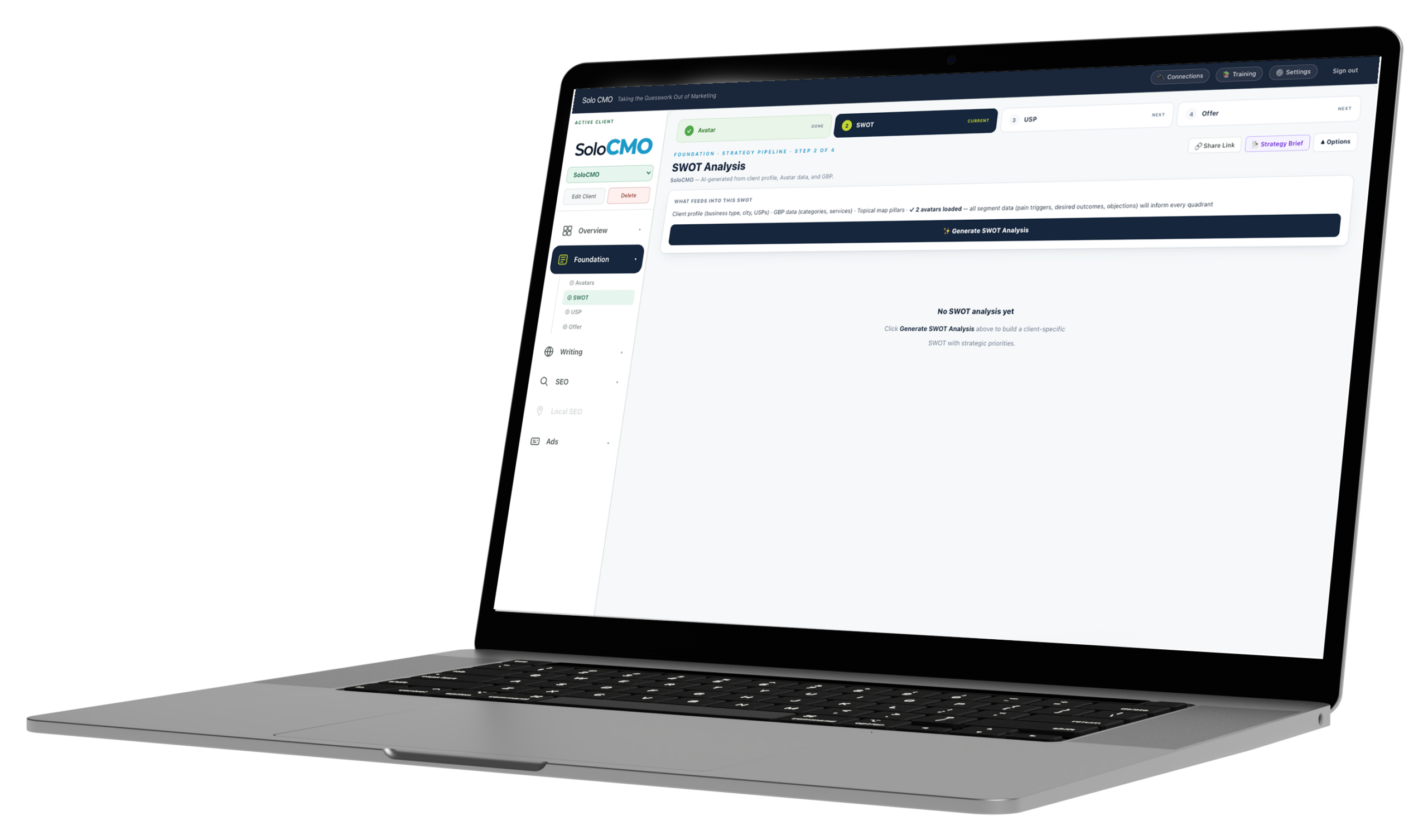
It shows its own working.
Before you read a single finding, the panel lists what informed it: the client profile, their Google Business Profile categories and services, the topical map pillars, and every avatar loaded for that client — with their pain triggers, desired outcomes and objections feeding each quadrant.
That's why the output names actual zip codes, actual hospitals and actual competitors rather than describing a category. And it's why you can trust it enough to put your name on it.
- Client profile — business type, city, existing USPs
- Google Business Profile — categories and services
- Topical map pillars from the SEO system
- Every avatar built for the client, scoped to a named persona
Seven findings per quadrant. Twenty-eight moves.
Each quadrant holds seven items, and each item carries a recommended move directly underneath it. The finding tells you what's true; the move tells you what to do about it this month.
Internal · positive
Strengths
7Assets a competitor can't copy quickly — licensing, service area, referral proximity, cost structure, retention economics.
Internal · negative
Weaknesses
7Gaps a marketing budget can actually close — review velocity, missing content, no follow-up system, an incomplete profile.
External · positive
Opportunities
7Market conditions worth moving on now — population shifts, referral channels nobody has cultivated, underserved segments.
External · negative
Threats
7Pressures outside the client's control — national franchises outspending them, regulation, labour tightness, algorithm risk.
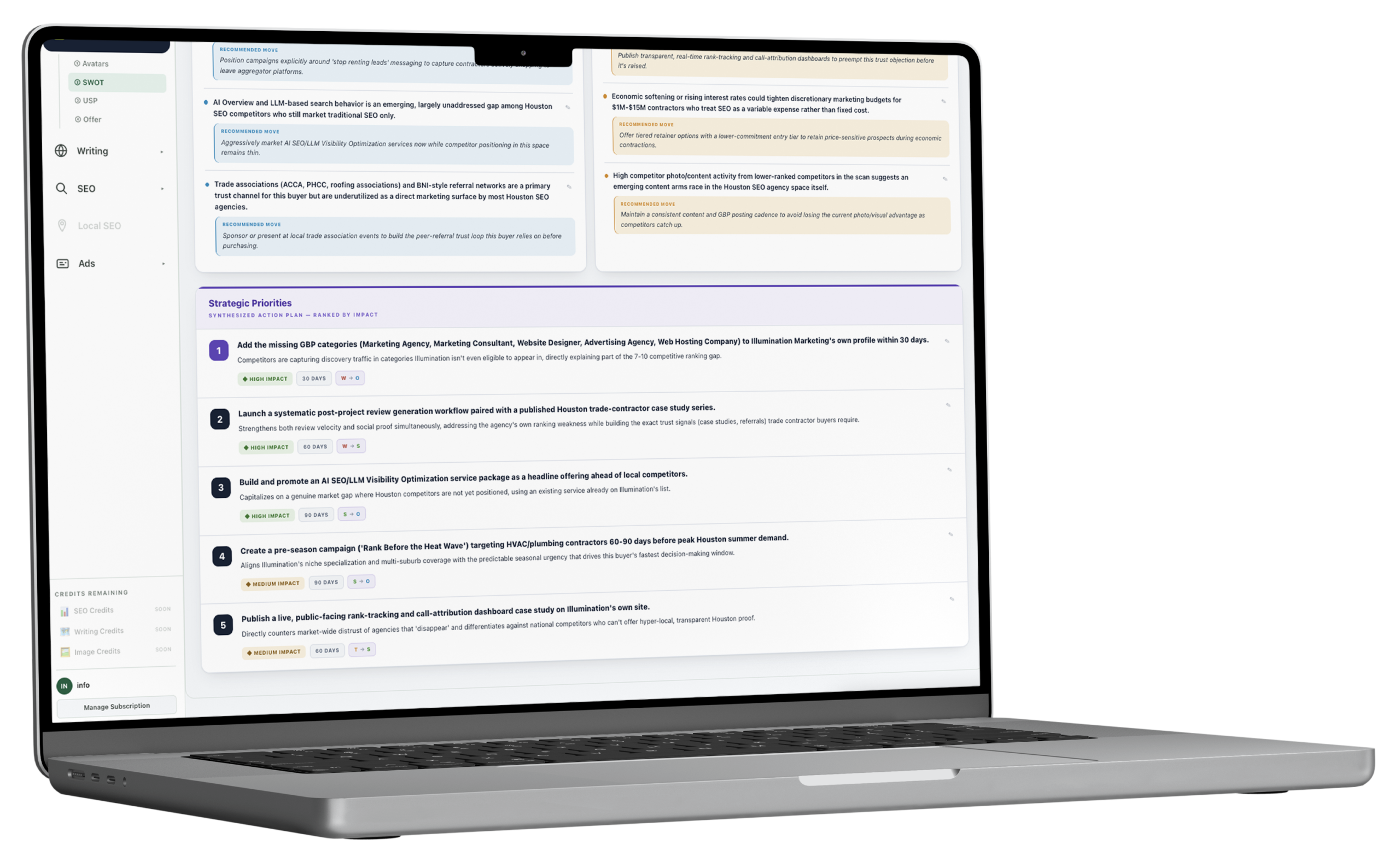
Then it turns twenty-eight findings into five things to do.
A grid isn't a strategy. The Strategic Priorities section synthesises the four quadrants into a ranked action plan — each priority tagged with its impact, a thirty or sixty day horizon, and which pairing it converts.
Those conversions are the actual strategic work: turning a weakness into an opportunity, using a strength to capture one, defending a weakness against a threat. Most SWOT tools never get past listing the boxes.
Step two of four, and it needs step one.
The SWOT sits inside the strategy pipeline. It reads the avatars you built before it, and the USP you build after it reads this.
Step 01
Avatars first
The analysis is scoped to a named persona, because a strength for one buyer is often irrelevant to another. Without avatars loaded, the quadrants have nothing to judge against.
Step 02
Generate, then read the inputs
The panel states what it used before it states what it found. Regenerate any time the client's profile, categories or avatar set changes.
Step 03
Work the priorities, not the grid
Five ranked items with horizons attached. Share the link or roll it into a strategy brief — this is the artifact that justifies a strategy retainer.
What feeds it, and what it decides.
Before and after in the pipeline.
SWOT, answered straight.
What is the SWOT generated from?
Does every finding come with an action?
What do the arrows in the strategic priorities mean?
Is it scoped to one customer type?
Can I send it to a client?
Every plan includes every module.
There are no feature gates. Plans differ only in how many clients you run and how much you generate for them.