
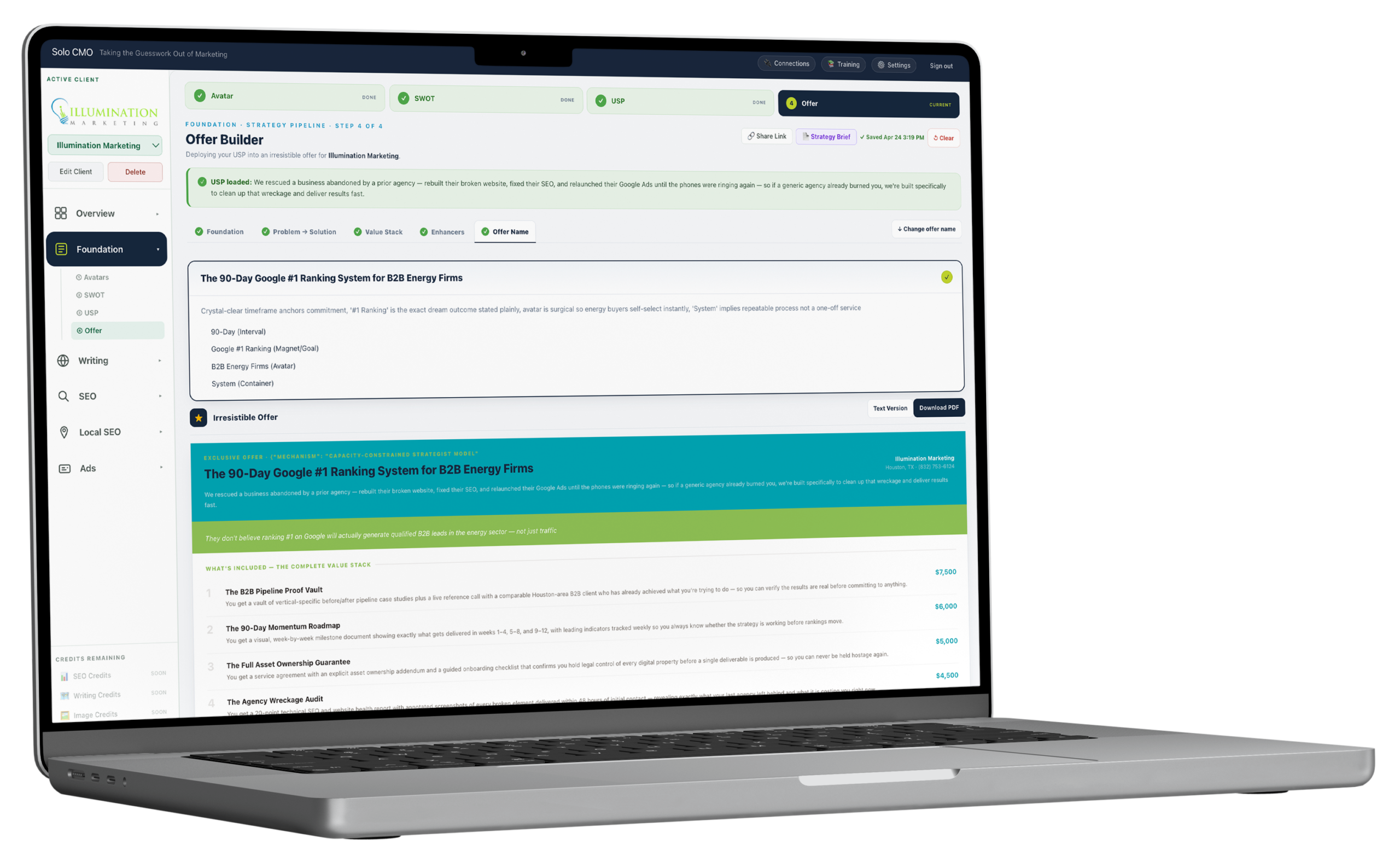
Four answers. Everything downstream inherits them.
Who the client sells to, where they actually stand, why anyone should pick them, and what the offer is. Settle those four in order and every page, ad and campaign the system generates is built on them — which is the difference between marketing for this client and marketing for a category.
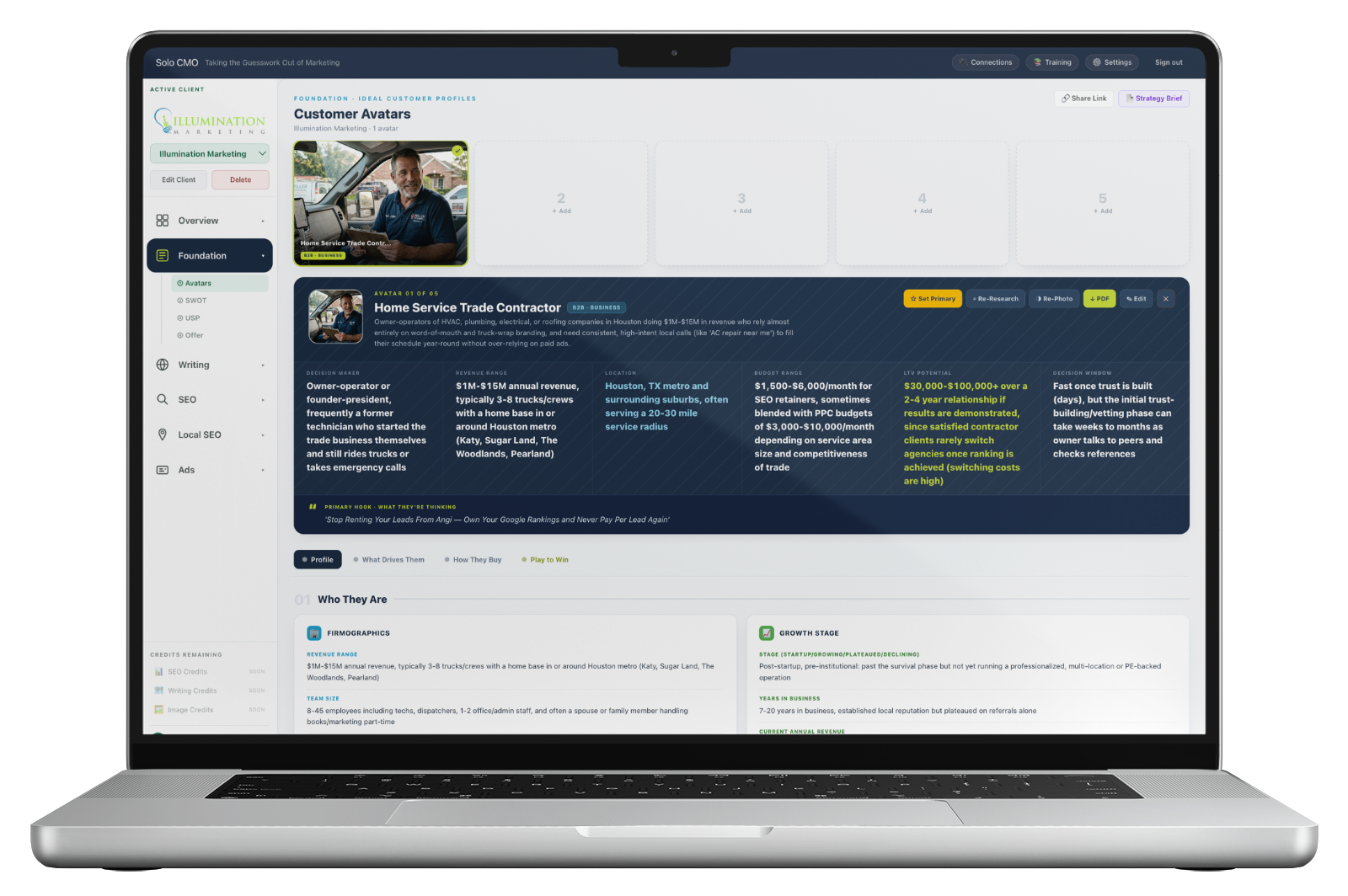
Generic input is why AI content sounds like AI content.
Ask any tool to write a page for a Houston plumber and you get a page about Houston plumbers — competent, interchangeable, and worth nothing in a market with forty of them. The model isn't the limitation. The brief is.
Most operators skip strategy because it feels like the part clients don't pay for. It's actually the part that decides whether everything they do pay for is any good.
Four steps, and the order is the point.
Each answer is the next one's input. That's why they're numbered in the product rather than sitting in a menu — you can't write a real USP for a customer you haven't defined.
Avatars
Who actually calls this business, what they're worried about, and what makes them pick up the phone.
Feeds → SWOT
SWOT
Where the business genuinely wins and loses — judged against that customer, not in the abstract.
Feeds → USP
USP
The one reason to choose them over the firm down the road, drawn from a strength that survives scrutiny.
Feeds → Offer
Offer
The reason to act now, built to deliver on the positioning rather than discount away from it.
Feeds → everything
Avatars
A buyer persona for the client's real market — not a demographic sketch, but the person who picks up the phone at 7pm because water is coming through the ceiling.
- Built from the client's own market, services and geography
- What they're worried about before they ever search
- What makes them choose one firm over another
- Multiple avatars where a business genuinely serves more than one
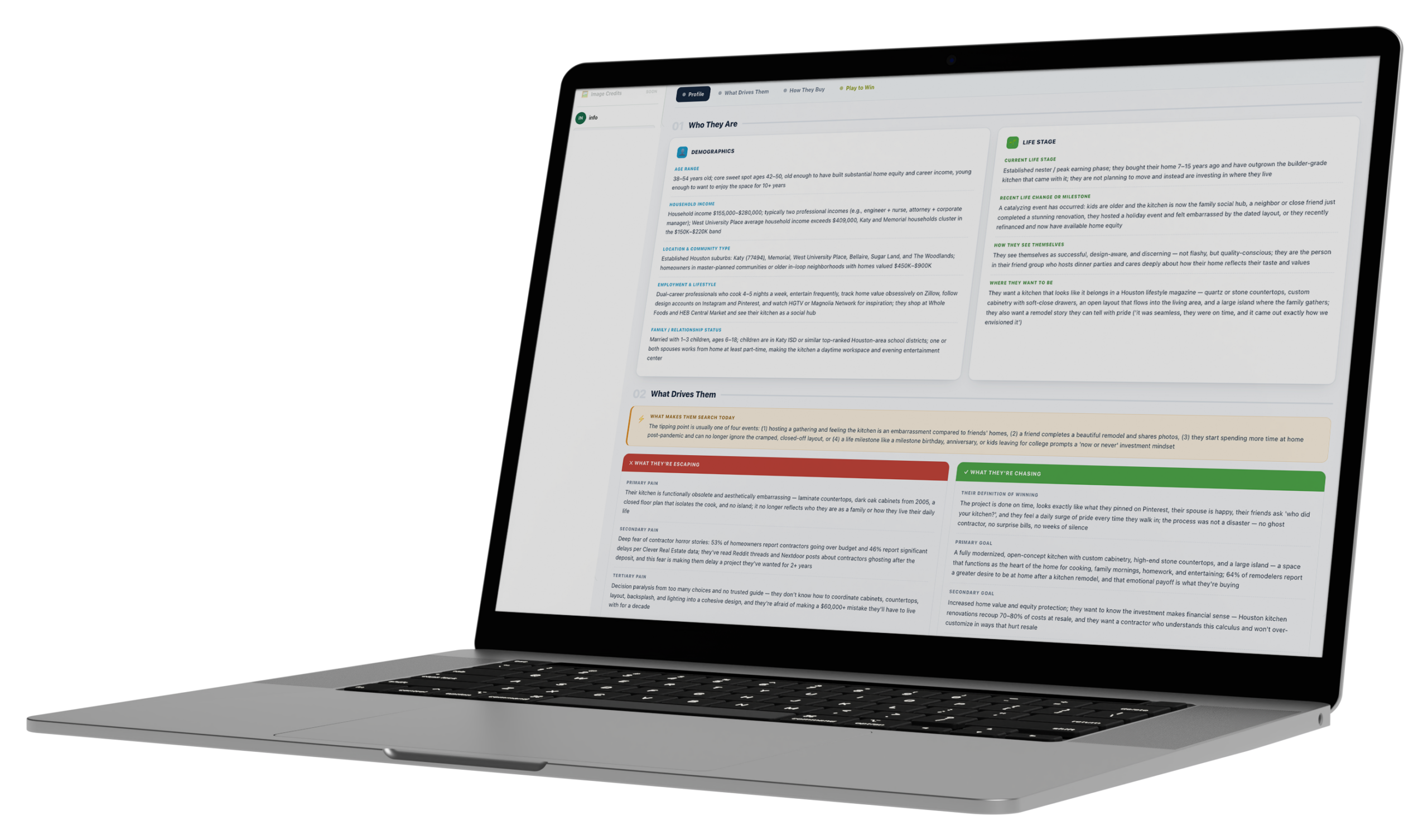
SWOT
Strengths, weaknesses, opportunities and threats — assessed against the avatar you just built, so "we care about quality" doesn't survive as a strength.
- Judged relative to the customer, not in the abstract
- Separates what's true from what's differentiating
- Surfaces the weaknesses a marketing budget can actually move
- Gives the USP something defensible to be built from
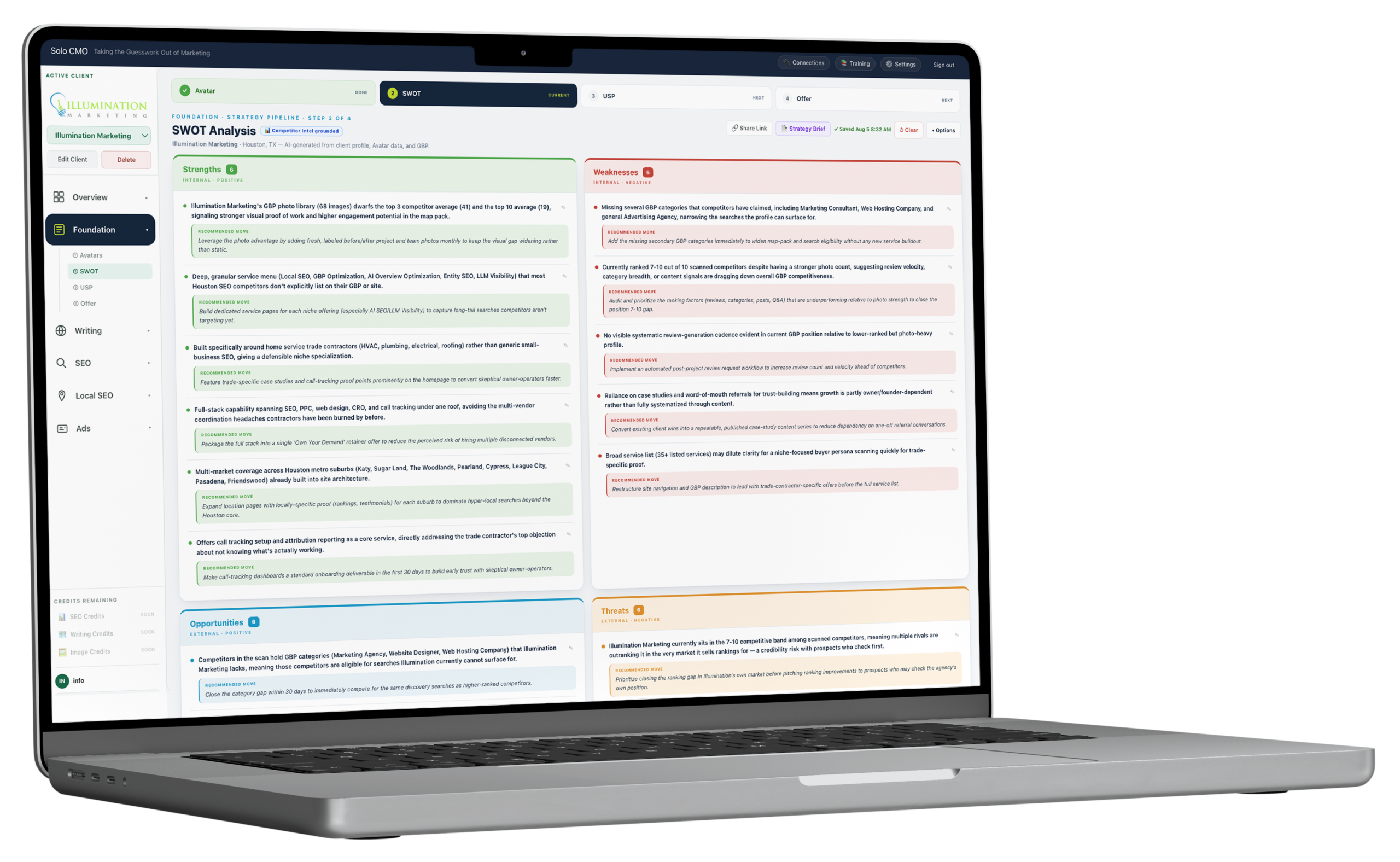
USP
A positioning line that survives contact with a competitor. Most local businesses land on the same three adjectives — reliable, experienced, family-owned — which is another way of saying nobody has one.
- Built from a strength the SWOT actually supports
- Tested against what the competition already claims
- Written to be repeatable across pages, ads and the phone
- Stable — it shouldn't change with the season
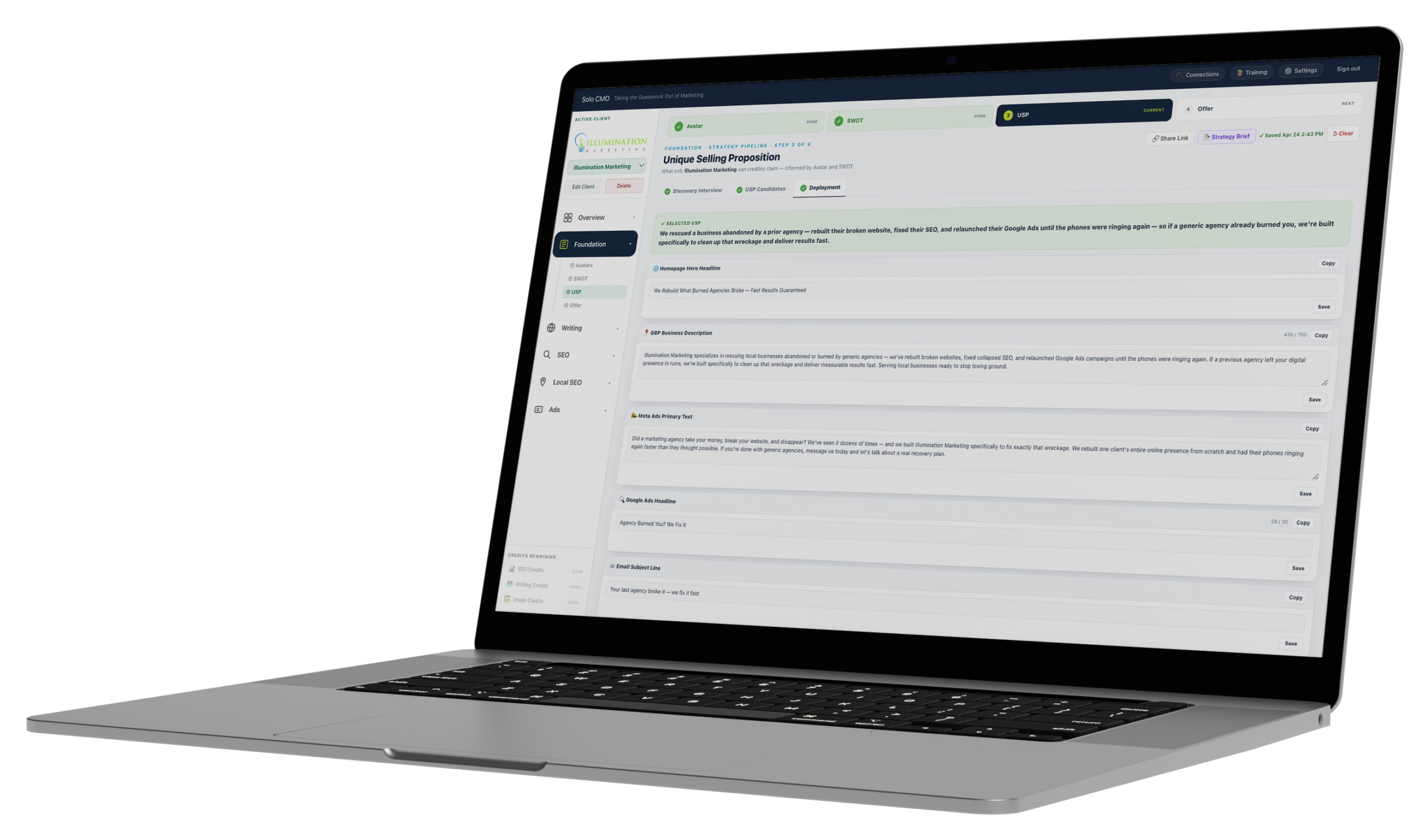
Offer
The reason to act this week rather than next quarter. An offer isn't a discount — it's the thing every ad and landing page in the system points at, so it has to be worth pointing at.
- Built to deliver on the USP rather than undercut it
- Carries a real reason the timing matters
- Becomes the target for ads, PPC landing pages and BOFU funnels
- Swappable by season or campaign without touching the positioning
Foundation is upstream of everything.
This is the system with the widest blast radius. Nothing else in the panel produces client-specific output without it — which is also why it's first in the sequence and why skipping it quietly degrades every module after it.
Foundation, answered straight.
Do I need to complete all four?
Where do these answers get used?
Is the foundation per client or shared?
What's the difference between a USP and an offer?
Does this replace real market research?
Every plan includes every module.
There are no feature gates. Plans differ only in how many clients you run and how much you generate for them.