
Nobody plans an over-optimized profile.
They just build one, a reasonable link at a time. This audits where a money page's anchors actually sit against natural ranges, then plans every anchor for the month's guest posts — with a cumulative exact-match cap that blocks the slot rather than warning you about it.
Every anchor decision is reasonable. The total isn't.
You place a guest post and you need anchor text. The money keyword feels like the productive choice, so that's what goes in — and it goes in again on the next one, and the one after that, because each decision is made alone and nothing is keeping a running count.
Eighteen months later a page has one hundred and eighty backlinks, two-thirds of them keyword anchors, almost no branded ones, and a profile that looks exactly like what it is. Nobody chose that. It accumulated.
Where the profile actually sits, against where it should.
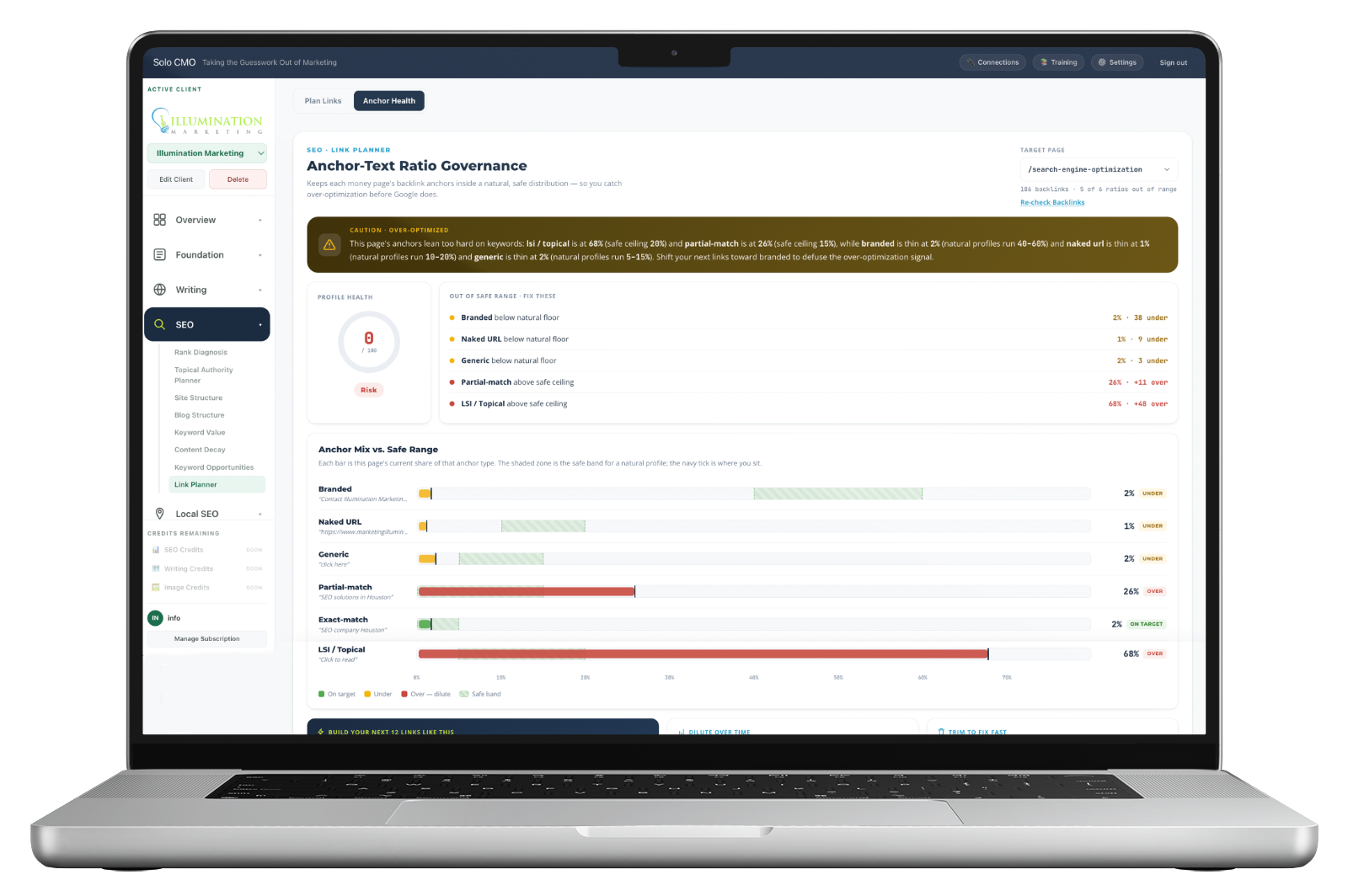
Each anchor type gets a band — the share a profile tends to have when nobody was optimizing it. Branded should dominate. Naked URLs and generic anchors should be common. Keyword-rich anchors should be the minority they'd naturally be.
Note that every category has a floor as well as a ceiling. A profile can be unnatural by having too few branded anchors just as easily as too many keyword ones.
A real money page with 186 backlinks — five of six ratios out of range.
It doesn't just grade the profile. It writes the next dozen anchors.
Knowing a profile is over-optimized doesn't help unless it changes what you place next month. The prescription names the count per anchor type — and pauses the categories that are already over, so you can't accidentally make it worse while trying to fix it.
Build your next 12 links like this
Rebalance toward branded and naked URL
- 4× Branded
- 4× Naked URL
- 3× Generic
- 0× Partial-match — paused until safe
- 1× Exact-match
- 0× LSI / Topical — paused until safe
And when a profile is already out of range, two routes — both costed.
Dilute over time
Build it out
Add enough non-offending anchors to bring the ratio down naturally. On the profile above, reaching the ceiling means roughly 444 more anchors of other types — slow, but nothing gets removed and nothing looks like a reaction.
Slower · lowest riskTrim to fix fast
Disavow the worst
Remove or disavow the lowest-quality offenders until the ratio is back inside range. On the same profile that's 89 of 186 links, and it's immediate — but every one of them needs a human decision first.
Faster · needs reviewThen plan the month, slot by slot.
Add the money pages that matter this month with the keywords behind them, set how many guest posts you're placing, and the plan allocates across money pages, homepage and supporting content — then fills in every slot with a category, an anchor and a destination.
Export it as a CSV and hand it to whoever is placing the posts. The person buying the links never has to make an anchor decision.
- Money pages get first priority, with the split stated as a percentage
- Allocation across money pages, homepage and blog or info content
- Every slot carries its category, anchor text and destination URL
- The mix recalculates live as you change the volume
- CSV export, saved to history so the next month builds on it
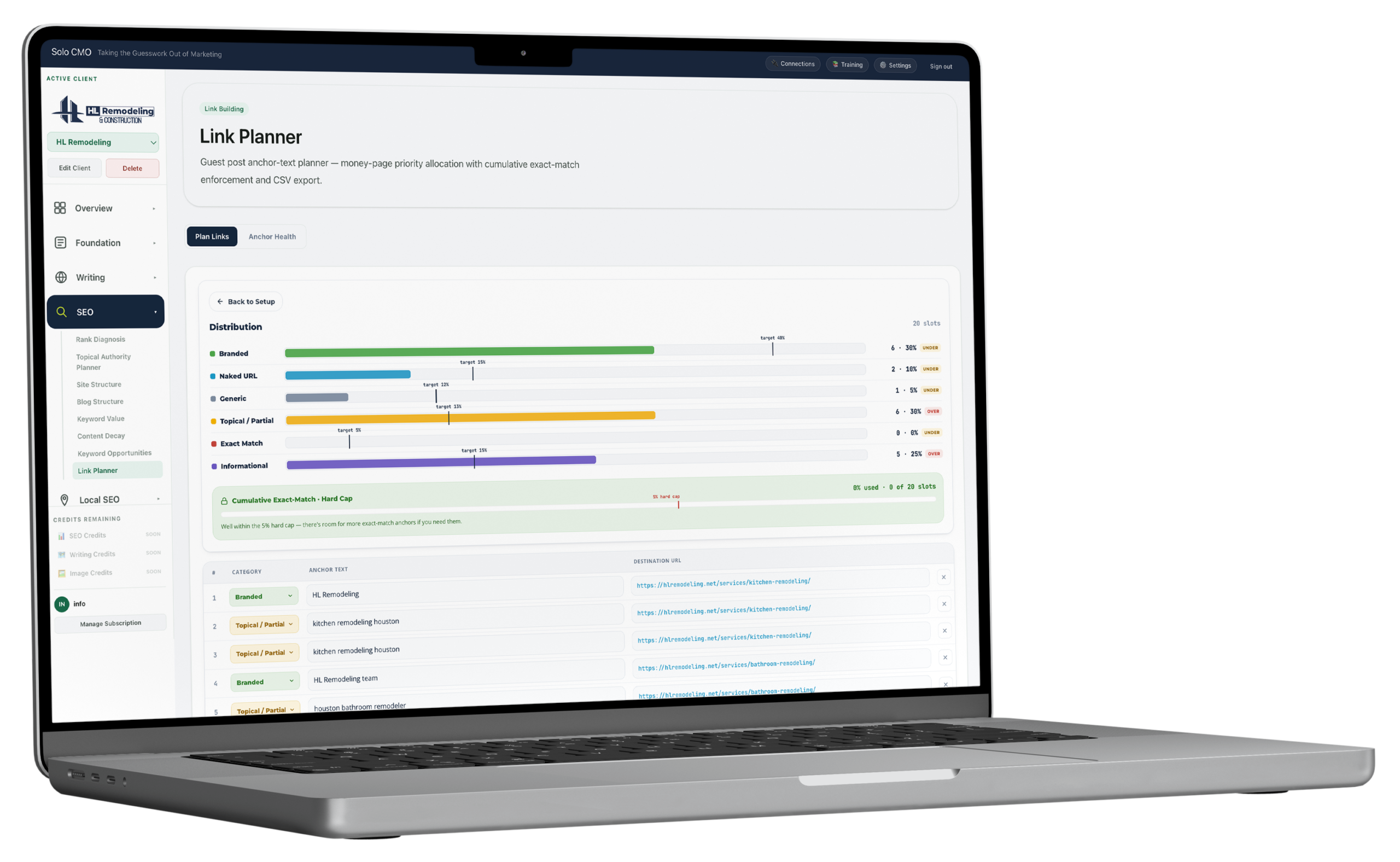
The cap blocks. It doesn't warn.
Exact-match is the anchor type that gets profiles into trouble, and it's the one that feels most productive to keep using. So the cap is cumulative across the whole month's plan, and when you reach it the next exact-match slot isn't available — same principle as the word ceiling in the content pipeline.
Velocity
How many links is safe this month
A sudden spike is its own signal regardless of how good the anchors are. The recommendation takes the client's referring domains against a competitor's, how long they've been building, and the traffic trend.
Floors too
Warned when branded runs thin
The plan flags a branded share that's too low, not just keyword anchors that are too high. Both directions are how a profile ends up looking built.
Per money page
Ratios governed page by page
A site-wide average hides the page that's in trouble. Each money page gets its own profile, its own health score and its own prescription.
Every module is on every plan. Plans differ only in how many clients you run.
What feeds it, and what it produces.
- Site Structure
- Money pages
- Keyword Value
- Which pages
- Backlink data
- Current mix
- Rank Diagnosis
- Where it hurts
Feeds the planner
- The month's plan
- CSV
- Next 12 anchors
- Prescribed
- Disavow list
- If trimming
- Profile health
- Per page
What comes out
What operators run alongside it.
Link Planner, answered straight.
How is this different from a backlink checker?
What is the exact-match hard cap?
What are the natural ranges based on?
What if a profile is already over-optimized?
How many links should I build in a month?
Every plan includes every module.
There are no feature gates. Plans differ only in how many clients you run and how much you generate for them.