
The hook has a name. Now it has a number.
Every ad kept with the psychological hook it used, the funnel stage it was built for, and the numbers it actually returned — so the next campaign starts from evidence instead of instinct.
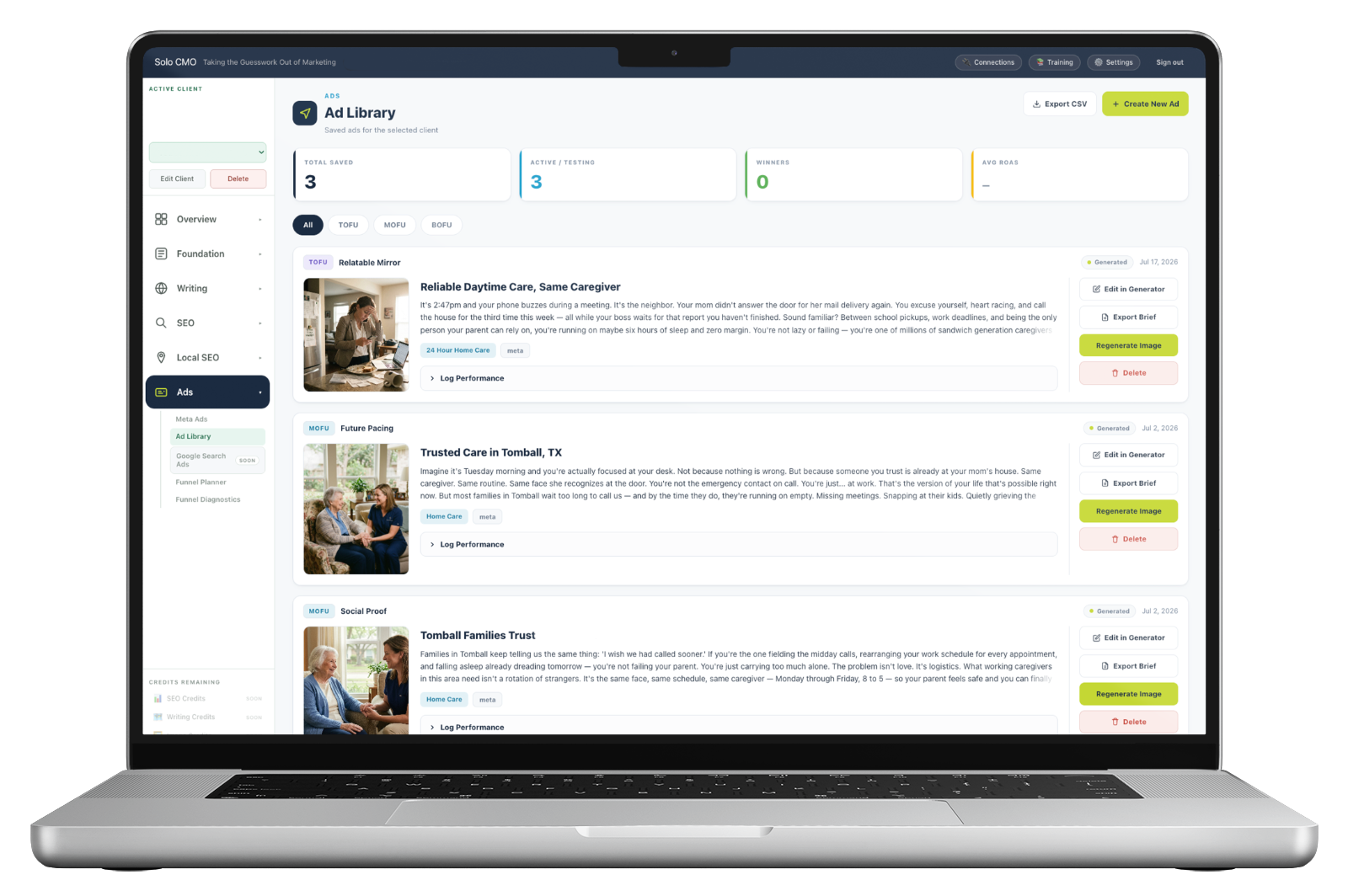
Every ad you've ever run is somewhere you'll never look again.
Ads Manager keeps the numbers. It doesn't keep the thinking. Nothing in it records that the ad returning 3.5x opened on a relatable scene aimed at someone who hadn't yet admitted they had a problem — because that isn't a field it has.
So every new client starts from zero, every quarter starts from zero, and after three years of running paid social for local service businesses you have a great deal of experience and no way to consult it.
The creative decision and the result, on the same row.
Each saved ad carries the hook it used and the funnel stage it was built for. Log what it did — click-through, cost per click, return, impressions, spend — and the two halves are permanently attached.
Reliable Daytime Care, Same Caregiver
"It's 2:47pm and your phone buzzes during a meeting. It's the neighbor. Your mom didn't answer the door for her mail delivery again…"
Real ad, real logged figures. The badge on the left is what makes the row worth keeping.
After twenty ads, the pattern is the asset.
One logged ad is a note. Twenty logged ads across a vertical is something no competitor has and no tool sells — a record of which psychological angles actually move a particular kind of buyer.
That's the answer to the hardest question in paid social, and it's the question every agency answers with a shrug and a hunch.
Illustrative. The point isn't the numbers — it's that the question "which hook works for home care" becomes answerable at all.
Three ads that all do the same job isn't a funnel.
Every saved ad is tagged top, middle or bottom of funnel. Filter by stage and a common problem becomes visible immediately — a client with plenty of attention-getting creative and nothing built to close.
It's the kind of gap that's obvious in a list and invisible in an ad account.
- Filter the library by funnel stage in one click
- Counts per stage, so a gap shows up as a number
- Status progression from generated, through testing, to winner
- Average return across the client's whole library
- Everything exportable to CSV
Cold audiences who don't know the business exists.
Aware, comparing, not yet committed.
Nothing built to close. The gap in one number.
Illustrative counts. Eleven ads and nothing that asks for the job.
A winner should be varied, not rebuilt.
Edit in generator
Reopen with everything intact
Stage, avatar, offer, hook and placements come back exactly as they were, so a proven ad becomes the starting point for the next three variations.
Regenerate image
New visual, same copy
Creative fatigue usually hits the image before the words. Refresh the visual on its own rather than throwing away copy that's still returning.
Export brief
The reasoning travels
The production brief exports with the ad, so whoever makes the visual gets the strategy behind it and not just a headline and a hope.
Every module is on every plan. Plans differ only in how many clients you run.
What feeds it, and what it feeds.
- Meta Ads
- The ads
- Your ad account
- The numbers
Feeds the library
Ad Library, answered straight.
What does logging performance actually give me?
Do I have to log the numbers by hand?
What are TOFU, MOFU and BOFU?
Can I change an ad after it's saved?
Is the library per client or across the account?
Every plan includes every module.
There are no feature gates. Plans differ only in how many clients you run and how much you generate for them.