Every campaign teaches the next one.
Model the funnel before the money moves. Write to a named awareness stage. Keep every ad with the hook it used and the numbers it returned. Then find out which stage is actually costing you.
Ads are where a solo operator's credibility gets tested fastest.
SEO failing is slow and arguable. Ads failing is a bill. The money leaves every day, the client watches it leave, and by week three somebody wants to know what came back.
And nothing accumulates. Every ad you've ever written lives in an account you'll never open again, with the numbers separated from the thinking that produced them. Three years in, you have a great deal of experience and no way to consult it.
Four modules, one loop.
Each hands something specific to the next, and the last one hands real numbers back to the first. That circuit is the difference between running campaigns and getting better at running them.
01 · plan
Model it
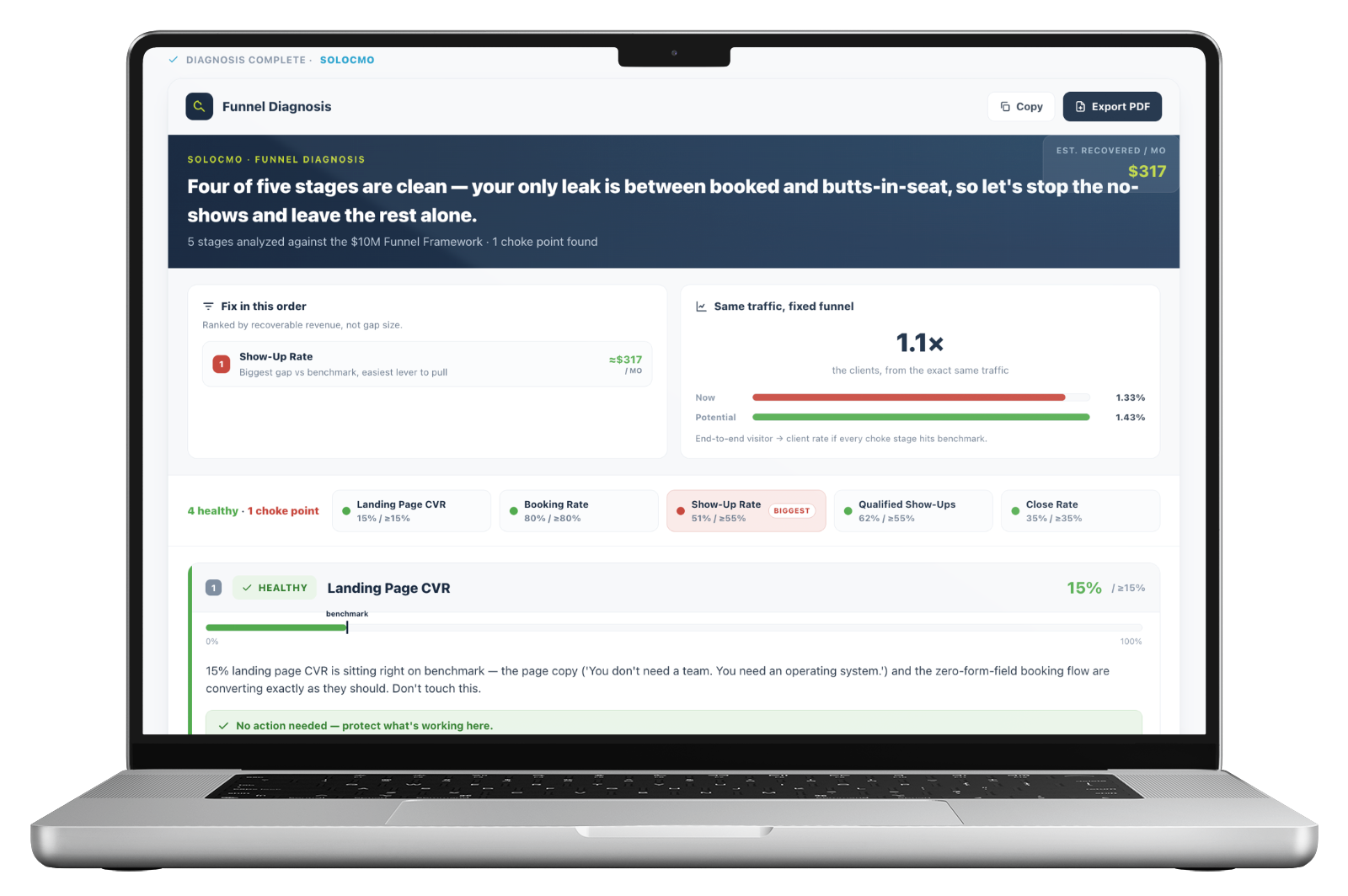
Build the funnel on a canvas and watch visitors, revenue and return cascade through at the rates you set — before any money moves.
Hands over: the targets each stage must hit
02 · create
Write it
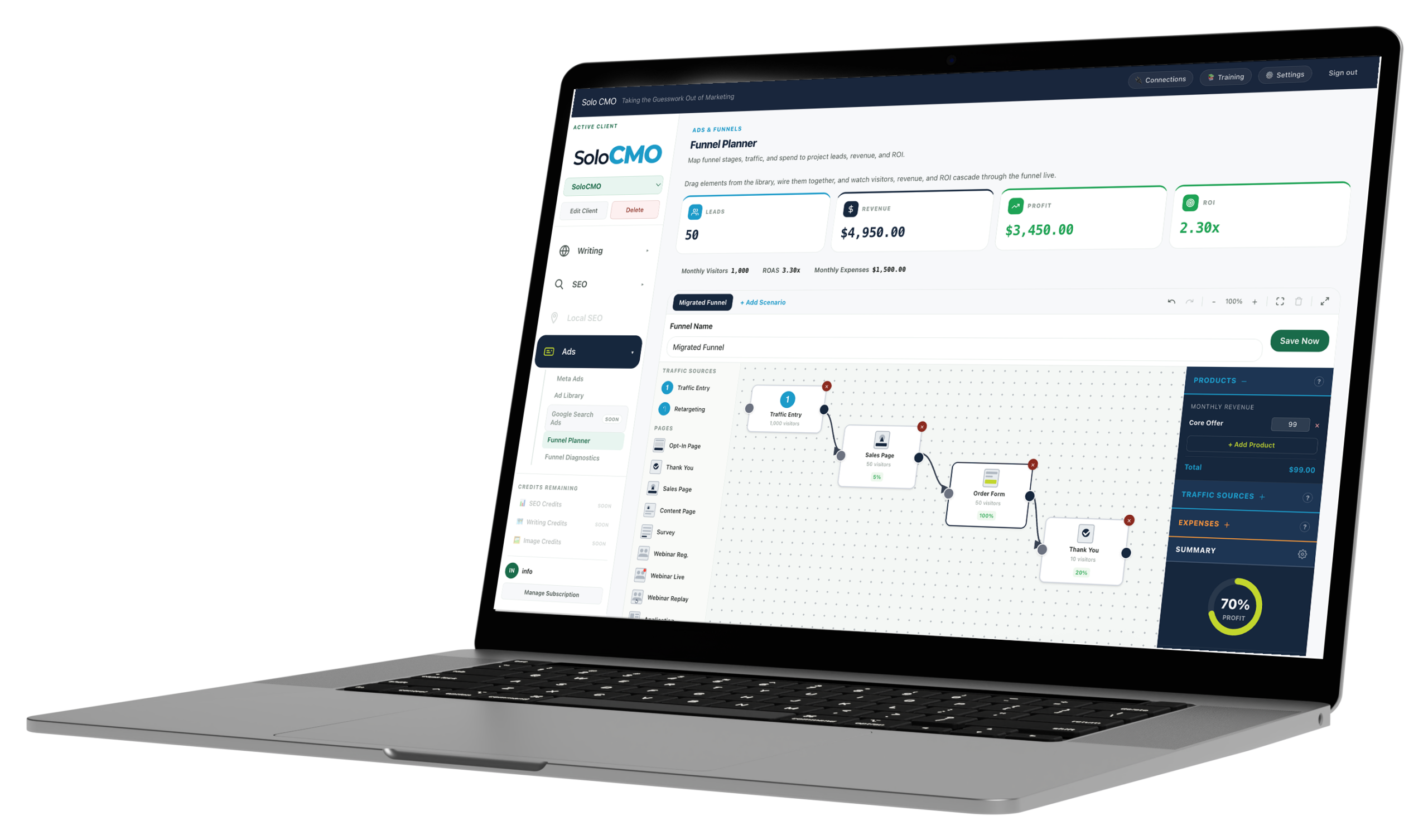
Copy built for a named awareness stage and a defined avatar, in three lengths at once, with the psychological hook stated rather than implied.
Hands over: an ad with its hook labelled
03 · keep
Log it
Every ad stored with its hook, its funnel stage and the numbers it returned — so the creative decision and the result stay attached.
Hands over: which angles actually work
04 · diagnose
Fix it
Five stages scored against benchmarks, choke points named, and a fix list ordered by recoverable revenue rather than by which number looks worst.
Hands back: the real conversion rates
The diagnosis feeds the next model. Which is why the second campaign for a client is built on measured rates instead of assumptions, and the fifth is built on a record no competitor has.
Do the math before you spend the money.
Two thousand a month sounds reasonable, so two thousand a month it is. Almost nobody works out what that has to produce at each stage to be worth doing — because doing it properly means a spreadsheet nobody wants to build.
Drag the stages onto a canvas instead, set the rates, and the arithmetic runs itself. Then build the version where the landing page converts at three percent rather than six, and see whether it still pays.
- Seventeen elements — traffic sources, twelve page types, three revenue steps
- Cost per lead, cost per job, average order value and ROAS on screen
- Scenarios side by side, so a conservative model sits next to the optimistic one
- A budget request backed by arithmetic the client watched you build
Name the mechanism, then measure it.
Generic AI ad copy is a targeting problem, not a writing problem — it doesn't know who's reading or what state they're in. So the awareness stage is chosen before a word is written, and the psychological hook is stated on the output rather than left implicit.
Which matters twice. Once because you can defend the creative on a client call. And again because a hook with a name is a hook you can attach numbers to.
- Five awareness stages, plus a blended three-act build for mixed cold traffic
- Long, medium and short-form written together, each to its own placement limit
- A creative brief with the strategic reasoning for whoever makes the image
- A hundred headlines across twenty angles, tagged and character-counted
- Every ad saved with its hook, its funnel stage and its logged performance
- Ads Manager can tell you an ad returned 3.5x. It can't tell you why.
The biggest gap isn't the biggest opportunity.
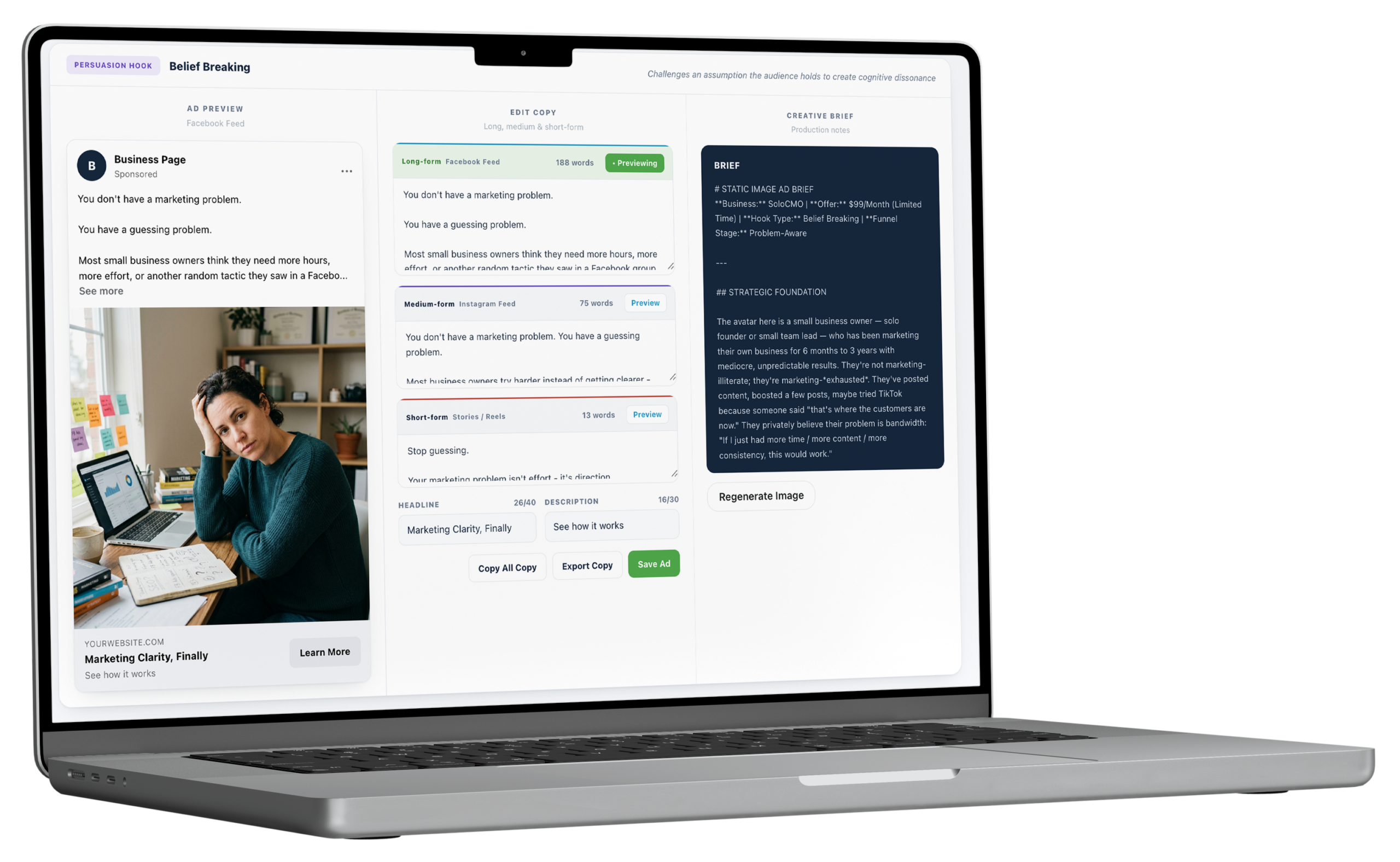
Five stages scored against published benchmarks that adjust for consumer or business audiences. Booking rate six points under, show-up rate eight — but a leak early in the funnel compounds through every stage after it, so the fix order isn't the order the gaps suggest.
Then the number that ends the budget conversation.
1.5xsame traffic
End-to-end visitor-to-client rate if every choke stage reaches benchmark. No extra budget in the argument at all — which is a far better thing to bring to a client than a request for more.
From a real diagnosis. Figures vary by funnel — the calculation doesn't.
Root cause
Why, in their industry
Not generic funnel advice. Why families researching care for a parent abandon a booking step, specifically — the context a checklist can't produce.
Action items
Quick win or structural
Every fix tagged with whether it's an afternoon or a project, so the easy recoveries happen this week rather than waiting on a rebuild.
Protect
What not to touch
A landing page at benchmark while booking leaks should be left alone. More leads into a broken middle spends the budget faster — advice against an agency's own instinct.
All five modules.
Four are live today. Search advertising is in the roadmap and marked as such in the app.
The whole path modelled before the spend, with the economics on screen.
Meta AdsCopy written to a named awareness stage, in three lengths, with the hook stated.
Ad LibraryEvery ad kept with its hook, its stage and the numbers it returned.
Funnel DiagnosticsChoke points named, ranked by recoverable revenue rather than gap size.
Search advertising, alongside the demand the SEO system is already building.
Every module is on every plan. Plans differ only in how many clients you run.
It starts from a client you've already defined.
The avatar, the positioning and the offer exist before the first ad does — built once in strategy and reused across content, local and paid. Which is why the generator asks what state the reader is in rather than who the client is.
Ads, answered straight.
What makes this different from an ad copy generator?
Why does naming the hook matter?
Is Google Search Ads available?
Is this suitable for small local budgets?
Does it connect to my ad account?
Every plan includes every module.
There are no feature gates. Plans differ only in how many clients you run and how much you generate for them.