
Start doing SEO again.
Eight modules that read each client's own Search Console, Analytics, Business Profile, backlinks and live pages — then answer three questions: what's actually wrong here, what should exist next, and which links to go earn.
Diagnosis, priced and prioritized. Not another dashboard.
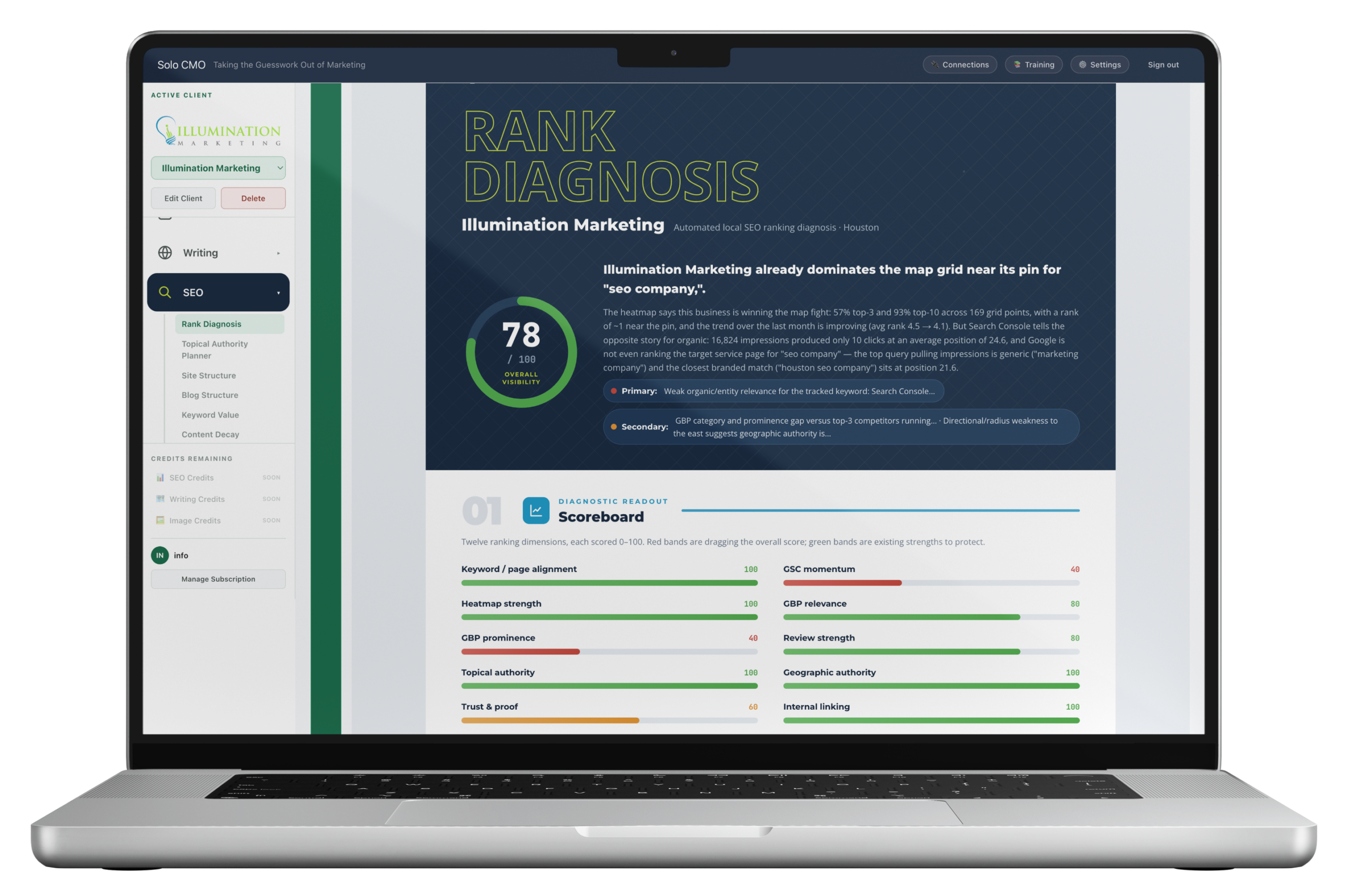
At fifteen clients you stop doing SEO and start checking on it.
The work that moves rankings is diagnostic. Sitting with one client's profile, heatmap, Search Console and live site together for an hour, and working out why they sit where they sit. Which terms are close enough to push. Which pages have started sliding. Which of last year's articles is quietly earning impressions for something nobody targeted.
Nobody has fifteen of those hours a week. So the honest version of most solo SEO is opening a rank tracker, noting that things look roughly the same, and going back to whatever's on fire. That isn't a discipline problem — it's an arithmetic one, and it's the reason retainers get cancelled by month six.
Eight modules, three questions.
They group by what they answer, which is also the order you'd work them. Diagnose what's true today, decide what should exist next, then go earn the authority to hold it.
Question 01 · diagnose
What's actually wrong here?
Why the site sits where it does, which pages have started sliding, and what it's already ranking for that nobody planned.
3 modulesQuestion 02 · plan
What should exist next?
The topic space mapped, every page tracked with live numbers, the supporting silos laid out, and each candidate priced in revenue.
4 modulesQuestion 03 · earn
Which links do we go get?
Anchor ratios audited against natural ranges, then every anchor for the month planned before a single post is placed.
1 modulePosition 27 is a fact. It isn't a reason.
Every rank tracker reports the number. None of them tell you it's because the Business Profile is filed under a broad category with no specialist category stacked behind it, while the page itself is technically fine and the reviews are excellent.
These three read the client's own data — Search Console, Analytics, the profile, the heatmap, the reviews, the live crawl — and produce reasons rather than positions.
- Six sources read together, twelve dimensions scored, eleven report sections
- How Google currently reads the business, against how it needs to
- Every page classified as critical, decaying, stable, new or growing
- Impression trend as the early warning, weeks before clicks fall
- Queries a page already earns that were never in its target set
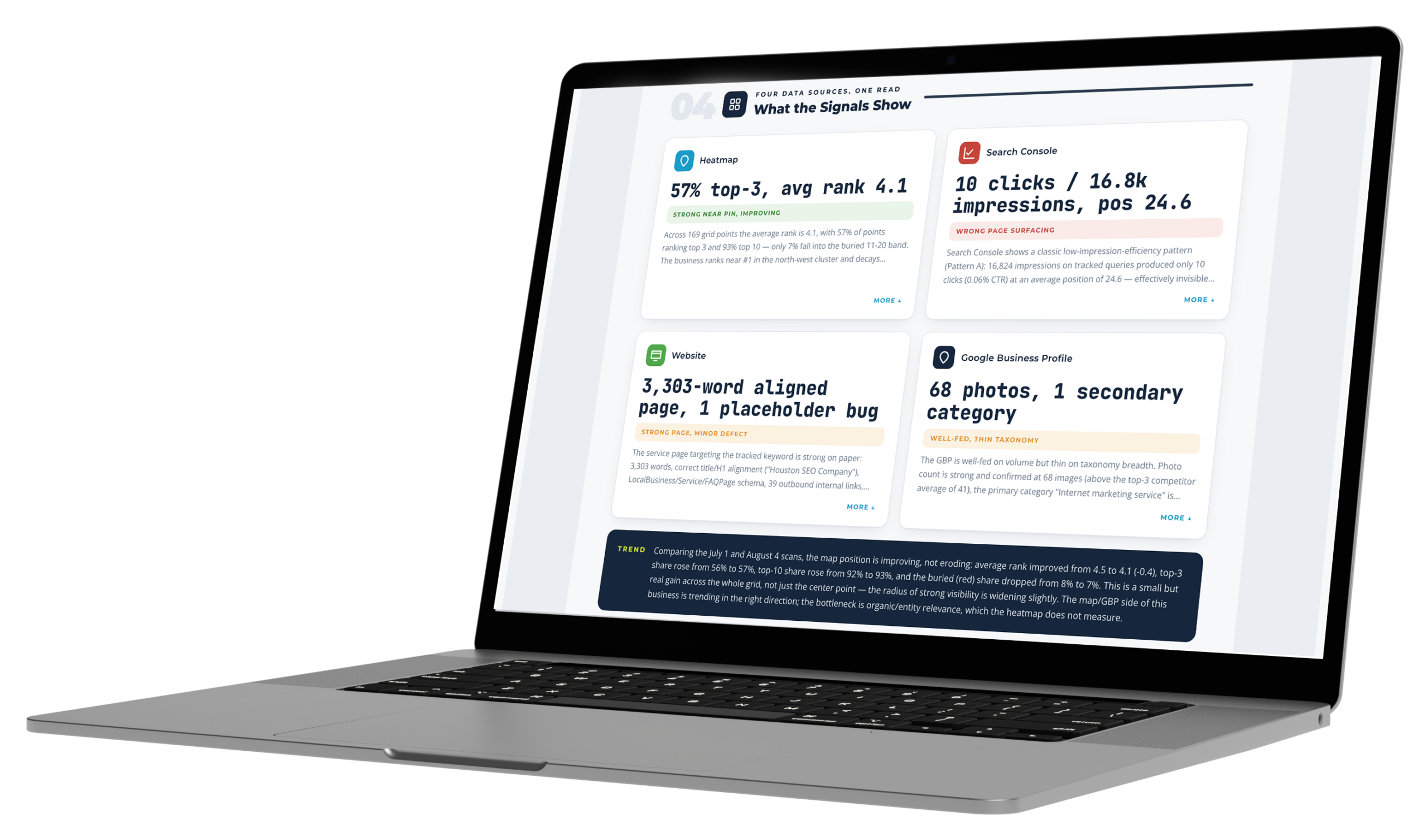
Six sources, twelve scored dimensions and a ninety-day roadmap — exported as a PDF with your agency's branding on it.
Content DecayEvery page classified across five states, sorted by impression trend so you catch the slide before the drop.
Keyword OpportunitiesTerms a page already ranks for that nobody targeted, triaged into three buckets with the gap location named.
What should exist, in what order, and what it's worth.
An interactive map of every page the site should have, with anything not yet built counted. The same plan as a working table, one row per page with its live numbers fetched rather than typed. The supporting silos underneath. And a revenue figure on every candidate.
That last one is the discipline. Search volume can't tell you which term is worth a page and which will never pay for itself.
- Five levels from navigation down to supporting articles, seeded from the live sitemap
- Everything planned but not yet built, counted in the header
- One row per page: keyword, difficulty, optimizer scores, live URL, backlinks, indexation, status
- Blog silos where every post links up to a money page
- Revenue modeled from real job values, with organic and map pack calculated separately
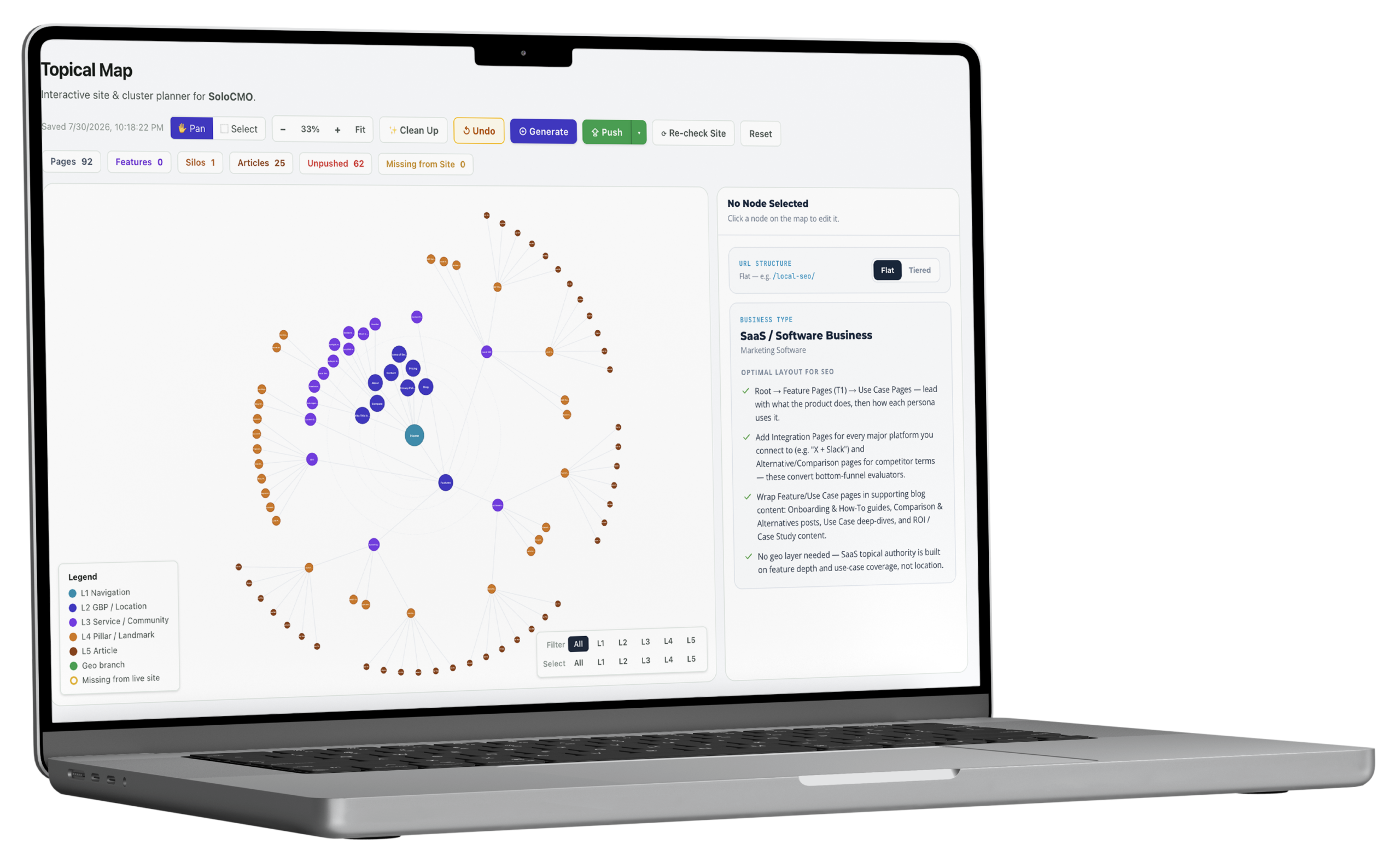
An interactive map of every page the site should have, with the missing ones counted.
Site StructureOne row per page with its keyword, scores, URL, backlinks and status — fetched, not typed.
Blog StructureSilos and subtopics where every post exists to support a money page.
Keyword ValueWhat a ranking is worth in revenue, not what the clicks would cost to buy.
Nobody plans an over-optimized profile. They just build one.
Anchor text gets chosen link by link, and the money keyword always feels like the productive choice. Eighteen months later a page has one hundred and eighty backlinks, two-thirds of them keyword anchors, and a profile that looks exactly like what it is.
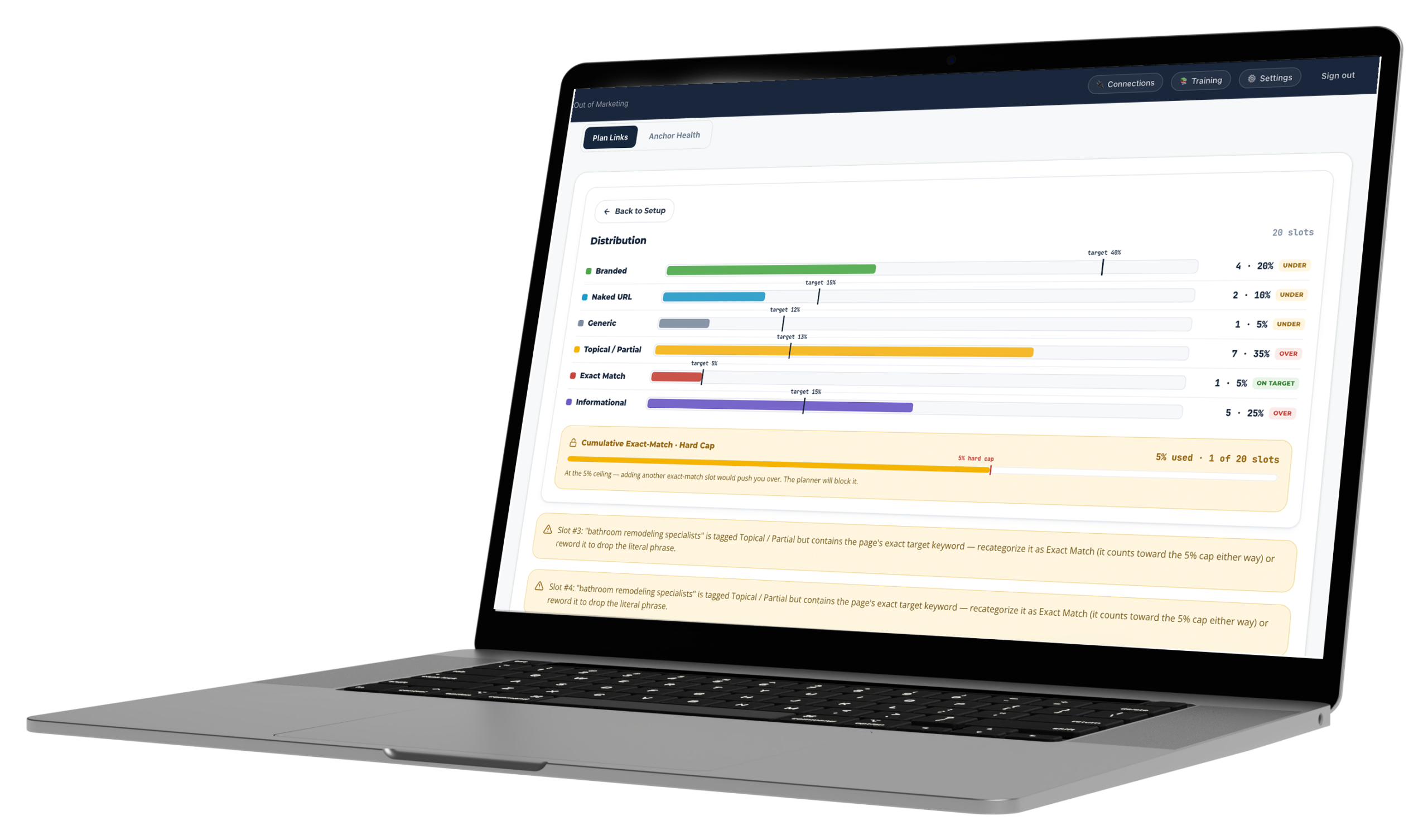
Link Planner audits where each money page actually sits against natural ranges, then plans every anchor for the month before a post is placed — with a cumulative exact-match cap that blocks the slot rather than warning you.
- Six anchor types with a floor and a ceiling on each
- The next twelve anchors prescribed, with over-limit categories paused
- Two remediation routes costed — dilute slowly, or trim and disavow
- A safe monthly link velocity based on the profile you're starting from
- The month's plan exported as a CSV for whoever places the posts
Three rules the whole system follows.
These are the reason it reads as one system rather than eight tools that happen to share a sidebar.
01
It reads their data, not an estimate
Search Console, Analytics, the Google Business Profile, the review corpus, the live sitemaps, the backlink profile, and a crawl of the pages themselves — all the client's own connected properties.
Which is why a diagnosis names a category problem on this specific profile rather than telling you what businesses like this usually get wrong.
02
It blocks rather than warns
A diagnosis won't run until every input is connected, because a report built on half the data reads confidently and sends you somewhere wrong. A link plan won't accept another exact-match slot once the cap is reached.
The same principle runs through the content pipeline, where a draft over its word ceiling stops. A tool that only ever says yes isn't checking anything.
03
It decides what. It never writes it
Every module here ends at a decision — the pages to build, the fixes to make, the links to earn, the order to do them in. The writing happens in content generation, against the plan these produce.
That separation is deliberate. A system that both decides what to write and writes it has an obvious incentive to find a great deal of work worth doing.
Three of these are things you hand a client.
Most SEO software produces dashboards nobody outside your business will ever look at. A meaningful part of this system was built to become a document instead.
The diagnosis
A branded PDF audit
Eleven sections carrying your agency's name and contact details. Most agencies open with a proposal — opening with a diagnosis is a different conversation.
The revenue model
The four numbers a proposal needs
Current monthly revenue at today's positions, target monthly at the positions you're going for, the monthly gap, and the annual opportunity.
The link plan
A CSV somebody else can execute
Every slot with its category, anchor text and destination. The person placing the guest posts never has to make an anchor decision.
All eight modules are on every plan. Plans differ only in how many clients you run.
All eight modules.
Six sources, twelve dimensions, a branded client report.
Topical Authority PlannerThe whole site mapped, with the missing pages counted.
Site StructureOne row per page, every number fetched.
Blog StructureSilos where every post has a money page to serve.
Keyword ValueRankings priced in revenue, not ad spend.
Content DecayThe slide caught before the drop.
Keyword OpportunitiesWhat you rank for by accident, and where the gap is.
Link PlannerAnchor ratios governed, next month's anchors planned.
What feeds it, and where the work goes.
- Avatars
- Who it's for
- SWOT
- Priorities
- Search Console
- Live data
- Analytics & GBP
- Live data
Feeds the SEO system
The SEO system, answered straight.
What does it connect to?
Does the SEO system write anything?
Which module do I start with?
Is any of this something I can show a client?
Do I still need my other SEO tools?
Every plan includes every module.
There are no feature gates. Plans differ only in how many clients you run and how much you generate for them.