
Six questions in. Six channel-ready assets out.
A discovery interview drafted from the client's own Google reviews, candidate positioning statements scored on four axes, and a deployment package that lands the winner into the homepage, the profile, the ads and the sales call — already inside each platform's character limit.
Reliable. Experienced. Family-owned.
Three claims, and every competitor within twenty miles makes all three. That's not a positioning problem, it's an arithmetic one: a differentiator that everyone can state isn't a differentiator, it's table stakes with better typography.
The reason most local businesses land there isn't laziness. It's that nobody ever asked them the right question. Ask an owner "what makes you different" and you get adjectives. Ask them "what do you do that competitors technically could do but don't bother with, because it's harder and less profitable for them" — and you get a real answer.
The six questions that get past the adjectives.
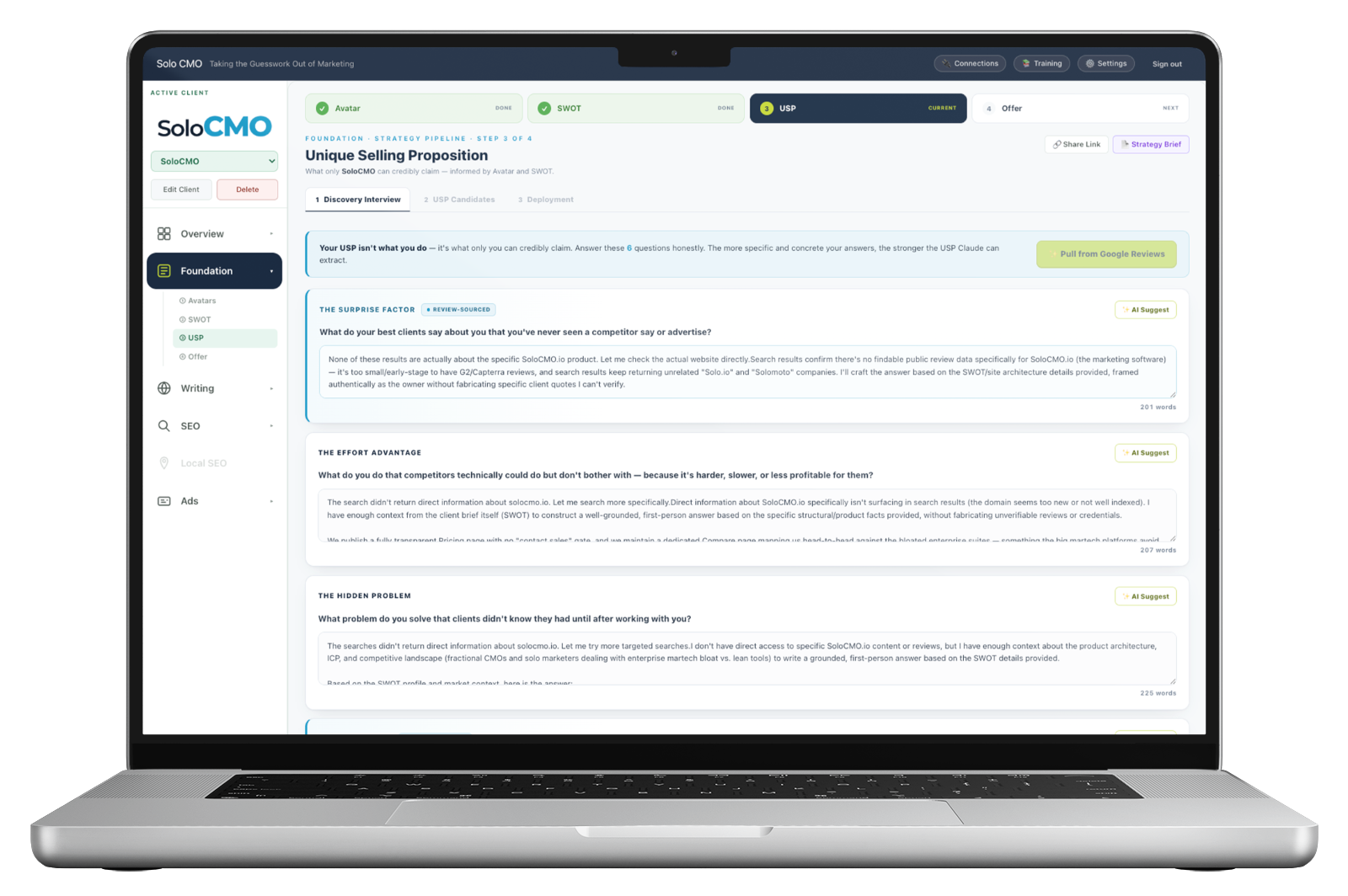
Your USP isn't what you do — it's what only you can credibly claim. These six are built to surface that, and four of them can be drafted straight from the client's Google reviews, so you start from what customers actually said rather than what the owner hopes is true.
Question 01
The Surprise Factor
What do your best clients say about you that you've never seen a competitor say or advertise?
Review-sourcedQuestion 02
The Effort Advantage
What do you do that competitors technically could do but don't bother with — because it's harder, slower, or less profitable for them?
Question 03
The Hidden Problem
What problem do you solve that clients didn't know they had until after working with you?
Question 04
The Win Reason
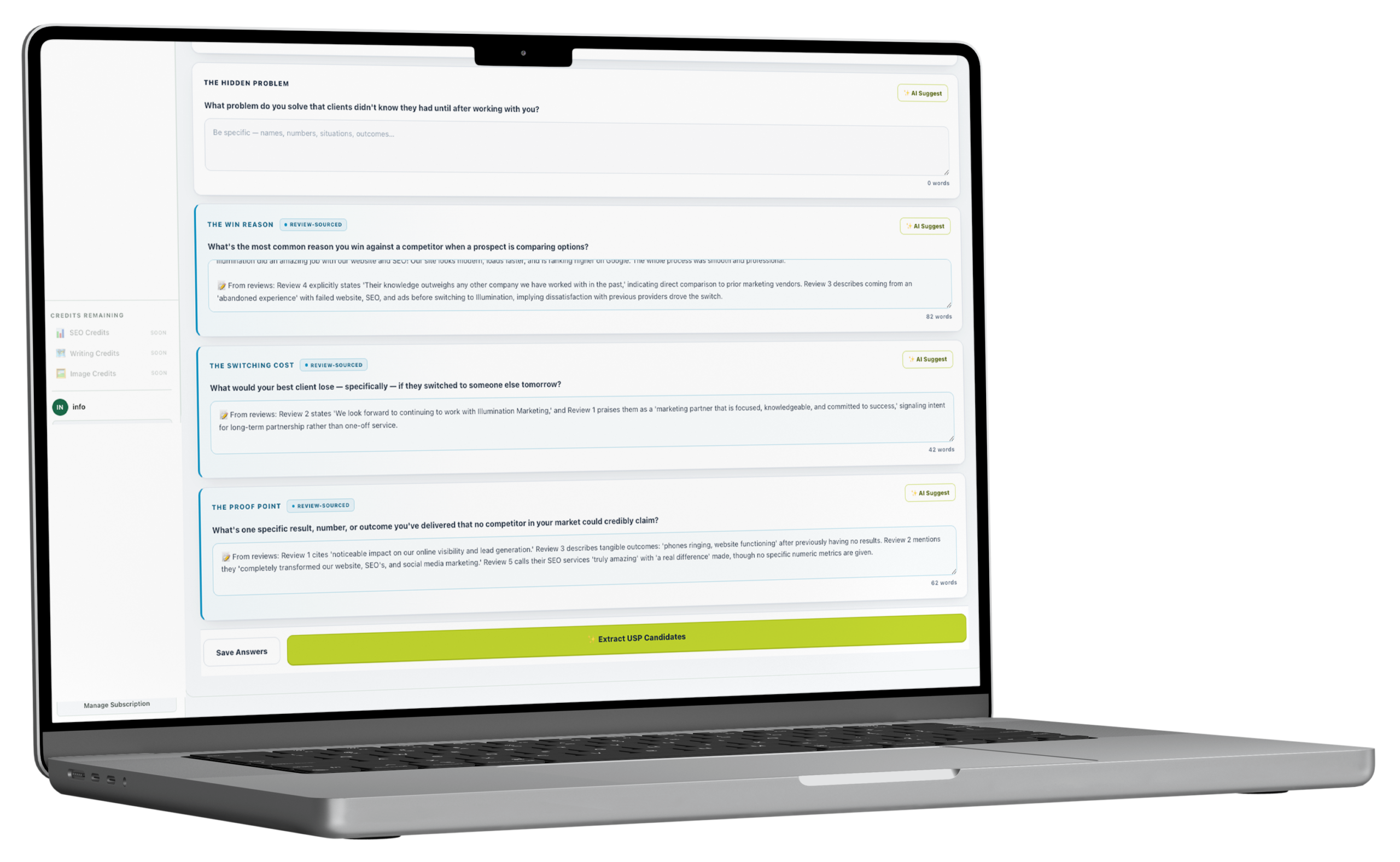
What's the most common reason you win against a competitor when a prospect is comparing options?
Review-sourcedQuestion 05
The Switching Cost
What would your best client lose — specifically — if they switched to someone else tomorrow?
Review-sourcedQuestion 06
The Proof Point
What's one specific result, number or outcome you've delivered that no competitor in your market could credibly claim?
Review-sourcedYour client's customers already answered four of these.
Pull from Google reviews and the review-sourced questions fill themselves with what people actually wrote — named staff, specific praise, the exact phrase a family used about why they'd never switch.
This matters more than it sounds. Owners are unreliable narrators about their own businesses. They undersell the thing customers keep mentioning and oversell the thing they're proud of. Reviews don't have that problem.
- Four of six questions drafted from real review text
- Answers cite the review they came from
- A suggest option on every question, including the ones reviews can't answer
- Everything editable before you extract candidates
Candidates, scored — so the choice isn't taste.
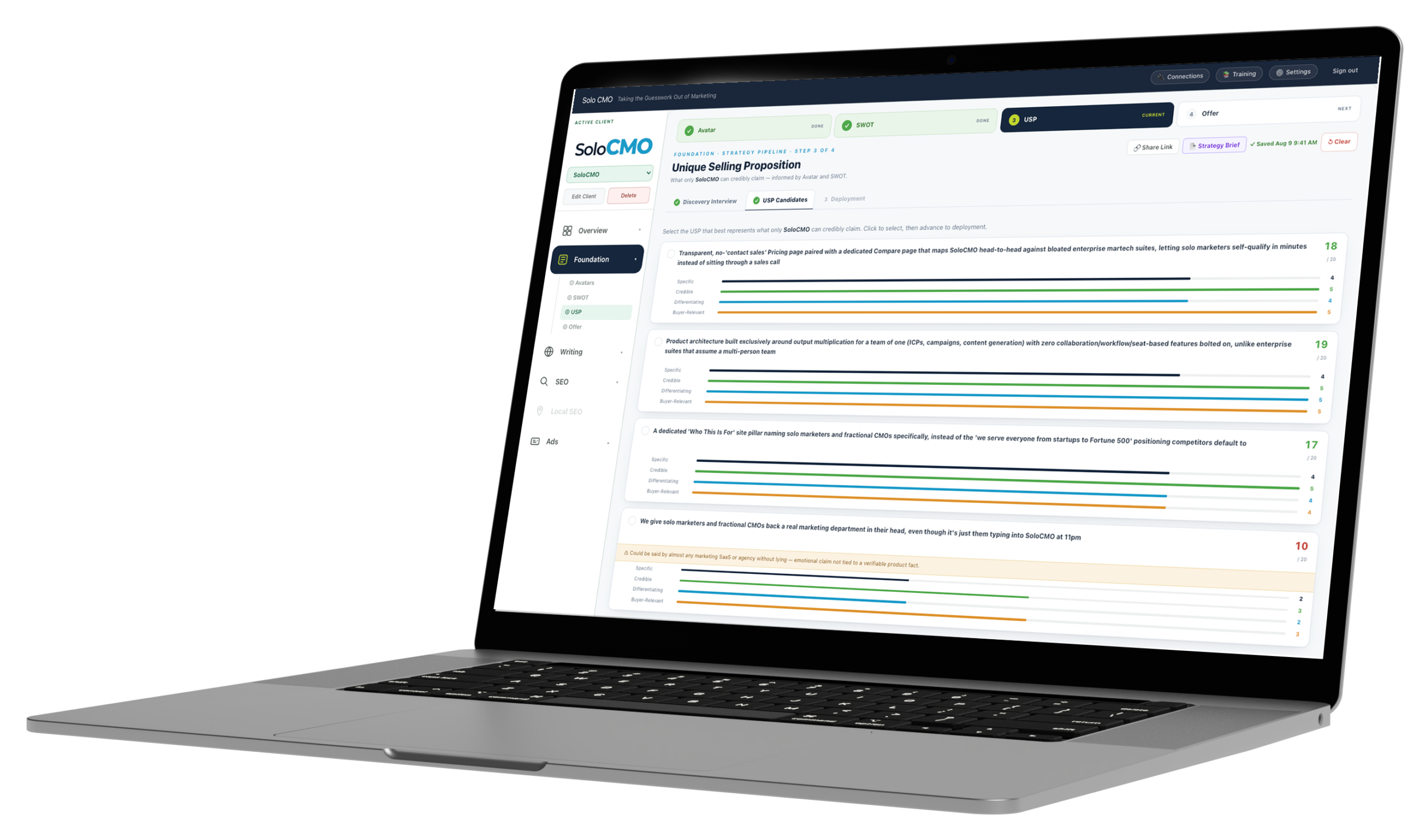
The interview produces several positioning statements, and each one is scored out of twenty across four axes. You still choose, but you choose against a rubric instead of picking whichever sentence reads best on the day.
Most weak USPs fail on the same axis. They're specific, credible and relevant to the buyer — and the competition can say the identical sentence.
Then it writes the six places the USP has to live.
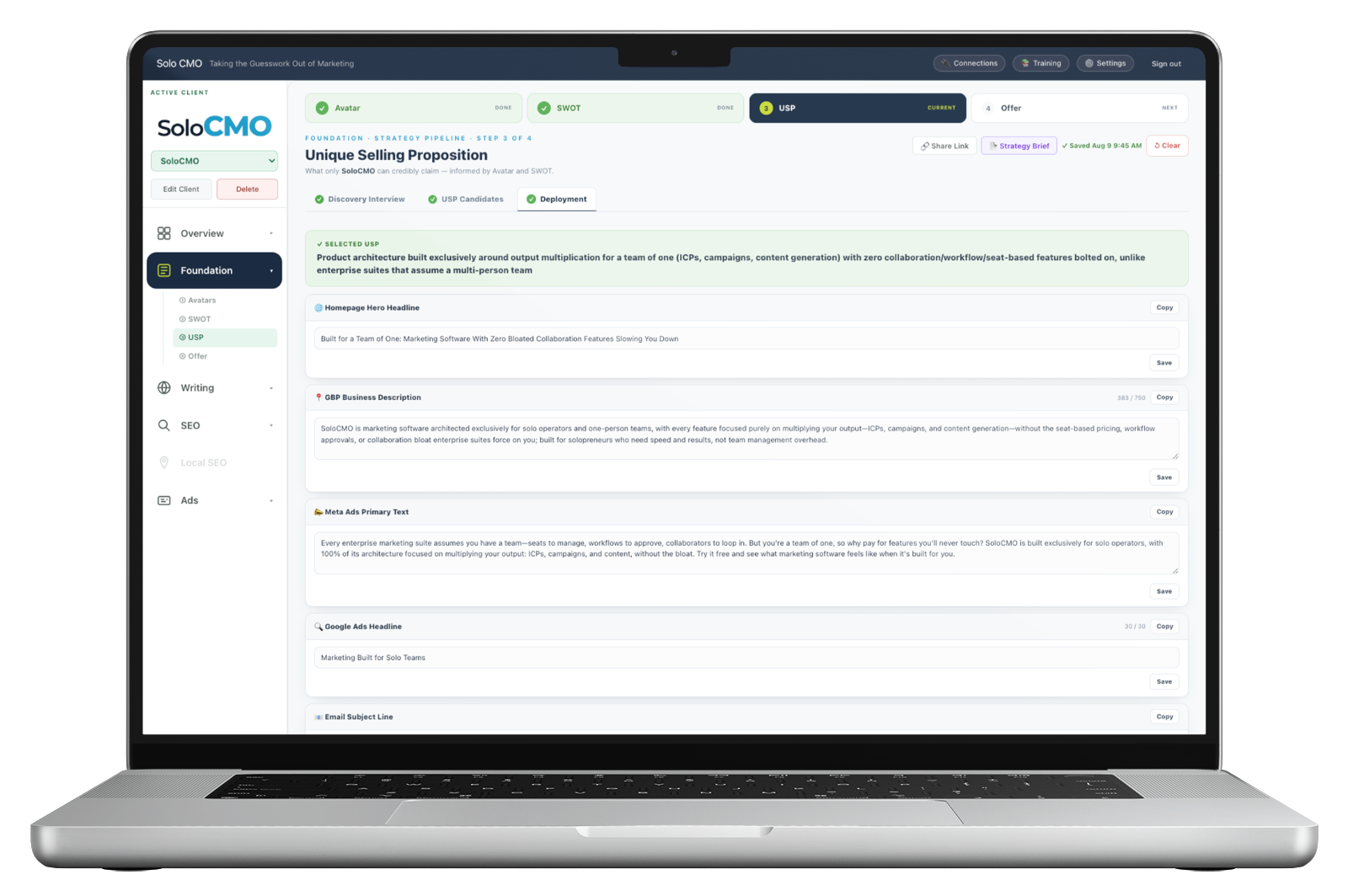
This is where most positioning work dies — the statement gets agreed and never reaches a single asset. The deployment package takes the chosen USP and produces the copy for each channel, already inside that platform's character limit.
- Homepage hero headline
- Google Business Profile description, against the 750-character limit
- Meta ads primary text
- Google Ads headline, against the 30-character limit
- Email subject line
- Sales one-liner for the phone
Each asset is editable and saved on its own, or copy the whole package at once. The counters update as you edit, so nothing leaves the system already too long for where it's going.
What feeds it, and where the assets go.
- Avatars
- Who it's for
- SWOT
- Which strength
- Review Manager
- Review text
Feeds the USP
- GBP Details
- Description
- Meta Ads Generator
- Primary text
- Google Search Ads
- Headline
- Offer
- Step four
Where the assets land
Before and after in the pipeline.
USP, answered straight.
Do I have to answer all six questions myself?
What are the candidates scored on?
What's in the deployment package?
Can I edit the generated assets?
What happens after the USP is set?
Every plan includes every module.
There are no feature gates. Plans differ only in how many clients you run and how much you generate for them.