
Fix the profile. Start driving calls.
Eight modules that run the Google Business Profile, measure where a business actually shows across its whole service area, and audit the forty-odd other places its details appear — from one screen, for every client.
Most of it edits and publishes rather than reporting back at you.
Local is maintenance, and maintenance is what breaks at fifteen clients.
Categories, services, hours, photos, reviews, citations. None of it is difficult and all of it is endless — and Google's own interface makes it worse, because every task means a separate login, a separate screen, and editing one item at a time.
So the profile gets set up once at onboarding and never revisited. The review queue grows. The photo library goes quiet. Nobody has ever checked the citations. And when the client asks why the phone isn't ringing, the honest answer is somewhere in a profile nobody has opened in eight months.
Your ranking isn't a number. It's a map.
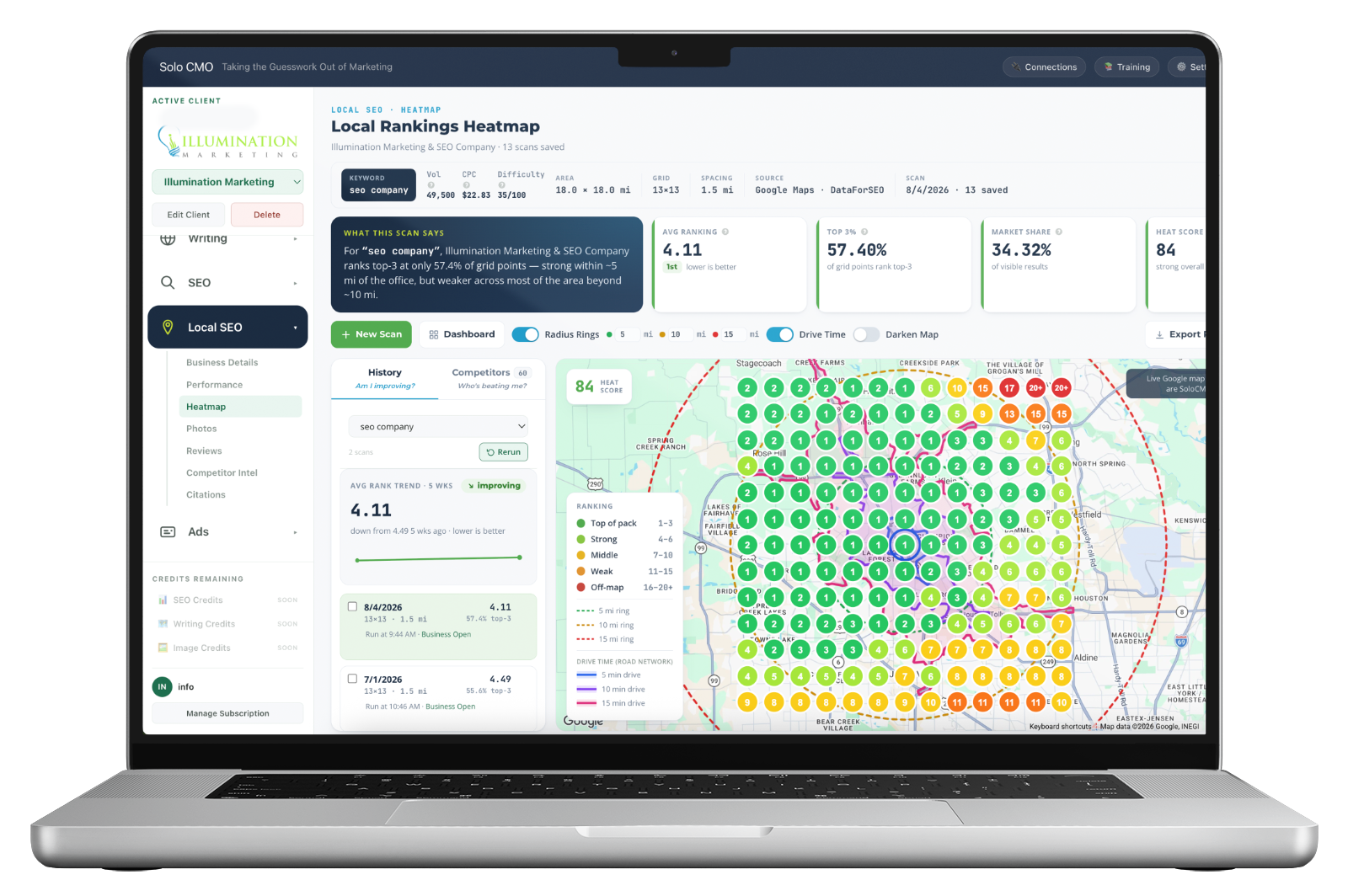
Map pack results move with the searcher. A business can hold the top three at its own address and disappear four miles out — which is exactly where the client wonders why nothing is happening. Report an average position and you've told them nothing they can act on.
Ranks top-3 at only 55.6% of grid points — strong within about 5 miles of the office, but weaker across most of the area beyond 10 miles.
Every scan opens with that sentence. The picture is the easy part; reading it is the product.
Eight modules, three jobs.
Run the profile, measure what it produces, and check everywhere else the business appears. In that order, because the profile is the part you control.
Job 01 · run
The profile
Categories, services, hours, photos and review replies — edited here and pushed straight to Google, without fifteen separate logins.
3 modulesJob 02 · measure
The position
Where the business actually shows across its service area, and what people did once they found it — with the history Google throws away.
2 modulesJob 03 · check
The context
Why the businesses above them are above them, and whether the client's details are correct on the forty-odd sites carrying them.
2 modulesThe profile is doing more of the work than the website.
Google states plainly that the categories you select affect local ranking. A page can be well built, well written and backed by excellent reviews, and still lose the map pack because the profile is filed under something broad with nothing specialist behind it.
Most agencies spend their time on the site, because that's the part they know how to bill for.
- Every profile field edited here and saved straight to Google
- A profile health score, with the single next fix named
- Services grouped under their category, with descriptions written in one action
- Photo categories fixed in bulk instead of one image at a time
- Review replies drafted in the owner's own voice and posted on your terms
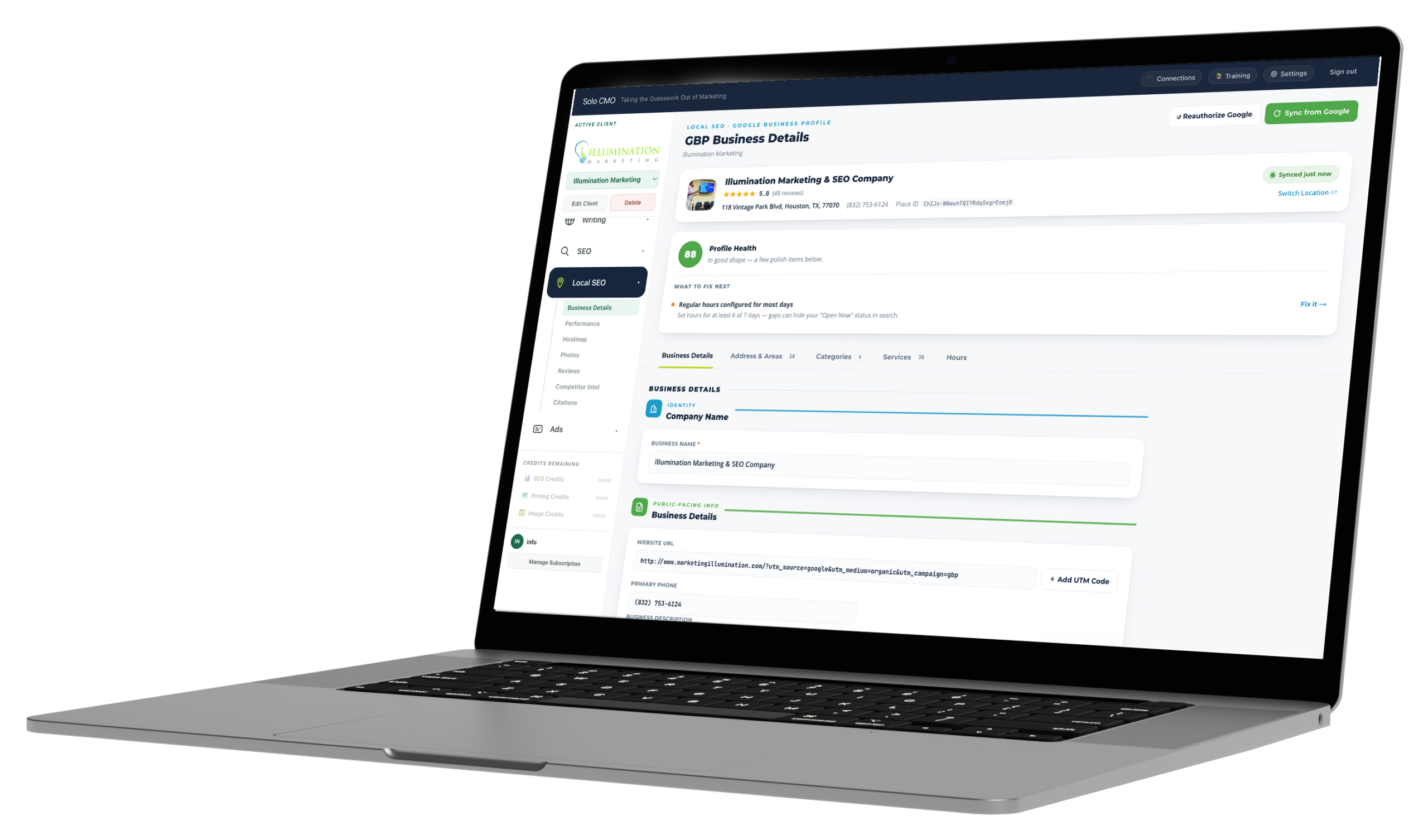
The whole profile on one screen — categories, services, areas and hours, pushed straight to Google.
ReviewsReplies trained on the owner's own writing, with a threshold that holds every low rating for a human.
PhotosThe library with its categories, the uncategorized share flagged, and bulk fixing in a pass.
Google keeps six months. You keep all of them.
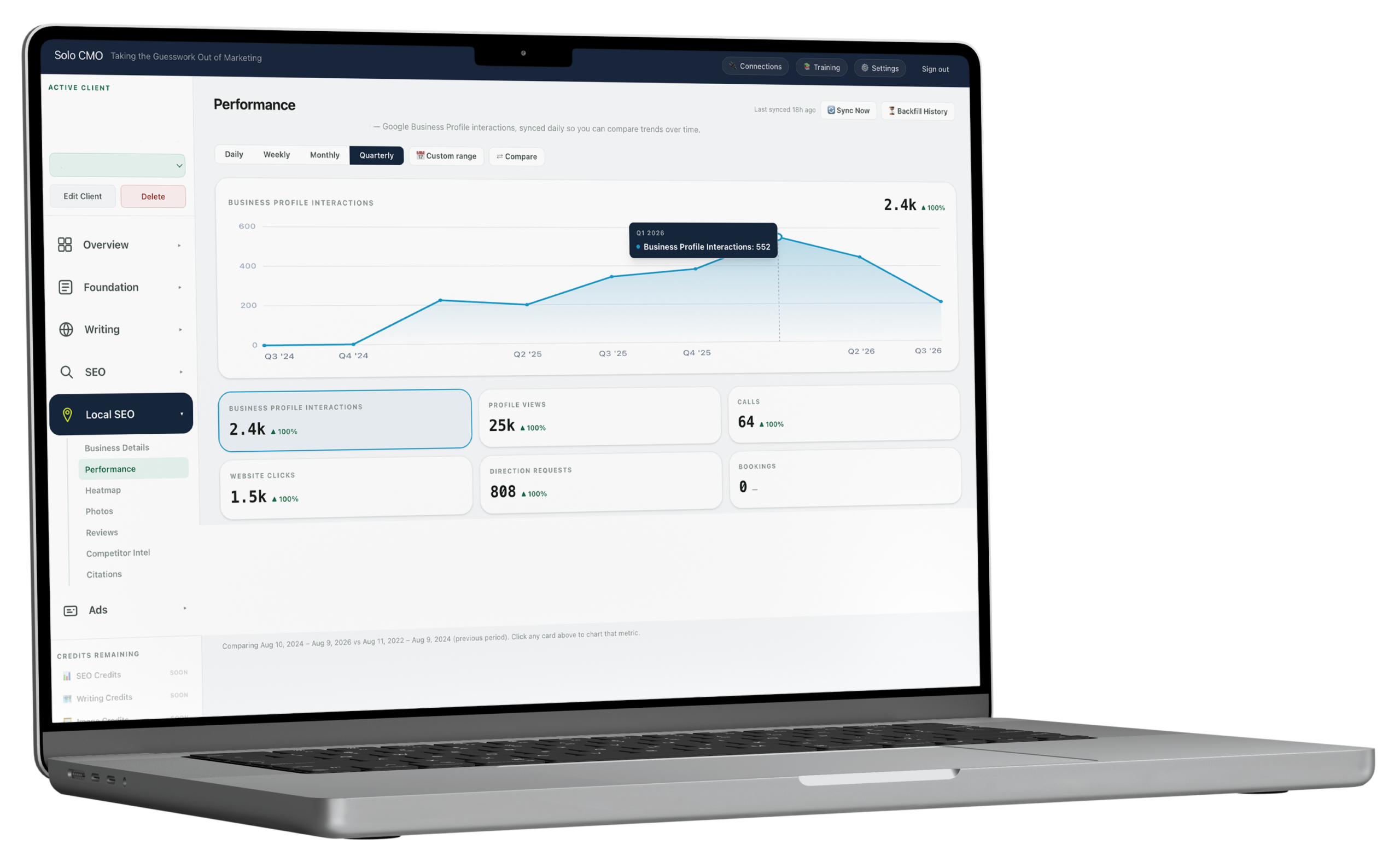
The grid tells you where a client is visible. Profile performance tells you what people did when they found it — calls, direction requests, messages, clicks. And the history behind both is kept rather than rolled off.
Which matters because Google's own performance view shows the current month and the previous five. Eighteen months are backfilled here on day one, and every day after is stored — so you can finally compare this July to last July.
- Position sampled across the whole service area, not at one address
- A Heat Score, and a plain-language read of the pattern on every scan
- Any grid point clickable down to the businesses actually ranking there
- Drive time as well as distance, because customers choose in minutes
- Eighteen months of profile actions backfilled, then kept indefinitely
- Scans scheduled, so the history builds whether or not anyone remembered
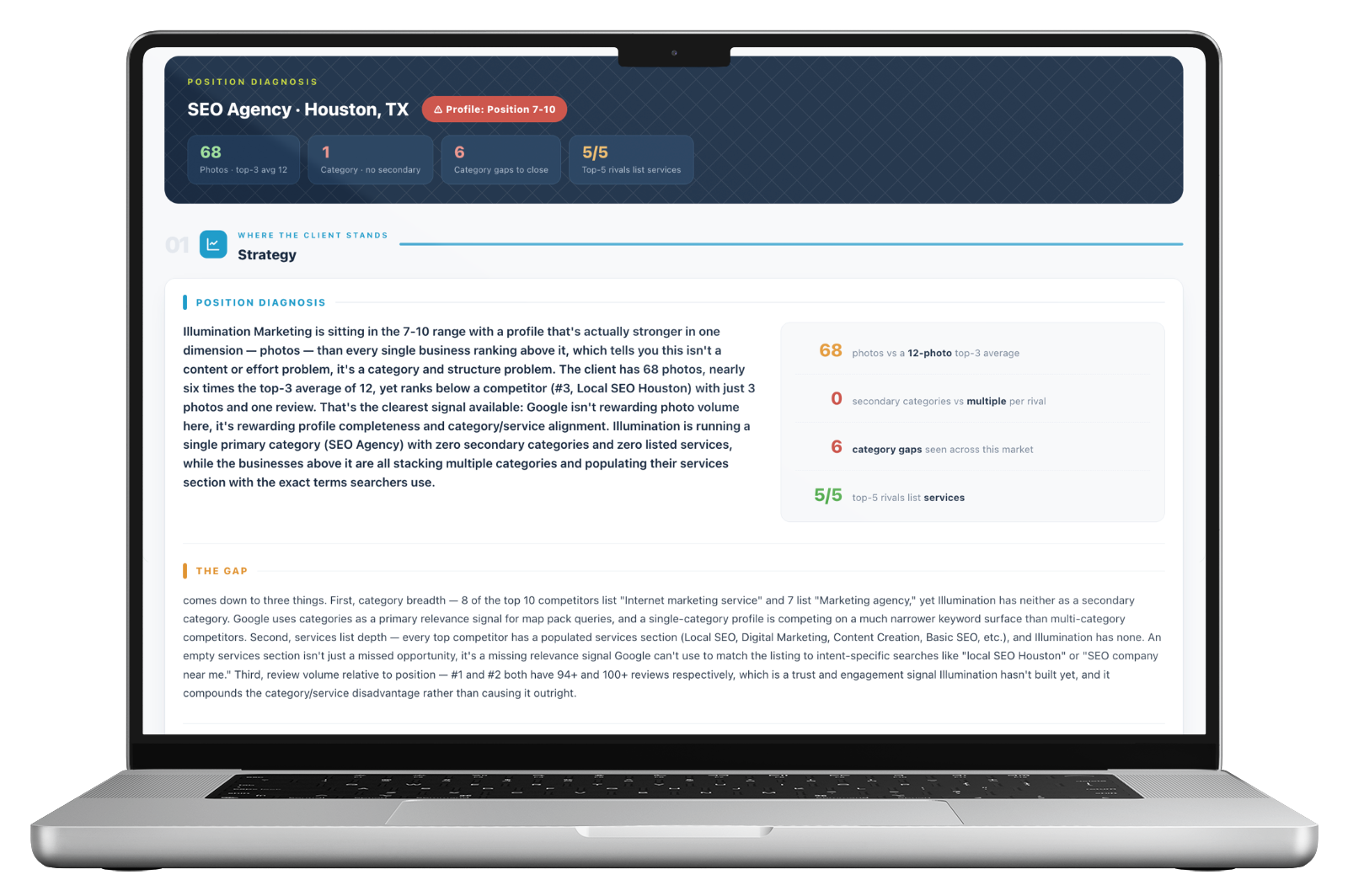
Why they're above you, and what the rest of the web says about you.
You already know which businesses outrank your client. What nobody can tell you in the time available is why, in terms specific enough to act on — and whether the client's own details are still correct on the forty-odd sites, aggregators, nav systems and assistants carrying them.
Both are audits nobody runs by hand, and both produce findings that go straight into the work rather than into a document.
- Every top-ten rival compared on categories, services, photos and reviews
- Gaps quantified — how many competitors hold a category, and which ranks
- First-mover findings where the whole market has left a field empty
- Roughly 46 directories checked, including in-car navigation and voice assistants
- A prioritized fix list, with the aggregator fixes that cascade at the top
- Threats and opportunities pushed onto the client's SWOT board
Three rules the whole system follows.
These are the reason it reads as one system rather than eight tools that happen to share a sidebar.
01
It writes back, not just reads
Profile fields save to Google. Review replies post. Photo categories update in bulk. Findings push onto the SWOT board and into the profile optimizer.
A dashboard that shows you fifteen profiles you then go and edit somewhere else has moved the work, not removed it.
02
It keeps what Google discards
Eighteen months of profile performance backfilled and then held forever. Every heatmap scan saved. Every competitor scan and citation audit kept with its date.
Which is what makes comparison possible — and comparison is the only thing that turns a number into evidence.
03
It says what it means
A citation health score of zero. A grid read that says weaker beyond ten miles. Competitor data marked "not pulled" rather than quietly guessed. A link to verify a ranking in Google Maps yourself.
Local SEO has enough tools that flatter the client. This one is built to be shown to them.
All eight modules.
The whole profile, edited here and pushed to Google.
PerformanceEighteen months backfilled, then kept forever.
HeatmapA geo grid that reads itself.
PhotosThe library, categorized in bulk.
ReviewsReplies in the owner's own voice.
Competitor IntelWhy they're winning, quantified.
CitationsForty-six sources, including the dashboard.
All eight modules are on every plan. Plans differ only in how many clients you run.
Four of these are inputs to the diagnosis.
On its own a heatmap is a picture and a review count is a number. Read together with Search Console and the live site, they become a reason — which is the job the rank diagnosis does, and why it won't run until these are connected.
Relevance
Categories and services
What the business is eligible to appear for at all — and the most common critical finding in a diagnosis.
Prominence
Reviews, photos and citations
The signals that say this is a real, active business the rest of the web agrees exists.
Distance
The grid
The one factor nobody controls, which is exactly why the other two have to be right.
- Google Business Profile
- Live data
- Avatars
- Who it's for
- USP
- The description
Feeds Local SEO
Local SEO, answered straight.
Does this replace logging into Google Business Profile?
How is this different from a rank grid tool?
Why does the profile matter more than the website?
What does it keep that Google doesn't?
Does it do things automatically?
Every plan includes every module.
There are no feature gates. Plans differ only in how many clients you run and how much you generate for them.