
Rank trackers tell you where. This tells you why.
Six data sources read together, twelve dimensions scored, and an eleven-section diagnosis that explains how Google currently reads the business, what's holding it back, and the exact sequence to fix it over ninety days.
It comes out as a PDF with your agency's name on it.
Position 27 is a fact. It isn't a reason.
Every rank tracker will tell you a client sits at 27 for their money keyword. None of them tell you it's because the Google Business Profile is filed under a broad category with no specialist category stacked behind it, while the page itself is technically fine and the reviews are excellent.
Finding that out means sitting with one client's profile, heatmap, Search Console and site together for an hour and thinking. It's the highest-value hour in local SEO, and at fifteen clients it never happens.
The answer is almost never in one place.
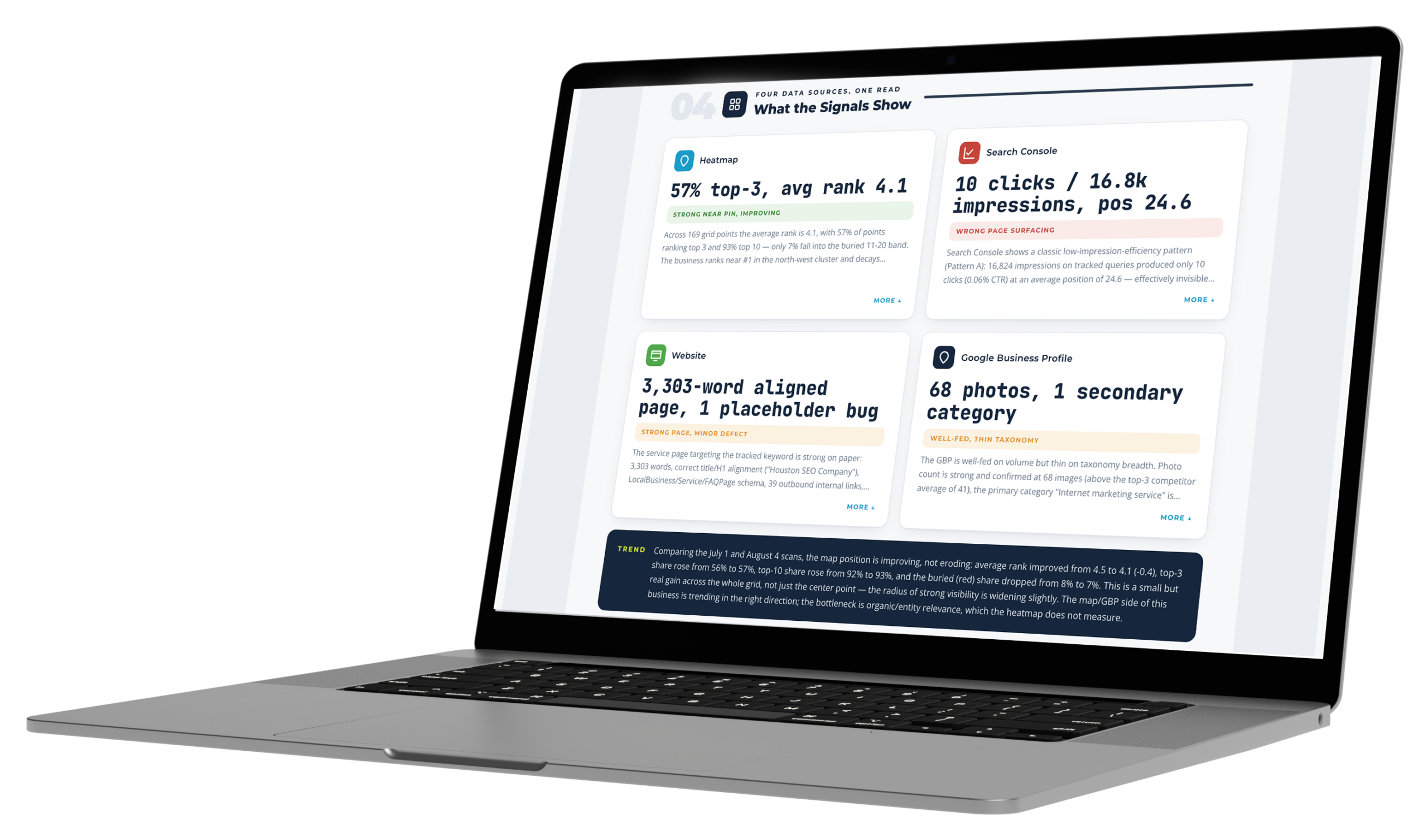
A page can be perfectly built and still lose because the profile is categorized wrong. A profile can be immaculate and still lose because nothing links to the service page. The diagnosis reads all six sources together, which is the only way those contradictions show up.
- Google Business Profile — categories, services, description
- Local heatmap rank grid — position across the service area, not just at the door
- Search Console — impressions, clicks, CTR and average position for what's really landing
- The review corpus — volume, rating and what the reviews actually mention
- The photo library — count, recency and subject matter
- An on-page crawl — title, headings, word count, indexation and internal links
It won't diagnose a client on half the data.
A diagnosis built on partial inputs is worse than none — it reads confidently and points you somewhere wrong, and you spend a month on the wrong fix. So the run is blocked until the checklist clears.
The same reason the content pipeline stops a draft that's over its word ceiling. A tool that only ever says yes isn't checking anything.
- Primary keyword set
- Tracked keyword set
- Target city and service area
- Primary service page URL
- Heatmap scan selected or grid uploaded
- Google Business Profile connected
- Search Console connected
- Competitive intel loaded
- Reviews connected
- Photos loaded
- Sitemap and on-page crawl configured
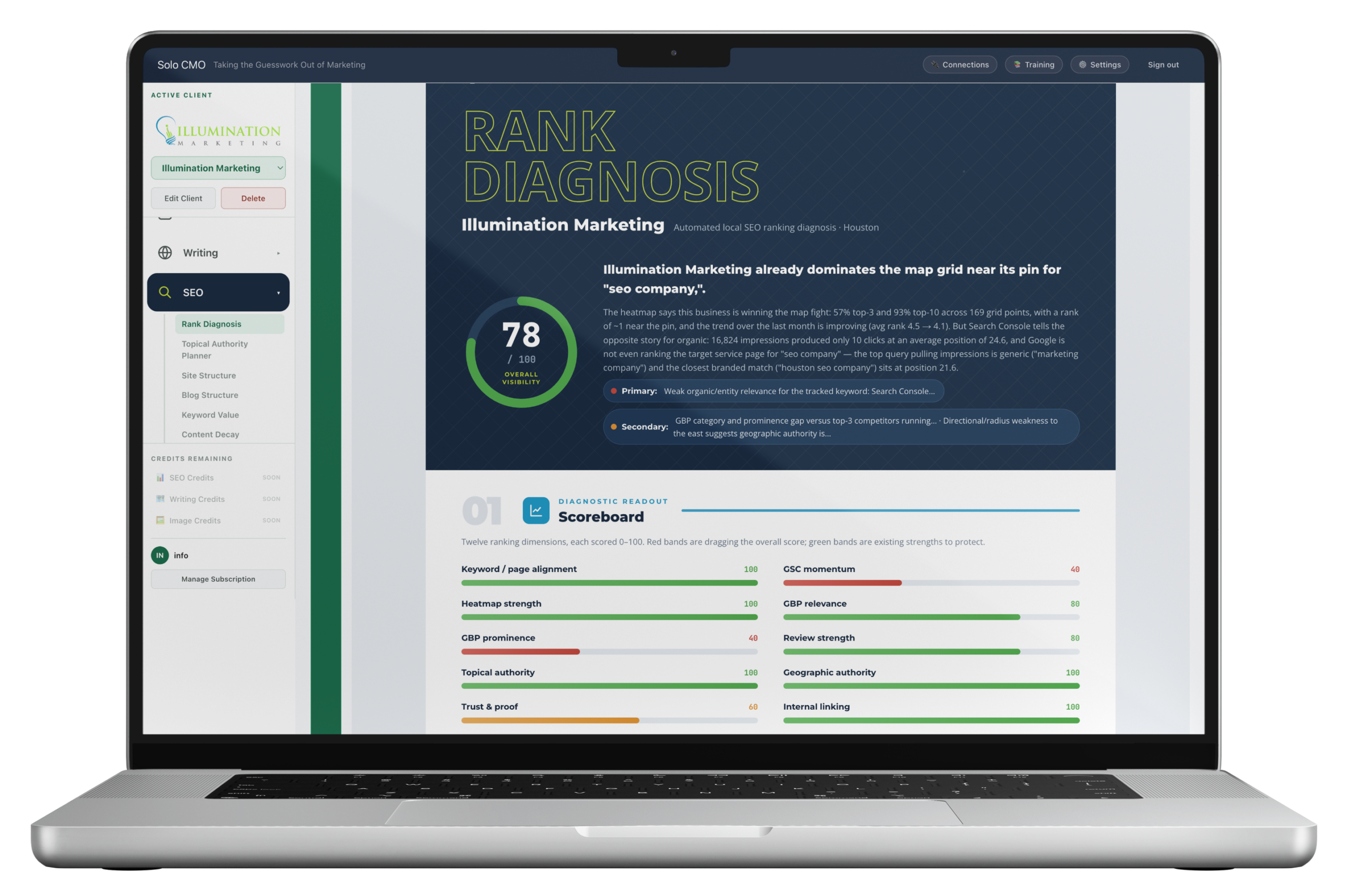
One number, then the twelve underneath it.
The overall score is a baseline you re-run against, not a grade. What matters is the breakdown: which bands are dragging the score down, and which are existing strengths worth protecting rather than fixing.
Overall ranking health Twelve dimensions, each scored out of 100. Red bands are dragging the total; green ones are strengths you should be careful not to break while fixing the rest.
Illustrative values. Replace with a real diagnosis before publishing.
How Google reads the business, and how it needs to.
Most local SEO problems aren't keyword problems. They're identity problems — Google has the business filed as one thing, the owner is trying to sell another, and no amount of on-page work closes a gap that lives in the category taxonomy.
The diagnosis states both readings plainly, then names the gap between them. That's the paragraph that changes what an owner does next.
Currently perceived as
A generalist
What the profile, the categories, the site structure and the review language add up to today — usually broader and vaguer than the owner believes.
Needs to be recognized as
The specialist for this service, in this city
The narrower entity that would actually win the money keyword, and what has to change for Google to read it that way.
It doesn't stop at the diagnosis.
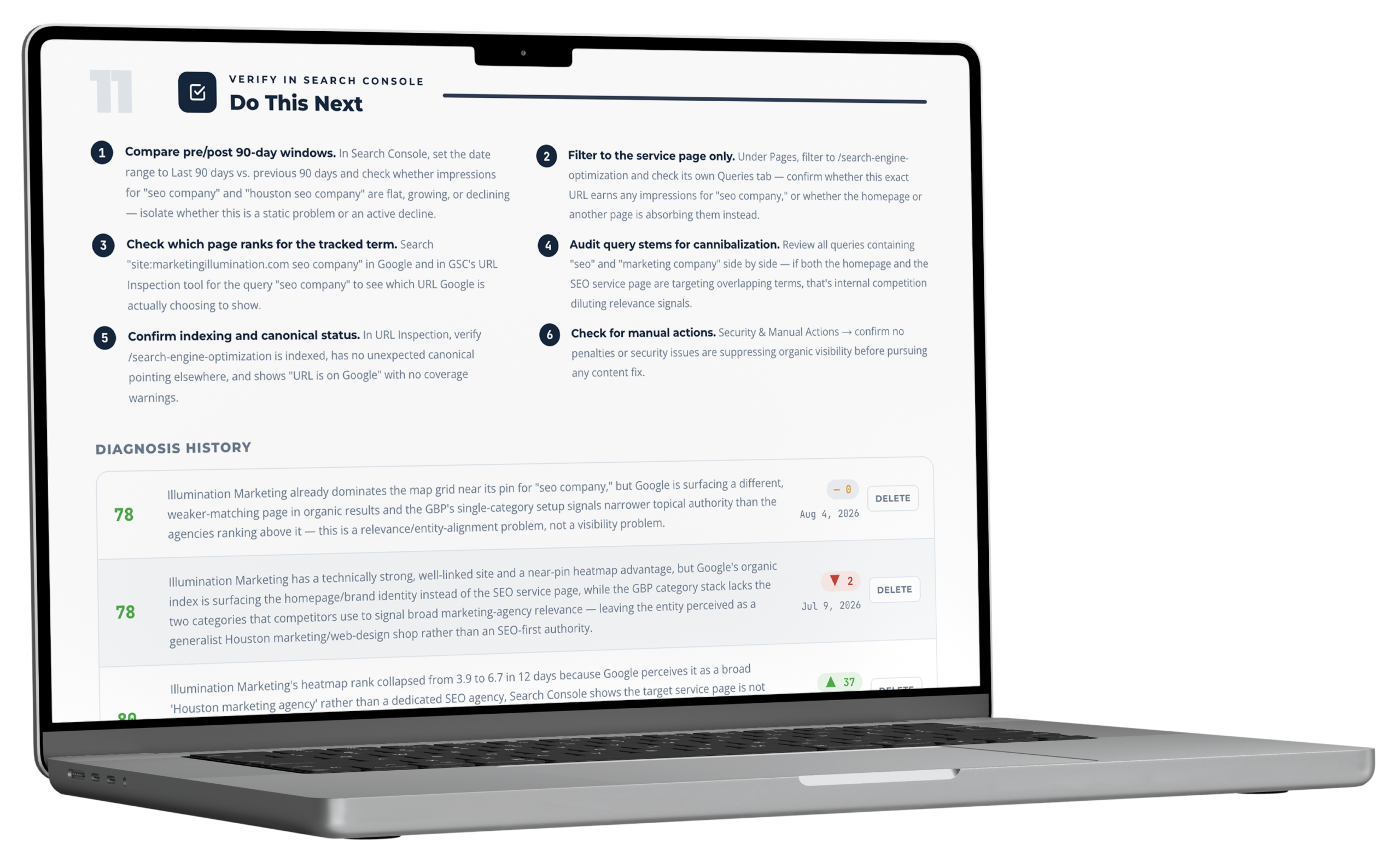
Five sections of the report are instructions: what to fix first, in what order, over what period, and exactly which pages, links and profile changes to make.
Priority fixes
Ranked by impact and effort
Each fix tagged by severity and by which dimension it moves — so a critical, low-effort category change outranks a medium, high-effort content build.
90-day roadmap
Three phases, in sequence
Stop the bleeding, build the proof, expand the map. Sequenced because some of this work only pays off after the earlier work has landed.
The build lists
Named pages, links and profile changes
Articles to write with intent and target page, internal links with source, destination and anchor text, and a full Google Business Profile plan.
Every module is on every plan. Plans differ only in how many clients you run.
It reads like a paid audit because it is one.
The report exports as a PDF carrying your agency's branding and contact details. Not a dashboard link, not a screenshot — a document an owner can read on their phone and forward to their business partner.
Which makes it one of the very few things you can put in front of a prospect before any work has started. Most agencies open with a proposal. Opening with a diagnosis is a different conversation.
- Eleven sections, from the scoreboard to the verification steps
- Your agency's branding and contact details in the footer
- Every diagnosis kept in a history, so the second run shows movement
- A closing list of what extra data would make the next one sharper
It diagnoses. The other modules do the work.
- GBP Details
- Categories
- Local Heatmap
- The grid
- Review Manager
- The corpus
- Search Console
- Live data
What it reads
What operators run alongside it.
Rank Diagnosis, answered straight.
Why won't it run until everything is connected?
What does it actually read?
Can I give the report to a client?
Does the score mean anything on its own?
Does it fix anything?
Every plan includes every module.
There are no feature gates. Plans differ only in how many clients you run and how much you generate for them.