
Every post has a job.
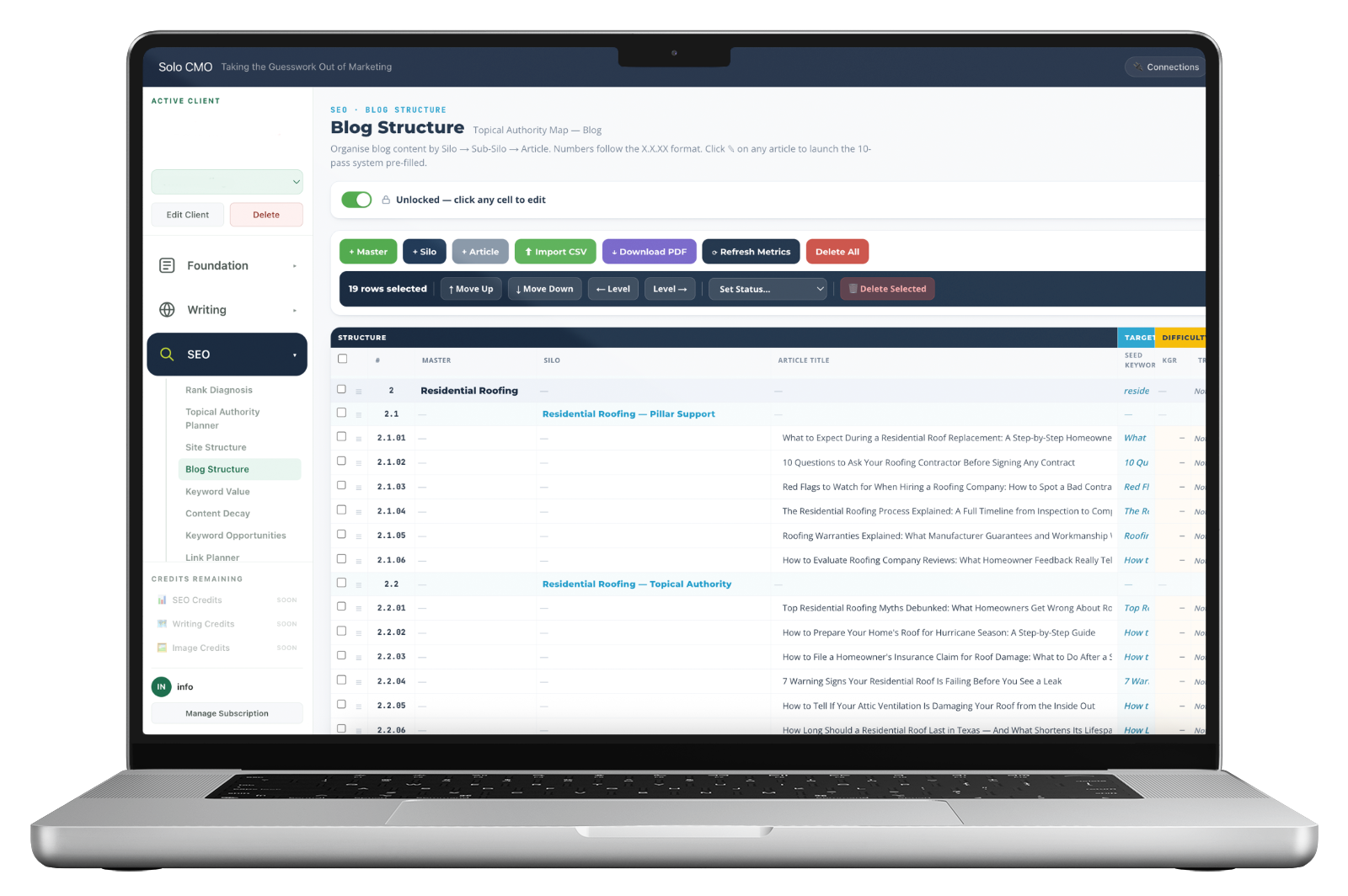
Blog content planned as silos and subtopics, each one built to support a specific money page. Same table as Site Structure — one row per post, with its target keyword, difficulty, scores, live URL, links and status — but organized around what the post is for.
Most local blogs are a pile, not a structure.
Twelve months of posts, chosen because someone found a keyword with volume and no competition. Some of them even rank. None of them link anywhere that sells, none of them belong to a topic the business actually wants to own, and the traffic they earn arrives, reads, and leaves.
Then the client asks what the blog has done for them, and the honest answer is that it produced sessions. Sessions aren't the product.
A money page, and the posts that hold it up.
Every silo starts at the page that sells. Underneath it sit the subtopics a buyer works through before they're ready to call, and underneath those sit the posts that answer them — each one linking up toward the page it exists to support.
Subtopic
Cost- What it costs by size
- What drives the price up
- Financing questions
Subtopic
Comparison- Full remodel vs. refresh
- Materials against each other
- DIY vs. hiring out
Subtopic
Process- How long it takes
- Permits and inspections
- Living through the work
Every arrow is an internal link, decided by the structure before a word is written. A post with no arrow is a post with no job.
One row per post, and the same seven column groups.
If you've used Site Structure this needs no explanation — the difference is what the hierarchy means. There, the levels are service and location pages. Here, they're silos, subtopics and the posts underneath them.
Structure
- Silo
- Subtopic
- Post
Targeting
- Target seed keyword
Difficulty
- Traffic
- KD
- Words
Scores
- Neuron
- POP
Publishing
- Live link
Authority
- Ref. domains
- Backlinks
- Ranking kw
Tracking
- Indexed
- Last checked
- Status
Fetched
Numbers, not guesses
Traffic and difficulty against the seed keyword, word count and optimizer scores against the live post, backlinks and indexation with a date beside them.
Status
Not started to published
The same four stages, counted at the top — so the answer to how much of the content plan is actually live takes a glance.
Row to brief
One click to the writer
The article brief pre-fills from the row, including which money page this post links up to, so the writing pipeline never has to guess the destination.
Twenty posts in a silo beat forty scattered.
Depth on one topic is a signal. Breadth across forty unrelated ones is noise, and it's how a blog ends up ranking for things nobody in the business wants to be found for.
Planning the silo before writing the posts also settles the thing that usually gets skipped: where each one links. The destination is decided by where the row sits, so the writing pipeline places the link rather than leaving it to whoever remembers.
- Every post assigned to a subtopic, every subtopic to a money page
- Internal link destination decided by structure, not by memory
- Thin silos visible as thin, so you know where to write next
- Posts belonging to no silo surfaced rather than quietly ignored
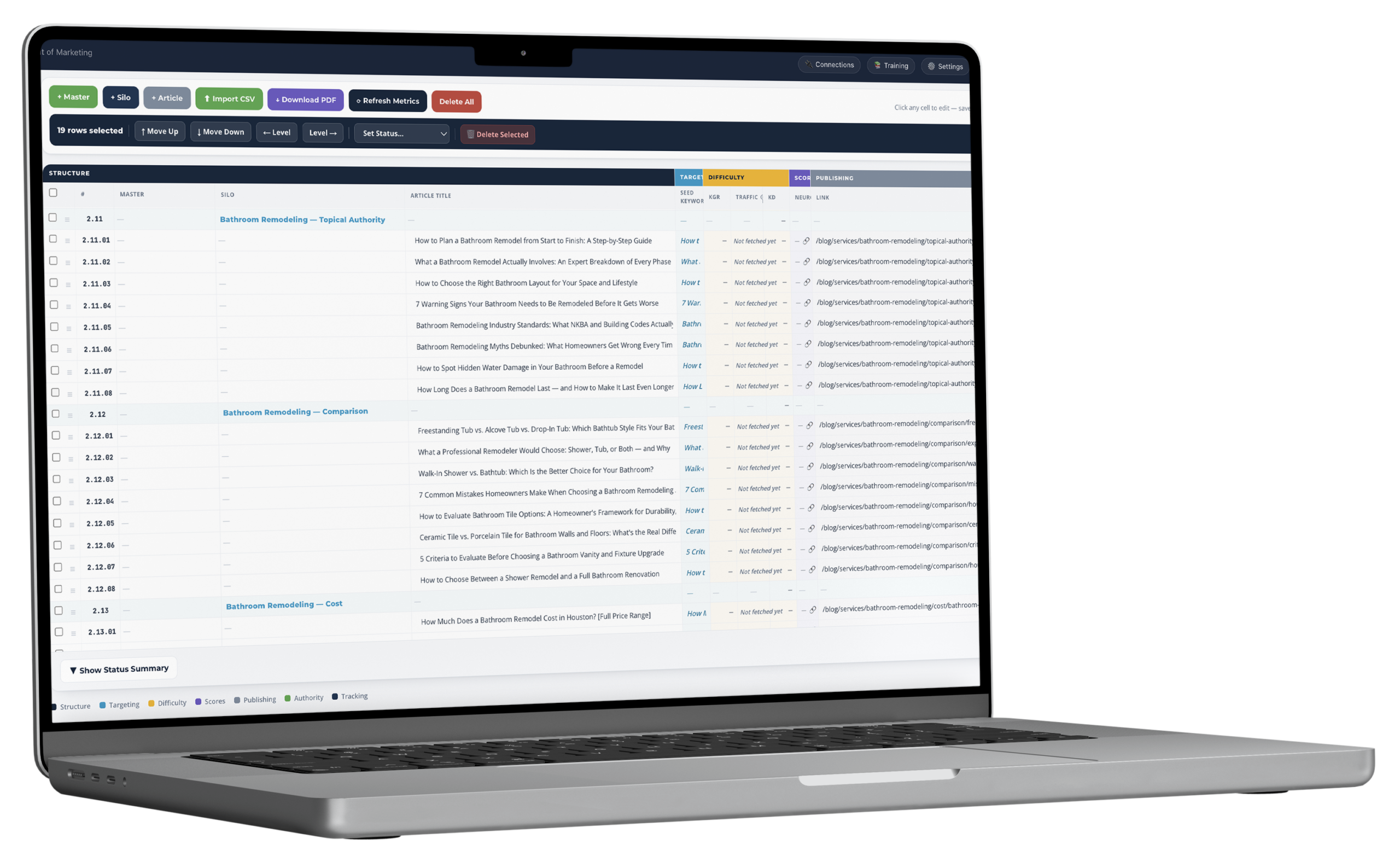
Import what's already published, sorted into silos.
Most clients arrive with a blog rather than without one. Seeding from their post sitemap pulls everything in and groups it into topical silos automatically — so an established blog shows up already sorted into the clusters it accidentally built, and the posts belonging to nothing are visible as exactly that.
Every module is on every plan. Plans differ only in how many clients you run.
What feeds it, and what it feeds.
What operators run alongside it.
The money pages these silos are built to support.
Topical Authority PlannerThe same clusters as a visual map, for seeing where a silo is thin.
Content generationWhere a planned post becomes a finished, linked article.
Content DecayCatches supporting posts sliding after they've been published a while.
Blog Structure, answered straight.
How is this different from Site Structure?
What is a silo, exactly?
Why not just publish whatever ranks?
Does it plan the internal links?
Can I import a blog that already exists?
Every plan includes every module.
There are no feature gates. Plans differ only in how many clients you run and how much you generate for them.