
Not who's beating you. Why.
Scan the top ten businesses for a keyword in a city and get the profile data that explains the position band — category breadth, photo depth, review volume, and the fields the whole market has left empty.
Then a ninety-day move, in priority order.
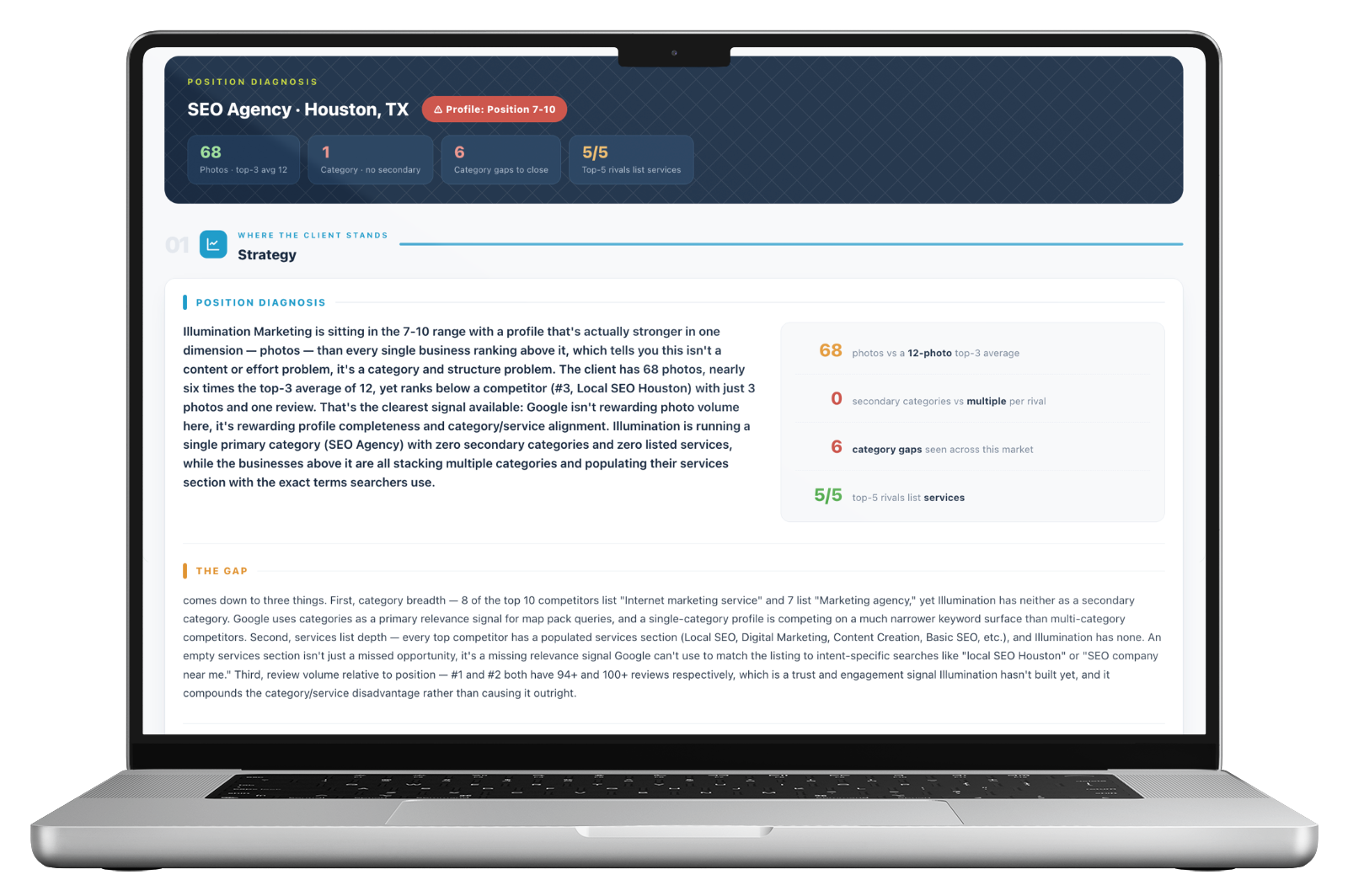
Competitor reports name the businesses. They never explain the ranking.
You already know who's above your client — it takes one search. What nobody can tell you in the time available is why, in terms specific enough to act on this week.
So competitor analysis becomes a slide with five logos and a sentence about them "having a stronger presence," which is true, useless, and impossible to build a quarter around.
Four numbers, and the position band explains itself.
The scan reads the structured data on every profile in the top ten — categories, services, photos, rating, review volume — and compares the client against it. Those are the fields Google matches queries against, which is why they explain a ranking better than anything on the websites does.
A real scan. The last number is green because zero is the opportunity, not the problem.
Where they stand
The band, and the reason for it
Written out in full — which rivals hold the top three, what they have that the client doesn't, and why that structural difference produces the gap.
The gap
Which levers actually matter here
Not every market is won the same way. The analysis names the two or three signals doing the work in this one, and says which to ignore.
The move
Ninety days, in order
Sequenced by effort against impact — the five-minute profile edit before the campaign that takes a quarter, with the target number attached to each.
Every gap quantified, and who else has already closed it.
A missing category isn't interesting on its own. A missing category that three of the top ten are using — including the business at number one — is a task with evidence behind it.
Missing categories (3)
Sometimes the whole market has left a field empty.
An empty field across an entire market is the rarest thing in local SEO, and it's invisible unless somebody compares the structured data on every rival profile side by side — which is exactly what nobody does by hand.
First-mover opportunity
10 of 10 competitors list no servicesNot one business in this market has filled in the services section of their profile. Fill in your client's and it becomes the only listing in the top ten giving Google — and anyone reading it — a structured account of what the business actually does. An afternoon's work, in a field nobody is contesting.
A real finding from a real market scan. This is the kind of thing that justifies a quarter's retainer in one screen.
Ten profiles, side by side, in the fields that count.
Rating, review volume, photo count, category count and services for every business in the top ten — so the benchmark isn't an impression, it's a column you can point at on a client call.
Full profile detail is fetched for the top five. Ranks six to ten are listed with what's available and marked as not pulled — rather than quietly filled in with guesses.
Review velocity
Not the count — the slope
Your client charted against named rivals over time. A competitor with fewer reviews gaining faster is a different problem from one sitting on a decade-old pile.
Market categories
Every category anyone uses here
The full taxonomy this market operates in, which is where the missing-category list comes from and often where a client discovers a service line they never listed.
Saved scans
Run it again in a quarter
Every scan is kept, so the second one shows movement — theirs as well as yours. Competitor gaps close too, and it's better to notice.
A competitor scan that ends in a PDF is a wasted scan.
Threats and market gaps push straight onto the client's SWOT board as strategic inputs. The gap report copies into the profile optimizer as a task list. Nothing has to be retyped, and nothing gets forgotten because it lived in a document.
To SWOT
Up to five items, one click
Dominant rivals become threats, uncontested fields become opportunities, and both land on the strategy board where the rest of the client's positioning already lives.
To the profile
The gap report, copy-paste ready
Missing categories and the services opportunity go straight into the profile module — where the fix actually happens, in the same session.
To the diagnosis
Competitive parity, scored
The scan is one of the inputs the rank diagnosis reads, which is why it won't run a full diagnosis without competitive intel loaded.
Every module is on every plan. Plans differ only in how many clients you run.
What feeds it, and what it feeds.
- Google Maps
- The market
- Business Details
- Your baseline
- Heatmap
- Who to watch
Feeds the scan
What operators run alongside it.
Competitor Intel, answered straight.
What does it actually compare?
What is a first-mover opportunity?
Does it tell me what to do, or just what's wrong?
Why do lower-ranked competitors show incomplete data?
Where do the findings go?
Every plan includes every module.
There are no feature gates. Plans differ only in how many clients you run and how much you generate for them.