
The best ad doesn't sound like an ad.
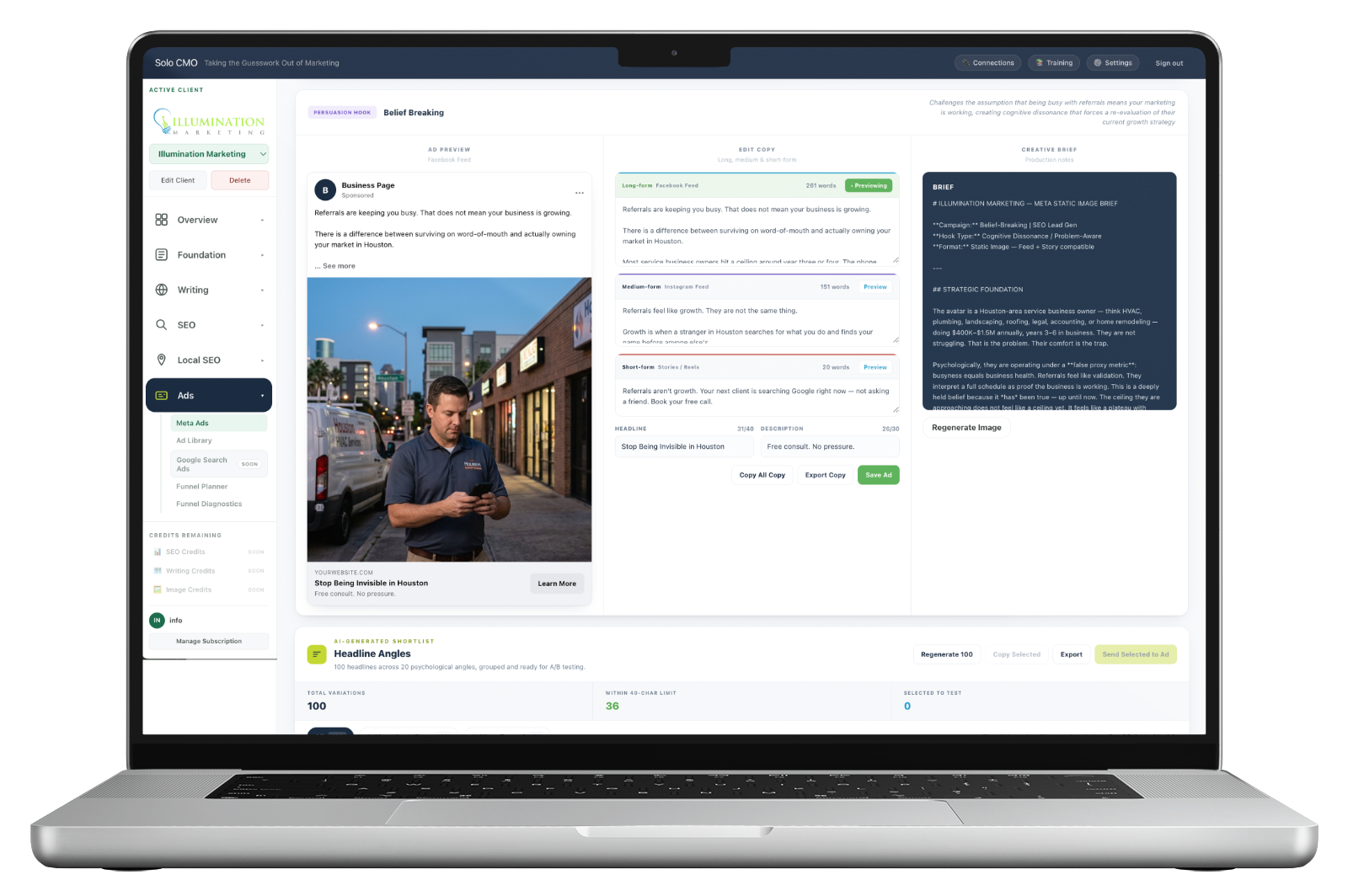
Copy written to a defined awareness stage, for a defined avatar, in long, medium and short form at once — with the psychological hook named, a production brief for the image, and a hundred headlines to test.
Generic ad copy is a targeting problem, not a writing problem.
Ask any AI for a Facebook ad and you'll get something fluent and useless, because it doesn't know who's reading or what state they're in. Someone who hasn't admitted they have a problem needs an entirely different opening from someone comparing three quotes this afternoon.
Write for both at once without a structure for it and you get the ad everyone writes — competent, forgettable, and scrolled past by both of them.
Pick which of five states they're in.
No awareness, feeling the pain, comparing options, knows you but hasn't committed, ready to buy. The stage decides the opening, the offer type and the close — which is why it's the first thing chosen rather than something the copy stumbles into.
And when it's all five at once — which, on cold traffic, it is.
Interest-based targeting on Meta mixes every awareness level into one audience. The blended setting builds the ad in three acts so it works on all of them without going vague.
A universally relatable moment. No brand name, no service. It has to land on someone who has never heard of the business and on someone already shopping.
A self-qualifying line that lets an aware reader recognize themselves without alienating a cold one. Agitate, then turn toward the solution.
A soft next step for the cold reader and a direct close for the warm one, sitting side by side — because the audience contains both.
Not just the copy. The reason the copy works.
Every generated ad states which connection hook it used and why that hook suits this reader at this stage. Which means you can defend the creative on a client call instead of saying the AI wrote it.
People feel understood when they see their own situation reflected back, which lowers defensiveness and builds trust before an offer is presented.
At the problem-aware stage this reader hasn't articulated "I need home care" — only "I can't keep living like this." They aren't scrolling looking for a solution; they're scrolling during a stolen ninety-second break between a work call and a school pickup, guard fully up against anything that feels like a sales pitch.
From the generated creative briefReal output, trimmed. That paragraph is the brief for whoever makes the image.
Feed, stories and reels are three different jobs.
A 250-word feed ad cut down to 30 words isn't a stories ad — it's a feed ad with the argument removed. So all three lengths are written together, each to its own constraint.
Headline and description carry live counters against Meta's limits, and they'll tell you when you're one character over rather than letting the platform truncate it.
- Long, medium and short-form generated in the same pass
- Reels copy written to be spoken aloud in the first three seconds
- A rendered feed preview, so you see it as the reader will
- Every version editable before it leaves
- Copy all, export, or save the ad to the client's library
One character over is still over. The counter says so before Meta does.
A hundred headlines across twenty angles.
Fifty that move a reader away from a pain, fifty that move them toward a pleasure, grouped by the psychological angle they use and tagged with their character count. Select the ones worth testing and send them into the ad.
Move away from — pain angles
Regret
Frustration
Waste
Move toward — pleasure angles
Lifestyle
Family
Freedom
100 total · 59 within the 40-character limit · click to select, then send to the ad
Real output, sampled. It generates past the limit and tells you which ones fit rather than silently trimming.
Every module is on every plan. Plans differ only in how many clients you run.
It starts from a client you've already defined.
The avatar, the positioning and the offer exist before the ad does — built once in strategy and reused across content, local and paid. Which is why the generator asks what stage the reader is in rather than who the client is.
- Avatars
- Who's reading
- USP
- Differentiators
- Offer
- The hook
Feeds the generator
- Ad Library
- Saved ads
- Funnel Diagnostics
- What converted
- Content generation
- Proven angles
The generator feeds
Meta Ads, answered straight.
What are the awareness stages?
What if my audience is mixed?
Do I get one version or several?
What is the creative brief for?
How do the hundred headlines work?
Every plan includes every module.
There are no feature gates. Plans differ only in how many clients you run and how much you generate for them.