Marketing Strategy
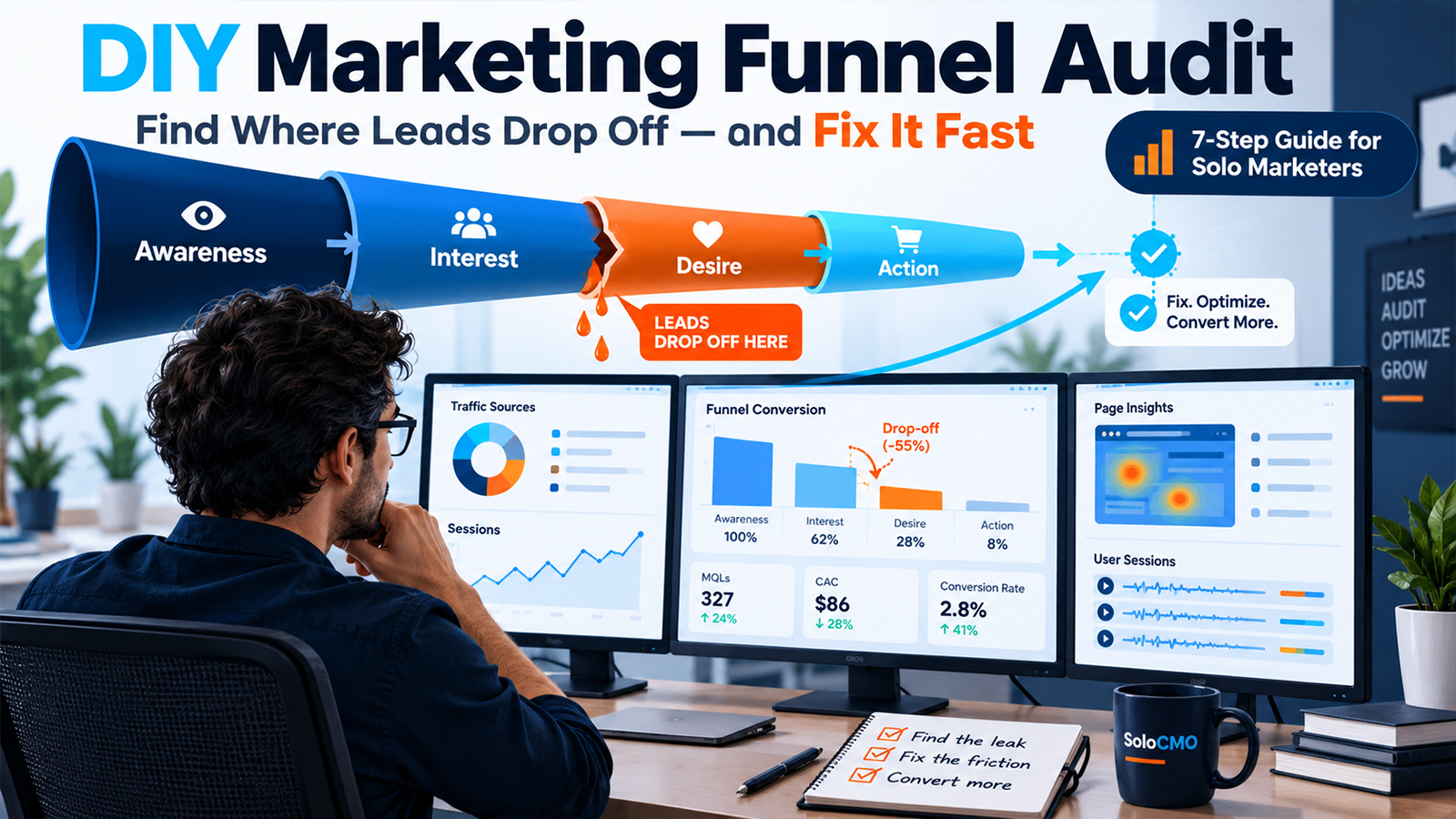
Leads are vanishing somewhere between the ad click and the closed deal, and you don’t have three weeks or three thousand dollars to find out where. That’s the reality for most solo marketing managers: you own social, email, content, the website, and reporting, and the moment something breaks in the funnel, you’re the one who has to figure out why, fast. The good news is that learning how to audit your marketing funnel yourself doesn’t require an outside firm or a funnel diagnostic invoice. You already have most of the tools sitting in your browser tabs right now.
How do you run a funnel audit without hiring an agency? Map your funnel stages. Pull traffic and conversion data from Google Analytics 4 and your CRM. Use Hotjar to see where visitors actually get stuck. Benchmark your numbers against 2026 industry norms. Then build a prioritized fix list. The whole process takes a day or two, not a month.
Key Takeaways
- A 7-step DIY process using tools you likely already have, Google Analytics 4, Google Search Console, Hotjar, and your CRM, can diagnose funnel drop-off in a day or two.
- Full-funnel agency audits typically run from a few hundred dollars for a quick check to $6,000 or more for a full engagement, with turnarounds of three to four weeks.
- Quarterly audits, or every 30 to 60 days if you run active ad spend, keep small leaks from turning into lost pipeline.
- The AIDA framework gives you a structure to map every funnel stage to a metric you can actually measure.
- AI-assisted tools now shrink the data-pulling and analysis part of a funnel audit from weeks down to a few hours.

What Is a Marketing Funnel Audit? (And What It Actually Measures)
A marketing funnel audit is a structured review of every stage a potential customer moves through, from the first time they notice your brand to the moment they become a paying customer.
The goal is simple: find the exact stage where your sales funnel loses the most people, and figure out why.
Most audits fail not because the marketer lacks data. They fail because the marketer lacks a framework to make sense of it. That’s where a model like AIDA earns its place.
The AIDA Framework Applied to Modern Funnels
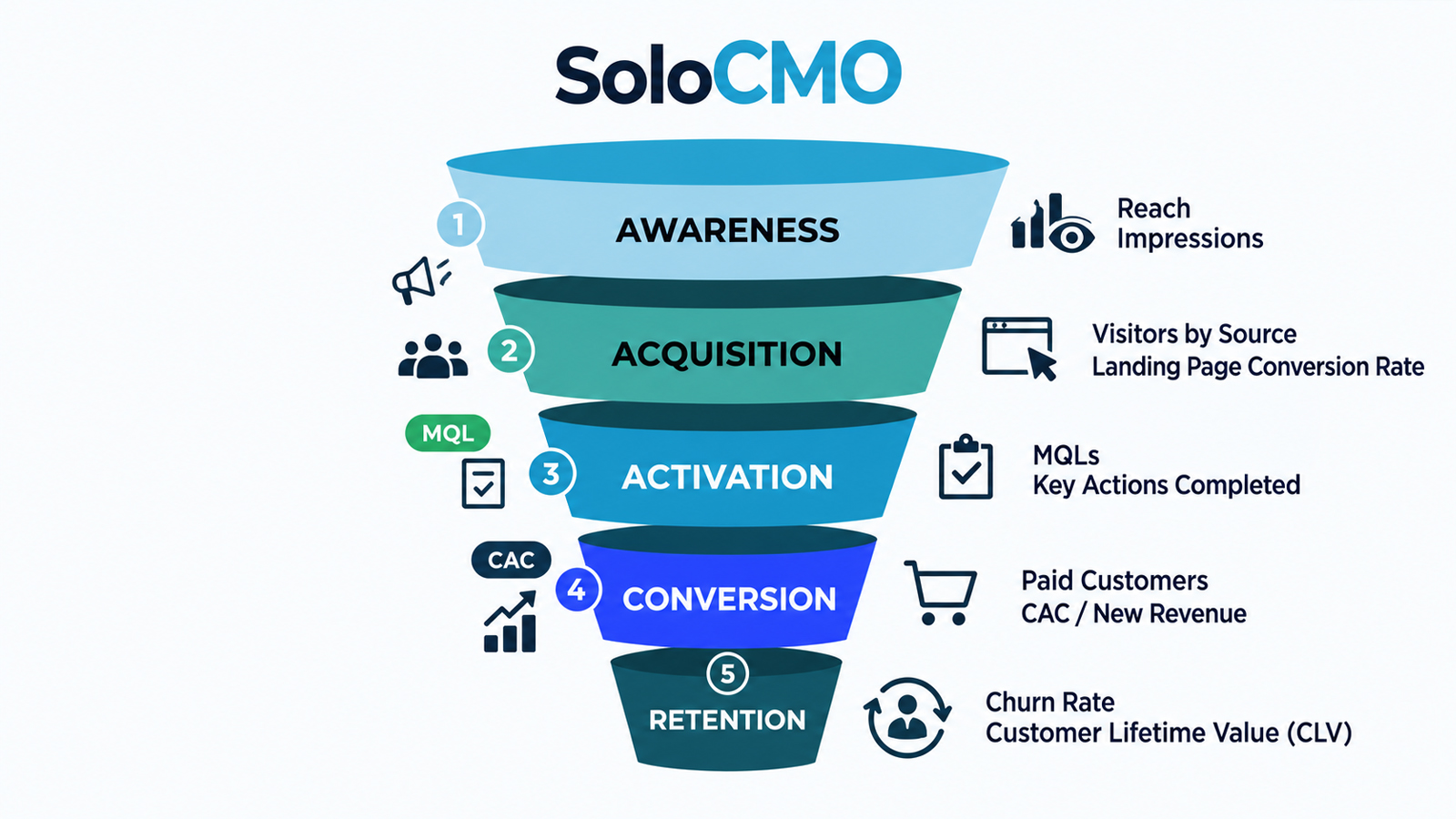
AIDA stands for Awareness, Interest, Desire, and Action. It maps cleanly onto the stages you’re already tracking. Awareness sits at the top of the funnel: traffic, impressions, brand awareness. Interest and desire cover acquisition and activation, things like email signups, content engagement, demo requests. Action is your conversion stage, where a visitor becomes a lead and eventually a customer. Retention sits just past Action, closing the loop back into advocacy and repeat business.
Why MQLs and CAC Are the Metrics That Matter Most
Two metrics tie every funnel stage back to revenue: marketing qualified lead (MQL) volume and customer acquisition cost (CAC). MQLs tell you whether your top-of-funnel activity is producing people worth pursuing. CAC tells you whether the cost of producing them makes financial sense. Top-of-funnel signals like traffic and impressions look good on a dashboard. But bottom-of-funnel signals, conversion rate and CAC, are what actually tell you if the funnel is healthy.
If this framework feels abstract, it usually clicks once you apply it to your own numbers in the steps below.

The 7-Step DIY Funnel Audit Process
This is the core sequence. Each step names a tool and a target, so you’re never stuck guessing what to check next.
Steps 1-3: Mapping and Pulling the Data
Step 1: Map your funnel stages on paper or in a spreadsheet before touching any analytics. List awareness, acquisition, activation, conversion, and retention as columns.
Step 2: Pull traffic and source data from Google Analytics 4 to see where volume comes from and how attribution splits across channels. A good result looks like a clear picture of which channels drive the most qualified traffic, not just the most clicks.
Step 3: Audit conversion rates at each stage using GA4 alongside your CRM (Salesforce or HubSpot CRM). You’re looking for the conversion rate from visitor to lead, lead to MQL, and MQL to opportunity.
Steps 4-5: Finding and Diagnosing the Drop-Off
Step 4: Identify the single biggest drop-off point, the stage losing the most volume compared to what you’d expect. This is usually obvious once steps 2 and 3 are done.
Step 5: Diagnose the root cause with Hotjar session recordings and heatmaps [1]. Numbers tell you where people leave. Recordings tell you why. A confusing message, a broken form, a page that loads too slowly. Watch a handful of sessions and the pattern usually shows up fast.
Steps 6-7: Benchmarking and Prioritizing Fixes
Step 6: Benchmark your findings against industry CAC and conversion norms so you know if a number is really a problem or just normal for your field.
Step 7: Build a prioritized fix list ranked by revenue impact, not by how loudly a stakeholder is complaining. The goal at this stage isn’t just to patch leaks. It’s to optimize each stage so it feeds the next one more efficiently.
Once you’ve run all seven steps, you’ll usually have more findings than you have time to act on in a given week, which is exactly what the checklist below is meant to help you triage.
Funnel Audit Checklist: What Metrics Should I Check?
What metrics should you check in a funnel audit? At minimum, check traffic and lead volume by source, landing page conversion rate, MQL qualification accuracy, CRM lead scoring, email nurture completion, CAC by channel, and your reporting schedule. Screenshot this list. Run it every quarter.
Quantitative Metrics to Pull
- Traffic and lead volume by source, pulled from GA4
- Landing page conversion rate by campaign
- CAC by channel compared against benchmark data
- Calls to action click-through rate by placement
Qualitative and CRM Signals to Check
- MQL qualification criteria and CRM lead scoring accuracy
- Email nurture sequence completion and drop-off rate
- Message consistency between your ad, landing page, and follow-up email
- Reporting cadence, whether you’re reviewing weekly numbers or only doing a monthly deep dive
Separating volume metrics from lead-quality metrics is where a lot of solo marketers get fooled. A spike in MQLs feels like a win until you notice half of them never should have qualified in the first place.

Common Funnel Leaks Solo Marketers Miss
These are the leaks an outside reviewer usually catches first, simply because they’re looking with fresh eyes. Naming them gives you that same edge without the invoice.
Technical and On-Page Leaks
Mobile page speed is a quiet killer. A landing page that takes four seconds to load loses a chunk of visitors before they ever see your offer. Orphaned SEO pages are another common leak: pages ranking for the wrong search intent, or ranking well but disconnected from any nurture touchpoint, so the traffic arrives and goes nowhere.
CRM and Messaging Leaks
CRM lead scoring mistakes let unqualified leads flood your MQL count, which inflates your funnel metrics without producing real pipeline. Email nurture gaps show up when sequences stop after two emails or never re-trigger for a lead who comes back to the site. And message mismatch, where your ad copy promises one thing and your sales page headline says something else, breaks trust in the first three seconds a visitor spends on your site. Unclear or duplicate calls to action make the problem worse by confusing whatever trust you had left.
If you spot two or three of these at once, it’s worth pausing before you fix anything, some of these leaks share a root cause, and patching them one at a time can waste a day you don’t have to spare.
DIY vs. Marketing Agencies: Cost, Time, and How Often to Audit
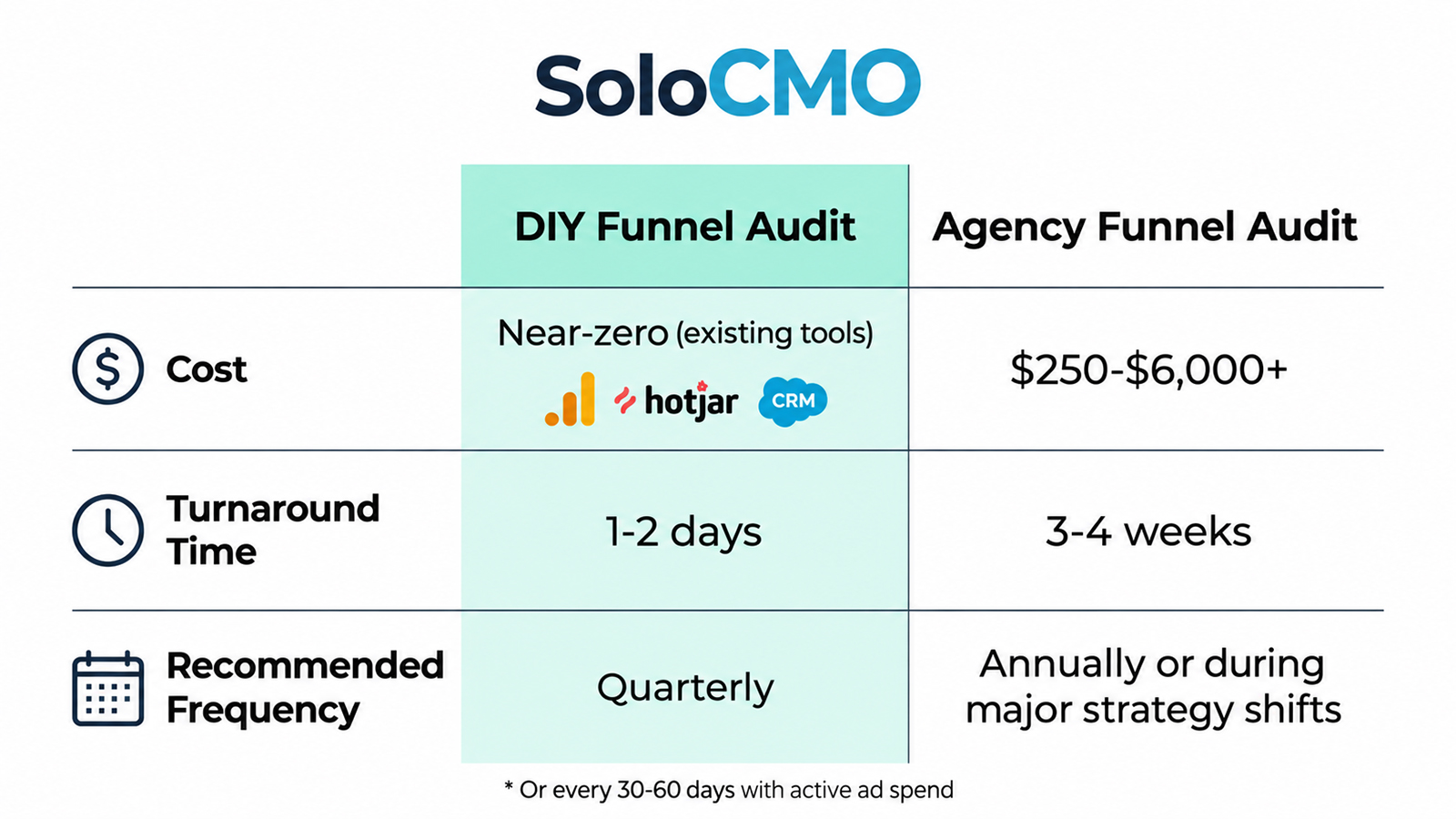
How much does an agency charge for a funnel audit? Full-funnel agencies typically charge anywhere from around $250 for a quick check up to $6,000 or more for a full audit across multiple channels [2]. Pricing scales with the number of channels and the ad spend under review. This is exactly why a solo marketer running a lean stack doesn’t need the same scope as a larger organization checking multiple full-funnel programs.
What Agencies Actually Charge
| Factor | DIY Audit | Full-Funnel Agency Audit |
|---|---|---|
| Time to complete | 1-2 days | 3-4 weeks |
| Cost | Near-zero (existing tools) | $250 (quick check) to $6,000+ (full audit) |
| Tools used | GA4, Search Console, Hotjar, CRM | Proprietary tools plus the same core stack |
| Best for | Ongoing quarterly diagnosis | Second opinion, ROI validation on marketing budget |
| Recommended cadence | Every 30-60 days | Annually or during major strategy shifts |
How Often You Should Run This Process
How often should you audit your marketing funnel? A quarterly schedule works for most SMBs. Teams actively spending on paid media or paid social should tighten that to every 30 to 60 days. Agencies still have a place here. Not as a must for the first diagnosis, but as a second opinion when you want ROI validation on a bigger marketing investment.

How Generative AI Tools Compress a Two-Week Audit Into a Few Hours
Steps 2 through 7 of the process above are exactly what generative AI tools now automate. Instead of manually exporting GA4 reports, cross-referencing Google Search Console data, and stitching CRM exports into a spreadsheet, an AI-assisted tool pulls and connects that data on its own. It surfaces the biggest drop-off point and drafts a prioritized fix list in hours instead of weeks.
What AI Automates in the Audit Process
A marketing manager we worked with was manually exporting GA4 and CRM data every month, spending most of a full day just assembling the report before any analysis could even start. Once that data pull moved into an automated workflow, the same audit took under two hours. The time saved went straight into acting on the fix list instead of building it. SoloCMO was built around this exact problem: more output for a team of one, without the seat-based collaboration features that big martech suites assume you need. There’s no workflow to set up for a team that doesn’t exist.
Where Human Judgment Still Matters
AI can speed up the data-gathering and pattern-spotting work, but it still takes a person to judge which fix actually moves revenue versus which one just looks urgent. That’s where some solo marketers want a second opinion before spending time on execution. If your fix list is built and you want expert eyes on prioritization before you touch a single campaign, an estimate for a funnel diagnostic can confirm the plan without the cost or timeline of a full agency retainer. No pressure either way, it’s a conversation, not a commitment.
Conclusion: You Don’t Need an Agency to Find Your Funnel’s Weakest Link
The 7-step process above is genuinely enough to figure out where your funnel is bleeding pipeline. No proposal needed. No kickoff call. No month of waiting to know which stage is broken. Run it this week, treat the checklist as a living document you revisit every quarter, and trust what the data tells you. If the fix list is built and you’d simply like a second set of expert eyes on prioritization before you spend a week executing, get an estimate and see what a lighter-touch funnel diagnostic looks like for your specific business, no retainer required. If it’s easier to talk it through first, that’s a fair way to start too.
FAQ
What is a marketing funnel audit?
A marketing funnel audit is a structured review of every stage a prospect passes through, from first touch to closed customer, built to find where the funnel is losing pipeline. It typically covers traffic, conversion rate, lead quality, and retention. A professional review can check your findings against broader industry data if you want a second layer of confidence.
How much does an agency charge for a funnel audit?
Marketing agencies typically charge between $250 for a quick check and $6,000 or more for a full-funnel audit, depending on channel count and ad spend under review [2]. If a full retainer feels excessive, some agencies offer a lighter, scoped free audit or diagnostic call to bridge the gap between DIY and full-service pricing.
What metrics should I check in a funnel audit?
At minimum, check traffic and lead volume, conversion rate by stage, MQL quality, and CAC by channel. These four categories cover the volume, quality, and cost side of your funnel. A professional pass can catch metric mix-ups, like a CRM field that’s silently mislabeling lead source data.
How often should you audit your marketing funnel?
Most SMBs should audit their funnel every quarter, tightening to every 30 to 60 days if they run active paid campaigns. Frequent audits catch small leaks before they add up. An outside review once a year can still catch drift that a marketer too close to the daily numbers might miss.
What tools do I need to audit my funnel myself?
You need Google Analytics 4 for traffic and conversion data, Google Search Console for organic search performance, Hotjar for session recordings and heatmaps, and a CRM like HubSpot CRM or Salesforce for lead and pipeline data. Tool setup errors, like a mistracked goal in GA4, are exactly where expert eyes tend to add the most value.
What is the difference between a funnel audit and a marketing audit?
A funnel audit is narrow and focused on the conversion path itself, while a marketing audit is broader and looks at brand positioning, messaging strategy, and overall marketing budget allocation. If you’re not sure which one your business actually needs, a professional scoping conversation can point you to the right starting place.
Do I have to run paid ads to have a funnel worth auditing?
No, organic-only funnels still have measurable stages worth auditing, from SEO-driven traffic through to conversion and retention. Attribution for organic-only pipeline is notoriously hard to self-diagnose since there’s no ad platform doing the tracking for you. This is one area where a professional review can help untangle things.
Sources
[1] https://www.hotjar.com/product/funnels/ [2] https://theconversionpulse.com/2025/09/06/how-much-does-a-funnel-audit-cost-and-is-it-worth-it/Recent Posts
Content Refresh vs Rewrite: Which Fixes Decaying Blog Posts Faster
A content refresh ships faster, usually in 1 to 3 hours versus 4 to 8 for a rewrite, but a rewrite recovers faster when the decay stems from a search intent mismatch. The rule of thumb is to refresh the post if it still matches what searchers want and most of it is salvageable, and to rewrite it if the

How to Build a Topic Cluster From Scratch for Your SaaS Blog
To build a topic cluster, pick a pillar topic that fits your product, collect subtopic keywords, group them by SERP overlap and intent, size the cluster, link every page to the pillar, publish in stages, then measure at cluster level. That is how to build a topic cluster in a way you can defend to a founder, and our topical authority

Where Leads Drop Off Between Ad Click and Signup
Funnel drop off between click and signup occurs at six points: the ad click, page load, above the fold, form start, form submit, and verification. The most significant leaks usually sit upstream, where the ad promise fails to match the page or where the page loads too slowly on mobile before the form ever appears. If your paid ad campaigns show
Get Smarter About Your Marketing
Practical SEO, AI, content, and marketing strategies you can put to work immediately.
Join the Newsletter