SEO
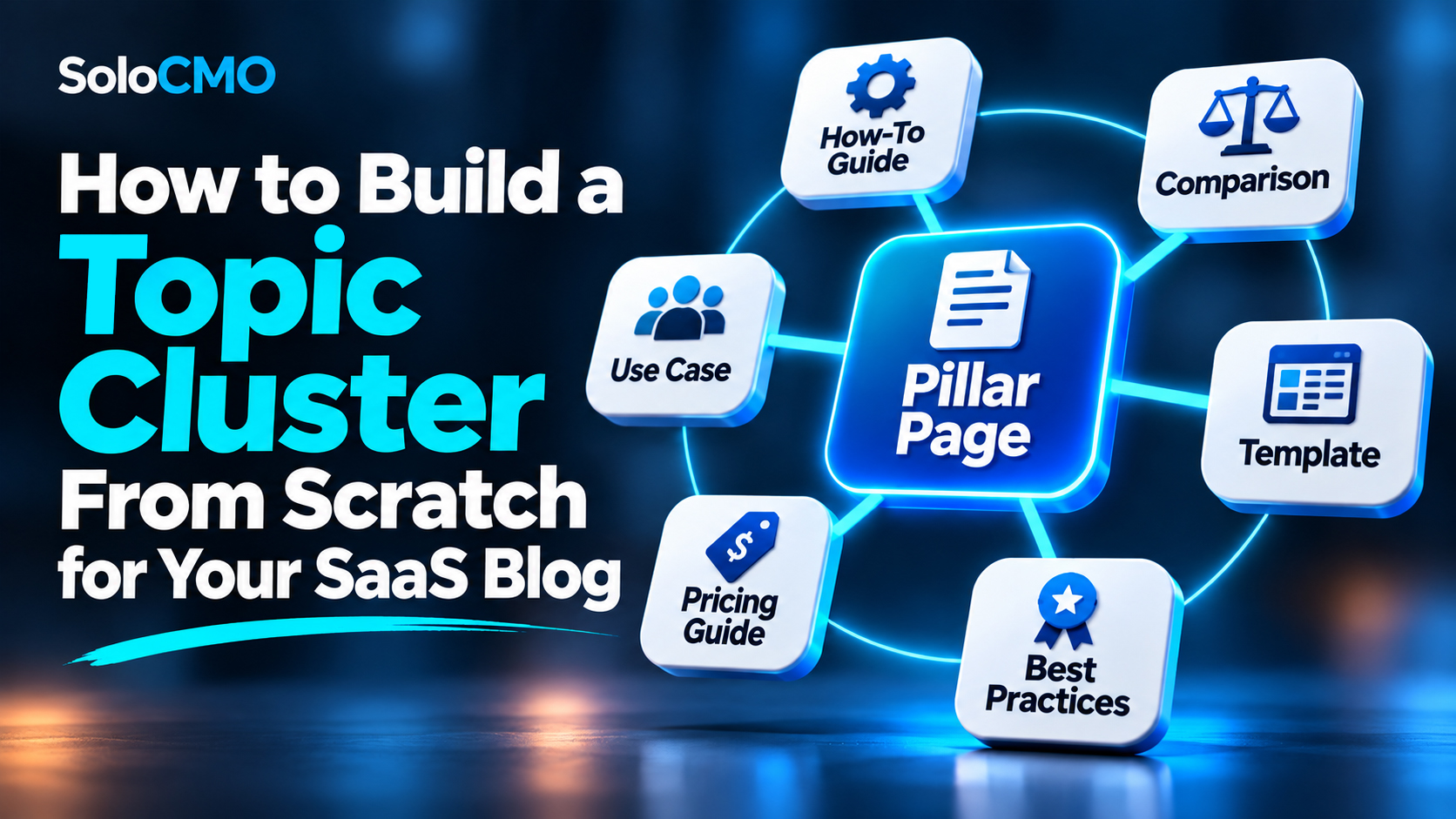
To build a topic cluster, pick a pillar topic that fits your product, collect subtopic keywords, group them by SERP overlap and intent, size the cluster, link every page to the pillar, publish in stages, then measure at cluster level. That is how to build a topic cluster in a way you can defend to a founder, and our topical authority planner follows the same sequence.
This guide is for fractional CMOs, freelancers, and small agency owners running a SaaS blog without a content team. Plan on 3 to 5 working days to a signed-off cluster map, 90 days to publish, and 3 to 6 months before rankings move.
Key Takeaways
- The process runs in seven steps: pillar topic, keywords, grouping and intent, size and page types, internal links, sequence and publish, then measure.
- Score pillar candidates on search volume, business relevance, competitive difficulty, and product fit before you commit.
- A minimum viable cluster is one pillar plus 5 to 7 cluster pages, expanded only when you find distinct intents.
- Every cluster page links to the pillar, the pillar links to every cluster page, and related siblings link laterally.
- Expect ranking movement in roughly 3 to 6 months, and track cluster-level leading indicators until then.

What Is a Topic Cluster in SEO, and How Do Pillar and Cluster Pages Differ?
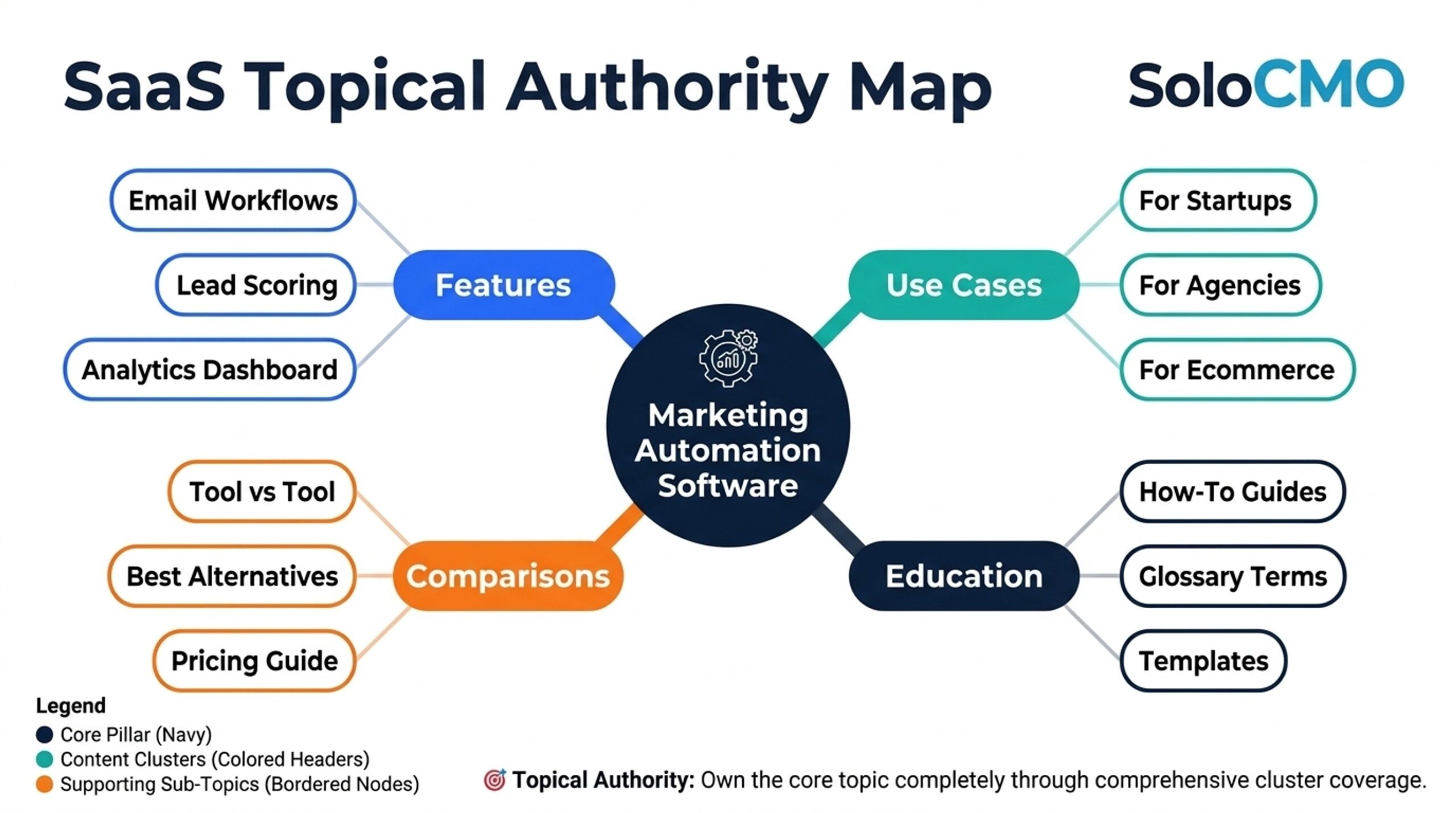
A topic cluster is a group of pages organized around one subject. A pillar page covers the broad topic at a high level, while each cluster page explores one specific topic in depth and links back to the pillar.
Picture a hub with spokes: the pillar sits in the center, cluster pages ring it, and neighboring spokes connect wherever their intent overlaps.
HubSpot popularized the pillar and cluster model, and it remains a staple of content marketing planning. One honest caveat: Ahrefs points out that Google has never officially endorsed “topic clusters” as a ranking concept. The model works because it gives your site depth, clear content structure, and consistent internal signals, not because it is a trick. That distinction matters when you defend the plan to a founder, and it is worth stating plainly in your deliverable so nobody is surprised later.
What is the difference between a pillar page and a cluster page?
A pillar page is a broad, long-form overview that targets a head term and summarizes every subtopic with a link to the full treatment. A cluster page is narrower. It answers one question or serves one intent in detail, then links up to the pillar. The pillar is the map and each cluster page is a single destination.
Why do topic clusters build topical authority?
Standalone blog posts compete alone. A cluster shows search engines that your site covers a subject from several angles, with pages that reference each other.
That fits Google’s Helpful Content guidance and the E-E-A-T framework, which reward first-hand experience and depth over thin, scattered coverage. It also turns a loose list of posts into a structured plan where your core topics are covered thoroughly rather than touched on once.
Building topic clusters this way is one of the most practical foundations for a durable SEO strategy, because each cluster compounds the authority of the pages around it.
Step 1: How Do You Choose a Pillar Topic for a SaaS Blog?
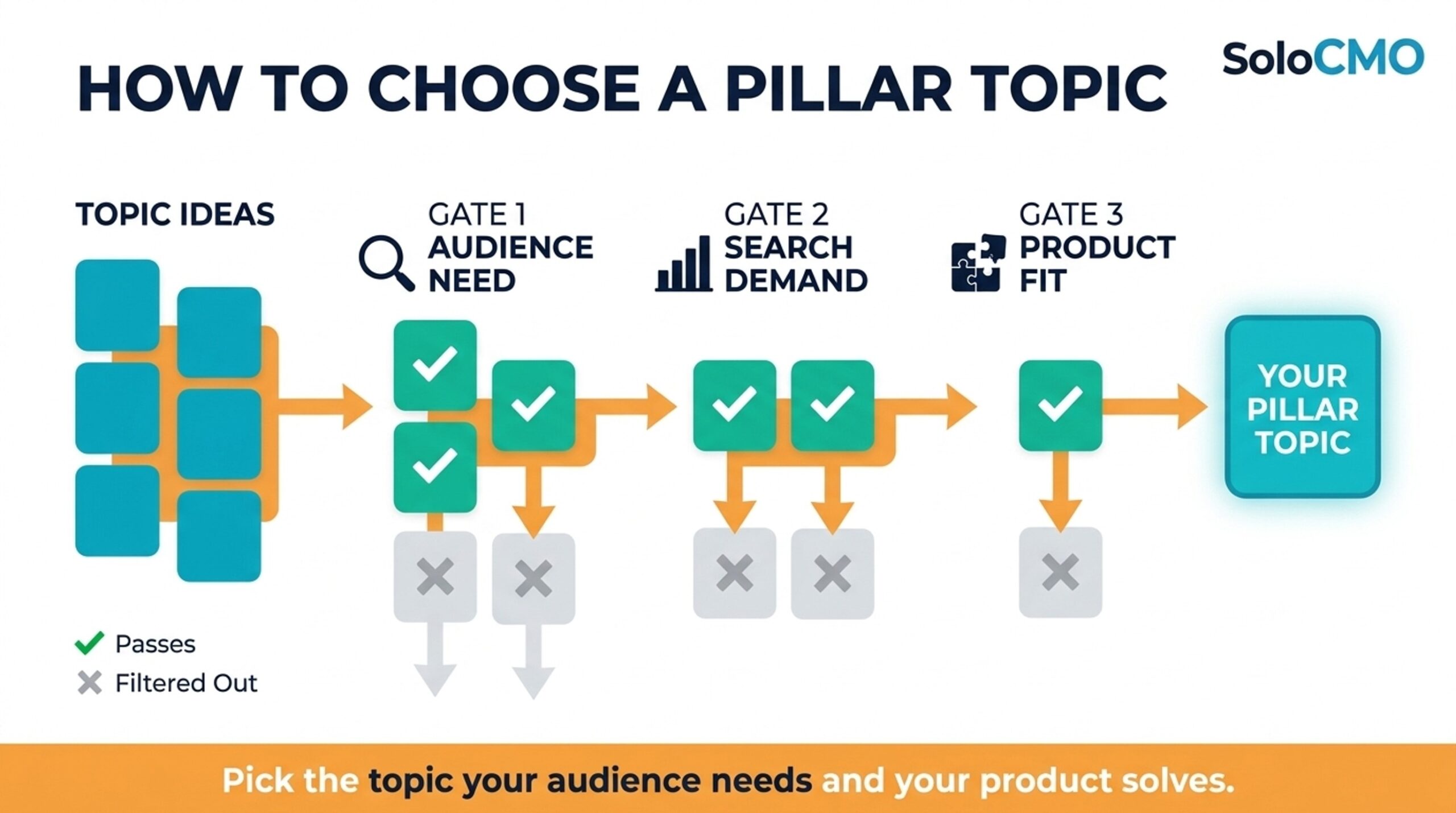
Start with your ICP’s problems and the product category, then list three to five topics a buyer would research before ever hearing your brand. Those become the candidates you score, which makes the decision defensible instead of a gut call. A pillar that draws traffic but never connects to the product is the most common and most expensive mistake.
Score candidate topics with a four-column matrix
Rate each candidate from 1 to 5 on four factors. Pull search volume from Google Keyword Planner or Ahrefs Keywords Explorer, then judge the other three yourself.
| Candidate topic | Search volume | Business relevance | Competitive difficulty (5 = easier) | Product fit | Total |
|---|---|---|---|---|---|
| Customer onboarding software | 4 | 5 | 3 | 5 | 17 |
| Customer success | 5 | 2 | 1 | 2 | 10 |
| Onboarding checklist templates | 3 | 3 | 4 | 3 | 13 |
The first topic wins even though “customer success” has more volume. A hub nobody on the sales team cares about brings visitors who never convert. If a client pushes back on a lower-volume choice, this table is the artifact that settles the conversation.
Apply the breadth, ownership, and expertise tests
Three rules settle close calls. The topic must be broad enough to support at least eight subtopics, yet narrow enough that you can realistically own it. It must also be one where you can say something specific from real experience, which is your strongest E-E-A-T asset. If you can’t create a pillar page that adds something a competitor’s page lacks, pick another topic, because strong pillar content is what the rest of the cluster depends on.
Your deliverable for Step 1 is a signed-off pillar topic and a one-line rationale you can hand to the founder.
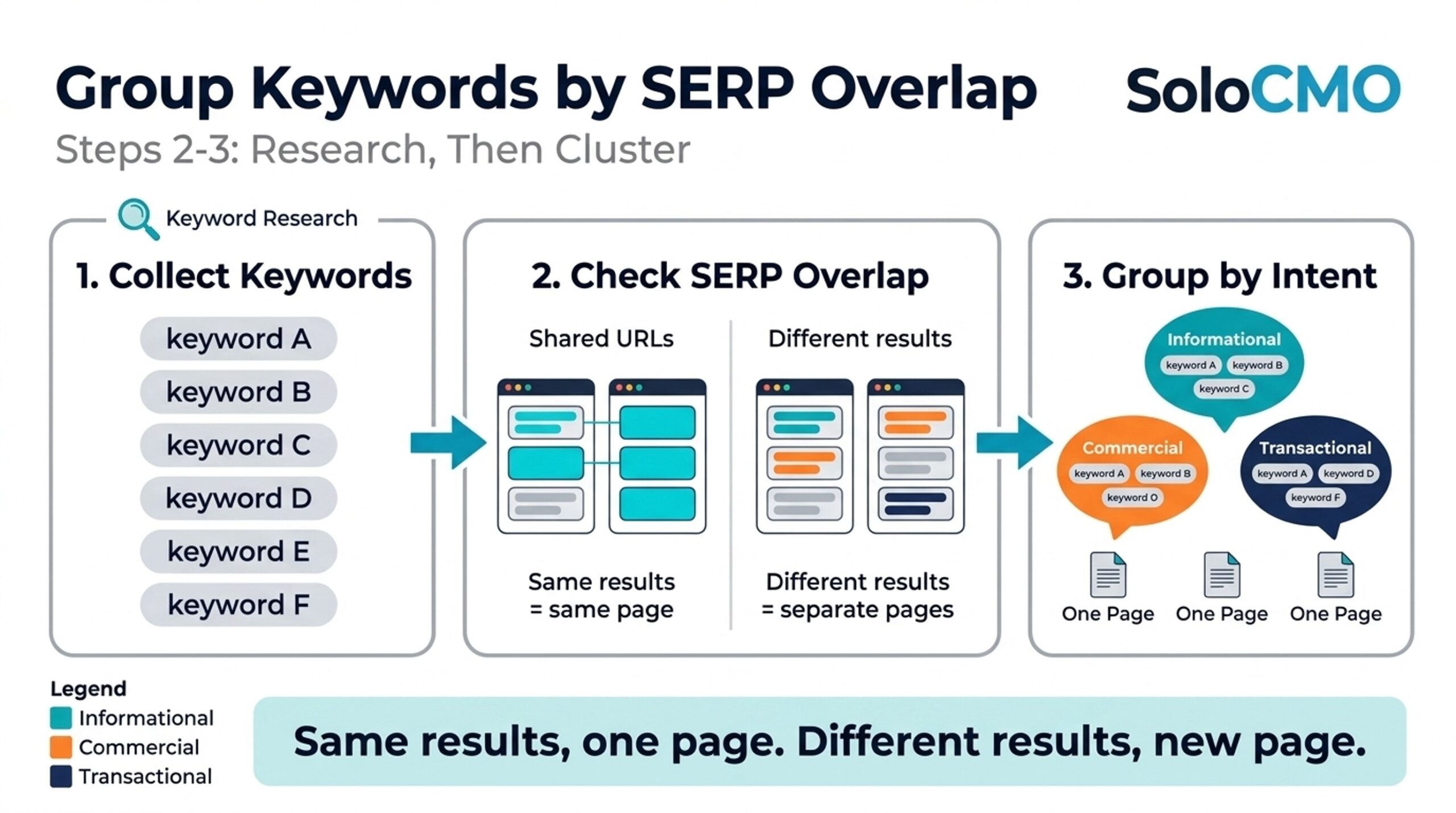
Steps 2-3: Keyword Research and Grouping Keywords by SERP Overlap and Intent
Good keyword research for topic clusters starts wide, then collapses quickly. The goal is a keyword-to-page map in which each page owns one specific topic, with the main topics of the cluster clearly separated from the supporting ones.
Step 2: Collect subtopic keywords from five sources
Pull from more than one place so your list reflects real buyer language rather than only tool data. Begin with an audit of your existing content in Google Search Console, which shows queries that already earn impressions. Then add these sources:
- Ahrefs Keywords Explorer and Content Gap, to find terms competitors rank for that you don’t
- Semrush Keyword Magic Tool and Topic Research, for question-style and long-tail variants
- Sales-call recordings and support tickets, where buyers use their own words
- People Also Ask boxes and Reddit threads, for the phrasing of real questions
If you only have time for one extra source, make it the sales calls. Nothing else gives you language your competitors’ tools have not already surfaced.
Step 3: Group by SERP overlap and label intent
A raw export of 300 keywords usually collapses to 20 to 30 pages once grouped. Use Ahrefs “Clusters by Parent Topic,” a tool such as Keyword Insights, or a manual rule: if three or four of the same URLs rank in the top 10 for two keywords, they belong on one page. This doubles as your first cannibalization check, since two keywords with identical results should never get two pages.
Label each group with one intent: informational, comparison, solution-aware, or bottom-funnel. Your deliverable is a keyword-to-page map with one page per intent.
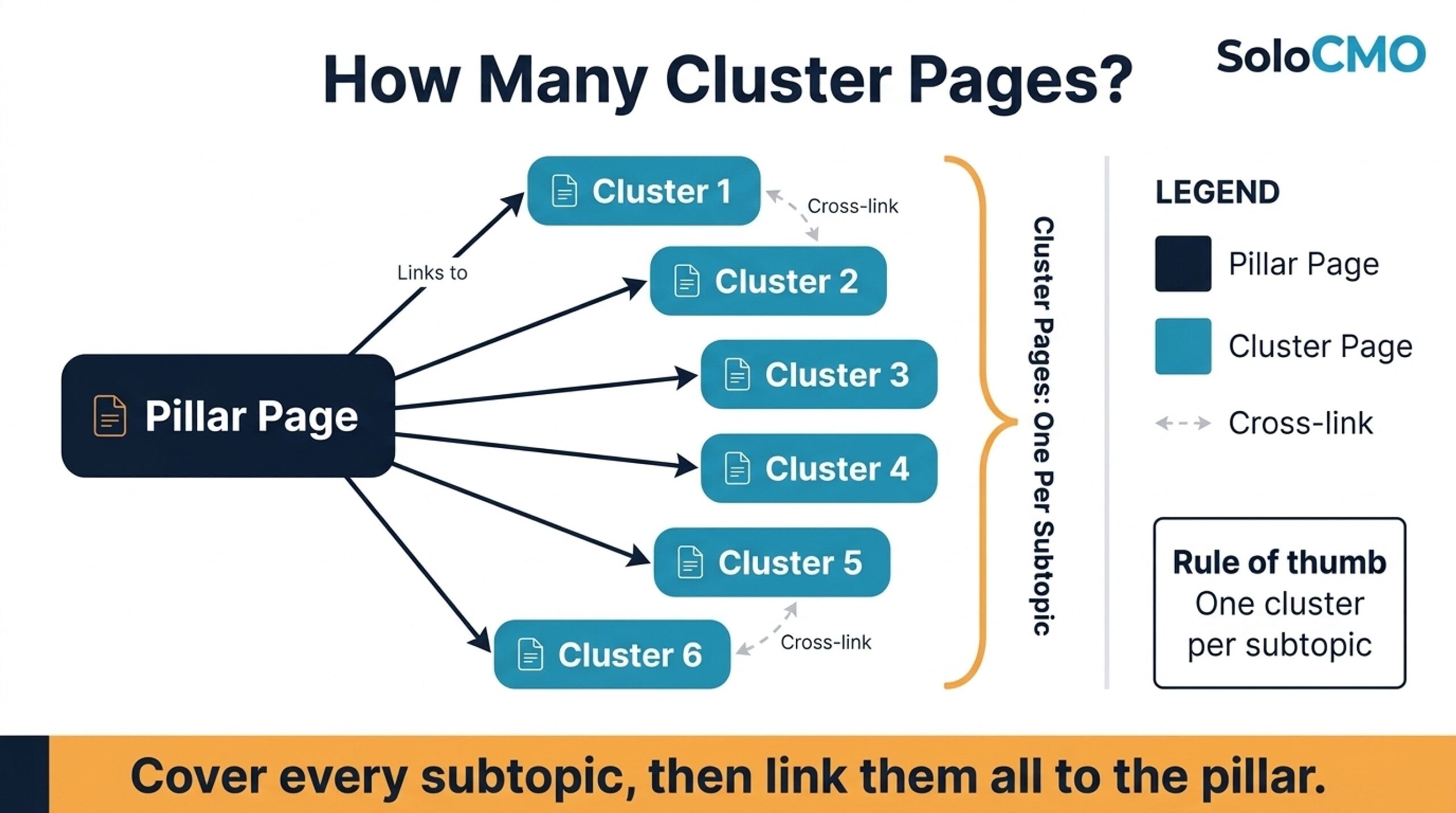
Step 4: How Many Cluster Pages Does a Pillar Page Need?
Advice varies widely, from 4 to 6 pages at the low end to 20 or more, and 8 to 12 is a common working range. No authoritative number exists.
Why advice on cluster size conflicts
Sizes differ because niches differ. A crowded category needs more pages to compete than a narrow one. Use a rule instead of a magic number: start with a minimum viable cluster of one pillar plus 5 to 7 cluster pages, then expand only when you find a new, distinct intent. Never add pages for synonyms. Whatever size you land on, document the cluster strategy before drafting starts, so every one of your topic clusters has a clear scope.
Page-type mix for a 10-, 20-, and 30-page cluster
This table shows a sensible split of cluster content by type.
| Page type | 10-page cluster | 20-page cluster | 30-page cluster |
|---|---|---|---|
| Pillar page | 1 | 1 | 1 |
| How-to guides | 4 | 7 | 10 |
| Comparison and alternatives | 2 | 4 | 6 |
| Template or tool pages | 1 | 3 | 5 |
| Use-case pages | 2 | 5 | 8 |
| Total | 10 | 20 | 30 |
Prioritize comparison pages early, since those buyers sit closest to a demo.
Brief each page with Surfer SEO or Clearscope
Run each page through a content brief tool such as Surfer SEO or Clearscope so that headings and terms match the SERP. Structure the pillar with one section per cluster page, each with a short summary and a link. That keeps the pillar scannable and makes linking nearly automatic.
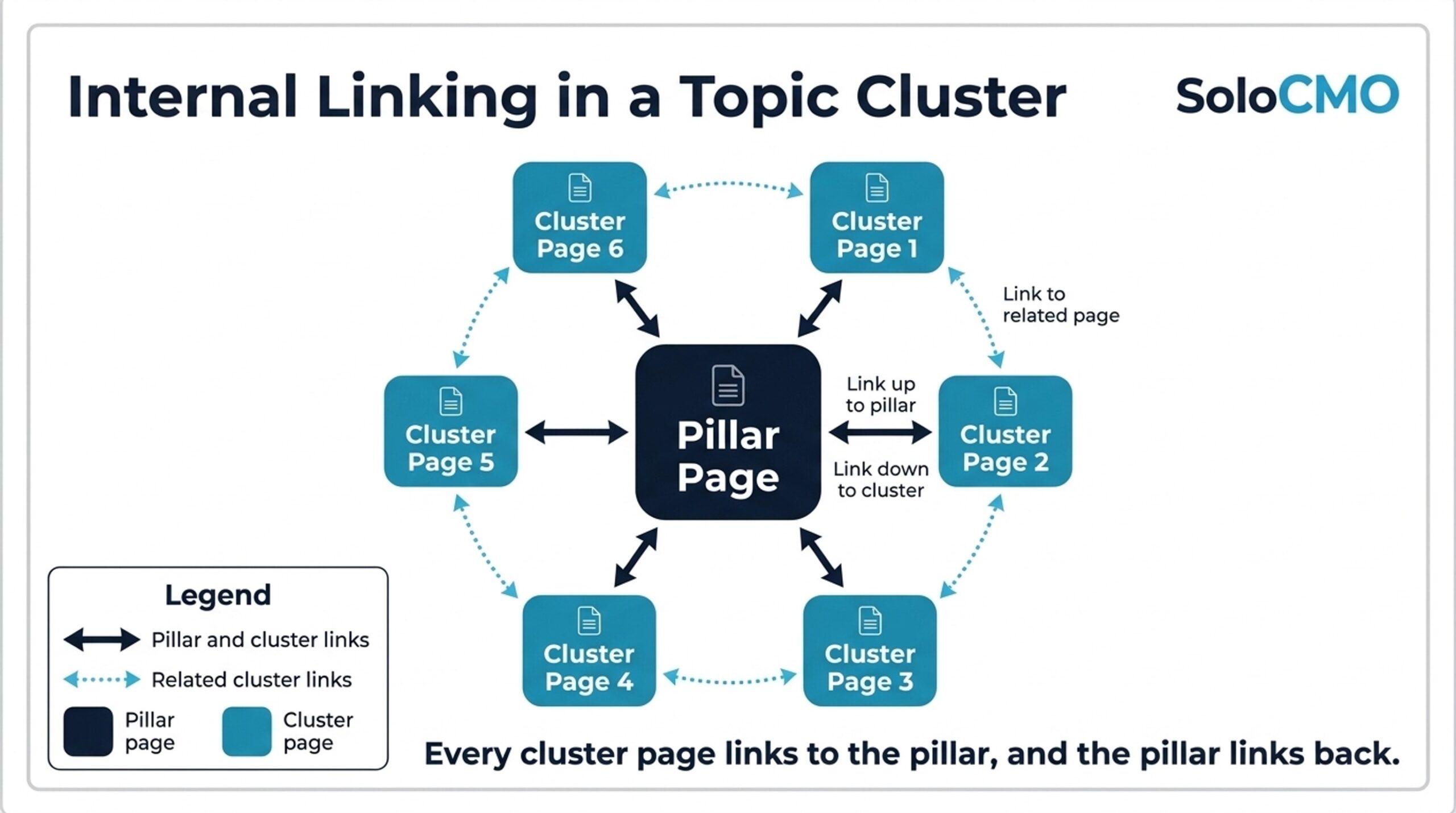
Step 5: How Do You Internally Link a Topic Cluster?
Internal links are what turn a pile of posts into a cluster. Without them, neither search engines nor readers can see how the pages relate.
The three linking rules
Apply these rules to every page and write them into your publishing checklist. The cluster page links to the pillar once, high on the page. The pillar links to every cluster page, added the day that page goes live. Each cluster page also links to two or three related pages where intent overlaps. Written down as a checklist, these three rules make the work easy to hand off or repeat across the topic clusters you build for the next client.
Anchor text and a sample link map
Use descriptive, varied anchors that match the target page’s topic. Avoid “click here,” and avoid repeating one identical exact-match phrase everywhere. A simple text link map looks like this:
- Pillar: customer onboarding software
- Pillar to and from How-to: set up an onboarding checklist
- Pillar to and from Template: onboarding checklist template
- Lateral: How-to checklist to Template checklist, and to Use-case for SaaS trials
Audit for orphan pages with Screaming Frog
After each publishing batch, crawl the site with Screaming Frog and filter for pages with zero inlinks. An orphan cluster page is a broken spoke, so fix it the same day and add the matching pillar link if it was missed.
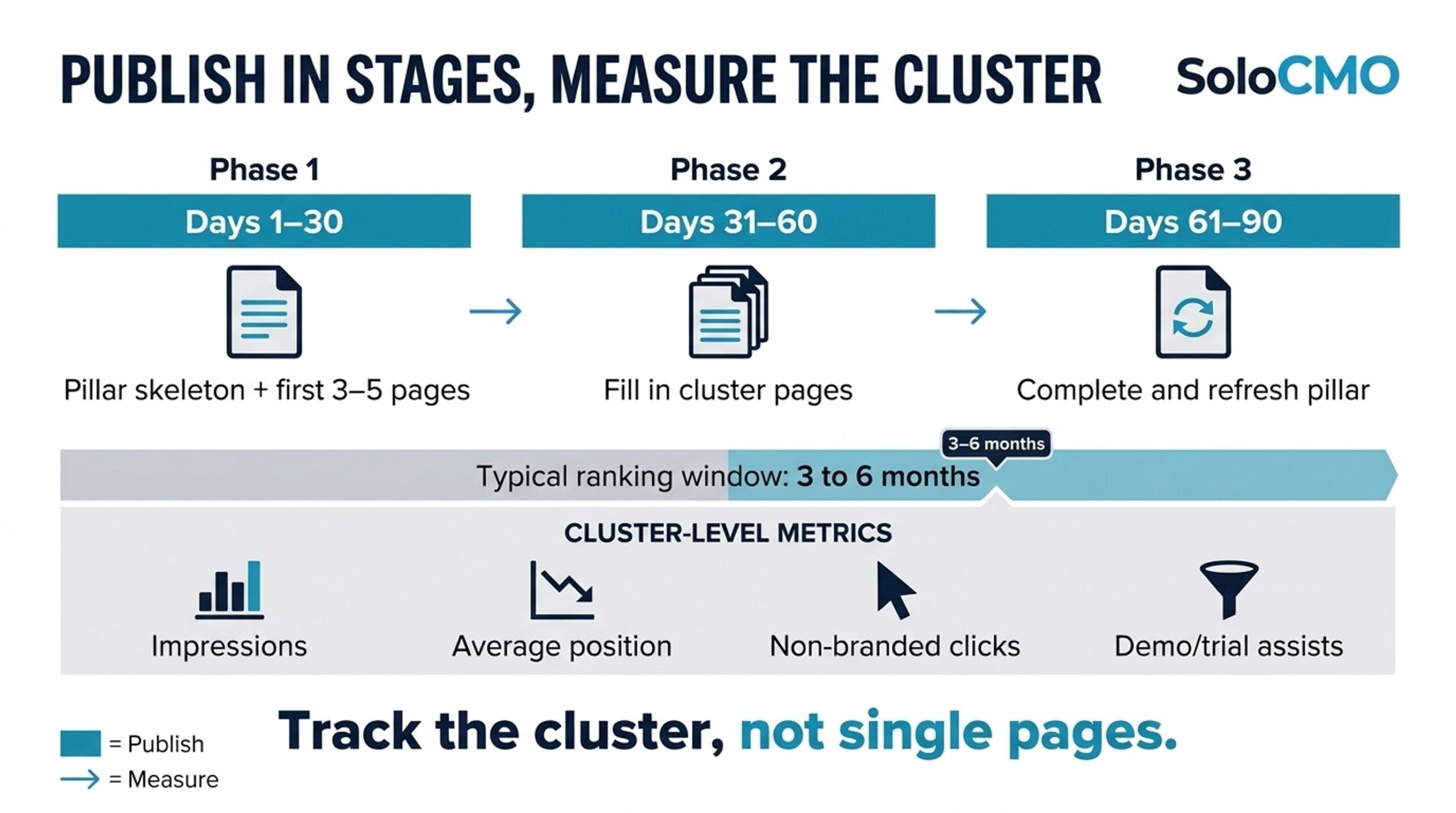
Steps 6-7: Sequence, Publish and Measure a Topic Cluster (and How Long It Takes to Rank)
Publishing everything at once is a mistake. Staging the work lets you learn early and adjust.
Step 6: A 30/60/90-day publishing calendar
In days 1 to 30, publish the pillar skeleton or the first three to five cluster pages, usually the how-to and comparison pages. Days 31 to 60 bring use-case and template pages. Days 61 to 90 are for filling remaining gaps, refreshing early pages, and updating the pillar. Each time a page goes live, update the pillar and any related content that should point to it.
Step 7: Cluster-level metrics and when to refresh or consolidate
Page-level reports hide whether the cluster works as a whole. In Google Search Console, filter by a URL pattern to see impressions, average position, and non-branded clicks across the entire cluster. In Ahrefs, group tracked keywords by cluster. Add demo and trial assists so you can show pipeline influence before rankings mature.
Refresh pages stuck beyond page two after 90 days, and merge pages that share queries. Update the pillar whenever a cluster page is added. A one-page cluster report built from these metrics is also the easiest thing to put in front of a founder at the 90-day mark.
How long does it take for a topic cluster to rank?
Most sources report ranking movement in about 3 to 6 months. Long-tail pages sometimes move sooner, and competitive niches can take 6 to 12 months. Report leading indicators, such as rising impressions, until clicks follow.
Generated 0:38 ago
What Does a Worked Example Look Like?
To make the process concrete, here is a compact cluster for a fictional SaaS category, customer onboarding software. The pillar is “Customer Onboarding Software: A Complete Guide.” The twelve cluster pages below each carry one intent label, and the link map follows the rules from Step 5.
| Cluster page | Intent |
|---|---|
| How to build a customer onboarding checklist | Informational |
| Customer onboarding best practices for SaaS | Informational |
| How to reduce time to first value | Informational |
| Onboarding email sequence examples | Informational |
| Customer onboarding software vs. product tours | Comparison |
| Best customer onboarding software for startups | Comparison |
| Top onboarding tool alternatives | Comparison |
| Customer onboarding checklist template | Template or tool |
| Onboarding timeline calculator | Template or tool |
| Customer onboarding for B2B trials | Use case |
| Onboarding workflow for enterprise accounts | Solution-aware |
| Customer onboarding software pricing guide | Bottom-funnel |
In the link map, the pillar links to all twelve pages and each page links back up. The checklist how-to links sideways to the template and the trial use case, and the two comparison pages link to each other and to the pricing guide.
What Are the Most Common Topic Cluster Mistakes?
Most failed clusters trace back to a short list of avoidable errors, and each one is cheap to prevent if you catch it during planning.
Cannibalization and orphan pages
Two pages chasing the same query split rankings and confuse search engines, so check SERP overlap before approving any new title. Orphan pages, which have no internal links pointing to them, break the cluster structure and are easy to find with a Screaming Frog crawl.
Ignoring product fit, publishing all at once, and neglecting the pillar
A cluster that ignores product fit attracts readers who never become buyers. Publishing everything in one burst removes your chance to learn from early data. Skipping pillar updates leaves the hub out of date as new spokes go live, which weakens the very links that hold the cluster together.

How Can a Team of One Execute a Topic Cluster Faster?
The planning work in Steps 1 to 5 is strategic, and it is yours to own. The slow part is production: briefs, drafts, and campaign assets for every page in the cluster. That is where AI-assisted generation earns its place, by compressing brief-to-draft time so one person can keep a 90-day calendar realistic.
SoloCMO is built for that specific job. It is AI-powered content and campaign generation for one-person marketing teams, designed around ICP, campaign, and content output rather than collaboration features you would never use. If you want to see how a production layer would fit your own cluster, you can get an estimate based on the cluster size you have in mind, with no commitment to anything beyond the numbers.
Conclusion
To create topic clusters that hold up in a founder meeting, run the seven steps in order. Score and pick the pillar, collect keywords, group by SERP overlap, size the cluster, wire the links, publish in stages, and measure at cluster level. Anchor each step to a deliverable, and your content strategy becomes a package you can present rather than a vague plan.
Once the map is signed off, the remaining work is production. If you want a second opinion on scope or timeline before you commit a client’s budget, SoloCMO can walk through your cluster and give you an estimate. Either way, the checklist is simple: pillar scored, keywords grouped, links mapped, calendar set, metrics defined.
FAQ
What is a topic cluster in SEO?
A topic cluster in SEO is a pillar page plus a set of linked cluster pages that cover one subject in depth. The structure signals topical authority to search engines, and because each cluster page targets one specific intent and links back to the pillar, related content stays connected.
How many cluster pages does a pillar page need?
A pillar page needs at least five to seven cluster pages to form a minimum viable cluster, and 8 to 12 is a common working range. Add more only when you find distinct intents, since expanding with synonym pages causes cannibalization, not coverage.
How do you choose a pillar topic for a SaaS blog?
Choose a pillar topic for a SaaS blog by scoring candidates on search volume, business relevance, competitive difficulty, and product fit. Pick the one that supports at least eight subtopics, that you can realistically own, and that you can discuss from real experience. Skip vanity topics.
How long does it take for a topic cluster to rank?
A topic cluster typically shows ranking movement in 3 to 6 months. Long-tail pages may move sooner, while competitive niches can take 6 to 12 months, so track cluster-level impressions and average position in the meantime to make progress visible before clicks arrive.
What is the difference between a pillar page and a cluster page?
A pillar page is a broad overview of a whole subject, while a cluster page goes deep on one specific question. The pillar links to every cluster page, and each cluster page links back to the pillar. Assigning one intent per page prevents overlap.
How do you internally link a topic cluster?
Link every cluster page to the pillar, link the pillar to every cluster page, and add two or three lateral links where intent overlaps. Use descriptive anchor text and audit for orphans with Screaming Frog. Step 5 above covers the full method.
Recent Posts
Content Refresh vs Rewrite: Which Fixes Decaying Blog Posts Faster
A content refresh ships faster, usually in 1 to 3 hours versus 4 to 8 for a rewrite, but a rewrite recovers faster when the decay stems from a search intent mismatch. The rule of thumb is to refresh the post if it still matches what searchers want and most of it is salvageable, and to rewrite it if the
How to Build a Topic Cluster From Scratch for Your SaaS Blog
To build a topic cluster, pick a pillar topic that fits your product, collect subtopic keywords, group them by SERP overlap and intent, size the cluster, link every page to the pillar, publish in stages, then measure at cluster level. That is how to build a topic cluster in a way you can defend to a founder, and our topical authority

Where Leads Drop Off Between Ad Click and Signup
Funnel drop off between click and signup occurs at six points: the ad click, page load, above the fold, form start, form submit, and verification. The most significant leaks usually sit upstream, where the ad promise fails to match the page or where the page loads too slowly on mobile before the form ever appears. If your paid ad campaigns show
Get Smarter About Your Marketing
Practical SEO, AI, content, and marketing strategies you can put to work immediately.
Join the Newsletter