SEO
If you’re asking how many blog articles for topical authority a niche requires, the working answer is roughly 20 to 50 interlinked articles per core topic, with 10 to 15 as a minimum viable cluster for low-competition niches. You’ve likely seen “there is no magic number” on every results page, but there is a defensible range with a method behind it, and anyone running an SEO content strategy for several clients can turn niche competitiveness into an article count you can put straight into a proposal.
Key Takeaways
- The working range is 20 to 50 interlinked articles per core topic, with 10 to 15 as a floor for low-competition niches.
- Five variables move the number: keyword difficulty, competitor coverage depth, existing site authority, content quality and original data, and internal linking.
- You can scope any cluster in six steps, from topic mapping through publishing cadence.
- Promise early movement in 3 to 6 months and competitive wins in 6 to 12, never a fixed ranking date.
- Measure with cluster-level Google Search Console impressions, top-10 keyword share, internal link coverage, and branded search lift.

Is There a Magic Number for Topical Authority, or Is It Topical Coverage?
There is no single magic number, and every SERP on this topic says so. The useful follow-up is the part most pages skip: a range, plus the logic that tells you where a given niche lands inside it. That logic is what you’ll carry into client conversations, so the sections below are built to be reused in your own scoping documents.
Why Coverage Beats Raw Volume
Topical authority describes how completely a site covers a subject and the questions around it. It measures coverage, not a tally of posts. One article can’t prove coverage or expertise, however strong it is, because a search engine has nothing to compare it against. Fifty thin articles that repeat each other prove even less.
Think of a topic as a map and your articles as locations on it. The goal is to cover the map. The count is simply how many locations that takes.
How Entity-Based Search Rewards Complete Coverage
Google no longer matches strings of words alone. Its understanding of entities and their relationships, stored in what is commonly called the Knowledge Graph, lets it judge whether a site addresses a subject in full. Google’s Helpful Content System, described in Google Search Central documentation, favors people-first material that offers original information rather than rewritten summaries.
Koray Tuğberk Gübür’s topical authority methodology puts this into practice with a semantic approach: map every entity, attribute, and question in a topic, along with the keywords that express them, before you count anything. His widely cited formulation treats topical authority as topical coverage plus historical data. E-E-A-T (Experience, Expertise, Authoritativeness, Trustworthiness) is a quality framework rather than a score. Still, complete, first-hand coverage is one of the clearest ways to show it.
Reconciling the 8-15 and 20-50 Benchmarks
Published guides disagree. Some suggest 8 to 15 supporting articles per pillar, which matches HubSpot’s pillar-and-cluster structure. Others recommend 20 to 30, 30 to 50, or even 150 or more. The figures aren’t contradictory. Smaller numbers describe narrow topics or low-competition niches. The 20 to 50 band fits a typical core topic. Larger numbers belong to broad or highly competitive subjects, and the five variables later in this guide tell you which one applies.
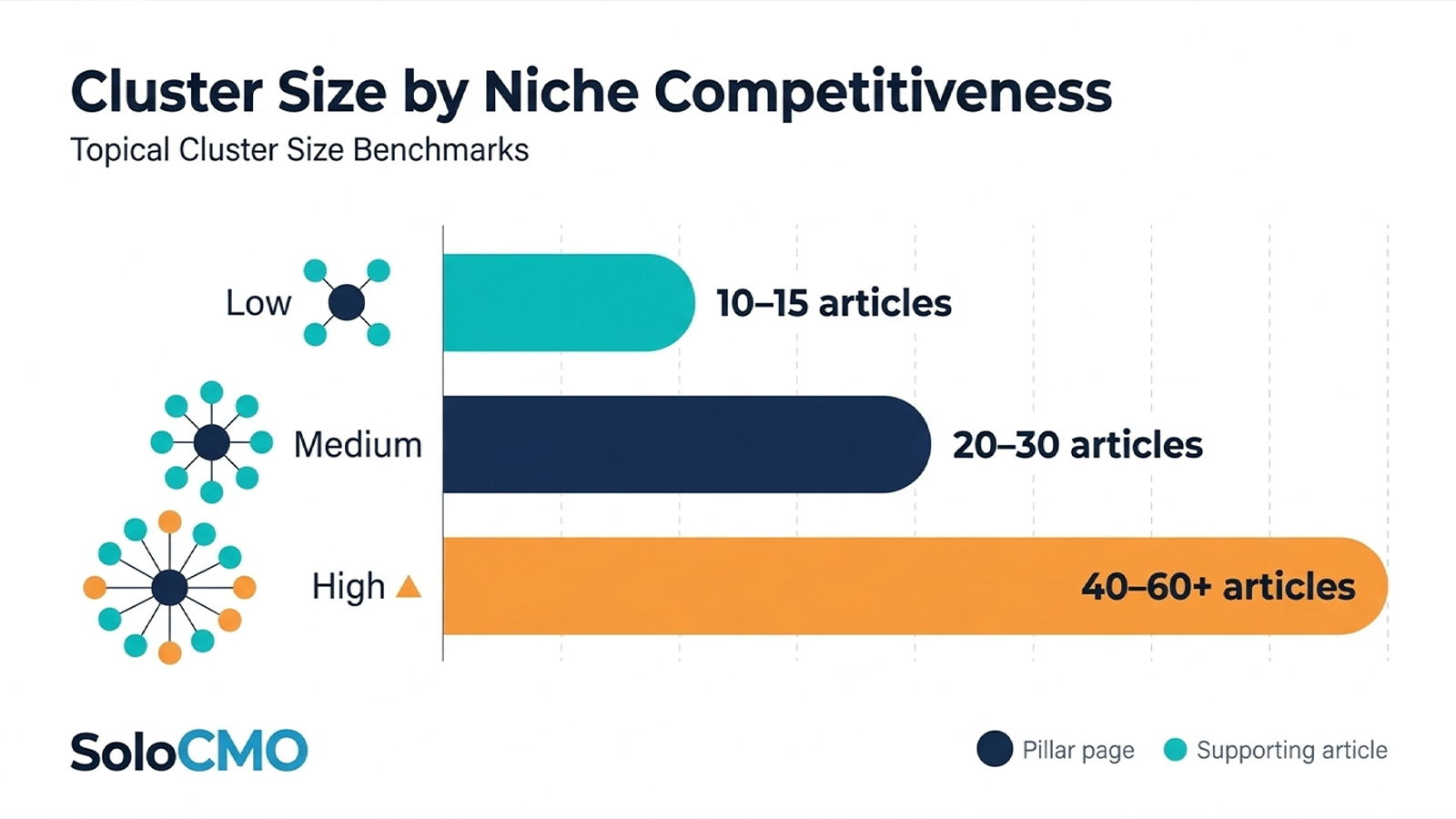
How Many Articles Make a Topical Cluster? (Benchmarks by Niche Competitiveness)
The Direct Answer: A Working Cluster Range
How many blog articles do you need to build topical authority?
A working topical cluster is typically 20 to 50 interlinked articles around one pillar, with 10 to 15 as a floor for low-competition niches. The table below is original synthesis built from the benchmark conflict above and observed SERP coverage. Treat it as directional, not as a Google-published standard.
| Niche competitiveness | Cluster size | Pillar-to-supporting ratio | Typical time to traction |
|---|---|---|---|
| Low | 10-15 articles | 1:9 to 1:14 | About 3 months |
| Medium | 20-35 articles | 1:19 to 1:34 | About 4-6 months |
| High | 40-50+ articles | Multiple pillars, often 1:15 to 1:20 each | About 6-12 months |
A narrow subtopic such as invoice automation for freelancers sits near the low row. A head topic such as email marketing sits near the high row, because the SERP leaders cover dozens of distinct subtopics and the keyword difficulty is correspondingly high. Ahrefs’ Parent Topic feature gives a quick read on this by showing how many different subtopics a top-ranking page captures. Screenshot the table into a proposal if it helps, but remember that scoping, not the table, sets the final number.
Can a Small Site Build Topical Authority With Fewer Than 20 Articles?
Yes, in narrow or low-competition subtopics. Ten to 15 deep, tightly interlinked articles can win when competitors cover the topic thinly. In medium and high competition, coverage gaps remain below 20 articles, and larger sites with more history will usually outrank you. If you’re unsure which row your client sits in, that’s a scoping question rather than a guess, and it’s the first thing worth settling before you quote a retainer.
What Are the 5 Variables That Change Your Article Count?
Start from the benchmark row, then adjust up or down for each variable. This reasoning is what justifies a consultant’s scoping fee, since it can’t be read off a chart.
Competition Variables: Keyword Difficulty and SERP Coverage Depth
Keyword difficulty is the first lever. When the head terms in a cluster carry high difficulty scores in Ahrefs or Semrush, expect a larger cluster and deeper articles. Keyword research also shows whether the cluster’s terms share a single search intent or split between informational, commercial, and transactional. Mixed intent forces different article types and raises the count, which is why SEO planning has to start with intent rather than raw volume.
SERP competitor coverage depth is the second lever. List the subtopics that top-ranking competitors cover, then compare them to your plan. The gap between their coverage and yours defines the necessary content. Semrush’s Keyword Gap tool makes that comparison fast by surfacing keywords competitors rank for that you don’t. That gap list is often the quickest way to justify a bigger cluster to a client.
Site Variables: Existing Authority and Internal Linking
An established domain with related pages needs fewer new articles. It already has baseline credibility and existing links to pass along. A new domain needs more volume and more patience, and it gains visibility more slowly.
Internal linking is the other site variable. A well-linked cluster signals coverage to crawlers and readers, and it’s one of the few ranking signals you control directly. Orphaned articles inflate the count without helping. A smaller, well-connected cluster can outperform a larger, scattered one.
Content Variable: Quality and Original Data
Original research, expert input, and first-hand experience can let fewer articles beat a larger generic cluster. The Helpful Content System rewards that kind of original information. If a client can supply proprietary data or real customer examples, you can often scope toward the lower end of the range. A quick question in the kickoff call, such as “what do you know about your customers that nobody else publishes?”, often surfaces more usable material than a week of desk research.
How Do You Scope a Content Cluster in 6 Steps?
This framework turns the variables above into a priced deliverable. The output is a prioritized topic list with an article count, a pillar-to-supporting split, and a publishing calendar. That becomes the retainer scope.
Steps 1-3: Research and Gap Analysis
The first three steps are research. Together they show how big the topic is, what competitors already cover, and where your gaps sit.
- Step 1: Map the topic. Use Ahrefs Keyword Explorer and Parent Topic, plus Semrush Topic Research, to surface subtopics, questions, and related keywords. This is where keyword research earns its keep.
- Step 2: Audit competitor coverage. Run Semrush Keyword Gap and Ahrefs Site Explorer against two or three SERP leaders to see which subtopics they own.
- Step 3: Identify subtopic and question gaps. Collect the queries your audience actually asks, drawing on People Also Ask boxes, forums, and sales calls.
Steps 4-6: Roles, Priorities and Cadence
The last three steps turn research into a plan you can price and schedule. Step 4 assigns roles: give broad head topics to pillar pages and specific subtopics and questions to supporting articles. Step 5 sets priorities: start with low-difficulty, high-intent topics so the cluster earns early traction. Step 6 sets a publishing cadence that matches real capacity, such as 4 to 8 articles per month for a solo operator working across several clients.
If you’d rather not build this scoping sheet from scratch each time, the topical authority planner walks through the same steps in a reusable format.

What Does a 1 Pillar + 25 Supporting Article Architecture Look Like?
The model below is an original worked example for a medium-competition topic. It follows the pillar-and-cluster approach HubSpot popularized, which grew out of its own blog reorganization.
One pillar page sits at the center as a broad, thorough guide to the topic. Around it sit 25 supporting articles, grouped into five to eight subtopic clusters. A sample breakdown: 6 definitional articles, 8 how-tos, 5 comparisons, 4 templates or tools, and 2 data or example posts. That mix covers the intents a searcher moves through, from learning to deciding.
How Many Pillar Pages and Supporting Articles Do I Need Per Topic?
Plan on one pillar per core topic with 15 to 35 supporting articles. Add a second pillar only when the topic splits into distinct intent areas that a single guide can’t serve well. Building authority this way keeps every supporting article attached to a clear parent.
Linking Rules That Make the Cluster Work
Linking is where clusters succeed or quietly fail. Five rules keep the structure intact:
- Every supporting article links up to the pillar.
- The pillar links down to every supporting article.
- Each supporting article links sideways to two or three close siblings.
- Anchor text is descriptive, never “click here.”
- No article is orphaned, which you can verify with Site Explorer or a crawl.
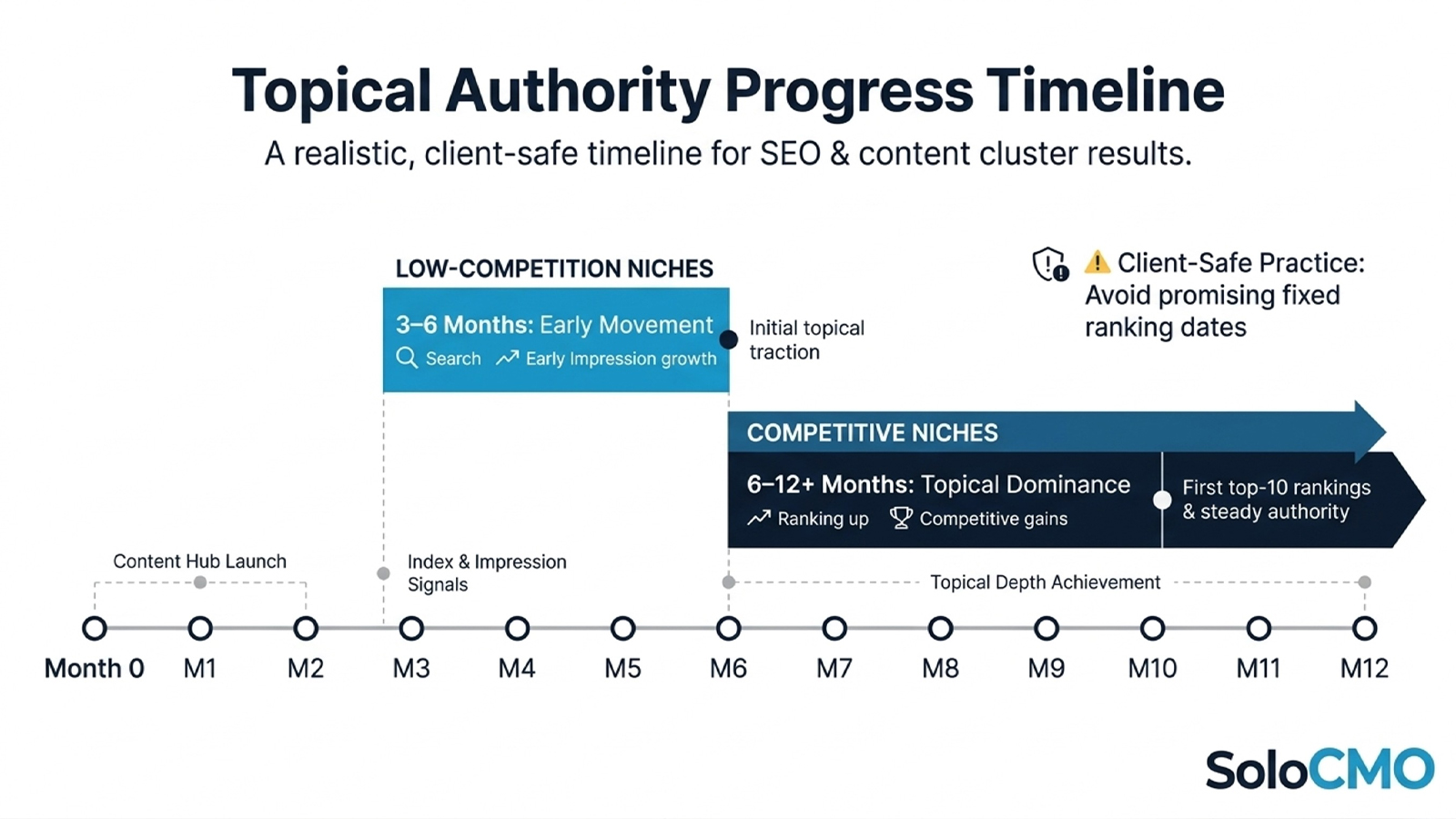
How Long Does It Take to Build Topical Authority? (What to Promise Clients)
Plan on 3 to 6 months for early movement and 6 to 12 months for competitive niches. Ahrefs’ own timeline guidance describes months 1 to 3 as a coverage-building phase, months 4 to 6 as the start of ranking improvements, and months 6 to 12 as compounding. Site age and existing authority shift every phase.
Is Topical Authority a Google Ranking Factor?
Not as a published score. Google’s John Mueller has said not to worry about topical authority as a metric, as reported by Search Engine Journal. Yet the 2024 Content Warehouse leak listed site-level focus fields such as siteFocusScore and siteRadius, which suggest Google evaluates how concentrated a site is on a subject. The honest position: there’s no single dial labeled topical authority, but coverage, relevance, quality, and linking signals produce the same effect. Don’t sell it as a lever you can pull.
What to Promise Clients and What to Avoid Promising
Promise what you control: a coverage plan, a publishing cadence, and monthly reporting on leading indicators. A line such as “we commit to publishing X articles and reporting these indicators each month” protects you. Avoid fixed ranking positions, traffic numbers, or dates.
Timing is also uneven. Gains and losses often land at core update rollouts rather than arriving gradually. Google Search Central documents these updates, and content marketing and SEO results can jump or dip around them. Visibility reports from your analytics are your proof while rankings catch up.
How Can a Team of One Produce 20-50 Articles?
Volume is the practical fear. A 25-article cluster across five clients looks impossible if each article is a standalone project. It becomes manageable once you change how the work is organized, which is why many solo marketers and consultants now plan production in batches.
Batching and AI-Assisted Drafting With Human Review
Batch by cluster. Research, outline, draft, and publish an entire subtopic group in one pass, so context, sources, and internal links carry from one article to the next. Use AI for first drafts, then add what a model can’t: first-hand experience, original data, and fact-checking. That human review supports E-E-A-T and keeps the cluster from turning into thin content.
Before publishing, run on-page optimization checks in Clearscope or Surfer SEO to compare coverage against what competitors include, down to the keywords and terms they use. These SEO checks catch missing subtopics before an article goes live. A sample capacity plan: 6 to 8 articles per week in batches could yield a 25-article cluster in roughly 4 to 6 weeks for one client. Speed depends on review discipline, so treat that figure as an estimate, not a promise.
Reusing ICP and Campaign Inputs
Every article should start from a defined audience and message, not a blank page. Reuse the client’s ideal customer profile, campaign angles, and objection list across the whole cluster. That’s the logic behind SoloCMO, which is built around output multiplication for a team of one: ICPs, campaigns, and content generation, with no collaboration or seat-based features designed for larger teams. The tool you pick matters less than the habit of reusing inputs and reviewing output before it ships.
How Do You Measure Topical Authority (and Avoid Common Mistakes)?
Topical authority isn’t a native metric in Google Search Console or Google Analytics. Define a proxy dashboard and report it monthly against a baseline captured before publishing begins. Capturing that baseline early is also what lets you show a client real movement later, rather than asking them to take your word for it.
Cluster-Level KPIs That Prove Progress
Segment Search Console by URL folder or a regex filter to isolate the cluster. Then track these indicators:
- Search Console impressions across all cluster URLs, since impression trends lead clicks.
- Share of topic keywords ranking in the top 10.
- Internal link coverage, meaning the share of cluster pages with the required links.
- Branded search lift, a sign that visibility is turning into recognition.
- Google Analytics organic sessions to the cluster.
Review the cluster at 90 days, then prune or merge articles that cannibalize each other, especially those competing for the same keywords.
Common Mistakes: Disconnected Posts, Thin Padding and Skipped Pruning
The first mistake is publishing a disconnected blog post with no pillar, no siblings, and no plan. It may rank for a long-tail query, but it adds little to coverage. The second is padding: writing filler articles to hit a count, which conflicts with the quality guidance in Google Search Central and the Helpful Content System. The third is skipping pruning. Overlapping or stale pages dilute the cluster, so every content update cycle should include merging and redirecting them.
Conclusion
The answer to how many articles you need is a range with a method behind it: 20 to 50 interlinked articles per core topic, 10 to 15 for low-competition niches, adjusted by five variables and scoped in six steps. Once you have that scope, you have the real deliverable. It anchors pricing, sets honest timelines, and keeps your content strategy and content marketing proposals defensible in front of any client.
You now have the range, the variables, and the method, so the next move is applying them to a real client niche. If you’d like a second set of eyes on the numbers, Get Estimate and we’ll scope that client’s cluster size and production cost together, with no commitment attached.
Frequently Asked Questions About How Many Blog Articles You Need
How many articles make a topical cluster?
A topical cluster typically contains 20 to 50 interlinked articles around one pillar page. Low-competition niches can work with 10 to 15 deep articles, while highly competitive subjects may need more than 50 across several pillars. The exact number depends on how much of the topic competitors already cover.
How long does it take to build topical authority?
Building topical authority usually takes 3 to 6 months for early movement and 6 to 12 months in competitive niches. Early signs include rising impressions and long-tail rankings. Site age, existing authority, and publishing consistency shift these timelines, so avoid promising fixed dates.
Is topical authority a Google ranking factor?
Google does not publish a topical authority score, and John Mueller has advised against worrying about it as a metric. Leaked documentation does reference site-level topic focus, so coverage and relevance clearly matter. Treat topical authority as an outcome of quality coverage, not a switch.
How many pillar pages and supporting articles do I need per topic?
Most topics need one pillar page supported by 15 to 35 articles. Add a second pillar only when a topic splits into distinct intent areas that one guide cannot serve. Each supporting article should link to the pillar and to two or three close siblings.
Can a small site build topical authority with fewer than 20 articles?
A small site can build topical authority with fewer than 20 articles in narrow or low-competition subtopics. Ten to 15 tightly interlinked, in-depth articles can outrank thinner competitors. In medium or high competition, coverage gaps remain below 20, and a niche-specific estimate is the safer way to scope it.
How do you measure topical authority?
Measure topical authority through proxies, because no native metric exists. Track Google Search Console impressions across the cluster, the share of topic keywords ranking in the top 10, internal link coverage, and branded search lift. Compare each against a pre-publishing baseline and report monthly.
Recent Posts
Content Refresh vs Rewrite: Which Fixes Decaying Blog Posts Faster
A content refresh ships faster, usually in 1 to 3 hours versus 4 to 8 for a rewrite, but a rewrite recovers faster when the decay stems from a search intent mismatch. The rule of thumb is to refresh the post if it still matches what searchers want and most of it is salvageable, and to rewrite it if the
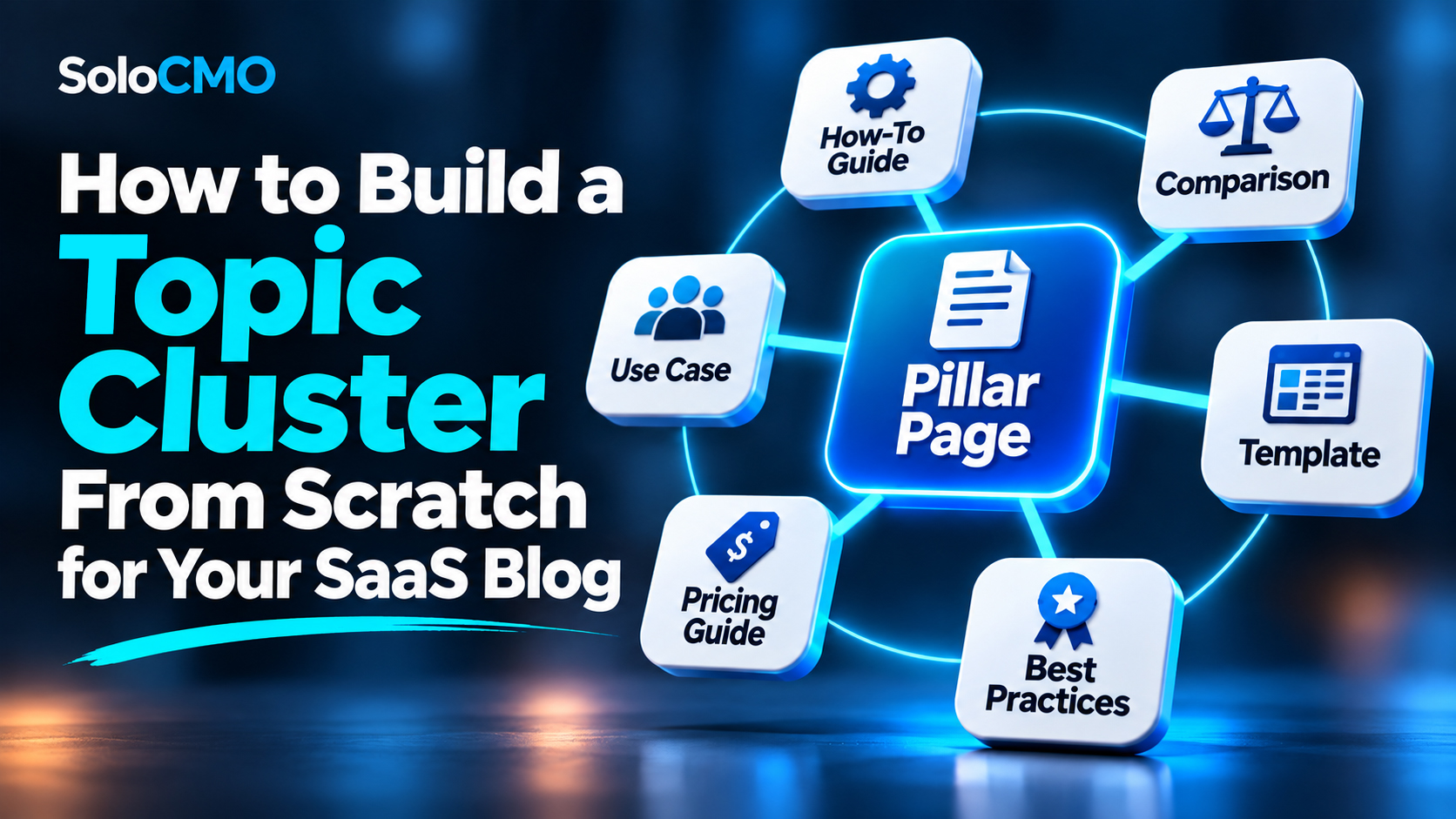
How to Build a Topic Cluster From Scratch for Your SaaS Blog
To build a topic cluster, pick a pillar topic that fits your product, collect subtopic keywords, group them by SERP overlap and intent, size the cluster, link every page to the pillar, publish in stages, then measure at cluster level. That is how to build a topic cluster in a way you can defend to a founder, and our topical authority

Where Leads Drop Off Between Ad Click and Signup
Funnel drop off between click and signup occurs at six points: the ad click, page load, above the fold, form start, form submit, and verification. The most significant leaks usually sit upstream, where the ad promise fails to match the page or where the page loads too slowly on mobile before the form ever appears. If your paid ad campaigns show
Get Smarter About Your Marketing
Practical SEO, AI, content, and marketing strategies you can put to work immediately.
Join the Newsletter