Content Generation
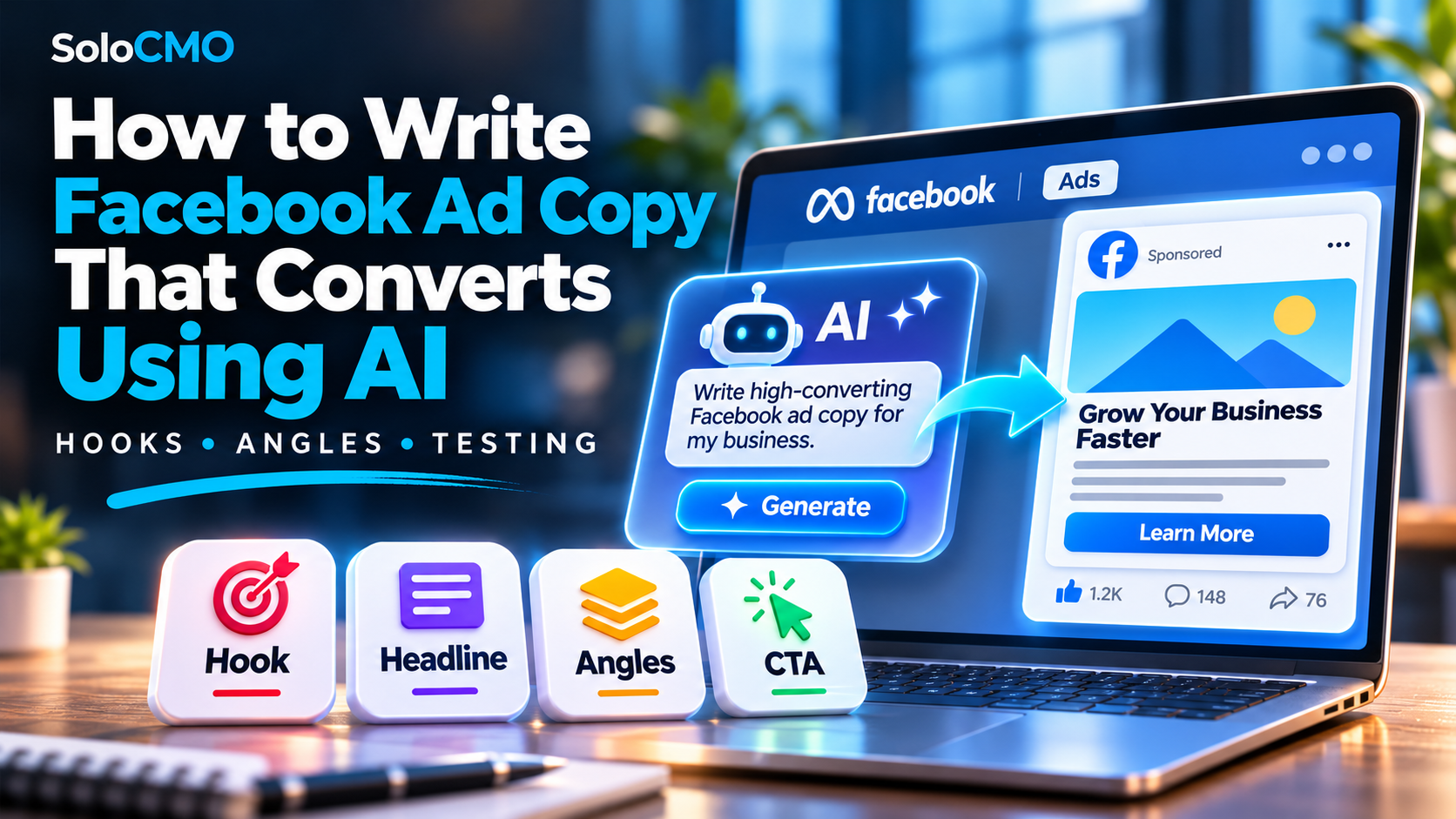
If you want an AI facebook ad copy generator how to guide that works, here it is: define your ideal customer and a one-sentence offer, feed the AI real customer language and a proven framework, generate and edit several variations, then test them in Meta Ads Manager. This AI-powered Meta ads workflow is repeatable and fixable, because generic output is an input problem, not a tool problem. You already use ChatGPT and you have seen the bland, interchangeable lines it returns when the prompt is thin.
Key Takeaways
- Define one ICP and a one-sentence offer before you open any AI tool.
- Mine reviews, support tickets, sales calls, and the Facebook Ad Library for real customer language.
- Build the prompt with role, ICP, offer, framework (AIDA, PAS, or BAB), tone, character limits, and constraints, then use AI to draft several angles.
- Edit by hand for specificity, a strong hook in the first 125 characters, and claims you can back up.
- Test 3-5 copy variations per round in one ad set, read CTR, CPC, CPA, and ROAS, and check Meta’s policies first so your copy that converts also gets approved.
Why Does AI Ad Copy Sound Generic, and How Do You Fix It With the Right Inputs?
Most marketers blame the model, but the model is rarely the problem. Generic prompts produce generic output, and a solo marketer can fix that with about an hour of preparation. If you are the person running paid social alongside email, content, and reporting, that hour is the best trade you can make.
Why Generic Prompts Produce Generic Copy
Type “write a Facebook ad for my product” and the model averages the whole internet. Three things go missing. Without an ICP, the AI has to guess who it is talking to. Without real customer language, it invents a voice nobody actually uses. Without offer clarity, it falls back on feature lists. That is why AI ad copy so often reads like a template, and the fix is better input, not a different tool. Ads that sound like everyone else’s rarely earn the click.
Step 1: Define Your ICP and One-Sentence Offer
Write down who you are talking to and what you promise, using this fill-in-the-blank template:
We help [specific audience] who [pain or trigger] get [specific outcome] in [timeframe] without [main objection].
Here is a filled-in example: We help solo marketing managers at small businesses who are buried in campaign work get a full set of tested ads in one sitting without hiring a copywriter. If you want help building this profile, see our guide to ICP generation. Keep the sentence short enough to say out loud. If you stumble reading it, the AI will stumble using it.
Step 2: Gather Real Customer Language
Real phrases outperform invented ones, so collect them before you prompt. Good sources include:
- Product reviews, yours and your competitors’
- Support tickets and chat transcripts
- Sales call notes and objections
- Facebook Ad Library results, where long-running competitor ads hint at what works
Copy exact phrases, not summaries. The AI will match your brand voice more closely when it can see how customers actually talk. When you ask the AI to generate copy from those exact phrases, the result sounds like your buyers rather than a template. Ten to fifteen strong phrases is plenty, and you can pull them in under an hour.

What Is the Best Prompt and Copywriting Formula (AIDA, PAS, BAB) for Facebook Ad Copy?
With your inputs ready, you can ask the AI to write copy that fits your customer. The same prompt works in ChatGPT or Claude.
Step 3: Build the Prompt
Paste this template and fill each bracket:
Role: You are a direct-response copywriter for Facebook and Instagram ads.
ICP: [your ICP sentence]
Offer: [your one-sentence offer]
Customer language: [paste 10-15 real phrases]
Framework: [AIDA, PAS, or BAB]
Tone: [match your brand voice, e.g., plain, warm, direct]
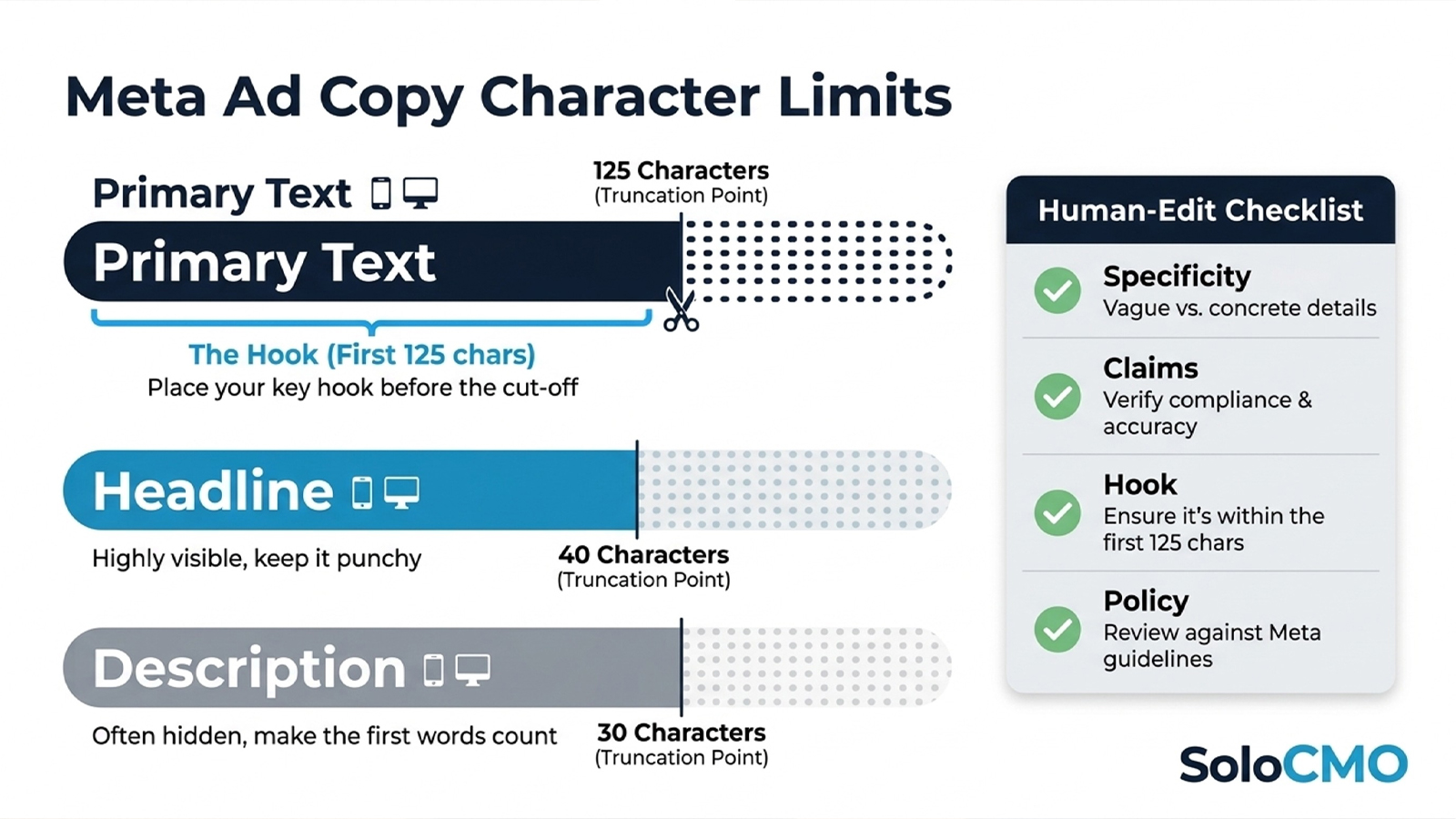
Limits: primary text under 125 characters for the hook, headline under 40, description under 30.
Constraints: Write 5 distinct angles, not rewordings. No unverifiable claims. Do not imply you know the reader’s personal traits.
Ask for angles first, then full versions of the best ones. When you feed the model your own customer phrases, the drafts stop sounding like a template and start sounding like your buyers. In practice, the AI generates sharper angles when the framework and constraints are spelled out in the prompt. Save the filled-in version so you can reuse it next month and only swap the offer.
Step 4: Apply AIDA, PAS, or BAB
These are classic direct-response structures, not Meta inventions. Each one gets a quick before and after here.
AIDA (Attention, Interest, Desire, Action). Before: “Our software saves time.” After: “Campaign day shouldn’t take all week. See how one afternoon can do it.”
PAS (Problem, Agitate, Solution). Before: “Try our ad tool.” After: “Writing five ad versions takes hours. Skip the blank page and start with drafts built from your own customer words.”
BAB (Before, After, Bridge). Before: “Better ads are here.” After: “Before: one tired ad running for a month. After: fresh tests every week. Bridge: a repeatable prompt.”
| Framework | Best for | Audience stage |
|---|---|---|
| AIDA | Considered purchases | Problem-aware, comparing options |
| PAS | Clear, painful problems | Cold audiences who feel the pain |
| BAB | Transformation offers | Warm audiences who want a result |
Test which ones perform best for your offer rather than guessing.
What Is the Best Formula for Facebook Ad Copy?
No single formula wins everywhere. PAS suits cold audiences with a clear pain, BAB suits offers built on change, and AIDA suits longer buying decisions. Run all three as separate angles and let the data choose.
How Long Should Meta Ad Copy Be, and How Do You Edit AI Variations Before Launch?
Draft quality matters, but fit matters just as much. Text that gets cut off on a phone loses its hook.
Step 5: Generate Variations Within Meta’s Character Limits
Meta recommends lengths rather than hard-capping most fields. The figures below are widely reported, so confirm them in the Ads Manager preview. Placements on Facebook and Instagram can truncate text differently.
| Field | Visible before truncation | Typical cap |
|---|---|---|
| Primary text | About 125 characters before “See more” | Longer allowed |
| Headline | About 27 characters on some placements | About 40 |
| Description | 25-30 characters | Often hidden |
Ask the AI to write each field, using the same angle at different lengths, and keep the hook first in every one. You can also generate ad variations for each placement from a single angle so the hook survives truncation. Longer copy works for warm or considered offers, but only if the opening line earns the click. If you are not sure how a line will look, the Ads Manager preview is a quick, free check.
Human-Edit Checklist Before You Launch
AI drafts, but you decide. Run every line of AI-generated copy through this check:
- Specificity: swap vague claims for a number, a name, or a detail
- Hook: the point lands within the first 125 characters
- Claims: anything measurable can be backed up
- Brand voice: it sounds like your company, not a robot
- Fresh angle: no two variations are just reworded twins
Meta Ad Policy Notes: Personal Attributes and Unsubstantiated Claims
Meta’s Advertising Standards bar ads that assert or imply personal attributes. A line like “Are you struggling with debt?” can trigger a rejection, so rewrite it as “Money tools for people who want a clearer budget.” Also avoid promises you cannot prove. AI cannot judge compliance, so that job falls to you. A quick read-through against Meta’s policy page before you publish can save you a rejected ad and a lost day.
How Many Copy Variations Should You Test in Meta Ads Manager, and Which Tool Saves the Most Time?
Testing turns drafts into data. It works best when it stays small enough that your budget can actually teach you something.
Step 6: How Many Copy Variations Should You Test on Facebook?
Run 3-5 distinct copy variations per round inside one ad set, and keep each ad set to about six ads or fewer so spend is not spread thin. Change one variable, such as the angle, and hold the creative constant. That way you know what moved results, and any lift ties back to a single copy variation.
Reading CTR, CPC, CPA, and ROAS, and When to Refresh
CTR tells you whether the hook works, and CPC shows auction efficiency. CPA and ROAS reveal business outcomes, but you can trust them only if your Meta Pixel and Conversions API are sending clean data. Judge ad performance on conversions, not early clicks alone. Call a winner after enough conversions and a stable stretch, then build the next round from its angle. For smaller accounts, plan to refresh your ad creatives every 14-21 days, or sooner when CTR falls as frequency rises.
What Is the Best AI Tool for Writing Facebook Ads?
Your choice depends on how much prep time you can spare. The times below are illustrative estimates, not measured results.
| Workflow | Estimated time per meta campaign | Notes |
|---|---|---|
| Manual ChatGPT or Claude prompting | 3-5 hours | Flexible, but you build every input |
| Jasper or Copy.ai | 2-4 hours | Templates help, context is still manual |
| Meta Advantage+ text options | 1-2 hours | Works from the inputs you supply |
| SoloCMO | Under 1 hour | ICP and campaign generation built in |
SoloCMO is designed for a team of one, with no seats or collaboration features to manage. It builds the ICP and campaign context for you, so more of your time goes to editing and testing across your ad campaigns. If you would like to see how that compares with your current process, our Meta ads page walks through it.
Conclusion
Strong copy comes from one loop, six moves: define the ICP and offer, gather customer language, build the prompt, apply a framework, edit for fit and policy, then test and refresh. None of it needs a copywriter or a media buyer, only a process you run the same way each time. AI drafts, and your knowledge of the customer decides whether the ad earns clicks.
Curious what this could save you? You can get an estimate of how many hours and dollars an AI-powered campaign workflow built for a team of one could reclaim. There is no commitment, and it is a handy number to have the next time someone asks where your week went.
FAQ
Can AI write Facebook ad copy that converts?
AI can draft Facebook ad copy that converts when you give it a defined ICP, real customer language, and a framework, although a human still edits and tests the output. Without that process, most solo marketers get generic results.
What is the best AI tool for writing Facebook ads?
The best AI tool depends on your volume and prep time. ChatGPT and Claude are flexible but manual, Jasper and Copy.ai add templates, and Meta’s Advantage+ generates text inside Ads Manager. A purpose-built tool like SoloCMO bundles ICP and campaign generation for one person.
What is the best prompt for writing Facebook ad copy with ChatGPT?
The best prompt names seven parts: role, ICP, offer, framework, tone, character limits, and constraints. Pasted customer language is what separates a strong prompt from a generic one, and gathering that language is the step a structured process handles.
What is the best formula for Facebook ad copy (AIDA, PAS, BAB)?
No formula wins every time. PAS suits cold audiences with a clear pain, BAB suits transformation offers, and AIDA suits considered purchases. Running all three as separate angles is the fastest route to a winner.
How long should Facebook ad copy be in 2026?
Primary text shows about 125 characters before “See more,” headlines run near 40 characters with about 27 visible, and descriptions run 25-30. Front-load the hook and verify previews for each placement before launch.
How many ad copy variations should I test on Facebook?
Test 3-5 distinct ad variations per round, with about six ads at most per ad set. Make each one a different angle rather than a rewording, since a repeatable generation process makes a 14-21 day refresh realistic.
Are AI ads allowed on Facebook?
AI-generated ads are allowed when they follow Meta’s Advertising Standards, including the rules on personal attributes and unsubstantiated claims. A human review step is essential because AI cannot judge policy compliance.
Why does AI-generated ad copy sound generic?
AI-generated ad copy sounds generic when the prompt lacks an ICP, real customer language, and a clear offer. Fixing those inputs, not switching models, is the real lever.
Recent Posts
Content Refresh vs Rewrite: Which Fixes Decaying Blog Posts Faster
A content refresh ships faster, usually in 1 to 3 hours versus 4 to 8 for a rewrite, but a rewrite recovers faster when the decay stems from a search intent mismatch. The rule of thumb is to refresh the post if it still matches what searchers want and most of it is salvageable, and to rewrite it if the
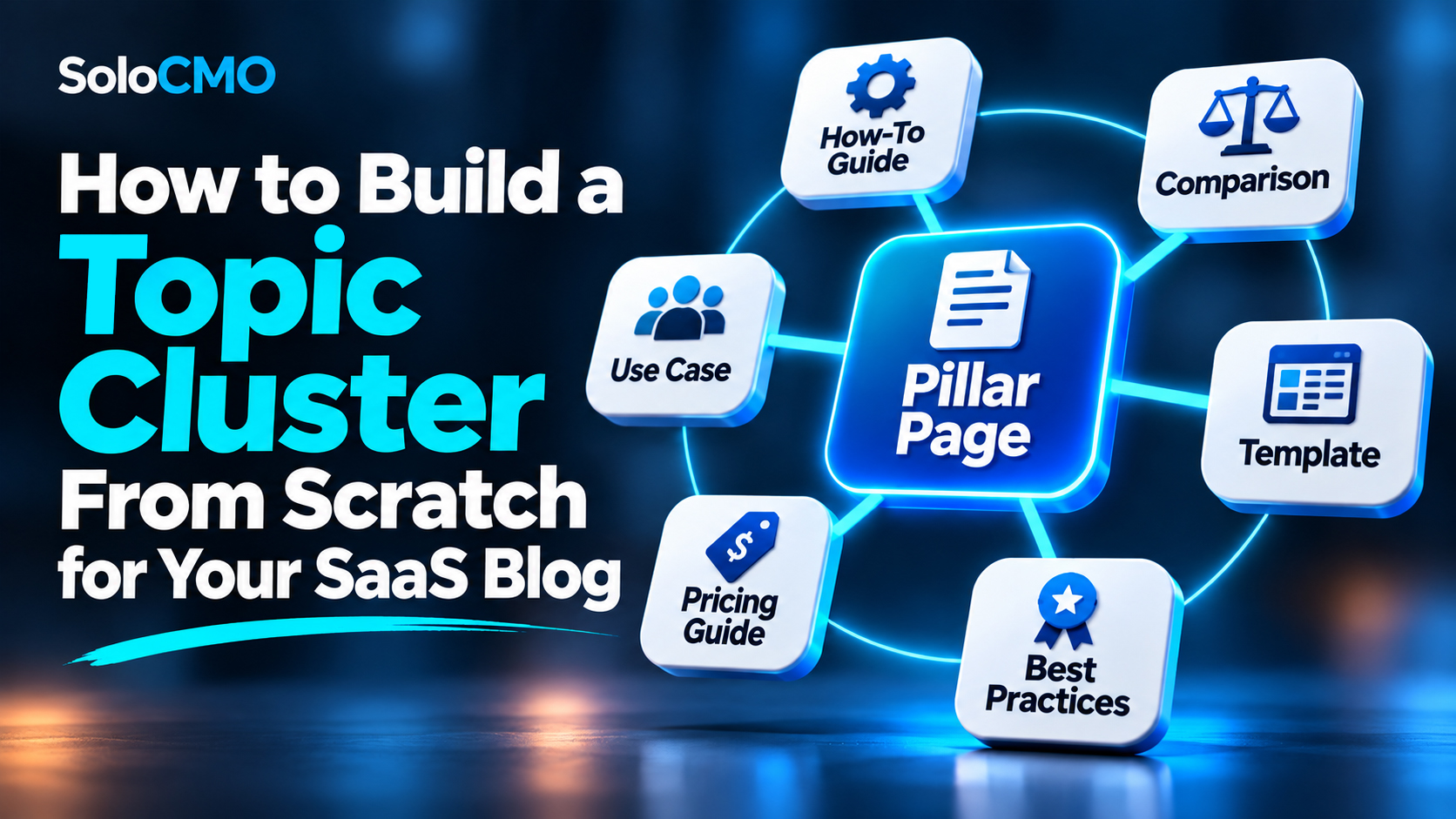
How to Build a Topic Cluster From Scratch for Your SaaS Blog
To build a topic cluster, pick a pillar topic that fits your product, collect subtopic keywords, group them by SERP overlap and intent, size the cluster, link every page to the pillar, publish in stages, then measure at cluster level. That is how to build a topic cluster in a way you can defend to a founder, and our topical authority
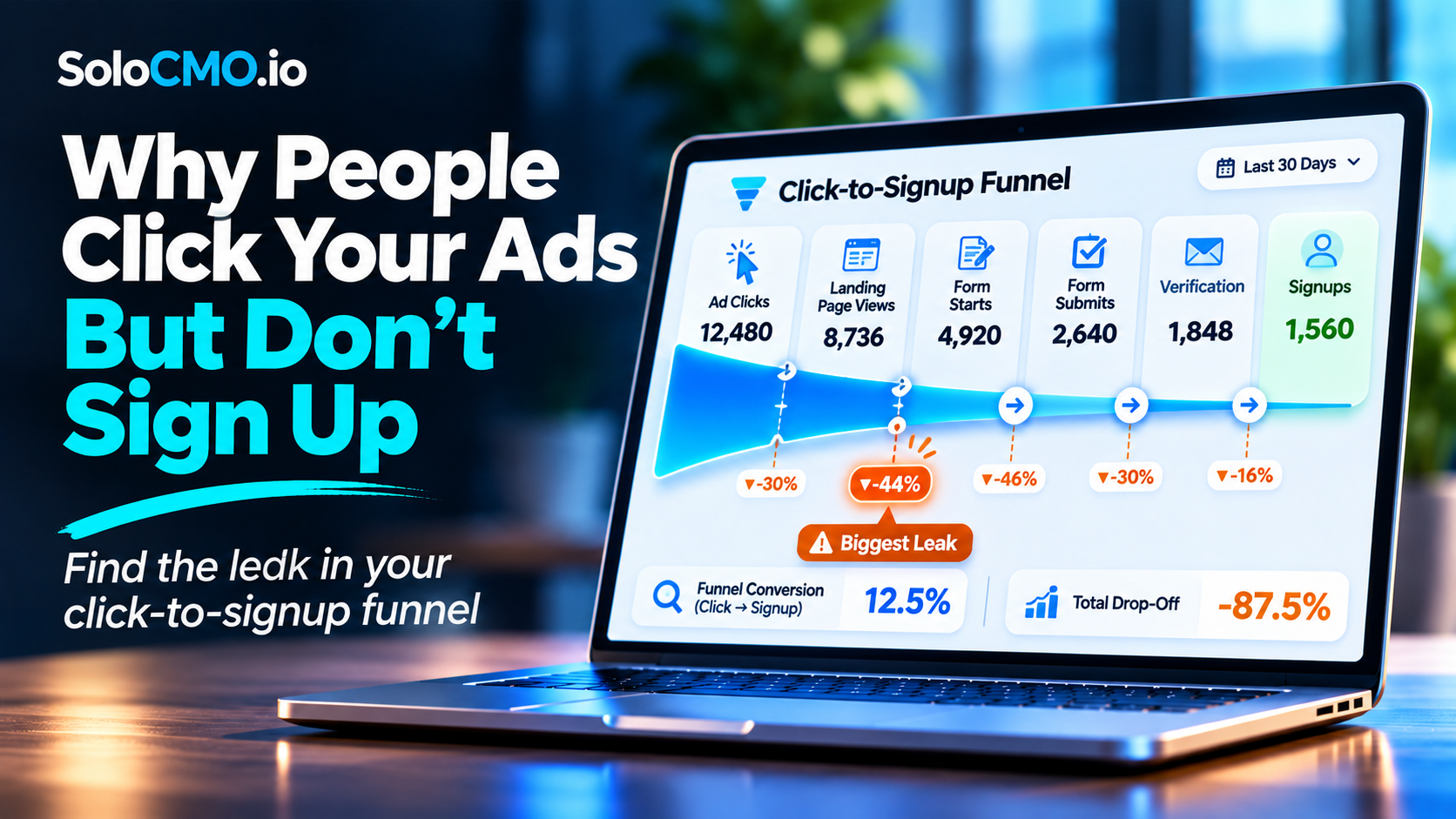
Where Leads Drop Off Between Ad Click and Signup
Funnel drop off between click and signup occurs at six points: the ad click, page load, above the fold, form start, form submit, and verification. The most significant leaks usually sit upstream, where the ad promise fails to match the page or where the page loads too slowly on mobile before the form ever appears. If your paid ad campaigns show
Get Smarter About Your Marketing
Practical SEO, AI, content, and marketing strategies you can put to work immediately.
Join the Newsletter