Local SEO
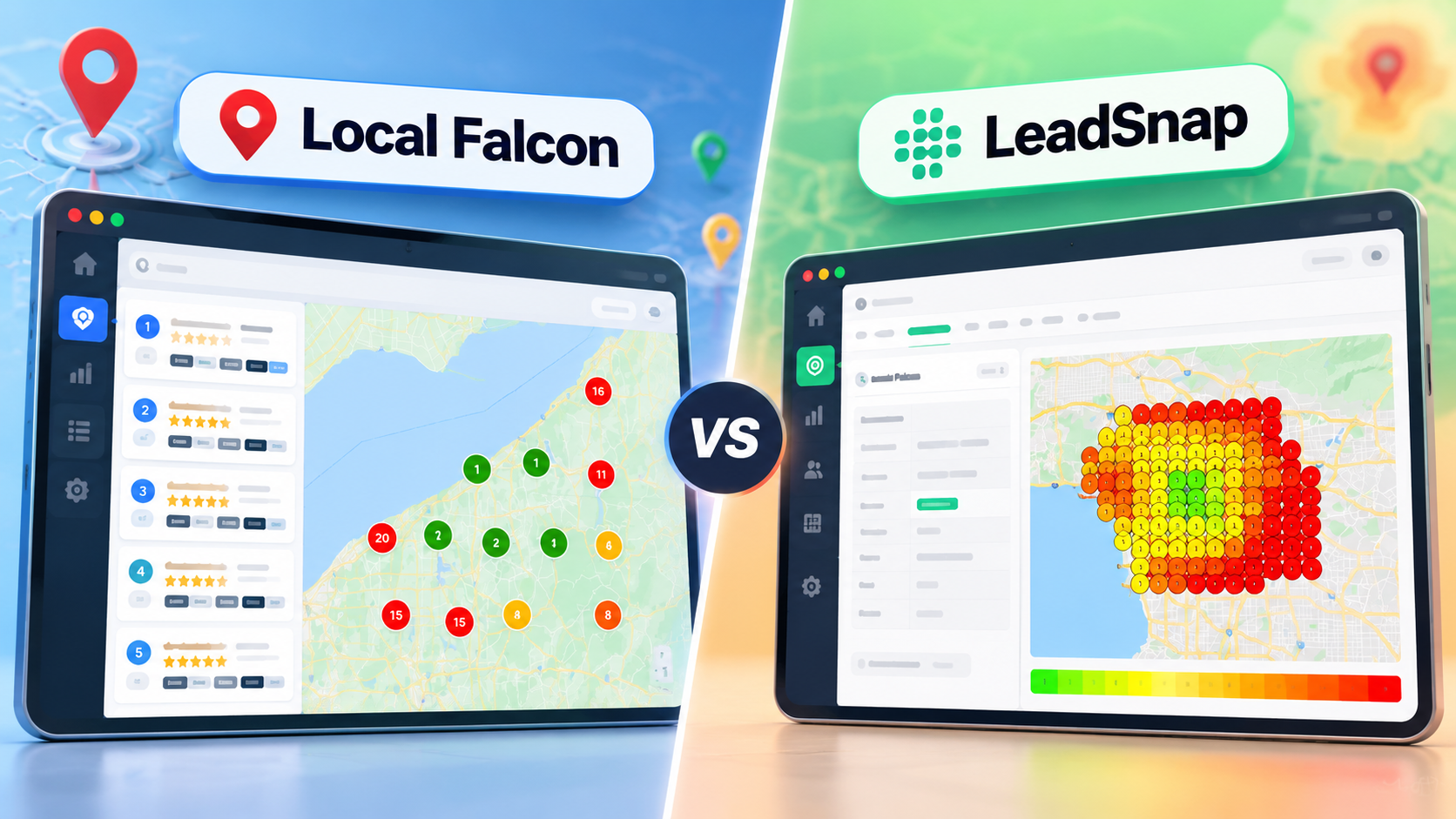
Local Falcon vs. LeadSnap: Which Local SEO Tool Is Better for Agencies?
You’ve clearly already done the homework, so no beginner’s explainer here. If you’ve narrowed things down to Local Falcon vs. LeadSnap, the real question isn’t which tool is objectively better, it’s which one fits how you actually deliver local SEO across every client account you manage, without a team behind you to fill the gaps. Both tools are legitimate. Both have real gaps. Let’s look at where each one actually earns its keep.
Key Takeaways
- Local Falcon is a specialist geo-grid rank tracker. LeadSnap is an all-in-one local SEO platform bundling citations, GBP management, and reporting. The real decision is depth versus breadth.
- Local Falcon pricing runs roughly $30 to $300 a month based on scan volume, while LeadSnap’s agency tiers run $97 to $400+ a month with flatter, more predictable pricing at scale.
- A 5×5 geo-grid scan on Local Falcon costs 25 credits. This means scan frequency and grid size, not just keyword count, drive your monthly bill.
- Neither tool fully solves the problem of turning raw rank data into a story a non-technical client understands. Both need some manual work layered on top.
- Standardizing one tool across every account comes down to which workflow gaps you’re willing to fill yourself versus automate.
Grid/Map Rank Tracking: Where Local Falcon Still Wins
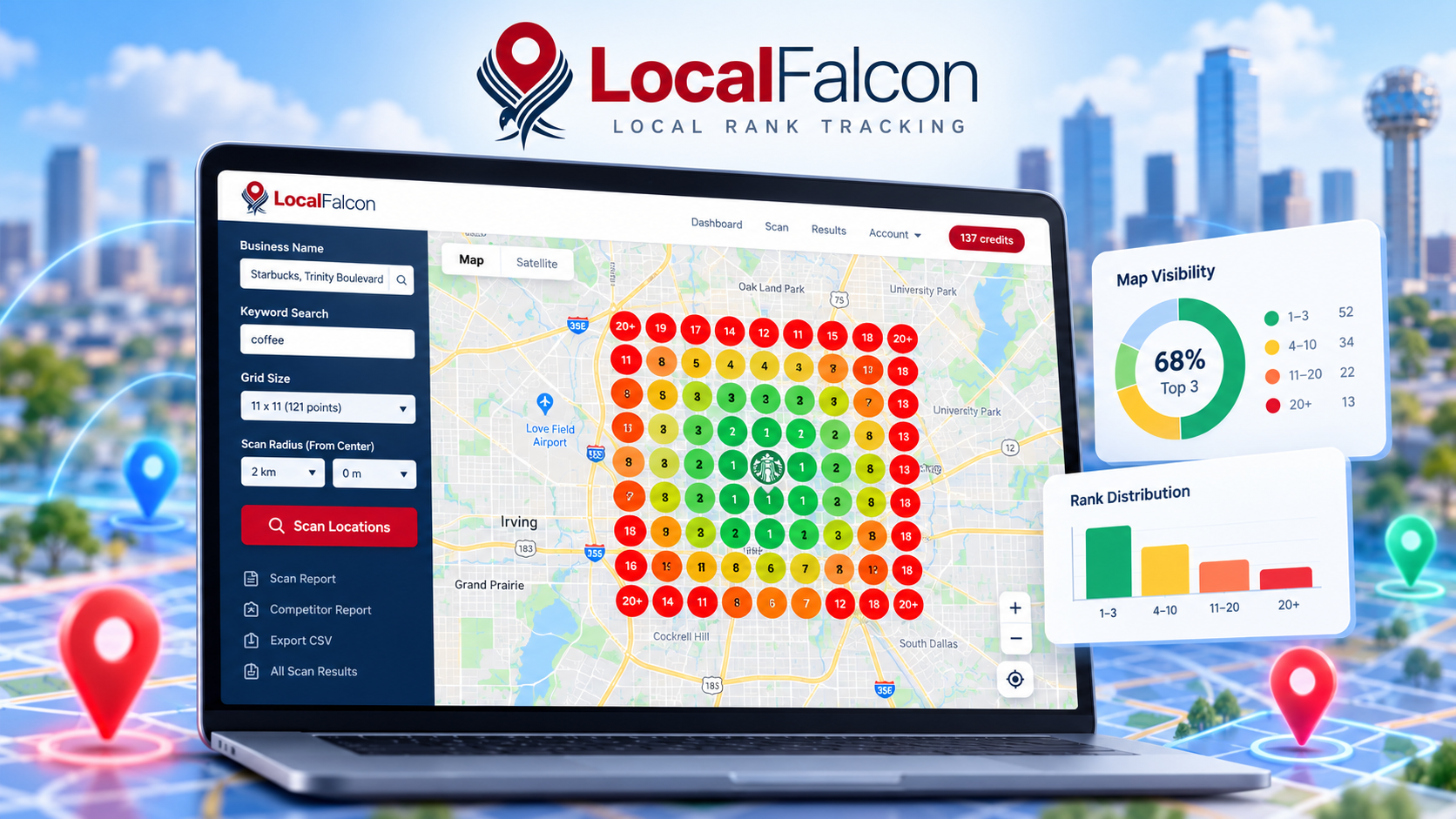
Local Falcon built its reputation on one thing: showing exactly where a business ranks at every point across a radius grid, not just a single average position. That distinction matters more than it sounds. A business can rank first a few blocks from its front door and fall to position nine a mile away. A single-point rank tracker would never show you that gap.
Geo-Grid Scans and Share of Local Voice
Local Falcon’s scans come in standard grid sizes, including 5×5, 7×7, and 15×15 points. This gives an operator a genuinely local grid view of map pack performance, rather than one number pretending to represent an entire service area. At its core, this is geo-grid tracking done with real precision: every point on the map gets its own rank data instead of a single blended figure. Its Share of Local Voice metric rolls all of that grid data into a single visibility score. That makes it easier to track whether a client’s local search presence is actually improving month over month, rather than just shifting around. For agencies whose clients compete on local rank in dense metro areas, this grid-level view is often the clearest way to prove progress that a single average position would hide.
Learn More: How To Read a Local SEO Heatmap: A Beginner’s Guide to Local Search Visibility
The Credit-Cost Tradeoff as You Scale
Here’s the honest weakness. Local Falcon runs on a credit system, and a single 5×5 scan burns 25 credits. Move up to a 13×13 or 15×15 grid, and credit use climbs fast, not evenly. For a solo operator managing ten or more client locations, your monthly scan habits, not your keyword list, are what push you into a higher pricing tier. The flexibility cuts both ways. One-off scans work great for checking out a lead before you sign them. But frequent full-grid tracking across many accounts adds up quickly. If you’re still mapping out how rank tracking fits into your broader service delivery, it’s worth seeing how a dedicated local SEO workflow handles this tradeoff before locking in a tool.
LeadSnap: The Falcon Alternative Built for Full GBP Operations
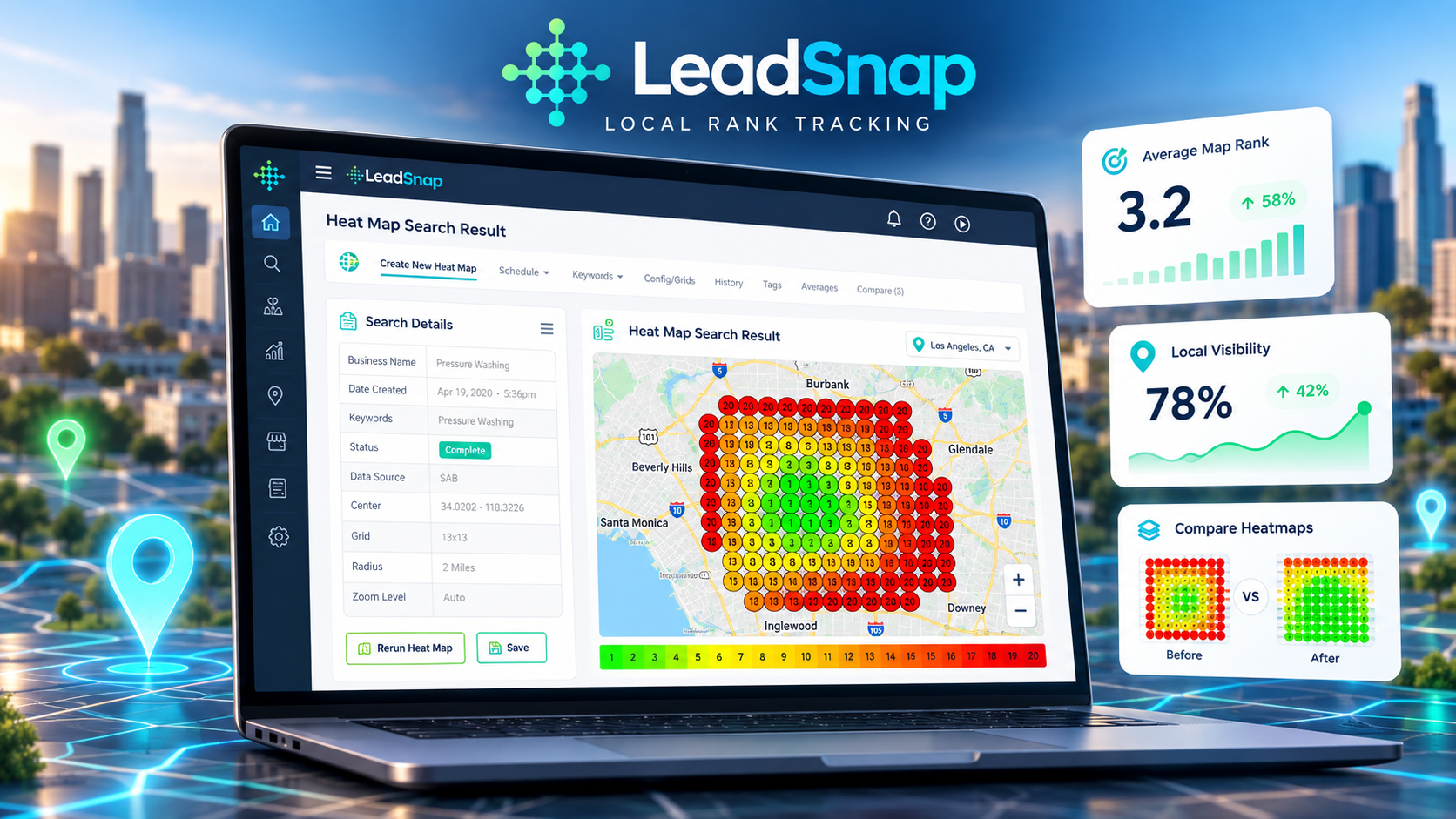
LeadSnap markets itself as a falcon alternative for agencies that want more than a tracking report. It’s built around one idea: an operator managing local SEO as a packaged service needs citations, profile management, and reporting living in the same login as rank data. For agencies evaluating Falcon Local against a fuller platform, the comparison usually comes down to whether that single-login convenience outweighs the depth of a dedicated grid tool.
What’s Bundled Inside LeadSnap
Rank tracking is only one module here. LeadSnap also handles GBP posting, review management, citation building, and automated client reporting, all under one roof. The platform is clearly built with reseller and agency workflows in mind, including white-label branding across client dashboards. That makes sense, since its pricing structure assumes you’re delivering this as a repeatable business line, not a custom build per account.
Where the Grid Detail Falls Short
The tradeoff is real. LeadSnap’s grid-mapping and rank visuals simply aren’t as detailed as Local Falcon’s dedicated geo-grid engine. If hyper-local ranking proof is your main selling point with clients, this is a real limitation. The interface also feels dated next to newer SaaS tools, which can slow down onboarding for an operator used to more modern design. Both of these are real costs of choosing breadth over specialist depth.
Citation Building & NAP Managemen
Citation consistency is one of the quieter local SEO problems. A business’s name, address, and phone number need to match across every directory. When they don’t match, trust signals to Google’s local algorithm quietly erode, even while rank tracking still looks fine on the surface.
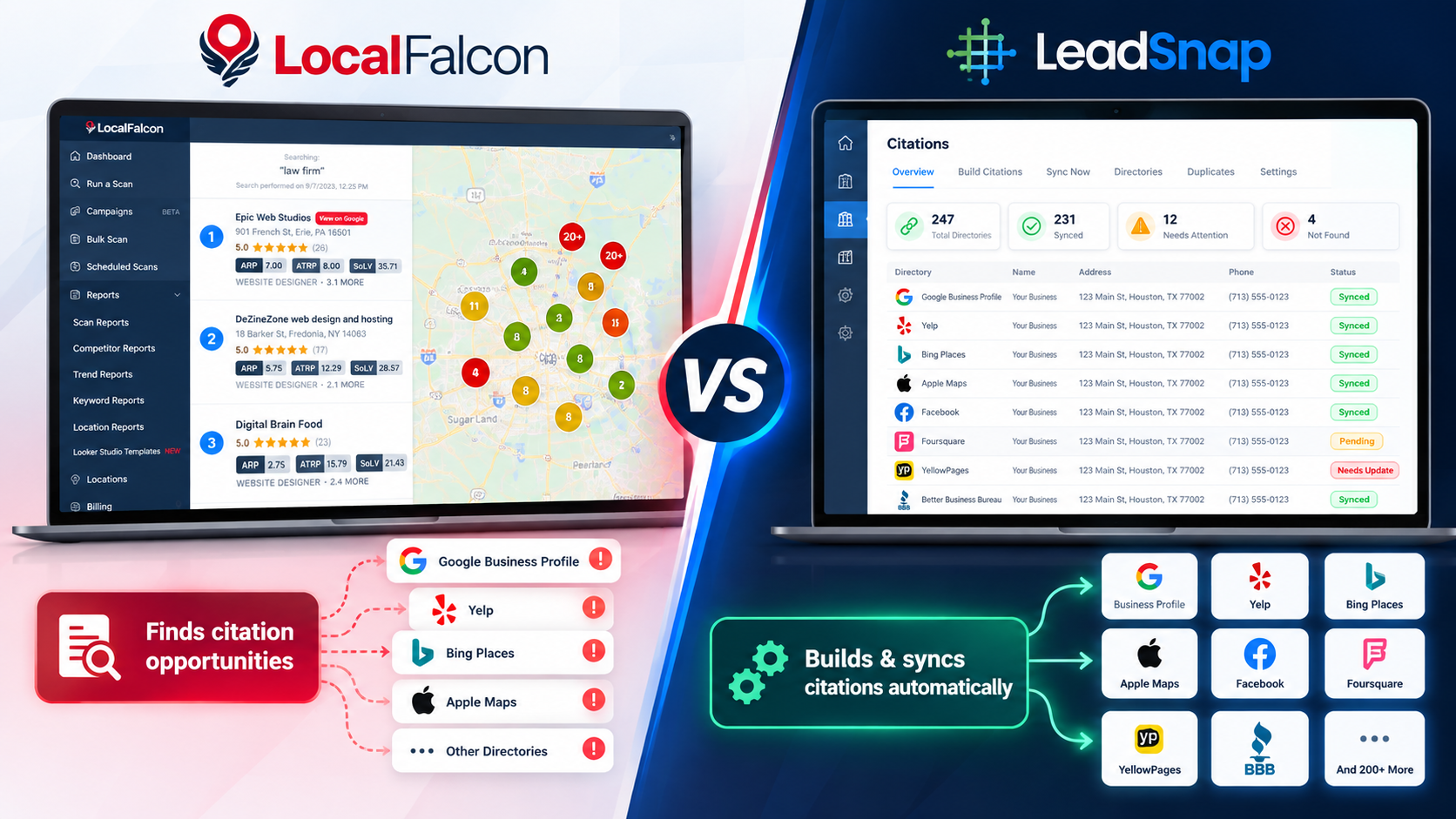
Local Falcon doesn’t build citations. It reports citation opportunities, pointing out where gaps exist, but leaves the fix to you or a separate tool. That’s a real hidden cost not reflected in its sticker price, since most operators need a second subscription or a manual process to actually close those gaps.
LeadSnap takes the opposite approach, automating citation building and sync across directories. This saves real hours compared to manual submission. But automation isn’t the same as accuracy. A few things worth watching regardless of which path you take:
- Automated citation sync can still spread inconsistent NAP data across directories if nobody checks it
- Manual QA remains necessary even with automated tools, especially after a client rebrands or changes a phone number
- Local Falcon’s citation-opportunity reports require you to fix the problem elsewhere, adding a workflow step
- Neither platform treats citation work as fully “set and forget,” no matter what the marketing copy implies
White-Label Client Reporting & Turning Data Into Insight
Grid maps look impressive. A client opens a report full of color-coded dots and instantly understands something changed. Understanding that something changed, though, isn’t the same as understanding what it means for their business.
Local Falcon’s Manual Narrative Gap
Local Falcon’s visuals are strong proof of work, but the operator still has to build the story by hand. Explaining what Share of Local Voice means, why a grid point improved, and what that means for local visibility takes real time. That time isn’t billed as strategy, even though it functions that way.
LeadSnap’s Built-In Reporting Layer
LeadSnap ships white-label dashboards and automated report generation right out of the box. This cuts down the hours spent building client deliverables by hand. For a solo operator, every hour spent narrating a report is an hour not spent on the next client or campaign. The data quality between the two tools isn’t really the differentiator here. What differs is how much of the translation work is automated versus left entirely on your plate.
GBP Optimization, Review Tracking & Competitor Intelligence
Review Velocity and Competitor Gap Analysis
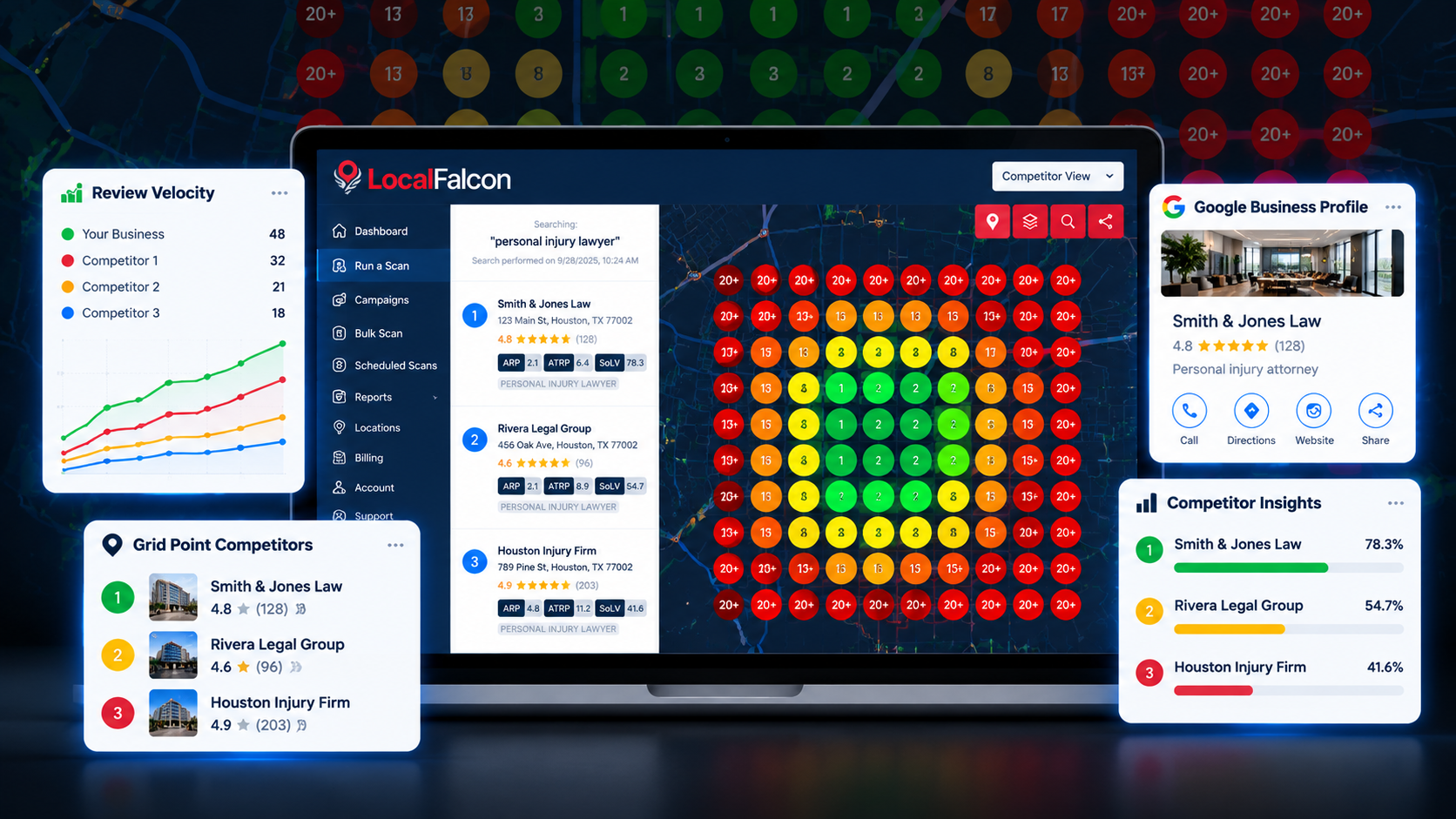
Local Falcon tracks review velocity and layers competitor intelligence directly into its grid view. This lets an operator see exactly which competitor is winning specific grid points, and why, which matters most when local pack rankings shift unexpectedly between scans. Review velocity, how quickly new reviews pile up relative to competitors, has become a more commonly cited local ranking signal. That makes this more than a vanity metric.
Who Actually Manages the Profile?
This is where a lot of buyers get confused. Local Falcon is observational. It tracks rank, reviews, and competitor movement, but it doesn’t edit or manage the Google Business Profile itself. LeadSnap, by contrast, includes GBP posting and profile management features. You can act on what you see, respond to reviews, and publish updates, all from the same dashboard used for tracking. If your workflow depends on acting on insights without switching tools, that difference carries real weight.
Pricing at Agency Scale and the Learning Curve for Solo Operators
Local Falcon’s Usage-Based Pricing
Local Falcon’s pricing runs roughly $30 to $300 a month, depending on scan volume and the number of keywords and locations tracked. An operator running ten clients with modest grid sizes could land in a mid-tier plan around $100 to $150 a month. Heavier grid usage pushes that number up fast, since cost scales with scans, not just account count.
LeadSnap’s Flat Agency Tiers
LeadSnap’s agency tiers run roughly $97 to $400+ a month, depending on client volume. That same ten-client roster would likely sit in a mid-to-upper tier, somewhere around $200 to $300 a month. That figure already includes citation building and reporting tools that Local Falcon doesn’t provide at any price point.
On the learning curve, Local Falcon’s grid data requires some SEO know-how to interpret meaningfully. LeadSnap has more ground to cover given its broader feature set, but each module tends to be easier to understand for a non-technical operator, even with its older interface design.
Rank Tracking vs. Lead Generation: Breadth of the Platform
Local Falcon’s Single-Purpose Focus
Local Falcon does one thing by design: geo-grid rank tracking. It doesn’t pretend to be a CRM, a citation builder, or a content tool. For an operator who already has a reporting and content workflow built elsewhere, that focus is a feature, not a limitation.
LeadSnap’s Lead Capture Layer
LeadSnap goes further, including a lighter CRM and lead capture layer that lets agencies find leads and manage them without exporting data into a separate system. The real question underneath all of this isn’t which platform is objectively better. It’s whether you want a focused tool paired with your own stack, or a broader platform that pulls more of the local SEO service line under one login. Agencies selling local SEO as a standalone offer tend to lean toward LeadSnap’s breadth. Agencies treating it as one line item inside a larger retainer often prefer Local Falcon’s precision paired with their own reporting layer. To be fair, neither tool functions as a full marketing operating system connecting SEO to the rest of your work, which is worth sitting with before you standardize on either one.
One fractional CMO managing six local clients ran both tools side by side for a month. Local Falcon gave sharper grid proof for two clients competing hard on map pack rank, but the reporting hours piled up. Switching those same two accounts to LeadSnap cut report-build time roughly in half, though the grid detail she showed clients got noticeably less precise. She ended up using both, split by workflow, not by client. Her takeaway was simple: tracking local rank accurately is only half the job. Explaining it to someone who has never seen a geo-grid map before is the other half.
| Dimension | Local Falcon | LeadSnap |
|---|---|---|
| Grid/map rank tracking granularity | Deep, dedicated geo-grid engine | Lighter, less granular |
| Citation building & NAP management | Reports opportunities only | Automated sync, needs manual QA |
| White-label client reporting | Visual but manual narrative needed | Built-in white-label dashboards |
| GBP optimization & review tracking | Tracks reviews, no profile edits | Tracks and manages profile directly |
| Pricing model at agency scale | $30-$300/month, usage-based | $97-$400+/month, flat tiers |
| Ease of turning data into client insight | Requires manual framing | Largely automated |
| Learning curve for non-technical team members | Moderate, grid data needs context | Moderate, more surface area, dated UI |
| Breadth: single-purpose vs. all-in-one | Single-purpose specialist | All-in-one platform |
Conclusion: There’s a Third Option Beyond Local Falcon vs. LeadSnap
Local Falcon and LeadSnap solve two different versions of the same problem. Local Falcon is built for operators who want deep geo-grid rank tracking and competitive visibility. LeadSnap expands the workflow with citations, Google Business Profile management, reviews, and client reporting.
But if you’re comparing these platforms because you want local SEO functionality without stitching together a growing stack of disconnected tools, SoloCMO is worth adding to the conversation.
SoloCMO brings robust local SEO capabilities into a much broader marketing system. Instead of stopping at rankings, reviews, competitors, and reporting, it connects those insights to the work that actually moves the business forward: strategy, content planning, SEO execution, competitive research, performance measurement, and proving the value of the marketing being done.
That distinction matters for solo marketers, consultants, and small agencies. You may not need a dedicated tool for every individual piece of the workflow. You may need one system that helps you understand what is happening, what to do next, and whether the work actually produced a result.
And SoloCMO delivers that broader functionality at a competitive price, particularly when you consider how many separate subscriptions it can potentially replace.
So the decision becomes less about Local Falcon vs. LeadSnap and more about what you actually need:
- Local Falcon if specialized geo-grid tracking is the primary job.
- LeadSnap if you want a broader collection of local SEO management tools under one roof.
- SoloCMO if you want local SEO capabilities connected to the rest of your marketing strategy and execution in one operating system.
If you’re already looking for more than another rank tracker, see how SoloCMO approaches local SEO and the rest of the marketing workflow together.
FAQ
Is LeadSnap a good Local Falcon alternative?
LeadSnap works well as a falcon alternative for agencies that want citations, GBP management, and reporting bundled into one dashboard. It trades some grid detail for that breadth, so the right fit depends on how deep your clients expect hyper-local proof to go.
Is Local Falcon better for rank tracking?
Local Falcon is the stronger choice specifically for geo-grid rank tracking and visual map pack proof. Whether it’s “better” overall depends on whether you already have reporting and citation work handled through another tool.
Does Local Falcon manage my Google Business Profile?
Local Falcon does not manage or edit a Google Business Profile. It’s an observational and reporting tool, so profile actions like posting updates or responding to reviews need to happen through a separate workflow or platform.
Does LeadSnap replace BrightLocal or Local Falcon?
LeadSnap can replace parts of either stack, depending on how much geo-grid detail your agency actually needs day to day. It’s not a true one-to-one replacement, since dedicated tools still track deeper grid data than LeadSnap’s built-in rank module.
How much does Local Falcon cost at agency scale?
Local Falcon generally runs $30 to $300 a month, depending on scan volume and the number of keywords and locations tracked. Credit use, driven by grid size and scan frequency, is the real variable that pushes cost higher as your roster grows.
What is a geo-grid rank tracker and why does it matter for local visibility?
A geo-grid rank tracker measures search rank at multiple points around a business location, rather than a single average position. This matters because map pack competition is hyper-local, and a business can rank well in one area while losing visibility just a mile away.
Which tool has better white-label reporting for client deliverables?
LeadSnap has the stronger built-in white-label reporting, with automated dashboards that need less manual assembly. Local Falcon’s grid visuals still work well for client deliverables, but they usually need added narrative support to land clearly.
Recent Posts
Content Refresh vs Rewrite: Which Fixes Decaying Blog Posts Faster
A content refresh ships faster, usually in 1 to 3 hours versus 4 to 8 for a rewrite, but a rewrite recovers faster when the decay stems from a search intent mismatch. The rule of thumb is to refresh the post if it still matches what searchers want and most of it is salvageable, and to rewrite it if the

How to Build a Topic Cluster From Scratch for Your SaaS Blog
To build a topic cluster, pick a pillar topic that fits your product, collect subtopic keywords, group them by SERP overlap and intent, size the cluster, link every page to the pillar, publish in stages, then measure at cluster level. That is how to build a topic cluster in a way you can defend to a founder, and our topical authority
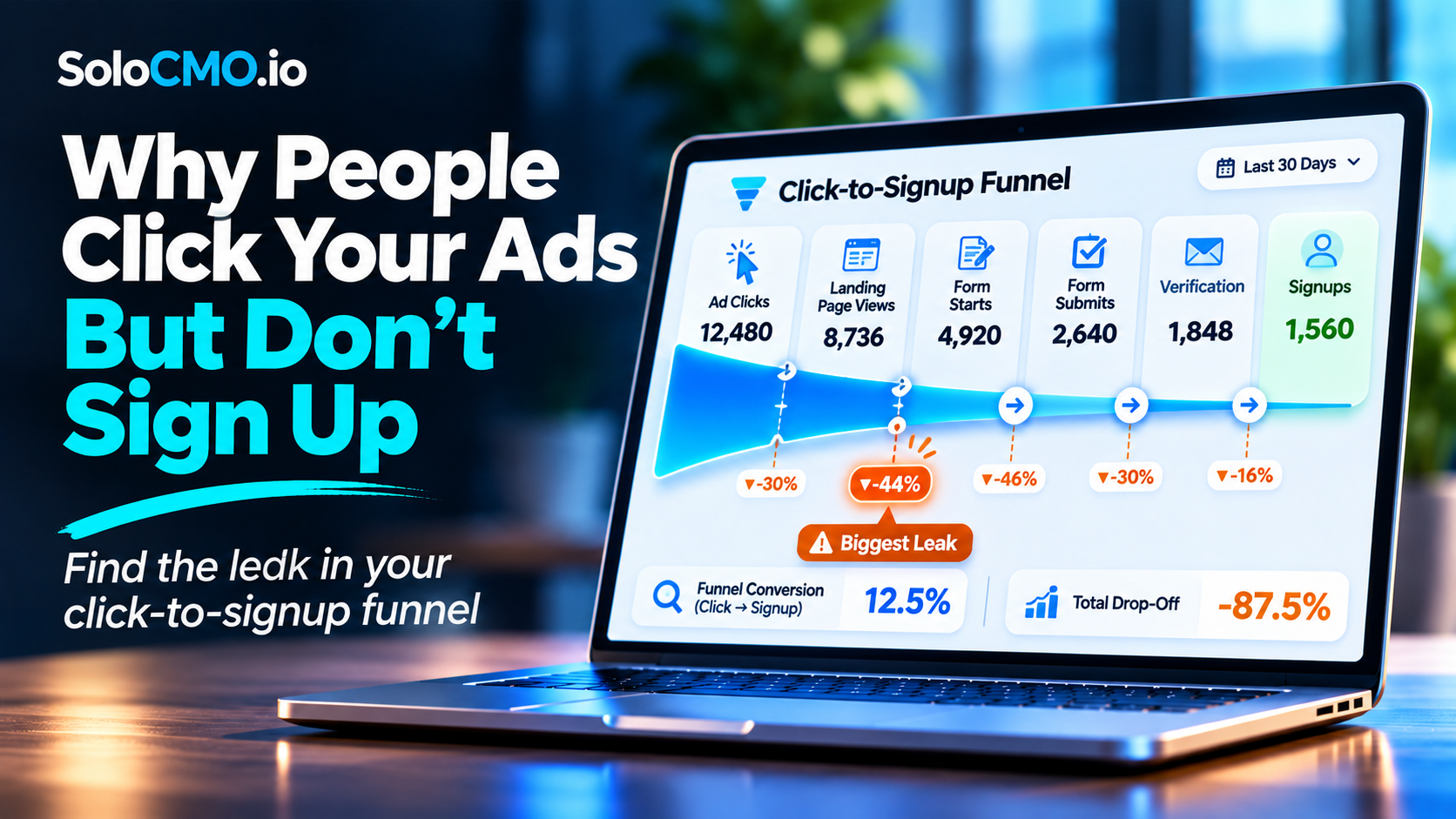
Where Leads Drop Off Between Ad Click and Signup
Funnel drop off between click and signup occurs at six points: the ad click, page load, above the fold, form start, form submit, and verification. The most significant leaks usually sit upstream, where the ad promise fails to match the page or where the page loads too slowly on mobile before the form ever appears. If your paid ad campaigns show
Get Smarter About Your Marketing
Practical SEO, AI, content, and marketing strategies you can put to work immediately.
Join the Newsletter