Local SEO
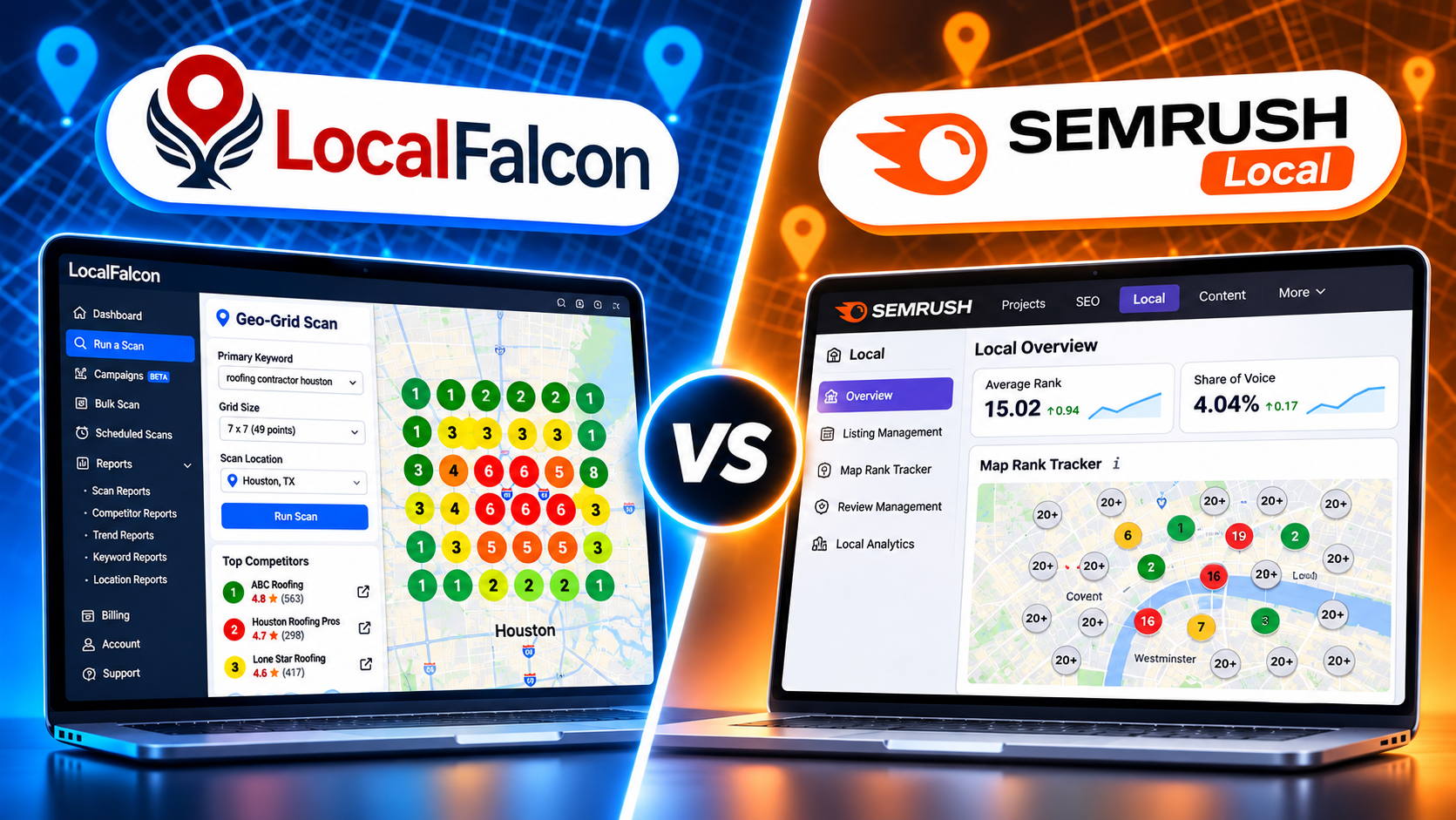
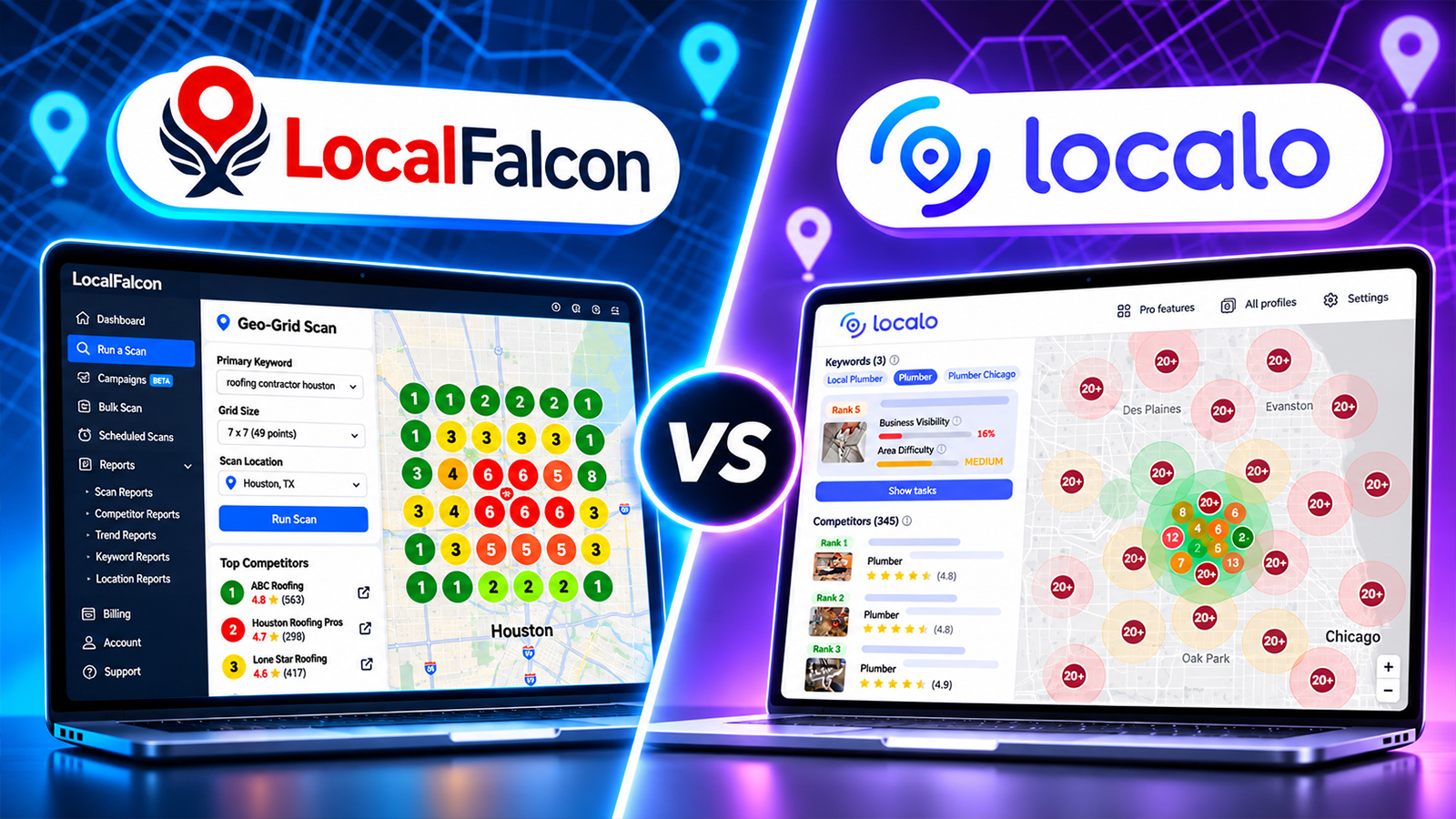
If you own local SEO on top of social, email, content, and reporting, you get one platform, no analyst, and no time to learn two of them. This Local Falcon vs Semrush Local comparison puts a geo-grid specialist next to a full-suite module, with real prices, so you can pick one and defend that choice to leadership. The right pick depends less on which platform is more powerful and more on how much your results vary by location and how much time you actually have.
Key Takeaways
- For a full comparison in short form: Local Falcon fits grid-level Google Maps visibility, while Semrush Local fits a broader suite with listing and review management.
- Local Falcon runs $24.99 (Starter), $49.99 (Basic), $99.99 (Pro), and $199.99 (Premium) per month. Semrush Local is $30 (Base) or $60 (Pro) per location per month, and core Semrush plans start around $130+/mo if you want the rest of the suite. Verify current pricing on each vendor site.
- Local Falcon gives you fast visuals for a leadership update. Semrush Local gives you more features, but it takes longer to learn.
- Neither one writes your campaigns or content, and that gap is where a solo marketer’s week usually disappears.
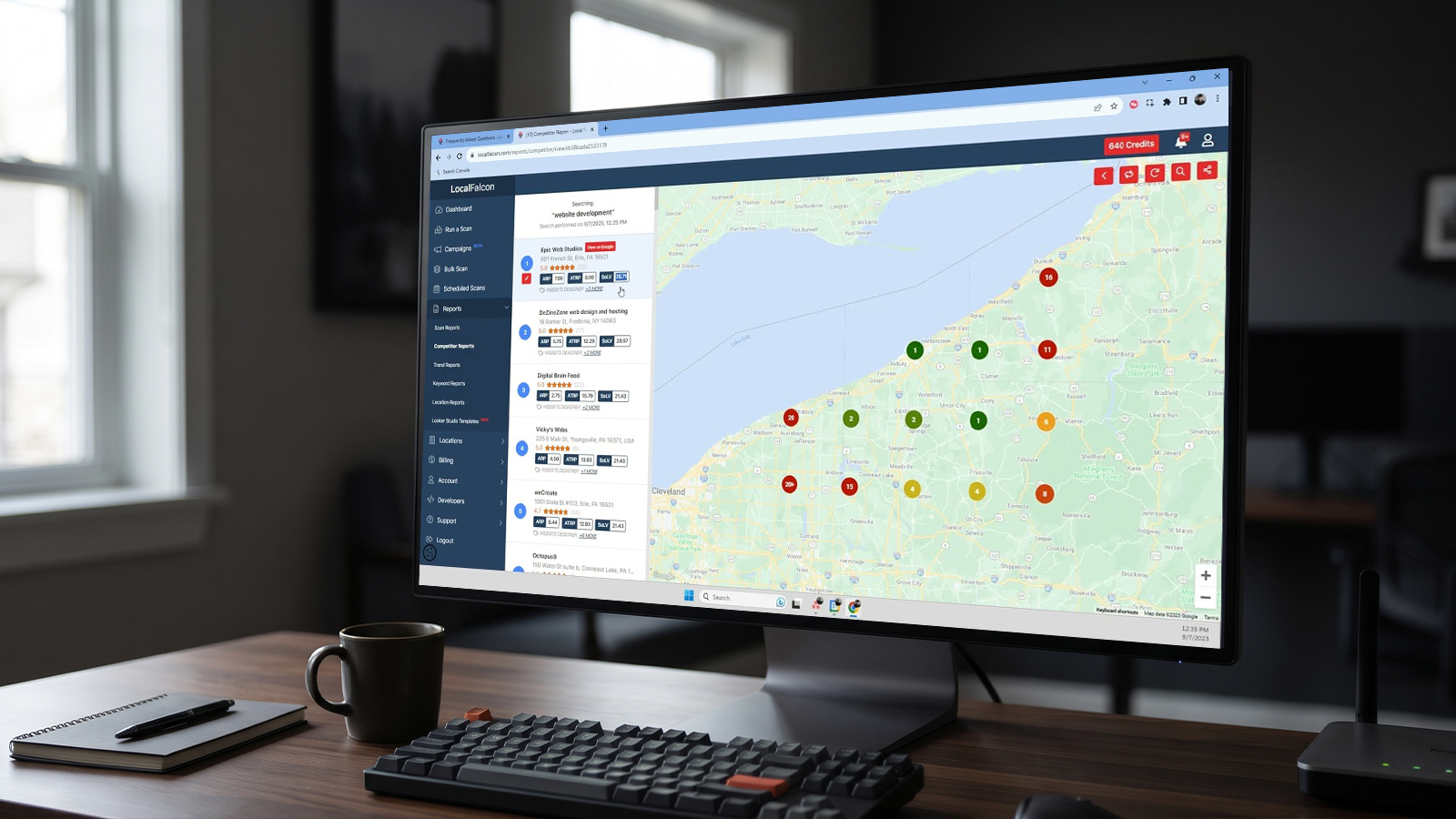
Local Falcon: Geo-Grid Rank Tracking for Google Maps
Local Falcon is the go-to geo-grid specialist. It scans a grid of points around your business and shows where you appear in Google Maps and the local pack, so you see visibility block by block rather than one number for a whole city. The narrow focus keeps the learning curve short, which suits a solo marketer who needs a quick picture, and G2 reviewers often mention quick setup and ease of use.
What Local Falcon Does Well
The heatmaps show where you rank and where you vanish, something a standard tracking tool hides. Because the product is built around your Google Business Profile visibility, the output ties straight to Maps and local pack results. You can track competitors on the same grid and see who owns which neighborhoods. The visuals screenshot cleanly and drop right into a slide. New accounts get 100 free credits, so a first scan costs nothing.
Where Local Falcon Falls Short
It does one job. There are no site audits, backlink analysis, keyword research, or content features, so you’ll need other software for the rest of your local SEO. It also tells you what’s wrong without telling you how to fix it, and that action plan is on you. Credits drain fast, too, which gets expensive if you watch many terms across many locations. And if your business doesn’t depend on the Maps pack, the product adds much less value.
- One job only, with no audits, backlinks, or content features
- Frequent grid scans burn through credits
- Diagnoses visibility but does not prescribe fixes
- Less useful without a physical or service-area presence
Best For and Pricing
Best for a solo marketer at a Maps-dependent business who wants fast, visual proof of where they rank and where competitors win. Tiers run $24.99 Starter, $49.99 Basic, $99.99 Pro, and $199.99 Premium on the vendor’s own pricing guide. Check the vendor site, since third-party sources list older figures.
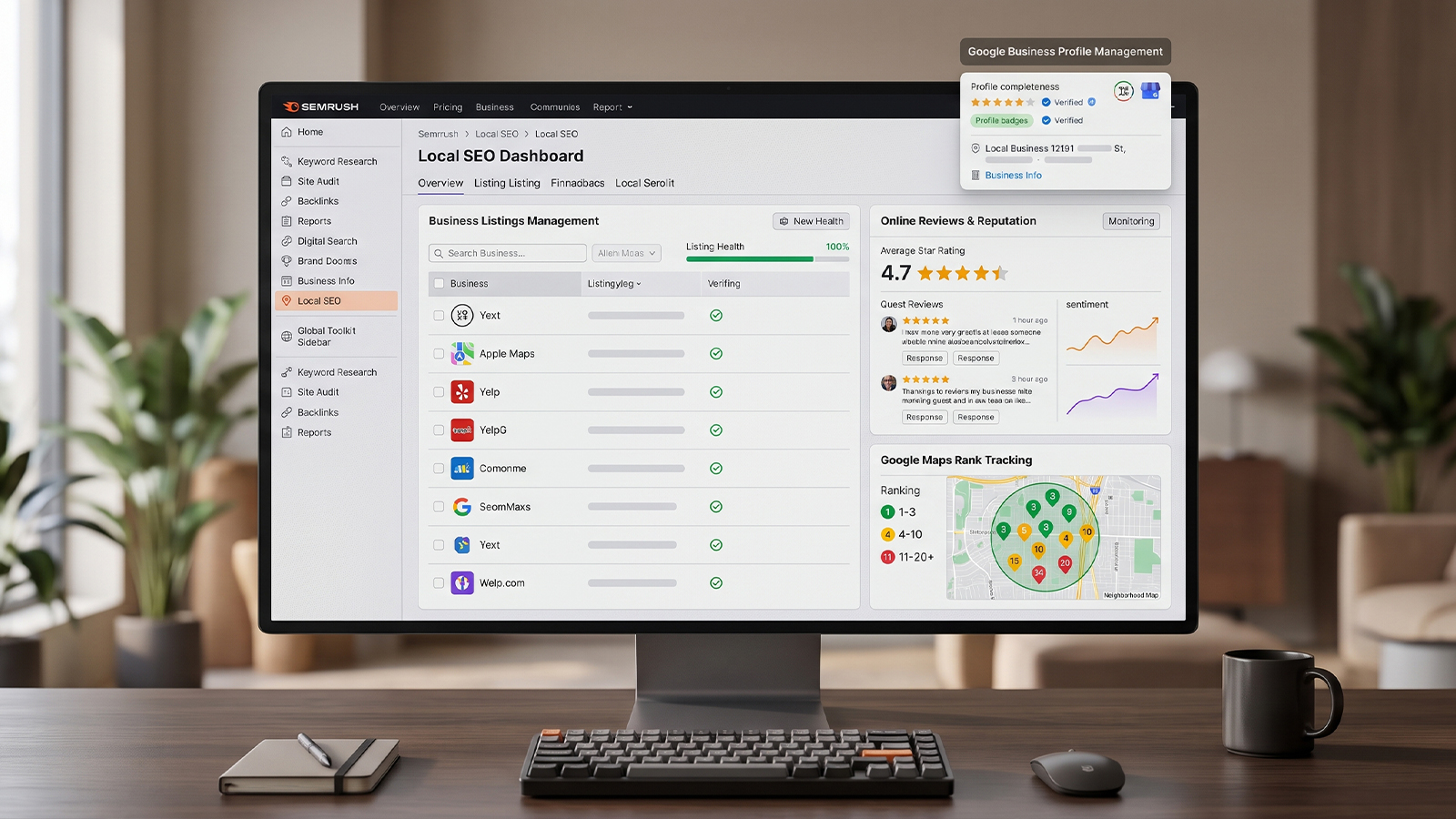
Semrush Local: Listings, Reviews and Rank Tracking Inside a Suite
Semrush Local is the local toolkit inside the larger Semrush platform. It covers Google Business Profile management, directory listings, review monitoring, and a Map Rank Tracker, all sitting next to the suite’s keyword, audit, and backlink features.
What Semrush Local Includes
The draw is breadth under one login. You can keep your business name, address, and phone data consistent across 70+ directories, and review management sits beside your Google Business Profile data. That gives you a wider view of local reputation, not just rankings. You also get strong competitive data, a large training library, and a mature support ecosystem. If your marketing function grows, the reporting grows with it.
The Trade-Offs of a Suite
Breadth is also the weakness for a team of one. Many features go unused while you keep paying for them. Pricing is per location, so the true cost climbs above the headline number with every address you add. Map credits are limited, too: Base gets about 375 and Pro about 1,225 per location per month. Setup takes longer before you see a useful local report. Grid tracking tops out at 15×15 and is less granular than a dedicated grid product, so block-by-block gaps are harder to spot. And if you want the keyword, audit, and backlink features that make the suite worth it, core Semrush plans start around $130+/mo on top of the local fee.
Best For
Best for a solo marketer whose local work sits inside a broader SEO job and who wants keyword research, audits, backlink data, and listing management in one place.

Rank Tracking Depth and the Location Problem
Rank tracking comes in two kinds. A standard rank tracker reports one position for a city or a single point. A grid scan checks many points around your business and shows how visibility shifts as you move away. BrightLocal’s comparison lists Local Falcon grids from 3×3 to 21×21 and Semrush grids from 5×5 to 15×15.
Why Your Ranking Changes Across Town
Local search behavior varies enormously by neighborhood, density, and competition. In a dense metro with many competitors per block, your position can swing sharply within a few streets, so grid views show a lot. In a small town where a handful of competitors dominate the pack, results barely move, and a standard report may be enough. Distance from the person looking matters a lot to Google.
Multi-location and service-area businesses feel this most. You can be first downtown and invisible two miles away, and a single average hides it. That answers a common question: why you show up in the 3-pack at your office but not across town. Your rankings depend on where the person is standing, not just on your profile.
If you manage several locations alone, a quick gut check helps before you spend a dollar. Pull up your top three service areas and ask whether your customers in each one see the same competitors. If the answer is “not even close,” grid detail is likely worth paying for. If the answer is “mostly yes,” a lighter option may do the job.
The Credit Math Behind Grid Scans
A 5×5 grid costs 25 credits per scan per keyword, so the math adds up fast. The 375 Semrush Base credits cover only about 15 such scans. Local Falcon’s $24.99 Starter includes 7,500 credits, which covers 300 of the same scans, so the two products are not close on raw scan volume. Before you pay for granularity, decide how much your results truly vary. Then build a scan plan around that answer.
Start by counting your locations, then your priority queries, then multiply by grid size and scan frequency. Begin with one scan every four weeks and tighten only where gaps appear. Skip dense grids where your results barely move. That small bit of planning keeps a focused product from becoming a surprise line item when leadership reviews the budget.
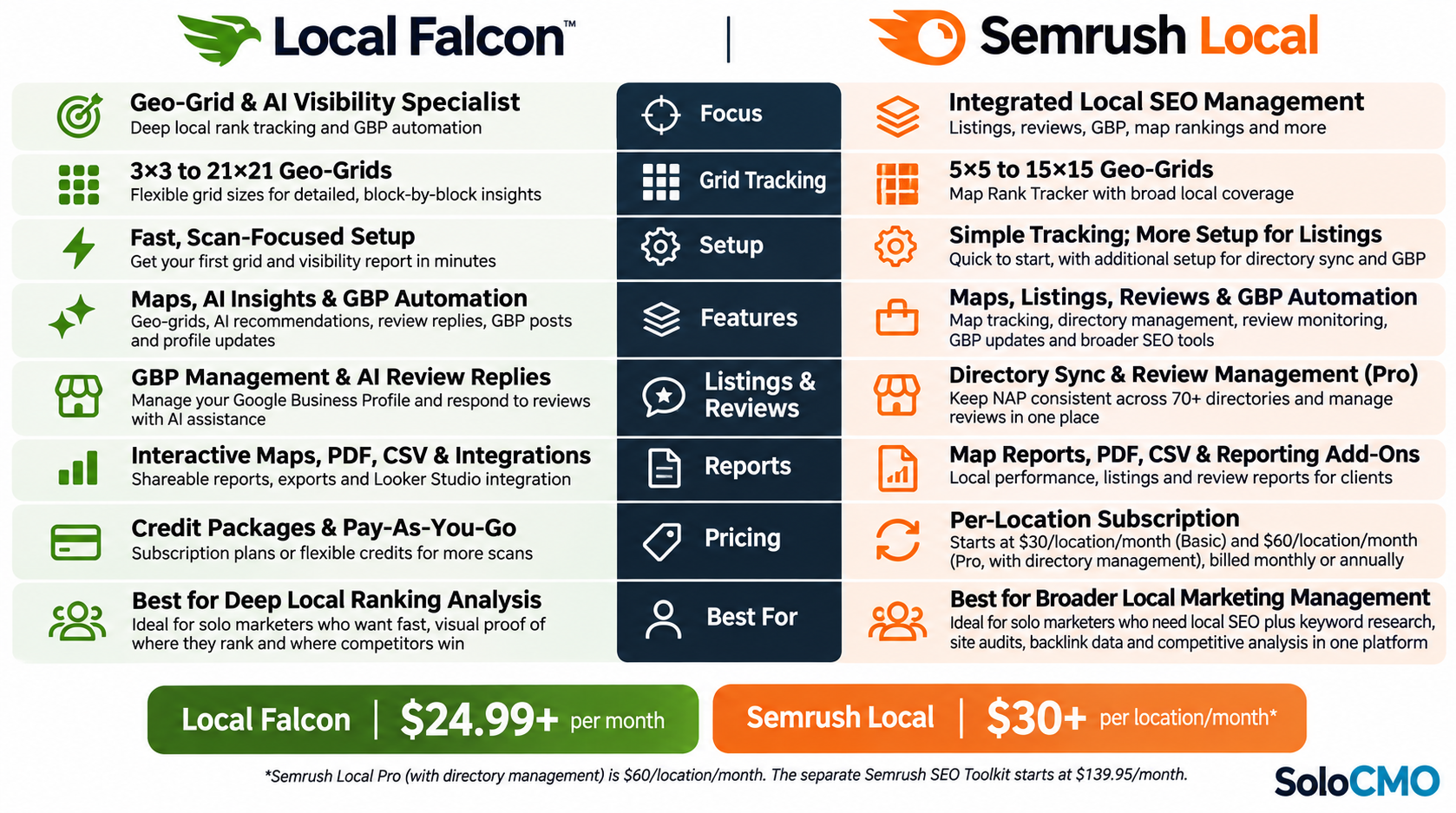
Local Falcon vs Semrush Local: Side-by-Side Table and Real Costs
Here’s the full side-by-side view. Read the grid and fit rows with the local angle in mind: the more your results vary by location, the more grid detail pays off.
The 8-Dimension Comparison
| Dimension | Local Falcon | Semrush Local |
|---|---|---|
| Core purpose and focus | Geo-grid visibility for Google Maps and the local pack | Local module inside a full SEO suite |
| Local rank-tracking depth (grid vs. standard) | Deep grids, 3×3 to 21×21; best for dense, high-variance areas | Grids 5×5 to 15×15, less granular; fine for low-variance areas |
| Setup time and learning curve for one person | Short; first scan in one sitting | Longer; many features to learn first |
| Breadth of SEO features beyond local | None; no audits, backlinks, or keywords | Keywords, audits, backlinks, competitor data |
| Listing and review management | Not offered | Directory listings, review management, profile monitoring |
| Reporting and leadership-ready visuals | Heatmaps that screenshot cleanly | Broad reports that scale with the team |
| Pricing and scalability | Credit-based, $24.99 to $199.99/mo; cost rises with scan volume | $30 or $60 per location/mo plus optional core plan; cost rises with locations |
| Fit for a team of one | Strong if you need grid proof and one focused product | Strong if local is one piece of a wider SEO job |
What Each Option Really Costs
Local Falcon runs $24.99 to $199.99 per month, and your real spend depends on credits. Semrush Local Base is $30 and Pro is $60 per location per month, on top of any core Semrush subscription you choose to add. Take a business with three locations on the Base tier: that’s $90 before the core plan, and $220+ with it. The same three locations on Local Falcon Starter cost $24.99, because Falcon doesn’t charge per location; your only constraint is the 7,500-credit pool. Local Falcon costs less to enter, and heavy scanning across many terms is the only thing that closes the gap. Verify current numbers on the vendor pricing pages, since sources disagree.
If you need to justify the spend, a simple one-page summary works well: what you pay each month, what question the product answers, and what decision it will change. Leadership tends to approve a small, clearly scoped line item faster than a big platform with a long feature list.
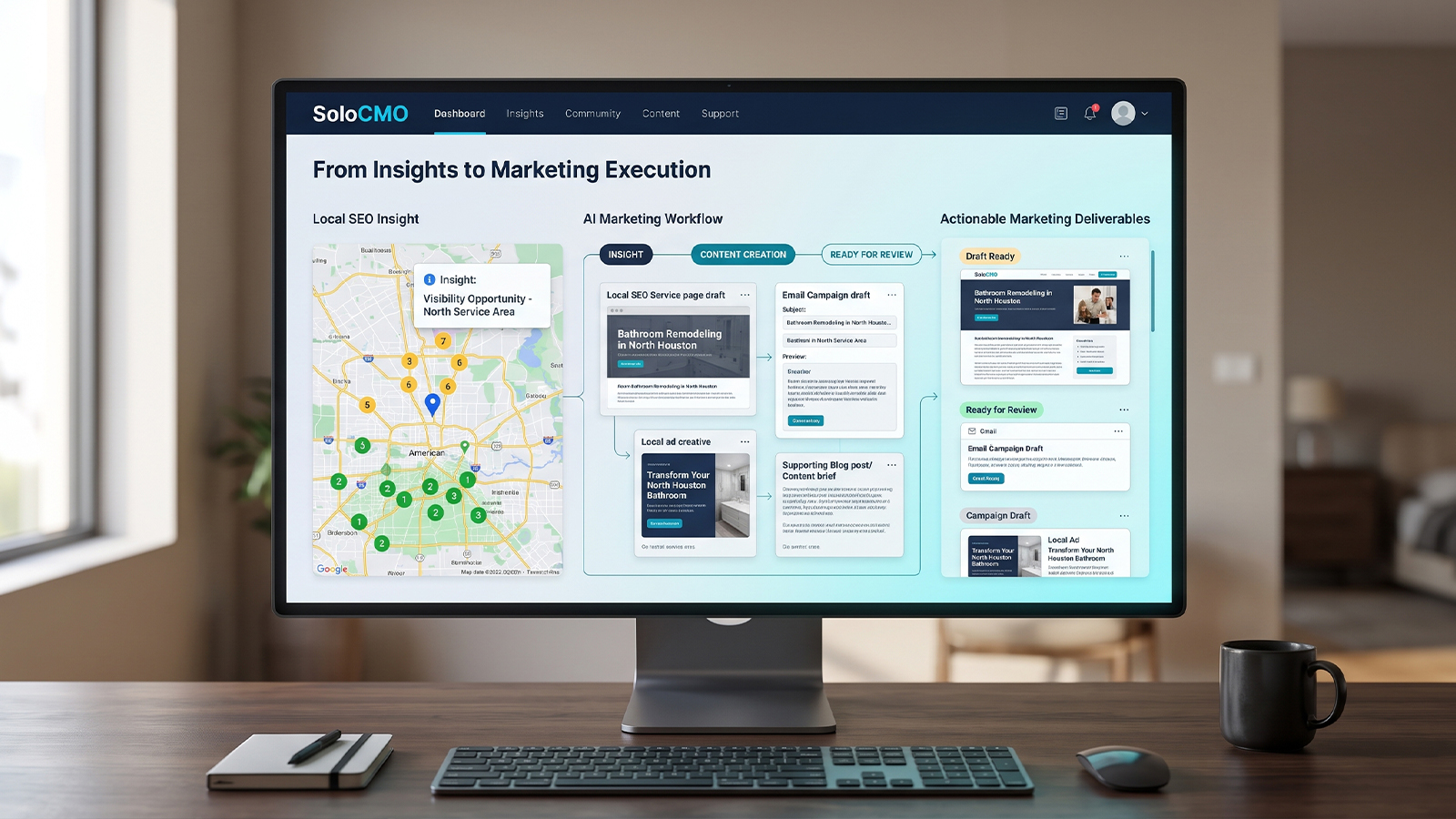
Why SoloCMO Is the Better Alternative for a Team of One
Every row in the table above describes what a tool shows you. None of them describes what happens next, and for a solo marketer that is where the budget actually goes. Local Falcon’s heatmap takes five minutes to read. Semrush Local’s listing report takes ten. The neighborhood service page, the review-request email, and the campaign that closes the cold zone they both point to can take the rest of the week, and neither product writes a word of it.
That is the gap SoloCMO is built for. It is not a geo-grid scanner or a listings manager, and it doesn’t replace either; you still need one of the two tools above to see where you stand. What SoloCMO does is take the finding, such as rank 6 across the north half of your service area on your best-paying query, and turn it into draft pages, emails, and campaign output you review rather than write from scratch.
Run the math the same way you ran the credit math. If a scan costs you $24.99 a month and the follow-up costs you six hours, the follow-up is the expensive part at any hourly rate. Falcon and Semrush compete on how clearly they show the problem. SoloCMO is the better alternative to both because it competes on how fast the problem gets fixed, which is the only number leadership asks about.
FAQ
Is Local Falcon worth it for small businesses?
Local Falcon pays off for small businesses that depend on Maps visibility. The 100 free credits let you test it first, and Starter is $24.99. Seeing the grid is only half the work, though, since someone still has to decide what to fix.
How much does Local Falcon cost?
Local Falcon costs $24.99, $49.99, $99.99, or $199.99 per month, depending on the tier. Credits fund each scan, so a clear plan for scan frequency keeps spending in check.
How many Local Falcon credits do you actually need?
One credit per grid point. A 5×5 scan is 25 credits, a 7×7 is 49, and a 9×9 is 81. One location, three keywords, a 7×7 grid, scanned every four weeks, uses 147 credits, about 2% of the 7,500 in Starter. Credit burn becomes a problem only when you scan weekly across many locations and terms.
Which is cheaper, Local Falcon or Semrush Local?
Local Falcon is cheaper at entry and cheaper per location, since it doesn’t charge per address. Semrush Local adds $30 or $60 per location and sits inside a platform that starts around $130+/mo, so compare your total, not the headline price.
Do I need a Semrush subscription to use Semrush Local?
No. Semrush Local can be added to an existing account or bought on its own, per location, according to Semrush’s own knowledge base. Third-party pages often say otherwise, so confirm on the vendor site.
Can I use Semrush for local SEO, and do I need both?
Semrush covers local SEO well, but its grid depth is shallower. Most solo marketers should pick one platform and add a second only if a real gap shows up.
Why am I in the 3-pack at my office but not across town?
Distance, density, and competitor concentration shape your position block by block. A heatmap shows the pattern but not the cause, so you still need a fix plan.
What do neither of these do?
Neither writes your campaigns or content. Both show you what is happening, and a one-marketer system like SoloCMO turns that insight into shipped work.
Conclusion
Choose Local Falcon if your priority is Google Maps and local pack visibility, you want fast, visual proof of where you rank and where competitors beat you, and you’d rather add one focused tool than learn a full suite. Choose Semrush Local if local SEO is one piece of a broader SEO responsibility, you also need keyword research, audits, and backlink data, and you value listing and review management in one place.
Whichever path matches your profile, you can defend it to leadership with the prices and trade-offs above. Both show you what’s happening, but neither ships your campaigns or content, and that is where a solo marketer’s time usually disappears. If you want something more encompassing, learn more about SoloCMO. It’s a one-marketer system built to turn insight into output, with a first campaign launched within 24 hours and a guarantee to cut your build time by at least 50% in 14 days. If you’re still weighing options, it costs nothing to read how it works and see whether it fits the way you already run your week.
Recent Posts
Content Refresh vs Rewrite: Which Fixes Decaying Blog Posts Faster
A content refresh ships faster, usually in 1 to 3 hours versus 4 to 8 for a rewrite, but a rewrite recovers faster when the decay stems from a search intent mismatch. The rule of thumb is to refresh the post if it still matches what searchers want and most of it is salvageable, and to rewrite it if the

How to Build a Topic Cluster From Scratch for Your SaaS Blog
To build a topic cluster, pick a pillar topic that fits your product, collect subtopic keywords, group them by SERP overlap and intent, size the cluster, link every page to the pillar, publish in stages, then measure at cluster level. That is how to build a topic cluster in a way you can defend to a founder, and our topical authority
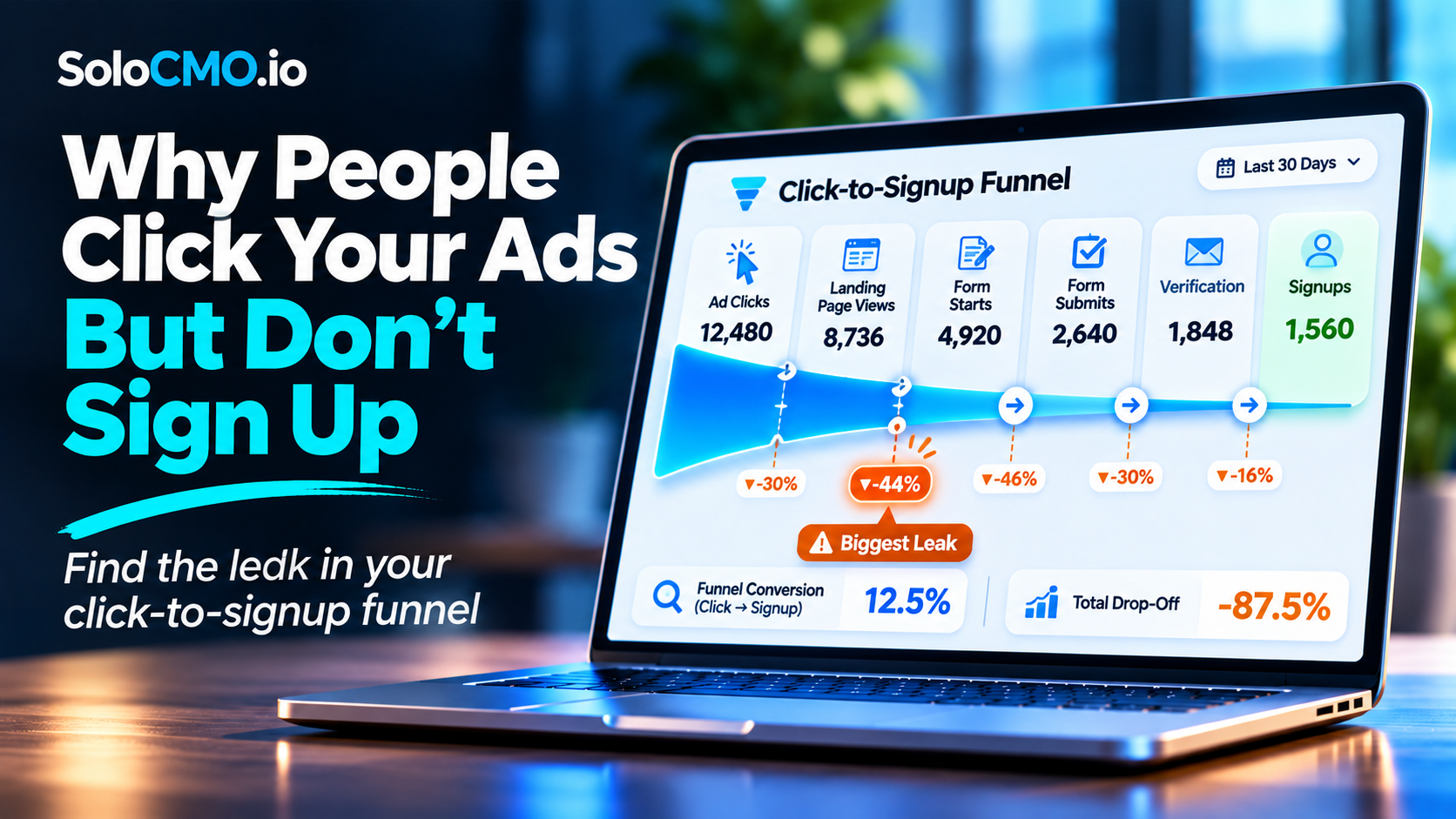
Where Leads Drop Off Between Ad Click and Signup
Funnel drop off between click and signup occurs at six points: the ad click, page load, above the fold, form start, form submit, and verification. The most significant leaks usually sit upstream, where the ad promise fails to match the page or where the page loads too slowly on mobile before the form ever appears. If your paid ad campaigns show
Get Smarter About Your Marketing
Practical SEO, AI, content, and marketing strategies you can put to work immediately.
Join the Newsletter