Marketing Strategy
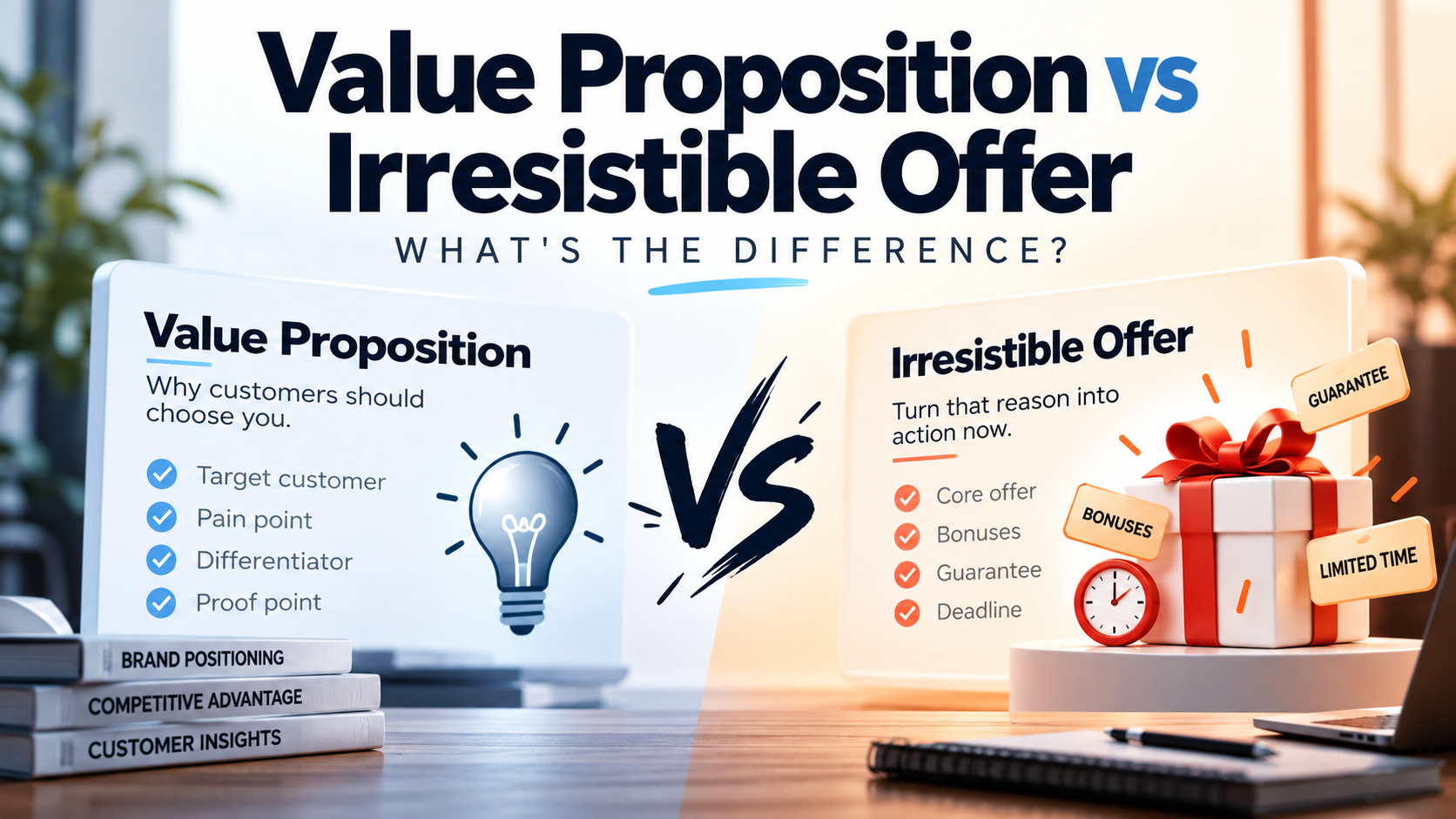
Here’s something nobody explained clearly before. Not while you had a campaign brief open and a deadline closing in. A value proposition is the strategic reason a customer should pick you over every other option out there. An irresistible offer is different. It’s the tactical, time-bound package built from bonuses, guarantees, and urgency. It turns that reason into action right now.
The value proposition vs irresistible offer split comes down to timing and job. One explains why you’re worth choosing. The other makes waiting feel like the wrong move. Want to see this in action instead of just explained? You can build a full irresistible offer once you’ve got the reasoning straight.
Once you know where each one fits in your funnel, building an irresistible offer stops being guesswork. It becomes a repeatable process.
Key Takeaways
- A value proposition explains why a customer should choose your product or service over competitors. An irresistible offer is the structured, time-bound package that gets them to act today instead of next month.
- Use a value proposition to set your strategic positioning. Use an irresistible offer to turn that positioning into a live campaign, landing page, or email.
- You need both. A value proposition without an offer rarely converts. An offer without a value proposition feels hollow.
- Frameworks like the Value Proposition Canvas and Hormozi’s Value Equation give each concept real structure. You don’t have to freehand it.
- Getting this distinction wrong is one of the fastest ways a solo marketer ends up rebuilding a campaign mid-week. Knowing which term applies to which asset (a unique selling proposition, a tagline, an offer stack) saves real time.
Quick Comparison Table: Value Proposition vs Irresistible Offer
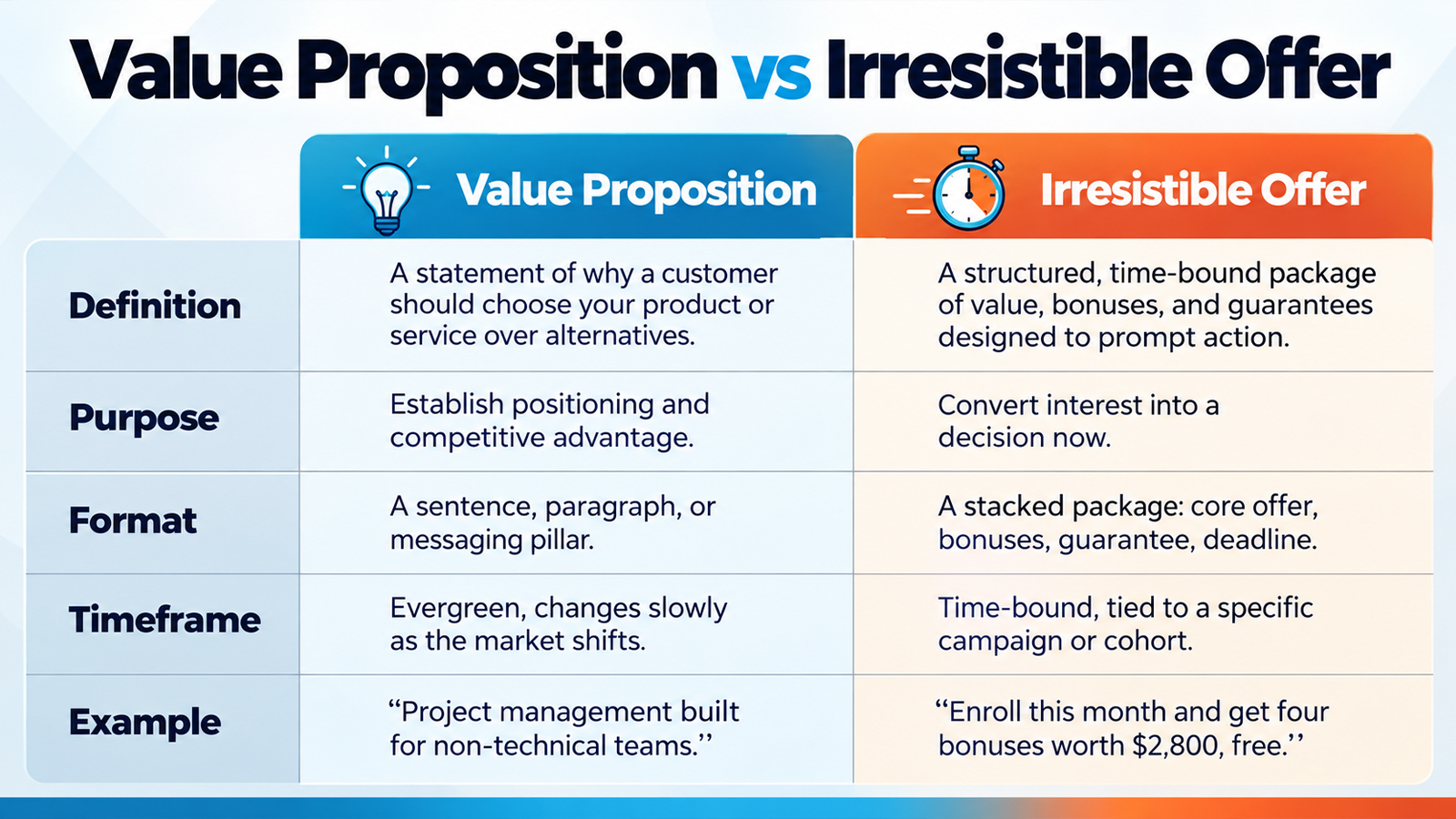
Before you dig into theory, here’s the fast version. This table is built for scanning, not studying. Check it mid-brief and move on. If you’ve ever wondered why a well-written value proposition still doesn’t convert interest into a decision now, the table below is where that gap usually gets explained.
| Value Proposition | Irresistible Offer | |
|---|---|---|
| Definition | A statement of why a customer should choose your product or service over alternatives | A structured, time-bound package of value, bonuses, and guarantees designed to prompt action |
| Purpose | Establish positioning and competitive advantage | Convert interest into a decision now |
| Format | A sentence, paragraph, or messaging pillar | A stacked package: core offer, bonuses, guarantee, deadline |
| Timeframe | Evergreen, changes slowly as the market shifts | Time-bound, tied to a specific campaign or cohort |
| Example | “Project management built for non-technical teams” | “Enroll this month and get four bonuses worth $2,800, free” |
A value proposition usually backs your whole brand or product line’s competitive edge. An irresistible offer gets rebuilt or refreshed for nearly every campaign you run.

What Is a Value Proposition? (Crafting Your Value Proposition)
A value proposition is a clear statement of the unique benefits a customer gets. It explains why they should choose your product or service instead of a competitor’s. It’s not a slogan. It’s not a list of features. It’s the argument, boiled down, for why you’re the right fit for a specific person with a specific pain point. And it explains why that value can’t be found anywhere else. Done well, it shows the unique value only your product delivers. That’s exactly what separates a great value proposition from a forgettable one.
Core Components of a Strong Value Proposition
A strong value proposition usually has four parts:
- A defined target customer, not “everyone who might buy software”
- A named pain point that customer actually feels day to day
- A differentiator that sets you apart from the rest of the field
- A proof point, like a guarantee, data point, or track record, that makes the claim believable
Miss any one of these, and the value proposition gets vague fast. Get all four right, and everything downstream, including the offer, has something solid to stand on. It also needs to match how your product actually gets used day to day. If it doesn’t, the claim will feel off the moment a customer tries it. A promise the product can’t back up breaks trust fast.
Real-World Value Proposition Examples
A project management tool built for non-technical teams might focus on simplicity: “The only project tool your whole team will actually use, no training required.” A customer support platform might lean on speed: “Answer every ticket in under two minutes, guaranteed.” Both name a target customer, a pain point, and a reason to believe. Neither one asks the customer to act right away. That’s the offer’s job. Both work because the wording connects with the exact person feeling that pain, not a general audience. When the wording matches how that person already talks about their problem, the value proposition does its job before the offer ever enters the picture. It’s far more likely to resonate with the potential customers you’re actually trying to reach.
Frameworks: Value Proposition Canvas and StoryBrand
Two well-known frameworks make this easier to build instead of guessing at it. The Value Proposition Canvas, created by Alexander Osterwalder, maps customer jobs, pains, and gains against your product’s features and pain relievers. This makes the fit visible instead of assumed. Donald Miller’s StoryBrand framework takes a different angle. It frames the customer as the hero of the story and your brand as the guide that solves their frustration. This keeps your messaging focused on the customer instead of your company. Used together, they cover both the analytical side (Osterwalder) and the storytelling side (Miller) of a strong value proposition. This helps you sharpen the message until it fits the audience you’re targeting, stays true to what that audience actually values, and connects well beyond a first read.
If you’re mapping this out for the first time, it’s worth doing on paper before you touch a landing page. A shaky value proposition tends to show up later as a shaky offer. And that’s a more expensive fix.

What Is an Irresistible Offer?
An irresistible offer is a structured, time-bound package of value, bonuses, guarantees, and scarcity. It’s built to push a buyer to act now instead of later. It’s what a value proposition turns into once it’s wrapped up for a specific campaign.
Core Components of an Irresistible Offer
Every strong offer includes a handful of moving parts:
- A value stack: the core deliverable plus extras that raise what the customer gets
- Bonuses tied directly to removing friction, not random extras
- Scarcity or urgency, like limited spots or a deadline
- A guarantee that shifts risk away from the buyer
- Price framing that shows the value delivered outweighs the cost by a wide margin
Hormozi’s Value Equation Explained
Alex Hormozi, in his book $100M Offers, built what’s now called the Grand Value Equation. It says value equals dream outcome multiplied by perceived likelihood of achieving it, divided by time delay multiplied by effort and sacrifice. The math isn’t really the point. The point is that great value comes from boosting the top of that equation (outcome, believability) while shrinking the bottom (time, effort) at the same time. That’s why bonuses and guarantees do more conversion work than a plain price cut. It’s also why a genuinely great value proposition, paired with the right stack, becomes a great value proposition offer that’s hard to walk away from.
Examples of Irresistible Offers in Action
A done-with-you onboarding bonus stack that gets a potential customer their first result within 24 hours cuts down perceived time delay. A guarantee tied to a specific, measurable outcome, not a vague “satisfaction guaranteed,” shrinks perceived risk. A cohort model that only opens six spots a month creates real scarcity instead of manufactured hype. Real customers respond to these mechanics because each one answers a fear or friction point they already have. It’s not because they’re clever copywriting tricks.

Is a Value Proposition the Same as a Unique Selling Proposition (USP)?
No. A value proposition is the broader statement of your overall value. A unique selling proposition, or USP, is the single most different claim inside it.
Value Proposition vs USP: The Scope Difference
A value proposition can hold multiple benefits, multiple proof points, and speak to more than one audience segment. A USP is narrower on purpose: it’s the one unique selling point that no competitor can honestly claim. HubSpot is a good example here. Its broader value proposition covers an all-in-one growth platform spanning marketing, sales, and service. But a specific product line inside HubSpot might carry a sharper USP, like being the easiest CRM to set up without help. Mixing up the two often leads marketers to cram an entire value proposition into a single punchy line meant to carry only one idea. The result usually reads as vague instead of sharp. Get this wrong, and both your differentiation and your competitor comparison end up muddy.
How Do You Turn a Value Proposition Into an Offer? (How They Work Together)
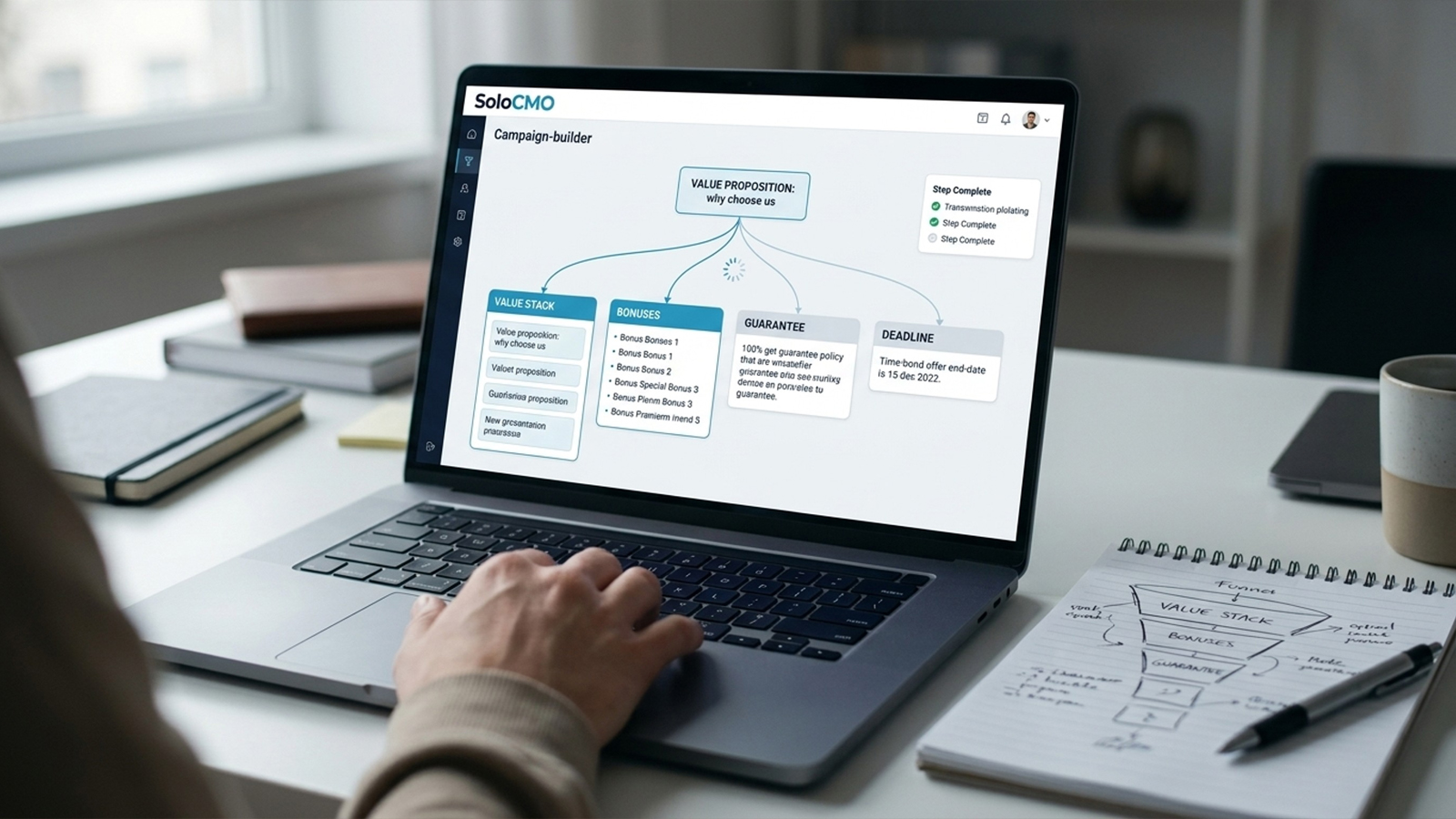
Think of the value proposition as the foundation and the offer as the wrapper built on top of it.
Value Proposition as Foundation, Offer as Wrapper
The value proposition answers “why you.” The offer answers “why now, why this deal.” A strong offer without a matching value proposition risks feeling like a discount trick instead of a real competitive edge. There’s no real reason behind the urgency. Clayton Christensen’s Jobs to Be Done idea is useful here. It asks what job the customer is actually hiring your product to do. Your offer needs to solve that same job, just faster and with less risk than the value proposition alone promised. It also needs to align with the same positioning so nothing about the pitch feels bolted on.
Worked Example: From Value Proposition to Offer Stack
Say a generic B2B SaaS company’s value proposition is “saves marketing teams hours each week through automation.” On its own, that’s a fine positioning statement. But it doesn’t push anyone to sign up today. Wrap it in an offer: a 14-day fast-start onboarding call, a library of ready-to-use templates, a scorecard proving hours saved, a guarantee that build time drops by half within two weeks, and a deadline tied to a limited monthly cohort. Now the same value proposition has a real reason to act attached to it. The fit between product and market shows up in the results, not just the pitch.
Curious what this looks like fully built out for a solo marketing team specifically? Our full offer breakdown walks through the same structure, deliverable by deliverable, so you’re not starting from a blank page.
Common Mistakes to Avoid
Most marketers don’t get this wrong because they’re careless. They get it wrong because nobody drew the line clearly before.
Mistake: Mixing Up the Two Terms
Using “value proposition” and “offer” as if they mean the same thing in a campaign brief confuses whoever reviews the work. It often produces an asset that’s half positioning statement, half sales pitch, and fully unclear.
Mistake: Offer With No Value Proposition Behind It
Leading with bonuses, discounts, and urgency with no real differentiation underneath reads as gimmicky to a skeptical buyer. And skeptical buyers can usually tell.
Mistake: Value Proposition With No Call to Action
A technically correct value proposition that never asks for action is one of the most common reasons campaigns get scrapped and rebuilt mid-week. That’s exactly the kind of frustration a solo marketer can’t afford. Along the way, plenty of marketers also confuse a value proposition with a tagline. A tagline is a short, memorable phrase built for recall. It’s not a strategic explanation of why a customer should choose your product over a competitor. Both matter. They’re just not the same tool.

How to Build Both for Your Business (Refining Your Value Proposition and Offer)
Refining your value proposition and building an offer around it doesn’t take a strategy retreat. It takes a clear sequence.
The 5-Step Build Checklist
- Define your ideal customer profile and the specific pain point they’re trying to solve
- Spell out your differentiation, including a clear USP that no competitor can honestly claim
- Build the value stack: core deliverable plus bonuses that remove real friction
- Add a guarantee and a scarcity or urgency mechanic to speed up the decision timeline
- Tailor the final package to your target customers instead of running one generic version for every segment. Keep the experience from ad click to checkout consistent with the promise you made upfront. A smooth user experience backs up every claim made earlier in the funnel
Testing and Refining With CRO and A/B Testing
Testing and refining your value proposition and offer isn’t a one-time task. Customer needs shift, new features ship, and what converted last quarter can go flat this quarter. Conversion rate optimization and A/B testing give you a way to check which version of a headline, offer stack, or guarantee actually works better, instead of relying on a gut feeling. Run one variable at a time, let the data decide, and refine the offer as results come in. Buyer expectations keep changing along with the market, and a good offer has to evolve right along with them. Treat this as an ongoing habit, not a box you check once. Each round of testing is a chance to sharpen the wording until it matches how customers actually talk about their own problem. It should also keep matching what potential customers say they want.
If testing isn’t realistic on top of everything else on your plate right now, that’s a fair place to be. It’s still worth building the offer correctly the first time. That way, whatever you test later is testing real variables, not just patching a shaky foundation.
Conclusion: Why This Distinction Saves a Solo Marketer’s Week
Knowing the difference between a value proposition and an irresistible offer isn’t just academic. It’s the difference between building a campaign once and building it three times because something felt off but nobody could name why. A compelling value proposition tells the customer why you’re worth trusting. A well-built offer tells them why today is the day to act. Put both to work together, and campaigns stop stalling in the middle of the funnel. You already have the strategic groundwork sorted out, and that’s the hard part. The next move is turning it into a stacked, deadline-driven offer without burning another week on the build. If it’s helpful, you can get an estimate and hand off the offer construction so you can get back to everything else on your plate.
FAQ
What is an example of a value proposition?
A clear value proposition example is “Project management built for non-technical teams, with zero onboarding required.” It names the target customer, the pain point (complexity), and the differentiator (no training needed) in one line. A strong example like this is where an offer conversation should start, not end.
What makes an offer irresistible?
An irresistible offer combines a strong value stack, a guarantee, and real scarcity or urgency so the perceived value clearly outweighs the perceived cost. Hormozi’s Value Equation frames this as boosting dream outcome and believability while shrinking time delay and effort. Stacking these elements correctly is a structured skill, not something to freehand under deadline pressure.
Is a value proposition the same as a unique selling proposition (USP)?
A value proposition and a USP are related but not identical. The value proposition is the broader case for why customers choose you. The USP is the single sharpest claim inside it. The full breakdown is above, but misapplying this distinction in a campaign brief is a common, fixable mistake.
How do you turn a value proposition into an offer?
You turn a value proposition into an offer by wrapping it in a value stack, bonuses, a guarantee, and a deadline that all support the same underlying promise. The worked example above shows this step by step. This transformation is exactly what a structured offer-build process is designed to handle.
Do you need both a value proposition and an irresistible offer?
Yes, you need both, because each one does a job the other can’t do alone. The value proposition builds belief and positioning, while the offer converts that belief into action. Skipping either one is one of the biggest reasons campaigns underperform.
What is the difference between a value proposition and a tagline?
A tagline is a short, memorable phrase built for brand recall. A value proposition is a fuller strategic explanation of your differentiation and who it’s for. Confusing the two often produces taglines that sound clever but convert nothing, because they were never built to carry the weight of a full value proposition.
Still sorting out where your own positioning ends and your offer should begin? That’s a normal place to be mid-brief, and it’s a quick thing to talk through if you want a second set of eyes on it.
Recent Posts
Content Refresh vs Rewrite: Which Fixes Decaying Blog Posts Faster
A content refresh ships faster, usually in 1 to 3 hours versus 4 to 8 for a rewrite, but a rewrite recovers faster when the decay stems from a search intent mismatch. The rule of thumb is to refresh the post if it still matches what searchers want and most of it is salvageable, and to rewrite it if the

How to Build a Topic Cluster From Scratch for Your SaaS Blog
To build a topic cluster, pick a pillar topic that fits your product, collect subtopic keywords, group them by SERP overlap and intent, size the cluster, link every page to the pillar, publish in stages, then measure at cluster level. That is how to build a topic cluster in a way you can defend to a founder, and our topical authority

Where Leads Drop Off Between Ad Click and Signup
Funnel drop off between click and signup occurs at six points: the ad click, page load, above the fold, form start, form submit, and verification. The most significant leaks usually sit upstream, where the ad promise fails to match the page or where the page loads too slowly on mobile before the form ever appears. If your paid ad campaigns show
Get Smarter About Your Marketing
Practical SEO, AI, content, and marketing strategies you can put to work immediately.
Join the Newsletter