
Marketing Strategy

A buyer persona not converting almost always traces back to one of five root causes: it was built on guesses instead of real deal data, it’s too generic, your ideal customer changed and nobody updated the document, it ignores the buying committee, or it’s never been checked against closed-won and closed-lost records. Before you rebuild anything from scratch, it helps to know what a real buyer profile actually looks like, and our buyer persona and avatar generator was built for exactly this kind of fast, solo fix.
Key Takeaways
- A buyer persona stops converting when it’s built on guesswork, kept too generic, left stale, or never checked against real deal data.
- A 4-question audit that compares persona claims to CRM records and campaign performance tells you fast whether the persona is really the problem.
- The fastest fix uses data you already have: CRM notes, sales calls, LinkedIn Sales Navigator, GA4, and NPS comments. You don’t need a new research project.
- A validated persona can be rebuilt in one day using AI-assisted synthesis, as long as a human checks it against real deals before it ships.
- Buyer personas and ICPs solve different problems. Mixing them up is one of the quietest reasons campaigns underperform.

What Is A Buyer Persona in Marketing Strategy?
A buyer persona is a research-based profile of the specific human who decides whether to spend money on your product or service. Not a mood board. Not a job title with a stock photo. A working document that captures goals, objections, decision triggers, and the buying behavior patterns that repeat across your closed deals.
In digital marketing, the persona sits underneath everything else. Your messaging, your ad targeting, your content marketing calendar, your email sequences all inherit whatever assumptions live in that document. Get it right and every downstream asset gets sharper. Get it wrong and you scale the error.
How Do You Use a Buyer Persona?
A persona that lives in a folder nobody opens isn’t doing any work. Teams that actually use buyer personas wire them into specific decisions.
- Content marketing: mapping topics to the questions potential customers ask at each stage instead of publishing whatever’s trending
- Paid and organic targeting: choosing keywords, audiences, and placements based on where that person already spends attention
- Messaging and offers: leading with the objection the persona actually raises, not the benefit you find most interesting
- Sales enablement: giving reps the language buyers use for their own problem
- Marketing campaign planning: deciding which segment a campaign is for before a single asset gets built

What Makes a Buyer Persona Stop Converting?
Most buyer personas fail quietly. Nobody notices until the email sequence flatlines or the ad spend stops turning into pipeline. Here are the patterns we see over and over.
Assumption-Built vs. Evidence-Built Personas
A lot of personas get built in an afternoon, based on what the founder or sales lead assumes the ideal customer looks like. That’s a guess dressed up as strategy. If nobody interviewed a real closed-won buyer, the persona is fiction with a job title attached. If your goal is to create buyer personas that hold up under real scrutiny, the process has to start with evidence, not a founder’s best guess.
When Demographics Replace Real Insight
Too many personas stop at demographics: age, job title, company size. That’s a shell, not a person. A good buyer persona also needs the psychographic layer: the goals, objections, and Jobs-to-be-Done triggers that actually explain a buying decision. A single demographic detail tells you nothing about why someone signs.
Stale Personas After an ICP Shift
Moved upmarket? Launched a new tier? Entered a new vertical? Your old persona now describes yesterday’s ideal customer. Personas that never get revisited after an ICP shift quietly drag down every campaign built on top of them.
Two more failure points round this out. Most personas ignore buying committee dynamics entirely, written as if one person makes the call. Research from SiriusDecisions, now part of Forrester, found that roughly 80 percent of B2B purchases involve three or more stakeholders. A single-persona document rarely reflects that reality. Personas are also almost never checked against closed-won and closed-lost deal data, so there’s no feedback loop telling you when persona and reality have drifted apart. Building a negative persona, the profile of who you should not target, is a step almost everyone skips too.
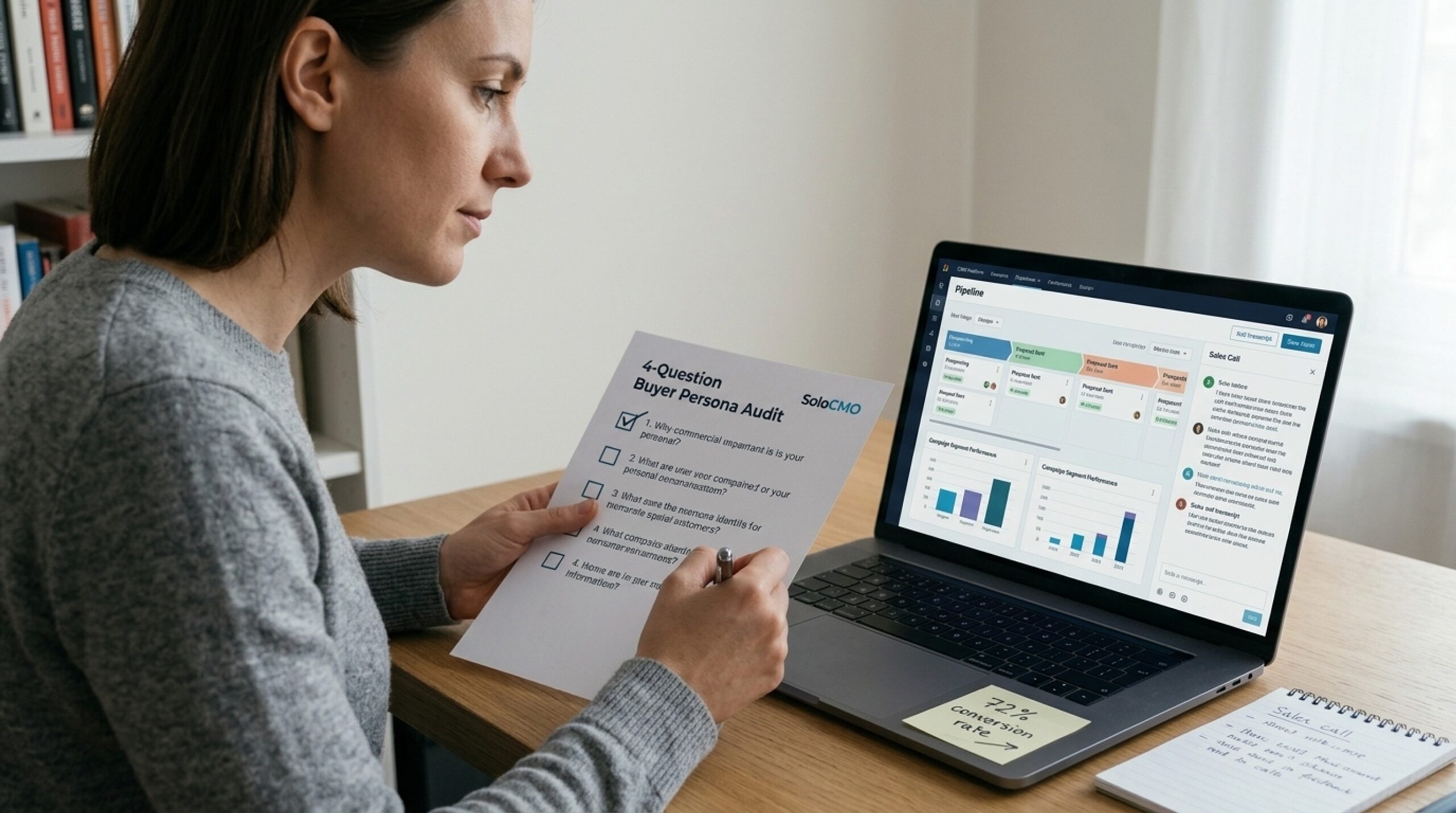
How Do You Validate a Buyer Persona With Real Data? (The 4-Question Diagnostic Audit)
This audit takes under an hour and tells you whether the persona is really the problem, or if something else in the funnel is to blame.
- Does the persona’s stated pain point match what’s actually logged in CRM deal notes inside HubSpot or Salesforce?
- Does campaign performance, when split out by persona, match your assumptions, or does another segment quietly outperform it?
- What does your sales team actually say in call debriefs about who buys and why?
- Where does drop-off concentrate in the funnel, and does that match the buying journey your persona assumes?
Reading CRM and Funnel Data Together
Pull both qualitative and quantitative signals. CRM fields give you the numbers. A 15-minute conversation with your sales team gives you the language and context behind them. If the pain point in your persona document doesn’t show up anywhere in actual deal notes, that’s your answer right there. This audit isn’t a research project. It’s a gut check you can run today, using data already sitting in your systems.
Which Data Sources Actually Fix a Broken Persona?
You don’t need new research. You need to pull together what’s already scattered across tools you already pay for.
- Closed-won and closed-lost interviews: the highest-signal source available, revealing real triggers and objections
- Support tickets and sales call recordings: unfiltered language buyers use to describe their own pain point
- LinkedIn Sales Navigator: firmographic patterns among closed-won accounts, including company size and job titles
- Google Analytics 4 behavior flow: shows which content actually moves prospects forward and which gets ignored
- NPS verbatims: an underused source of sentiment and language straight from existing customers
Deal-Level Sources: Closed-Won and Closed-Lost
Your CRM, whether that’s HubSpot or Salesforce, already holds the insight you need. Deal notes, call transcripts, stage-by-stage history. Together they tell you exactly what convinced someone to buy, or what killed the deal.
Behavioral and Sentiment Sources: GA4 and NPS
GA4 shows you the actual path someone takes before converting, not the path you assumed they’d take. NPS scores and their open-text comments show you how existing customers describe their own experience. That’s often the exact language your messaging should build around, and it’s the raw material that lets you personalize outreach instead of sending the same generic message to every lead. None of this requires a new tool or a research budget, just an afternoon of pulling it together.

How Do You Rebuild a Persona in a Day, Not a Month?
One SMB software company had a persona built two years earlier around a junior buyer title. When they finally pulled their last 12 closed-won deals, they found the actual signer was almost always one level up, with a different core objection than the persona assumed. The fix wasn’t a new research phase. It was one afternoon spent reading their own CRM data.
A 5-Step Solo Workflow
- Pull the last 10 to 15 closed-won and closed-lost deals and extract common pain points, objections, and phrases
- Cross-reference that with CRM firmographic fields and your top-converting GA4 content paths
- Use AI-assisted synthesis to draft a first-pass buyer persona from the combined data set in hours, not weeks
- Validate the AI draft against at least three real sales calls or customer conversations before finalizing anything
- Publish it into a simple buyer persona workbook your email, ad, and content workflows can actually use
Where AI Helps and Where It Can’t Be Trusted Alone
Can AI create accurate buyer personas? AI is genuinely fast at spotting patterns across scattered data, and it can draft a workable persona in minutes. But it can’t replace the human step of checking that draft against real sales calls and closed deals. Skip that validation and you’ve just replaced one guess with a faster, better-dressed guess. This is the exact workflow our own ICP generator is built around: synthesize fast, then confirm against real deal data before anything goes live.
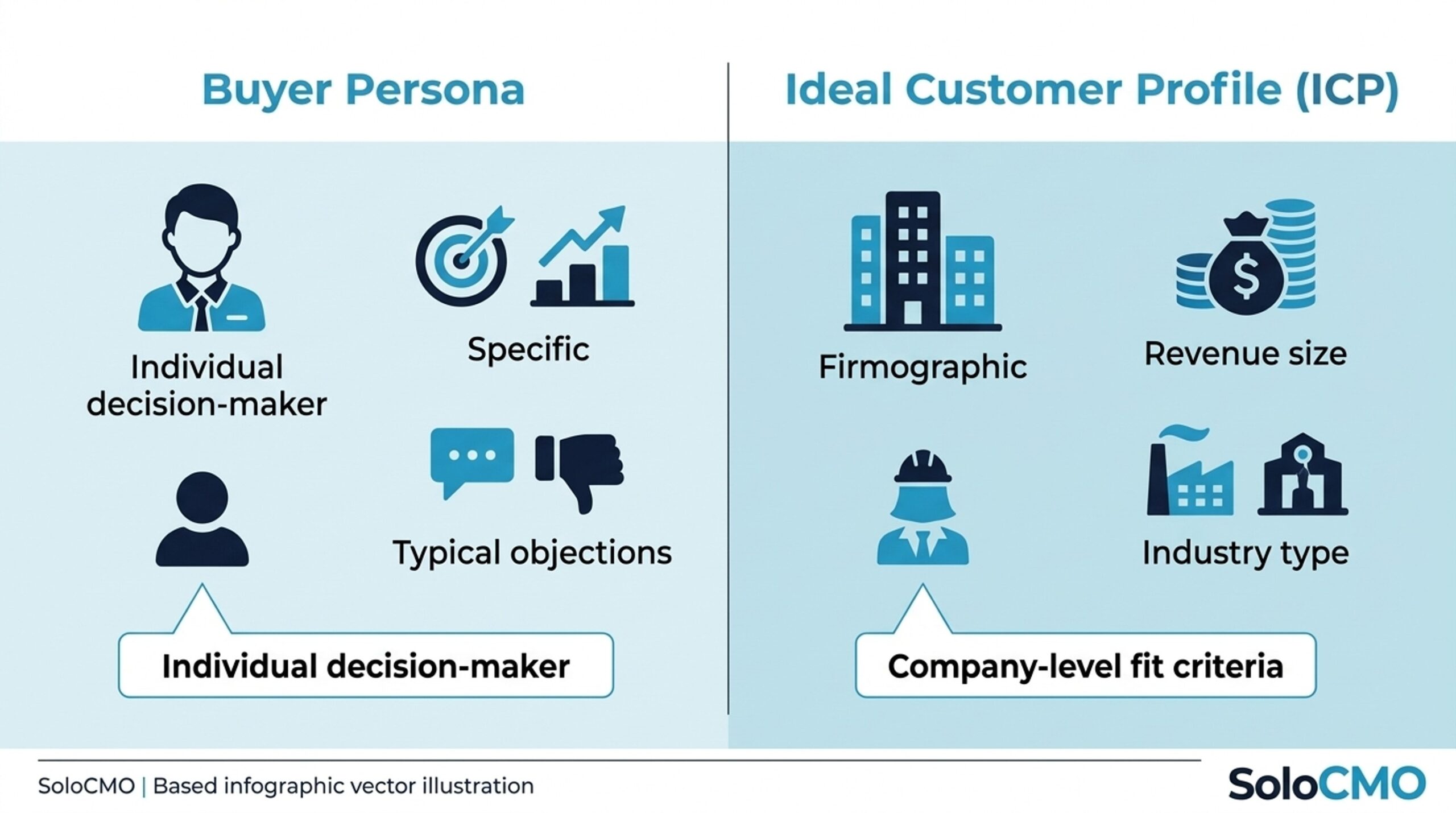
Buyer Persona vs. ICP: Why Solo Marketers Confuse Them
An Ideal Customer Profile (ICP) describes the company that fits your product. A buyer persona describes the individual human who buys or influences that purchase inside that company. Solo marketers often build one document trying to do both jobs. It ends up doing neither well.
| ICP | Buyer Persona | |
|---|---|---|
| Defines | The company that fits your product | The individual who buys or influences the buy |
| Scope | Firmographic: industry, size, budget, tech stack | Psychographic: goals, pain points, objections, JTBD triggers |
| Built from | Closed-won account data, LinkedIn Sales Navigator | Sales call feedback, interviews, NPS verbatims |
| Used for | Targeting and lead scoring | Messaging, content, and inbound marketing personalization |
How Many Good Buyer Personas Does a Small Business Actually Need?
Most B2B teams need one ICP paired with two to three personas that cover the core buying committee: a decision-maker and one or two secondary influencers. That’s enough to represent real customer segments without becoming unmanageable for a single marketer. Trying to maintain multiple personas per customer segment, or a new ICP for every persona, is a fast route to neglect. Fewer, sharper personas beat a stack of stale ones nobody updates.
Once your rebuilt persona is live, treat it as a hypothesis, not a finished product. Compare email open-to-conversion and landing page results before and after the switch, and give it two full campaign cycles before judging the outcome. A light quarterly check, pulling last quarter’s closed-won and closed-lost deals against current campaign performance, keeps the persona from going stale again.
Conclusion: Fix the Persona, Fix the Pipeline
A buyer persona that doesn’t reflect real deal data will keep dragging down email opens, ad clicks, and landing pages, no matter how much creative effort you pour into them. That’s not a discipline problem. It’s a missing feedback loop.
You now know exactly why your persona stopped converting, and the fix doesn’t require a research team, an agency, or months on the sidelines. It’s a data-synthesis problem, and it’s solvable in a day. If you’d rather talk it through than piece it together solo, get an estimate and we’ll help you rebuild the persona and put it back to work in your campaigns.
FAQ
What makes a buyer persona ineffective?
A buyer persona becomes ineffective when it’s built on assumptions, stays too generic, or is never checked against real closed-won data. Demographic-only details, without pain points or objections, leave sales reps and marketers guessing. A data-driven rebuild fixes this by grounding every claim in actual deal history.
How often should you update a buyer persona?
A buyer persona should get a light review every quarter and a full rebuild whenever your ICP shifts. Waiting years between updates, which is common advice in some HubSpot community threads, lets your persona drift far from your actual customer base. A structured quarterly cadence is realistic even for a team of one.
What’s the difference between a buyer persona and an ICP?
An ICP defines the company that fits your product, while a buyer persona defines the individual person inside that company who makes or influences the buying decision. Confusing the two is one of the most common mistakes solo marketers make. Keeping them as separate, connected documents fixes it.
How do you validate a buyer persona with real data?
Validating a buyer persona means comparing its stated pain point against CRM deal notes, campaign performance by segment, and direct sales team feedback. If those three sources disagree with the persona, it needs a rebuild. Running this consistently is far easier with a dedicated system than a manual quarterly scramble.
How many buyer personas should a small business have?
Most small businesses need one ICP supported by two to three buyer personas covering the main roles in the buying process. Scaling past that without dedicated tooling usually leads to personas nobody maintains. Fewer, well-validated personas outperform a large, stale library every time.
Can AI create accurate buyer personas?
AI can pull together a persona draft from scattered data sources in hours instead of weeks, speeding up the whole process. But it still needs human validation against real sales calls and closed deals to be accurate. That AI-plus-human workflow is exactly what a purpose-built platform should support.
How do you know if your persona is the reason campaigns are underperforming?
Contradicting CRM data and segment-level campaign performance together signal that the persona is the problem, not some other part of the funnel. That gap, checked with the 4-question audit above, is the fastest way to isolate the real issue. If you don’t have time to run that audit yourself, that’s exactly where a quick conversation can save you weeks of guesswork.
Recent Posts

Why Is My Funnel Converting Below Industry Average?
A below-average funnel conversion rate almost always comes from one of five causes: mismatched traffic, a weak landing page or offer, poor follow-up, weak lead qualification, or the wrong benchmark. You don’t need a week of guessing to find the cause. A structured funnel diagnostic can find it in hours. If you’d rather hand the work off, that’s exactly what
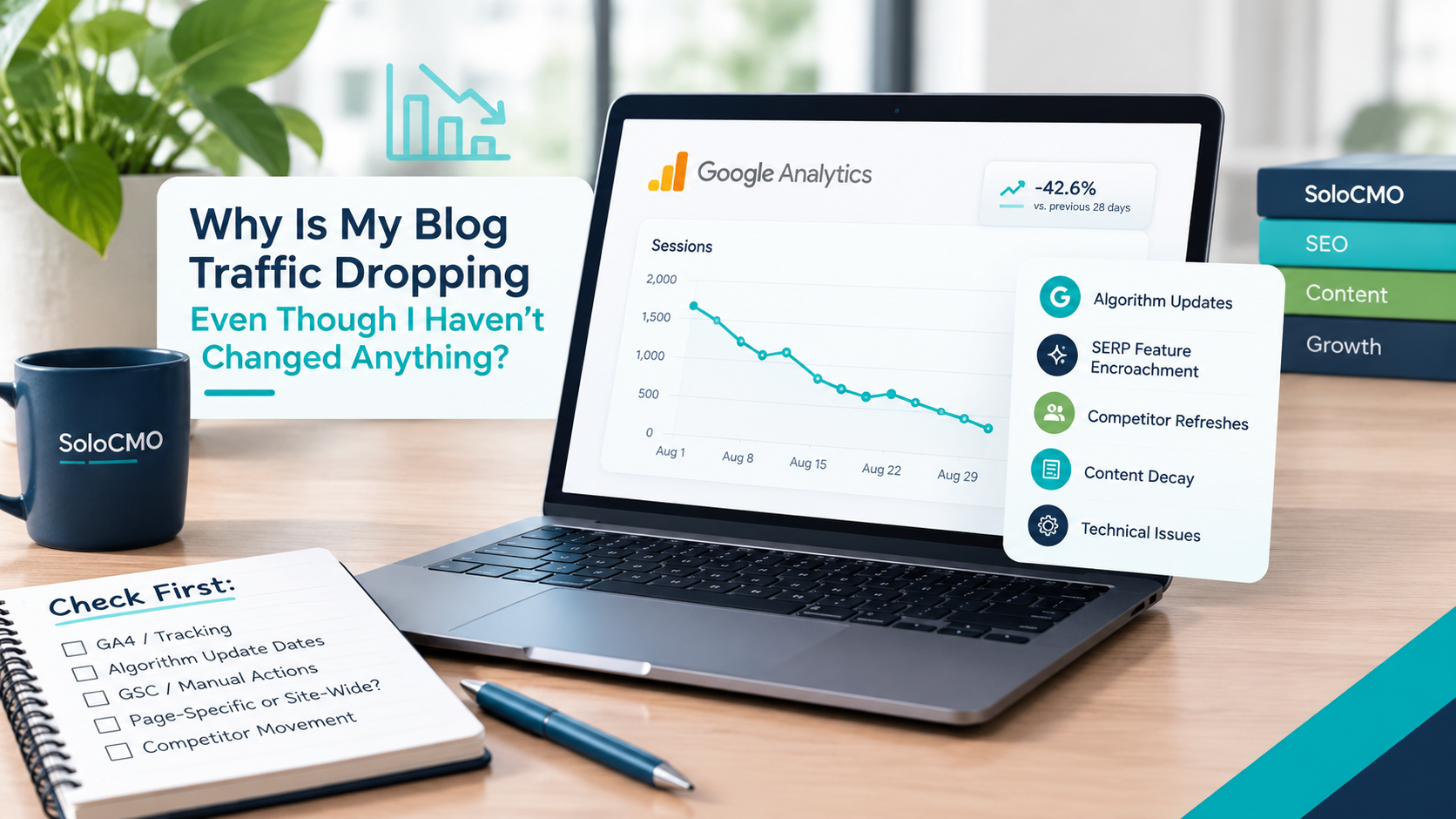
Why Is My Blog Traffic Dropping Even Though I Haven’t Changed Anything?
If you’re staring at a declining line in Google Analytics and mentally replaying every recent action looking for what you broke, stop. Blog traffic dropping for no reason is one of the most confusing problems a solo marketer can face. Here’s the short answer: it’s almost never something you did. Traffic drops without site changes are usually caused by algorithm
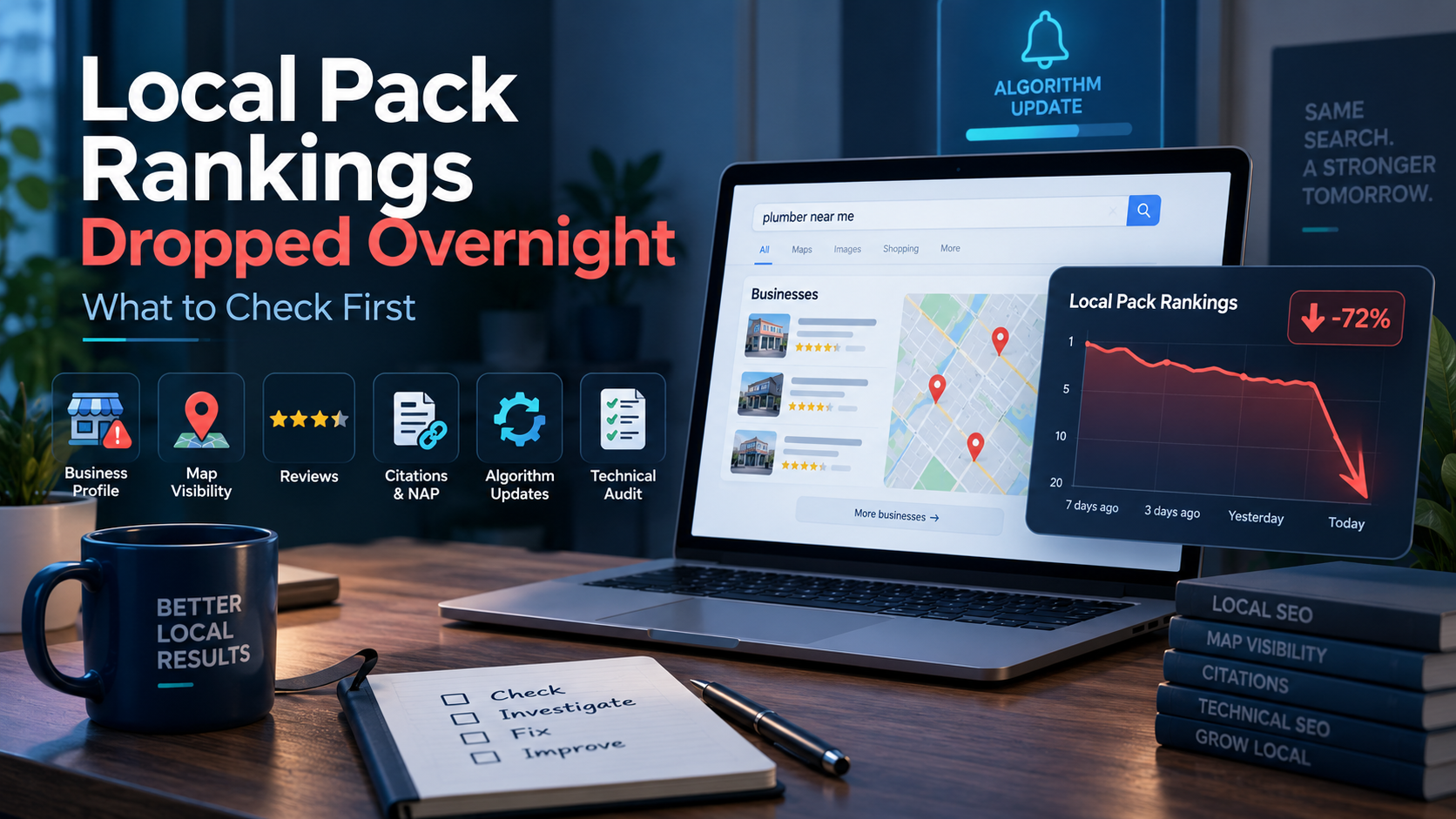
Local Pack Rankings Dropped Overnight: What to Check First
Okay, first thing: check your Google Business Profile status. When local pack rankings drop overnight, that’s the fastest and most common cause, and confirming it takes under two minutes. This isn’t a mystery that needs an agency or a week of guessing. It’s a known, ordered checklist, and you can run it yourself in the next hour. If your GBP
Get Smarter About Your Marketing
Practical SEO, AI, content, and marketing strategies you can put to work immediately.
Join the Newsletter