Local SEO
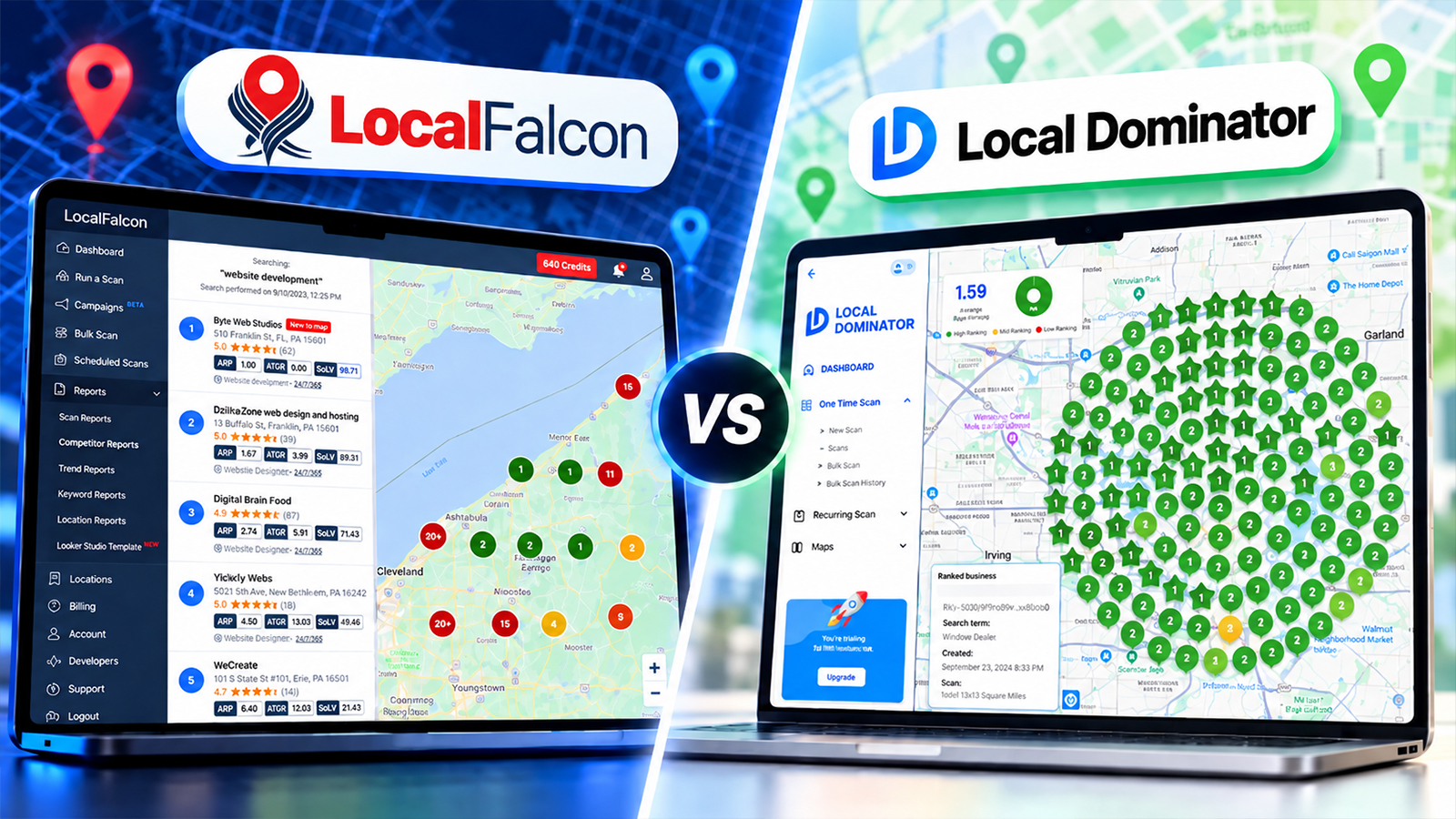
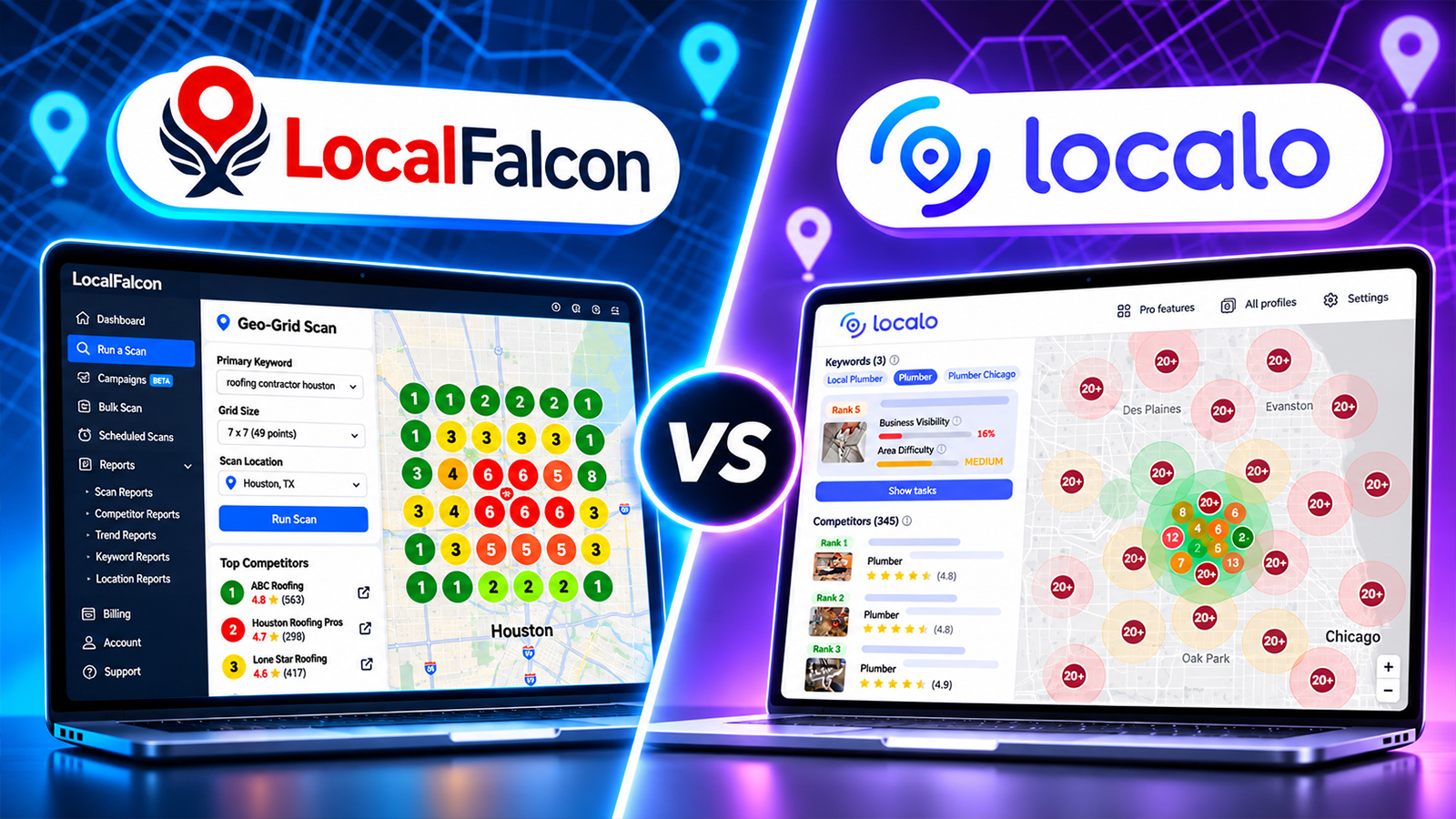
You’ve narrowed it down to Local Falcon vs. Local Dominator. At this point, you don’t need another rundown of what geo-grid tracking is. You need someone to look at both tools fairly and help you land on an answer fast. Here’s the real question behind “which tool is better”: which one fits a job where you own local SEO performance along with every other marketing task on your plate. The tool you pick should make that job faster, not heavier. This comparison names the real strengths and weaknesses of both. It ends with a plan you can act on today.
Key Takeaways
- Local Falcon starts around $29 a month and scales to $99 or more with credit-based scanning. This suits agencies and multi-location accounts with flexible budgets.
- Local Dominator starts lower, roughly $19 to $69 a month, with a simpler setup built for single-location solo operators.
- Grid size drives credit cost on both platforms. A bigger grid gives you a sharper map. But it also burns through your monthly allowance faster.
- Neither tool solves the real problem: turning rank data into fixed listings, better citations, and improved reviews still takes hours most solo marketers don’t have.
- The right choice comes down to scale and budget flexibility versus simplicity and price. It’s not about which brand is more popular.
What Rank Tracking Actually Means for a Solo Marketer
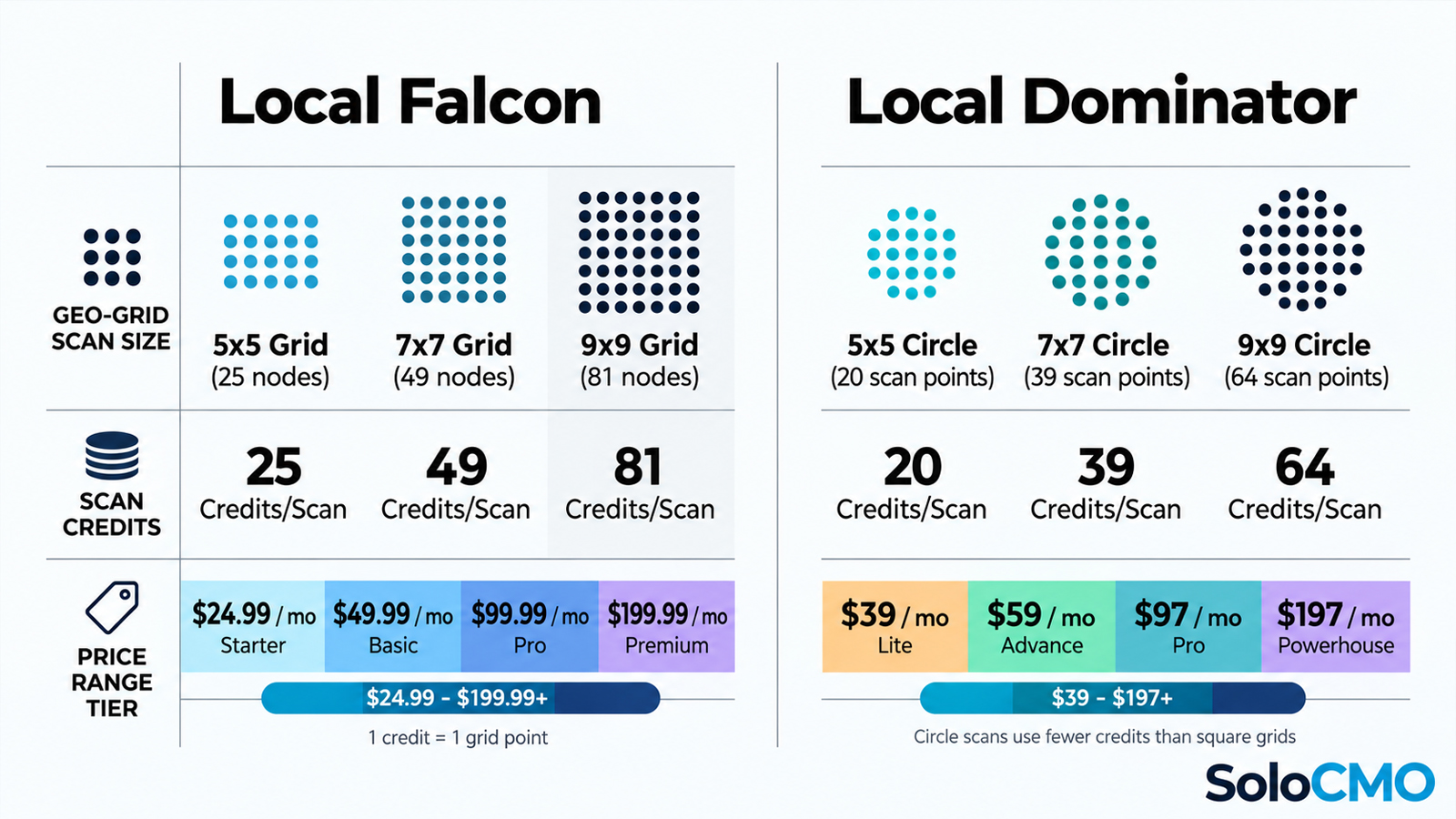
Geo-grid rank tracking works in a simple way. It runs a search for a target keyword from dozens of fake locations around a business. Then it plots each result on a visual grid. Instead of checking one search result from one spot, you see the full picture. You see where your business shows up strong and where it disappears. A 5×5 grid checks 25 points. A 7×7 grid checks 49. A 9×9 grid checks 81. More points mean more precision. But they also mean more credits spent per scan.
For someone handling local SEO as just one piece of a much bigger job, this matters more than it would for an agency with a full-time SEO hire. You don’t have a second person to double check a strange ranking. You don’t have time to spend an afternoon searching by hand from different neighborhoods. You need the grid to tell you the truth fast. The data only earns its keep if you can act on it before the next fire drill pulls you away.
Why Geo-Grid Data Beats a Single Rank Check
A single search from your office tells you almost nothing. That’s because Google changes results based on your exact location. A geo-grid scan removes that bias and shows real differences across a city or service area. This is the only way to know if your visibility is actually strong, or if it just looks that way from your desk. Whether you call it a geogrid or a ranking grid, the method is the same: fake searches across fixed points, mapped back to one visibility score. If you’ve never had to read one of these maps before, it helps to know how to read a local SEO heatmap before you compare tools based on their output alone.
The Real Constraint Isn’t the Tool, It’s the Hour You Don’t Have
Both tools can hand you a map full of dots. Neither one tells you why a dot is red instead of green. Neither tells you what to fix first. That’s where your week actually disappears, no matter which tracker made the data. Keep this in mind as you read on. It shapes which tool actually saves you time versus which one just looks good in a demo.
Local Falcon: Strengths, Weaknesses, and Best Fit
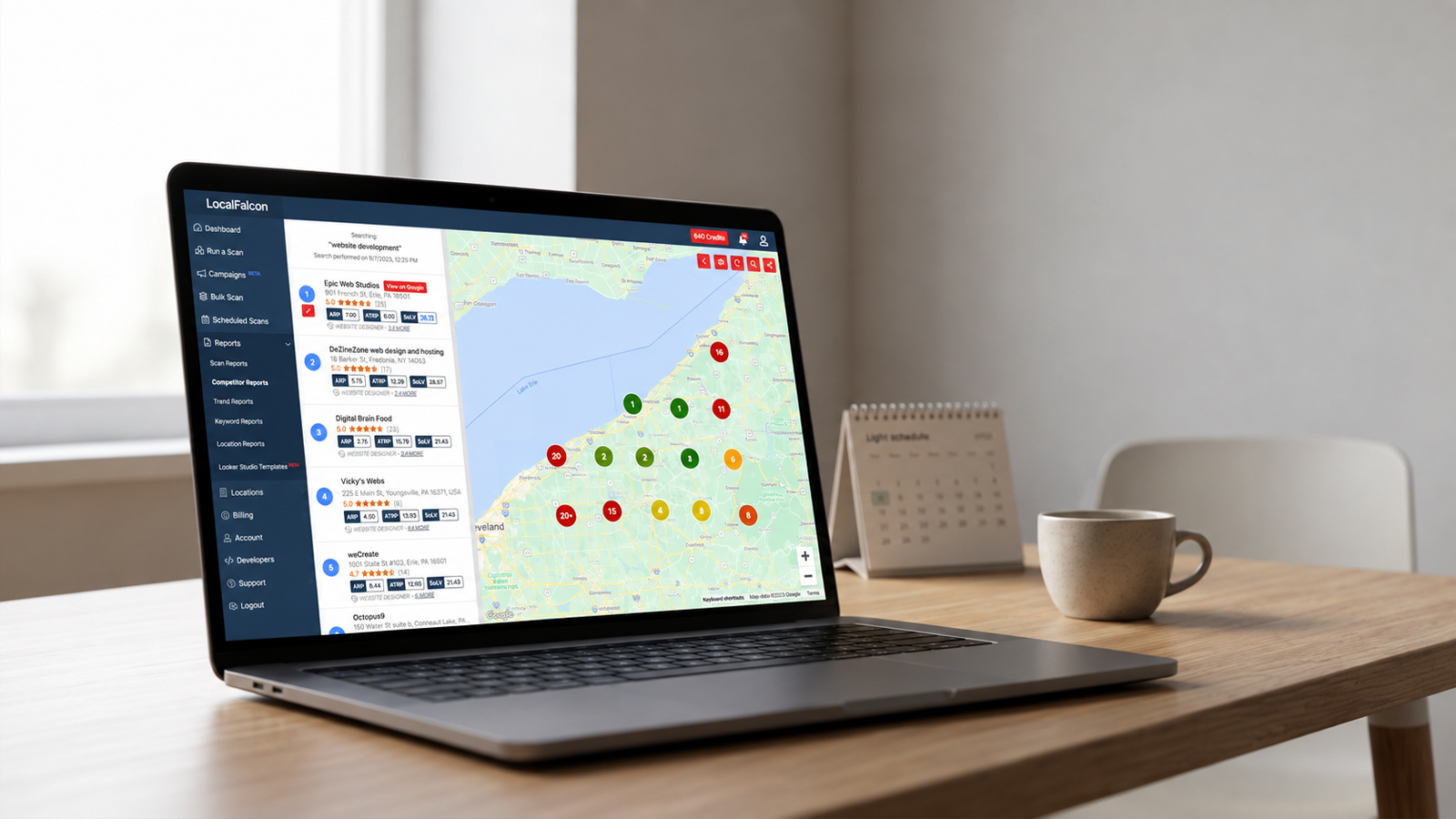
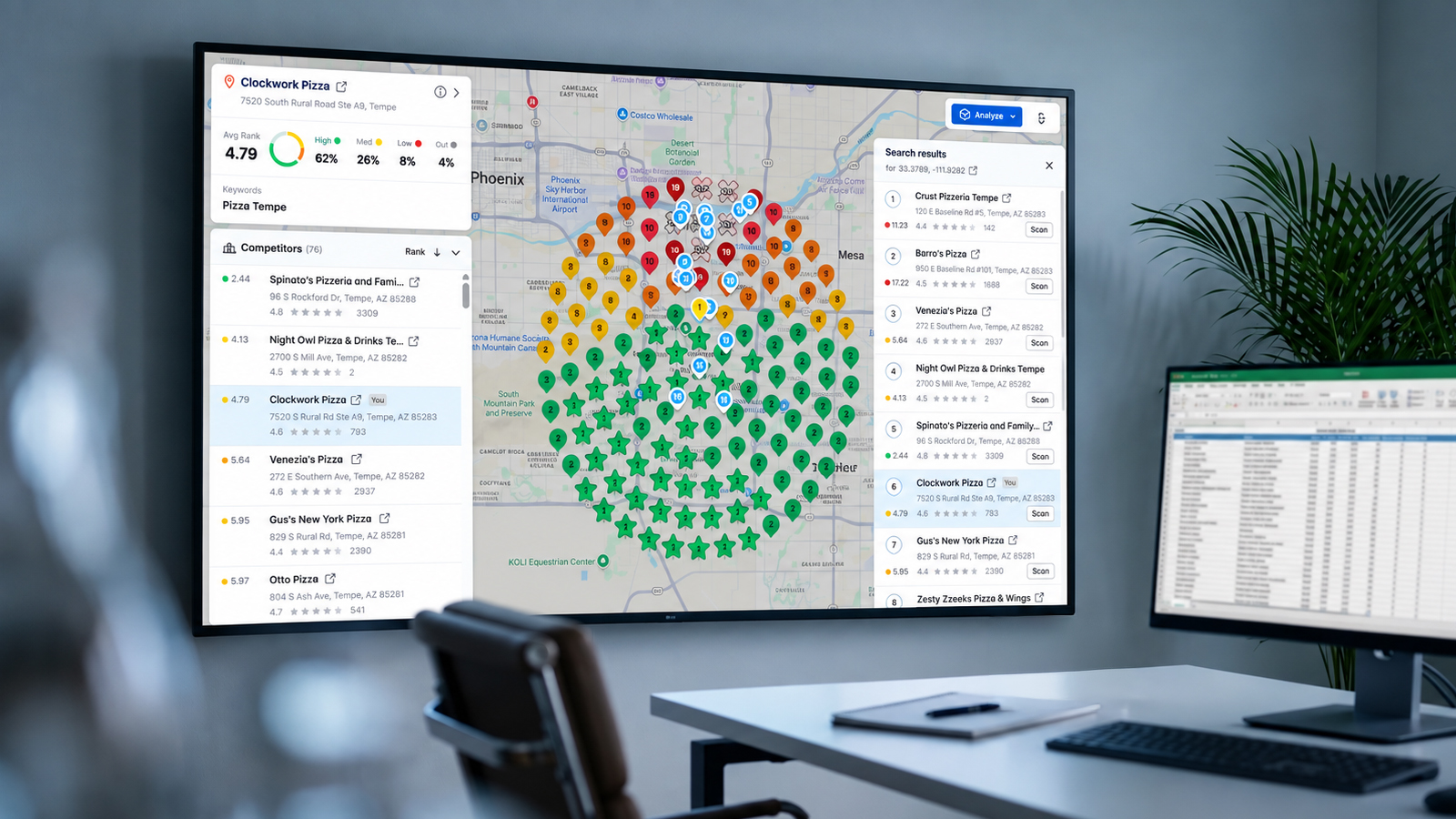
Local Falcon is the more established name in geo-grid tracking, and it shows in how deep the product goes. Falcon AI adds automatic insights on top of raw scan data. Competitor tracking shows how nearby businesses stack up keyword by keyword. Built-in GBP audits flag profile issues before they hurt rank. Links to Google Sheets, Zapier, and an open API mean the data can flow into whatever reporting setup you already use. Some solo marketers also use falcon local scans for a quick, one-time read on a location’s visibility. This helps them decide if a deeper, scheduled tracking plan is worth the credit spend.
Where Local Falcon Shines
- Industry-standard visuals that leadership and clients already recognize on sight
- Falcon AI and GBP audits add analysis beyond a plain ranking map
- Frequent product updates and a mature set of integrations
- Flexible scan sizing, so you can scale grid size to the keyword or market
Where Local Falcon Falls Short for a Team of One
Pricing runs $29 to $99-plus a month depending on plan tier and credit volume. Credits disappear fast if you scan often or track several keywords across multiple locations [1]. A 7×7 scan can use roughly 49 credits in a single pass. So a handful of keywords across even one location adds up fast. The interface and Falcon AI features also take real time to learn. Reports still need manual formatting before they’re ready to hand to a boss. Falcon’s local tracking is powerful, but that power is wasted if you spend an afternoon figuring out how to use it. The grid structure underneath is what makes that power possible in the first place. Every scan is really just a grid of fake searches mapped back to your profile’s visibility.
Local Dominator: Strengths, Weaknesses, and Best Fit
Local Dominator entered the market as a leaner option, and it leans into that identity. Setup is fast. The interface avoids clutter. Competitor benchmarking comes included rather than locked behind a pricier tier. Pricing runs roughly $19 to $69 a month depending on scan volume. This gives more breathing room for a single-location SMB than Falcon’s upper tiers [2].
Where Local Dominator Shines
- Lower entry price point for solo operators and small budgets
- Simple interface that gets you to a scan quickly, without a long setup process
- Competitor benchmarking included at lower plan tiers
- A genuinely good fit for single-location businesses that don’t need agency-scale management
Where Local Dominator Falls Short for Growing Needs
Dominator reporting works fine, but the smaller brand name means you may need to explain where the data comes from. This matters most when you share it with people who already recognize Falcon by name. The set of integrations is thinner, and the user community is smaller. There are fewer tutorials. There are fewer help threads if you hit a snag. The update pace and long-term plan are also less proven than more established competing products. So you’re betting on a newer player.
Geo-Grid Scan Accuracy, Granularity, and Pricing Side by Side
Grid size is the single biggest driver of both accuracy and cost on either platform. A loose 5×5 grid gives a general read on local pack visibility. A tighter 9×9 grid shows block-by-block differences across a dense city area. Both tools scan against live Google Maps data, so the source is the same. The difference is how each platform packages the scan and prices the credits behind it.
How Grid Size Drives Credit Cost
A 7×7 grid scan run against one keyword can use around 49 credits per scan. Tracking five keywords with that grid size burns through 245 credits in a single pass [1]. Scale that across weekly scans and multiple locations, and Falcon’s higher tiers start to make more sense. Dominator’s scan limits tend to stretch further per dollar at the lower price points. This works well if your tracking needs stay modest.
Comparison Table: Local Falcon vs. Local Dominator
| Dimension | Local Falcon | Local Dominator |
|---|---|---|
| Ease of setup and learning curve | Moderate to steep, especially for Falcon AI | Fast, minimal configuration needed |
| Geo-grid scan accuracy and granularity | High granularity, flexible grid sizing | Solid accuracy, fewer customization options |
| Pricing and credit/scan limits | $29 to $99-plus/month, credit-based, burns fast | $19 to $69/month, more scan headroom per dollar |
| Competitor tracking depth | Deep, includes GBP audits and AI insights | Included, but less granular |
| Reporting and leadership presentation | Data-rich but needs manual formatting | Simpler output, may need brand context |
| Integrations with existing marketing stack | Google Sheets, Zapier, API access | Limited integration ecosystem |
| Support and community resources | Large community, extensive tutorials | Smaller community, fewer self-serve resources |
| Scalability for multi-location tracking | Strong, built for agency-scale management | Limited, best for one or a few locations |

Competitor Tracking, Reporting, and Integrations
Competitor visibility is where the two tools differ the most in practice. Falcon’s competitor tracking pairs with its GBP audit feature. So you get both a ranking comparison and a check into why a competitor might be beating you. Dominator includes competitor benchmarking too, but the analysis stays closer to the surface. It shows position differences without as much backup detail.
Competitor Analysis: Depth vs. Simplicity
If you need to understand why a competitor sits above you in the local pack, Falcon’s extra layer of detail saves a step. If you just need to confirm who’s winning and by how much, Dominator answers that question just as clearly, with less to sort through.
What Neither Tool Covers: Citations and Report Polish
Neither platform builds or manages a local citation. Neither one fixes a local citation that’s already inconsistent across directories. Both are rank visualization tools, not full local SEO software. That distinction matters, because it’s easy to assume a rank tracker handles everything. It doesn’t. You still own citation cleanup, review management, and the actual report formatting that turns a scan into something a boss can read in ten seconds. A content marketing manager at a regional home services company ran into exactly this gap last year. She picked a geo-grid tool and got a clean weekly scan. But she still spent four hours every Friday turning screenshots into a deck before she could show leadership anything useful. Moving that reporting step into an automatic workflow cut her Friday afternoon down to under 30 minutes. If that Friday-afternoon scramble sounds familiar, it’s worth a few minutes to see what that workflow looks like once a scan turns into something presentable.
Falcon Alternatives Worth a Look
Solo marketers search for a falcon alternative for a few common reasons: price concerns, a wish for a leaner interface, or simple tiredness with features they’ll never use. That search is worth taking seriously, because the market has more than two solid tools at this point.
Why Marketers Look Beyond Falcon
The biggest driver is cost. Credit-based pricing rewards light, small-scale use. It punishes anyone scanning often or tracking several keywords across more than one location. A falcon alternative that charges flat monthly pricing, or includes more generous scan limits, can be a better fit for a budget that doesn’t flex month to month.
Other Tools in the Conversation
- Whitespark, which focuses more on citation building and local search tracking rather than pure geo-grid visuals
- Local Dominator, already covered here, as a direct lower-cost alternative
- Other niche geo-grid tools with smaller feature sets and smaller price tags to match
Local Dominator and Whitespark represent two different paths away from Falcon: one trims features to cut cost, the other shifts focus toward citation management entirely. Neither replaces the need to act on what the data shows.

Choosing Between Local Falcon, Local Dominator, and a Broader Alternative
Local Falcon and Local Dominator are both useful when the primary question is straightforward: Where does this business rank in Google Maps across its service area?
The difference is how much complexity you need around that answer.
Local Falcon is the stronger fit for marketers managing more locations, more keywords, more clients, and more sophisticated competitive analysis. Local Dominator takes a leaner approach. It gives smaller operators the core geo-grid visibility they need without requiring as much software, setup, or monthly spend.
But there is another question worth asking before choosing either platform:
Do you only need to measure local visibility, or do you also need help deciding what to do after the scan?
That distinction changes the comparison considerably.
Choose Local Falcon If
Local Falcon makes the most sense when local rank intelligence itself is a major part of your workflow.
It is particularly well suited for agencies, consultants, and marketers who need to monitor multiple businesses or locations and want more depth around what is happening inside the local search results.
Choose Local Falcon if:
- You manage multiple locations or client accounts. The platform is better suited to a growing portfolio where you need to organize repeated scans across many businesses, keywords, and geographic areas.
- Geo-grid visibility is an important client deliverable. If clients expect to see exactly where their rankings improve or decline across a city, the visual reporting gives you strong evidence.
- Competitor analysis matters to your strategy. Seeing who occupies individual grid points can help explain why a business performs differently from one neighborhood to another.
- You want more supporting local-search intelligence around the scan. GBP auditing, competitor information, and additional reporting features make it more than a basic map checker.
- Your scan volume changes from account to account. Credit-based usage can work well when some clients need extensive monitoring while others only require occasional scans.
- You already have the rest of your marketing workflow handled elsewhere. Local Falcon can function very effectively as a specialist tool inside a larger stack.
The tradeoff is that more scanning means more credits, and the platform is still primarily showing you what is happening. Your team remains responsible for turning that information into a strategy, completing the work, and communicating the result.
Choose Local Dominator If
Local Dominator is more appealing when you want to answer the ranking question without building a larger local SEO technology stack around it.
For a solo marketer, consultant, or small business managing only a handful of profiles, that simplicity can be an advantage rather than a limitation.
Choose Local Dominator if:
- You manage one location or a small number of businesses. You may not need the additional account-management infrastructure designed for larger portfolios.
- Your primary need is geo-grid rank tracking. If you mainly want to see where the business ranks geographically, a leaner tool may accomplish the job.
- Price sensitivity matters. A simpler platform can make more sense when local rank tracking is only one small part of your marketing responsibilities.
- You want to get scans running quickly. Fewer layers and features generally mean less configuration and a shorter learning curve.
- You do not need an extensive ecosystem of integrations or agency features. Paying for capabilities you rarely use does not create additional value.
- You prefer a focused tool rather than an expanding software suite. For some solo operators, fewer options simply means less software to manage.
The limitation is essentially the same one you encounter with any dedicated rank tracker: the output is still a diagnosis, not the treatment.
A red grid point can tell you visibility is weak. It cannot, by itself, determine which marketing action deserves priority, complete that action, or explain the outcome to a client.
When SoloCMO Becomes the Better Alternative
This is where SoloCMO belongs in the conversation.
If the only thing you need is a geo-grid scan, a dedicated rank tracker may be the most economical choice. There is no reason to buy a broader platform simply to generate a map.
But most solo marketers are not responsible for rank tracking alone.
They are responsible for looking at the rankings, figuring out why visibility is weak, determining what should happen next, coordinating the work, producing content, evaluating competitors, tracking results, and eventually explaining everything to a client, owner, or leadership team.
That is a very different job.
SoloCMO is designed around the workflow that begins after the data appears.
Instead of treating local rank tracking as an isolated task, SoloCMO connects local SEO to the broader marketing process so the operator can move from measurement → diagnosis → planning → execution → reporting without piecing together as many disconnected tools and manual processes.
That makes it worth considering when:
- Local SEO is only one part of your marketing responsibility.
- You are managing SEO, content, strategy, competitive research, and reporting yourself.
- You want the data to lead directly to an actionable plan rather than another spreadsheet or dashboard.
- You are trying to reduce the number of separate subscriptions required to run a client account.
- You need to turn marketing activity into something a client or business owner can actually understand.
- Your real constraint is time rather than access to more data.
The distinction is important.
Local Falcon and Local Dominator help answer: “Where do we rank?”
SoloCMO is designed to help answer: “What should we do about it?”
For a one-person marketing department, consultant, or lean agency, that second question is often where most of the workload actually lives.
Conclusion: Choose the Tool That Matches the Job You Actually Have
If your primary need is sophisticated geo-grid tracking across multiple locations or clients, Local Falcon is the stronger choice. Its deeper competitive intelligence and more scalable account structure make sense when local search visibility is a major part of what you monitor and report.
If you are managing only one or a few locations and primarily want a straightforward, lower-cost way to see where a business ranks geographically, Local Dominator may be all you need.
But if you are comparing rank trackers because you are trying to make an entire one-person marketing operation more efficient, the decision should not stop with the scan.
A ranking map tells you whether visibility is improving or declining. It does not decide which problem deserves attention first. It does not create the strategy. It does not execute the work. And it does not automatically turn the results into the story your client or boss needs to understand.
That is where SoloCMO becomes a different kind of alternative.
Rather than adding another specialized tracker to the stack, SoloCMO is built to connect local SEO intelligence with the planning, execution, and reporting that comes afterward. You get robust local SEO functionality as part of a broader marketing system designed around the realities of doing the work with a lean team, at a competitive price compared with assembling multiple standalone tools.
So the choice is really:
- Local Falcon when you want deeper local rank intelligence.
- Local Dominator when you want simpler, lower-cost local rank tracking.
- SoloCMO when you want local SEO connected to the rest of the marketing work that actually has to get done.
If that third problem sounds more familiar than simply needing another geo-grid map, the SoloCMO Local SEO page shows how that workflow comes together in practice.
FAQ
Is Local Dominator better than Local Falcon?
Local Dominator is better for solo marketers managing one or a few locations who want a lower price and simpler setup. Local Falcon is better for anyone managing multiple locations or clients who needs deeper competitor and GBP audit features. Neither tool is objectively better. The right pick depends on your scale and budget.
What’s the difference between Local Falcon and Local Dominator pricing and credits?
Local Falcon runs $29 to $99-plus a month on a credit-based model. Local Dominator runs $19 to $69 a month with more scan headroom at similar price points. Credit cost rises with grid size and keyword count on both platforms. Cost efficiency only matters if you also have time left to act on the results.
Which tool is best for a solo marketer managing a single location?
Local Dominator is the leaner fit for a single-location business, with faster setup and a lower monthly cost. Its simplicity still doesn’t remove the reporting and follow-up work that comes after every scan.
How do geo-grid scans and grid size affect credit cost?
Larger grids like a 9×9 scan use more credits than a 5×5 scan because they check more search points. A single-location business rarely needs the largest grid size, since a mid-size grid already shows real local pack differences without the extra cost.
Does Local Falcon or Local Dominator include citation building or GBP management?
Neither tool manages local citations or builds them directly. Both focus on rank visualization. That gap is exactly where a solo marketer needs a faster way to turn scan results into fixed listings and cleaned-up profiles.
Which tool has better client or leadership-ready reporting?
Both tools need manual formatting before a screenshot is ready for leadership. Falcon’s added data depth often means more work to interpret it, not less. Dominator’s simpler output is quicker to read but may need extra context since the brand is less widely known.
What are the best Local Falcon alternatives for a small budget?
Whitespark and Local Dominator are the two most commonly cited falcon alternatives for smaller budgets. The decision should come down to workflow fit, citation needs versus pure rank visualization, rather than brand name recognition.
How much does each tool actually cost per month in practice?
Local Falcon typically runs $29 to $99-plus a month, while Local Dominator runs $19 to $69 a month depending on scan volume. The bigger monthly cost for most solo marketers isn’t the subscription fee. It’s the hours spent making sense of the data once the scan finishes.
Sources
[1] Local Falcon Pricing – Local Falcon, https://www.localfalcon.com/pricing [2] Local Dominator Software Reviews, Demo & Pricing – 2026, https://www.softwareadvice.com/product/522558-Local-Dominator/Recent Posts
Content Refresh vs Rewrite: Which Fixes Decaying Blog Posts Faster
A content refresh ships faster, usually in 1 to 3 hours versus 4 to 8 for a rewrite, but a rewrite recovers faster when the decay stems from a search intent mismatch. The rule of thumb is to refresh the post if it still matches what searchers want and most of it is salvageable, and to rewrite it if the

How to Build a Topic Cluster From Scratch for Your SaaS Blog
To build a topic cluster, pick a pillar topic that fits your product, collect subtopic keywords, group them by SERP overlap and intent, size the cluster, link every page to the pillar, publish in stages, then measure at cluster level. That is how to build a topic cluster in a way you can defend to a founder, and our topical authority
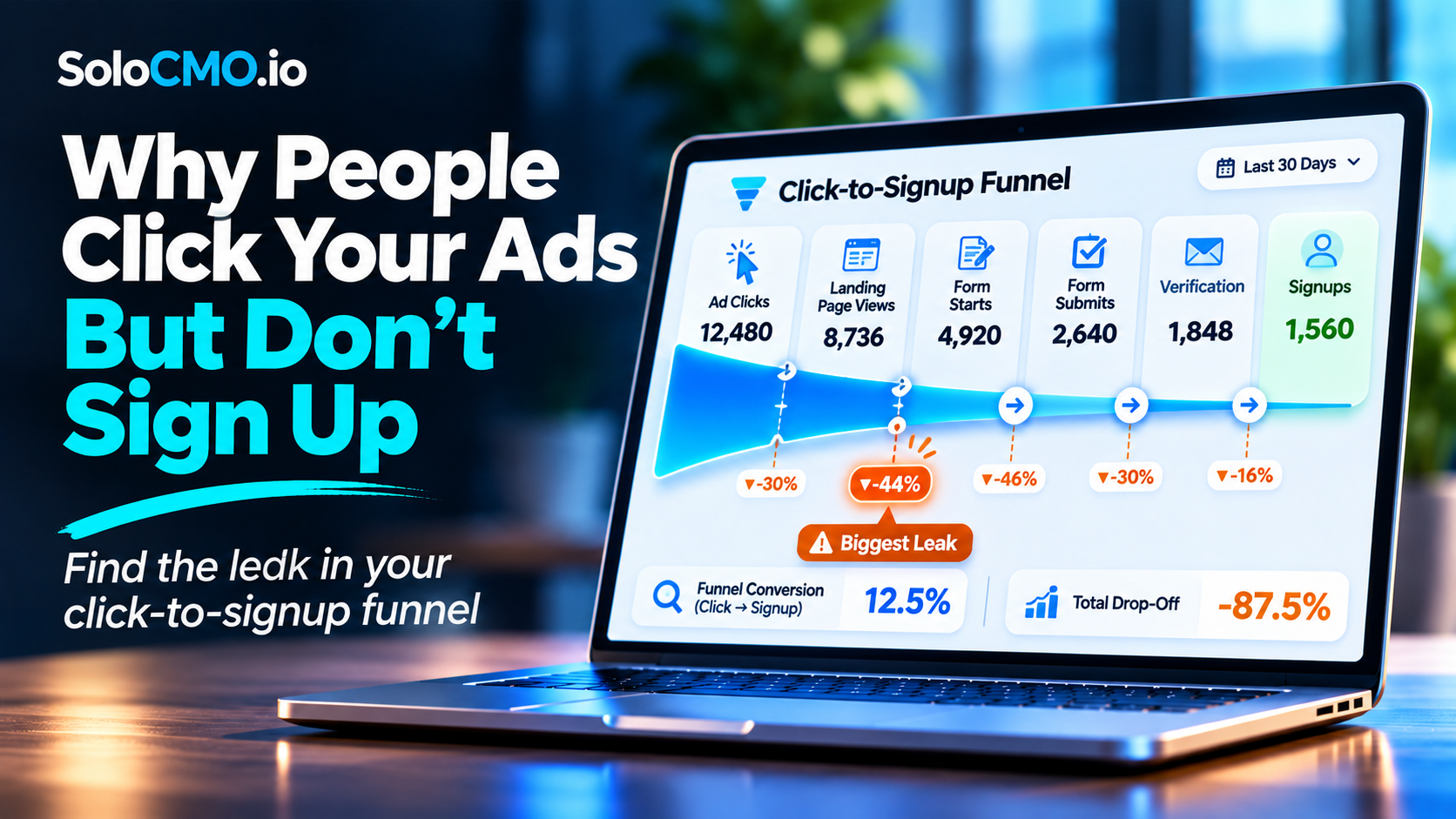
Where Leads Drop Off Between Ad Click and Signup
Funnel drop off between click and signup occurs at six points: the ad click, page load, above the fold, form start, form submit, and verification. The most significant leaks usually sit upstream, where the ad promise fails to match the page or where the page loads too slowly on mobile before the form ever appears. If your paid ad campaigns show
Get Smarter About Your Marketing
Practical SEO, AI, content, and marketing strategies you can put to work immediately.
Join the Newsletter