Local SEO
You already know what BrightLocal and Local Falcon do. You’ve probably demoed both. The real BrightLocal vs. Local Falcon question isn’t a feature checklist, it’s which one you want governing every client report you ship for the next twelve months, because switching tools mid-roster is its own special kind of pain. Before you lock in either subscription, map your local SEO reporting workflow against what each tool actually does well. Agencies skip this step constantly, then end up paying for citation credits or scan packs they never fully use. This comparison breaks down coverage, pricing, reporting polish, and speed to deliverable, so you can standardize with a real answer instead of a guess.
Key Takeaways
- BrightLocal covers citations, reviews, GBP audits, and rank tracking in one platform. Local Falcon is a geo-grid rank tracker only. It has no citation or review tools built in.
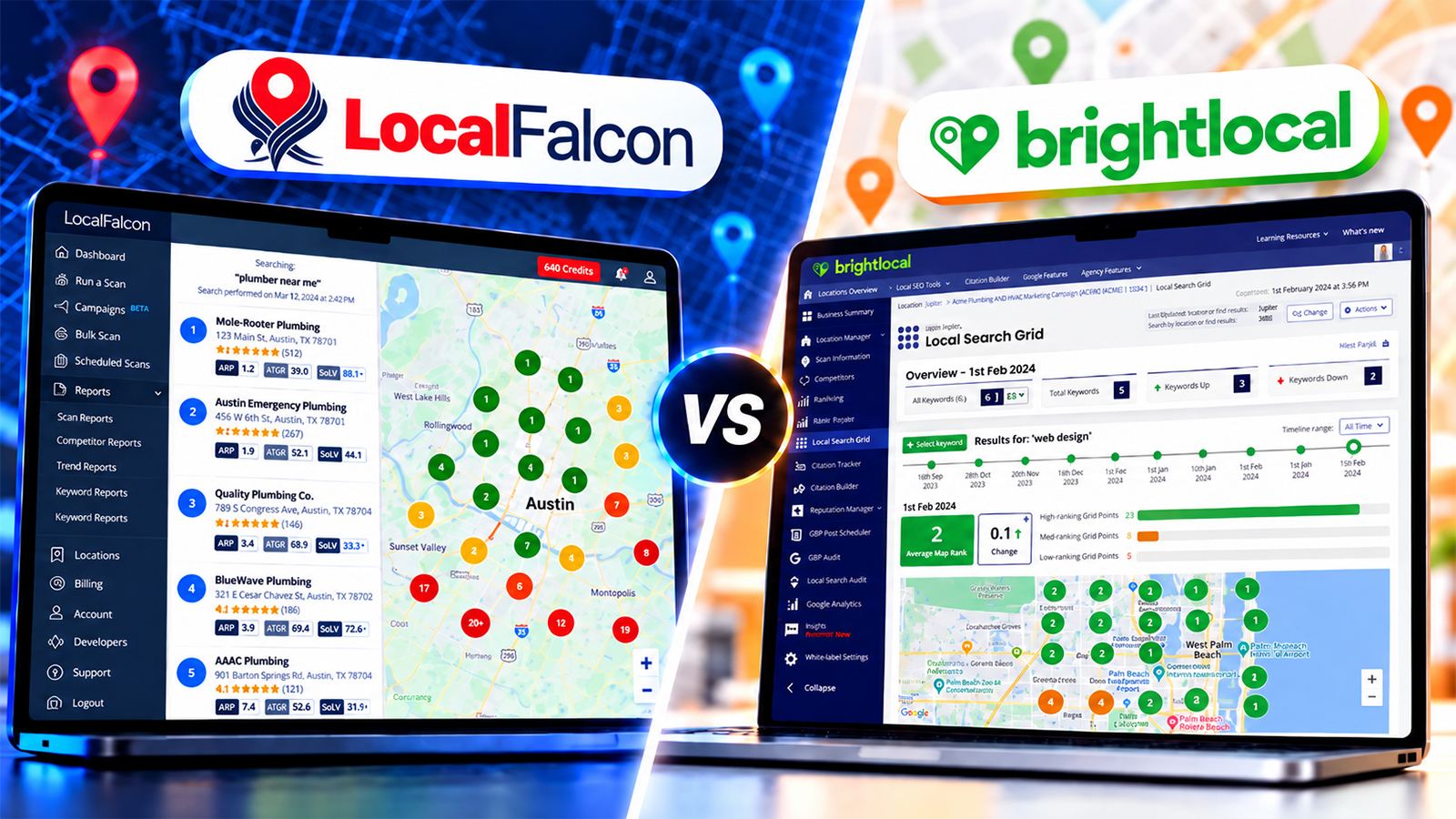
- Local Falcon’s grid heatmaps show block-by-block ranking changes more clearly than BrightLocal’s grid-based tracker. That makes it the stronger sales and diagnostic visual.
- BrightLocal starts around $39-$199+/month but commonly runs $400-$1,000+/month once you add multiple locations and citation credits. Local Falcon starts at $29-$129+/month and scales to $200-$500+ with heavy scan volume.
- Neither tool gives you a complete answer on its own. Many agencies end up running both and manually bridging the gap between them.
- The right choice depends on whether you run a full-service local SEO shop or a lean operation whose edge is precise, visual proof.
Breadth of Local SEO Coverage: Full Suite vs. Review Tracking Specialist
This is where the two tools diverge most sharply. Settle this question first, because it shapes everything else, from pricing to staffing.
What BrightLocal Bundles In
BrightLocal, often searched as “bright local” by agencies typing the brand name as two words, puts citation building, review tracking, GBP audits, and rank tracking under one login. For agencies managing NAP consistency across many client locations, that bundling saves real time. Cleanup work that used to mean juggling spreadsheets now happens inside a single workflow. BrightLocal’s pricing reflects that breadth, and the GBP audit module is useful, but it feels bolted-on next to the depth of the citation tools. Several reviewers have flagged this as the platform’s weaker link.
Where Local Falcon Stays Deliberately Narrow
Local Falcon, sometimes referred to by agencies simply as falcon local when comparing shorthand tool names in internal docs, has zero built-in citation building or review tracking. It does one job: geo-grid rank visualization. Nothing more. Both platforms offer competitor analysis, but the comparison isn’t apples to apples. BrightLocal’s version pulls in citation gaps and review sentiment across competitors. Local Falcon’s competitor analysis is purely rank-position based across the grid. If your agency already owns tools for review tracking and citations, that narrowness is a feature, not a flaw. If it doesn’t, you’ll feel the gap on day one of trying to build a full audit for a new client.
Grid Heatmap Accuracy: Visualizing Hyperlocal Rank Tracking
Once coverage is settled, the next real difference is how each tool shows ranking data. Agencies tend to have strong, specific preferences here, and it’s worth testing both on a real client account before you decide, not just a demo property.
How the Local Grid Scan Works
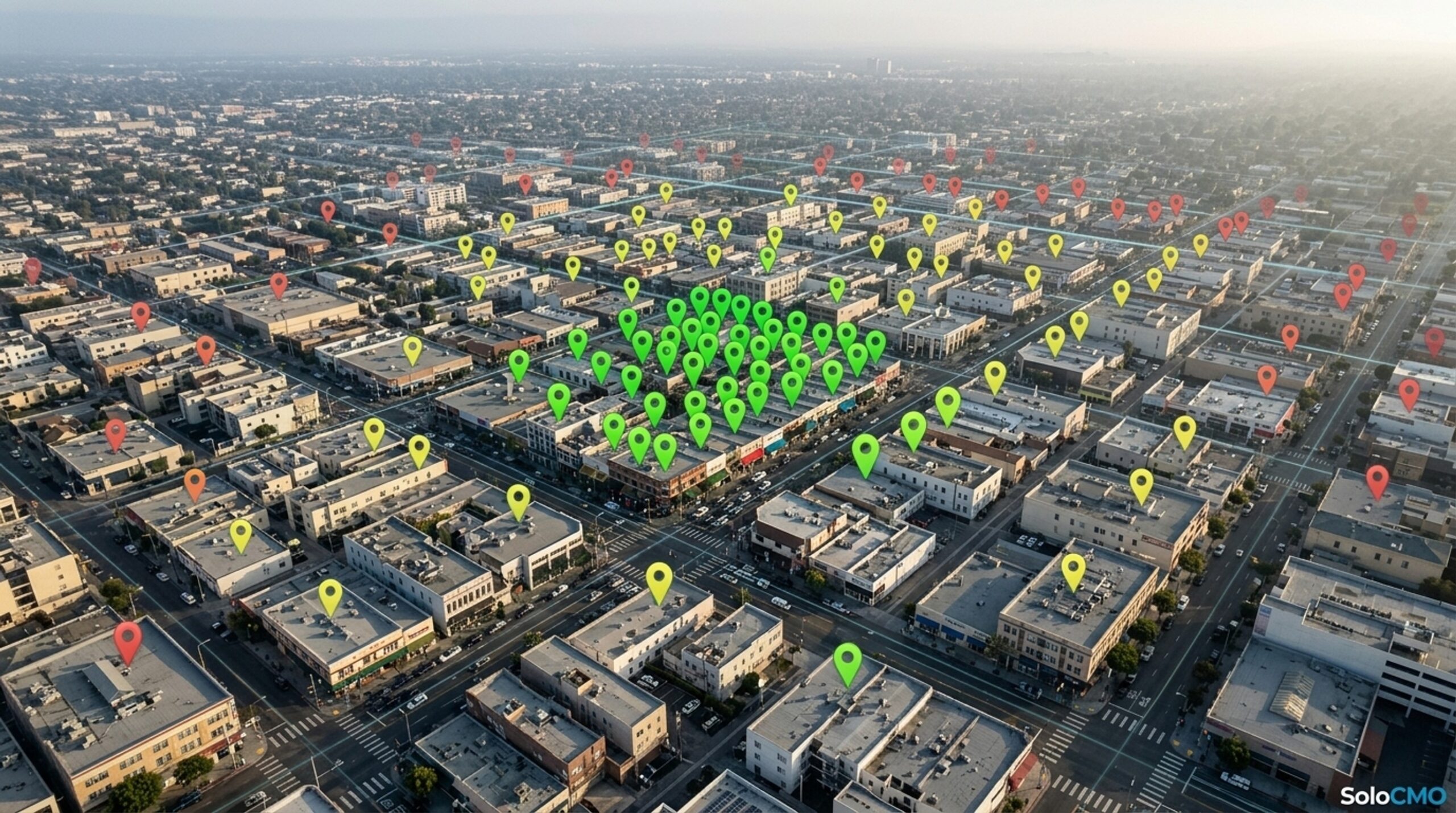
Local Falcon’s map scan renders a dense local grid of pins, commonly up to 21×21. It shows exactly how a google ranking shifts block by block, not just across a whole city. As a local rank tracker, that geogrid view matters most when you’re explaining to a client why they sit top-3 in one pocket of their service area and nearly invisible two miles away. Multi-location clients bring up this exact question constantly. Local Falcon has also expanded its rank tracker to cover ai visibility surfaces beyond the classic Google Maps pack, giving agencies an early read on how businesses show up as search results evolve.
Where BrightLocal’s Tracker Falls Short on Granularity
BrightLocal’s grid-based tracker covers similar ground but defaults to a coarser grid. That makes it less intuitive for showing hyperlocal rank changes to a client who wants to see exactly where their visibility drops off. A 21×21 scan simply shows more positional detail than a default 7×7 grid. That difference separates a surface-level local rank check from a real diagnostic. If your pitch depends on precise rankings proof, weigh this gap carefully before you standardize.
Pricing Models: Predictable Subscriptions vs. Scan Credits at Scale
Numbers matter more than feature lists once you’re managing several client accounts. Here’s where the real math lives, and it’s worth running these numbers against your own roster before you sign an annual contract.
BrightLocal’s Cost Curve as You Add Locations
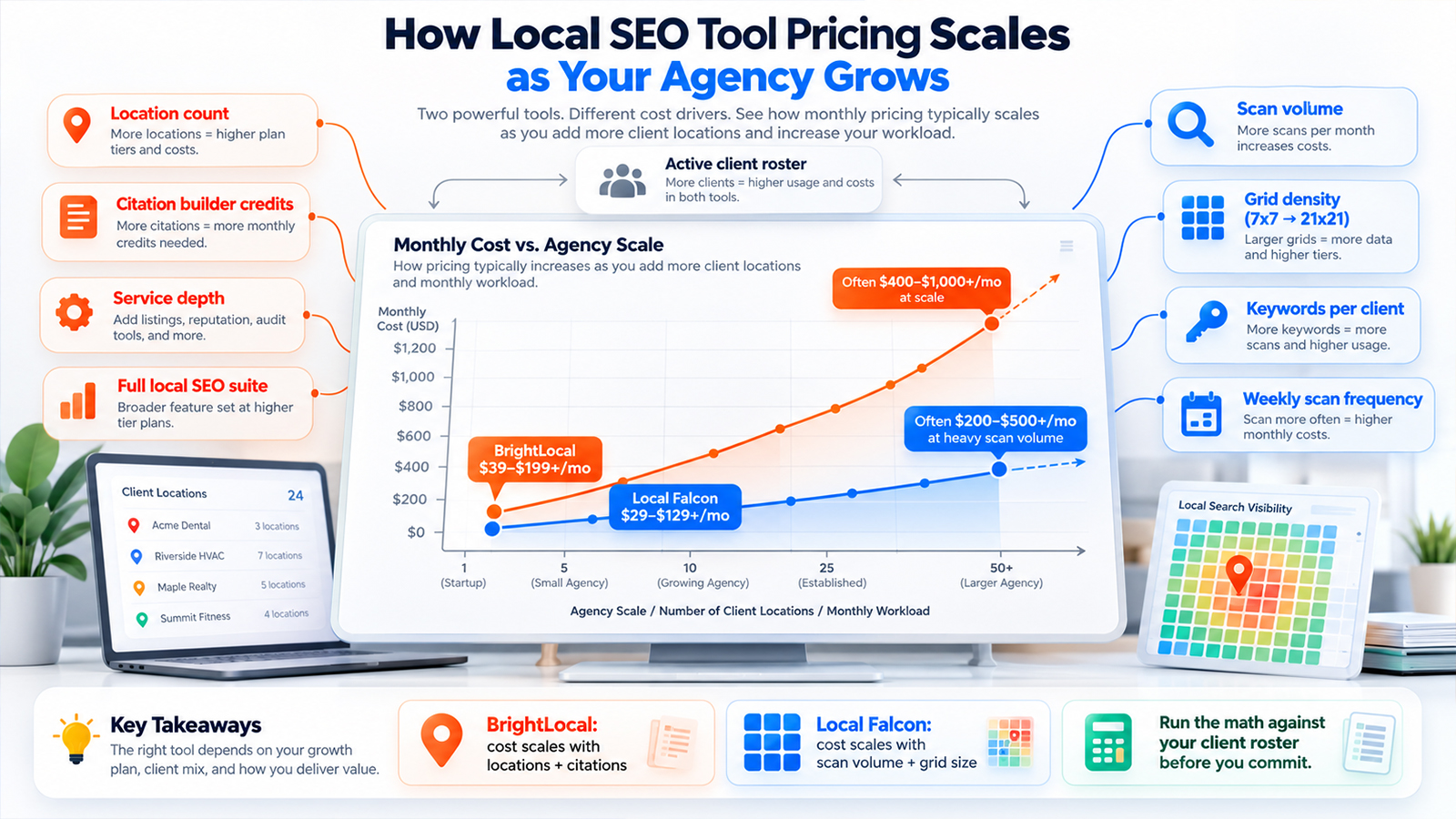
BrightLocal’s pricing starts around $39-$199+/month per agency plan, but that entry tier rarely reflects real-world spend. Add multiple client locations and citation builder credits, and the total commonly climbs to $400-$1,000+/month. Cost grows with locations and citation activity. An agency’s bill is tied directly to client count and service depth.
Local Falcon’s Scan Credit Math
Local Falcon’s pricing starts at $29-$129+/month, and it’s scan-based rather than flat-rate. Heavy multi-client scan volume, say a 7×7 grid across five keywords run weekly for several clients, can push real spend to $200-$500+/month. That’s generally more predictable than citation credit stacking, but scan credits still burn faster than you’d expect once you’re tracking many keywords across many locations each month.
The main cost drivers worth mapping against your own client roster before you commit:
- Location count: BrightLocal’s citation and audit costs scale directly with how many client locations you manage.
- Citation builder credits: these stack quickly on BrightLocal and are the single biggest reason entry-tier pricing understates real spend.
- Scan volume and grid density: Local Falcon’s credits burn faster the larger the grid (e.g., 21×21 vs. 7×7) and the more keywords you track per client.
- Scan frequency: weekly scans across multiple clients push Local Falcon spend from the $29-$129+ entry tier toward $200-$500+/month.
- Number of active clients: both tools’ true cost only becomes clear once you multiply per-location or per-scan pricing across your full roster, not just a single account.
| Dimension | BrightLocal | Local Falcon |
|---|---|---|
| Breadth of local SEO coverage | Full suite: citations, reviews, audits, rank tracking | Rank tracking and geo-grid visualization only |
| Visual clarity of rank data | Grid-based tracker, less intuitive for block-level variance | Dense geogrid heatmap, strong visual proof |
| Pricing model | $39-$199+/mo, often $400-$1,000+/mo at scale with citation credits | $29-$129+/mo, often $200-$500+/mo at heavy scan volume |
| Ease of onboarding new staff | Steeper learning curve given multi-module platform | Fast, single-purpose tool, quick to learn |
| White-label reporting polish | Polished, client-ready out of the box | Raw data focused, often needs rebuilding into decks |
| Geo-based rank tracking accuracy | Coarser default grid | Dense, granular local grid (up to 21×21) |
| Best fit | Many clients, full managed service | Solo consultants or lean agencies, few clients |
| Speed to first deliverable | Slower onboarding lift for full audit-to-report cycle | Fast, single scan is pitch-ready quickly |
White-Label Reporting and Agency Software Fit
Pricing tells you what you’ll pay. This section tells you what you’ll actually hand your clients, which is usually the detail that decides renewals.
Report Polish Out of the Box
BrightLocal’s white-label report output is polished from the start. It’s built for agencies that need to hand a finished report to clients with little rework. Local Falcon’s reporting leans toward raw data. Rankings and visibility data often need manual rebuilding into a client-facing deck before it’s presentable. As agency software, BrightLocal’s bulk account tools suit teams managing dozens of clients. Local Falcon’s leaner interface suits solo consultants managing a handful of accounts.
Onboarding Curve for New or Junior Staff
Onboarding a junior staffer on BrightLocal takes longer, simply because so many modules live under one roof. Local Falcon’s single-purpose design means a new hire can usually run a scan correctly within an hour. Both ecosystems offer api access for agencies that want to pull rankings data into their own dashboards, but neither one is plug-and-play without some technical setup on your end.
One fractional CMO managing reporting for several small retail clients found that her junior hire needed almost two weeks to confidently navigate BrightLocal’s citation and audit modules before producing a clean report. Once she added Local Falcon for sales-stage visuals, the hire ran independent scans within a day. That freed the CMO to focus on strategy calls instead of software training.

Speed to First Deliverable: Which Tool Wins the New Client Pitch
Eventually this comes down to a practical question: how fast can you put something in front of a prospect or client?
Local Falcon’s Edge in Sales Conversations
You can generate a single grid scan in minutes and drop it straight into a pitch deck. That’s a strong visual proof point for new client outreach before any contract is signed. BrightLocal requires more onboarding lift: connecting GBP, pulling citation data, and configuring rank tracking, all before a full audit-to-report workflow is ready. It’s better suited to an existing client relationship than a cold pitch.
Why Some Agencies Look for Falcon Alternatives
Some agencies look for falcon alternatives because scan credits and raw reporting add friction. For them, the real question usually isn’t which single tool to add next. It’s whether rank tracking and client reporting should live inside a broader system built for a lean team from the start. This is where solo operators often end up paying for two subscriptions, a tracker plus a reporting layer, just to produce one clean deliverable. SoloCMO was built around that exact gap: a product stack designed for a team of one, without the seat-based bloat of enterprise suites, at a more competitive price than stitching two specialized tools together. If that gap sounds familiar, it’s worth a quick look before renewing either contract.
Conclusion: Choosing Between BrightLocal and Local Falcon
Choose BrightLocal if you run local SEO as a full managed service for multiple clients and need citations, reviews, audits, and reporting under one roof with minimal tool-switching. Choose Local Falcon if your edge is precise, visual proof of local pack rankings, especially for sales pitches, competitor audits, or diagnosing hyperlocal ranking issues, and you’re fine pairing it with other tools for citations and reviews.
Either way, you now know which profile fits your agency, and that’s the real decision, not the brand name on the invoice. If you’d rather see exactly where two subscriptions, manual report-building, and credit stacking are costing you hours instead of guessing, book a free Workflow Audit with SoloCMO. There’s no pitch involved, just a look at your actual reporting workflow before you commit another dollar to either platform, and where a one-person-built system could cut that time in half.
FAQ
Is BrightLocal better than Local Falcon?
Whether BrightLocal is better than Local Falcon depends entirely on the scope you need, not some universal ranking. BrightLocal wins on breadth for agencies running full-service local SEO. Local Falcon wins on precision for teams whose edge is visual ranking proof. If you’re unsure which scope matches your client roster, map your actual workflow first. That will answer the question faster than another feature comparison.
What is Local Falcon used for?
Local Falcon is used for geo-grid rank tracking. It visualizes exactly how a business ranks in Google’s local pack across a mapped area. It’s built specifically for that job rather than as a full local SEO suite, which makes it narrower but sharper than all-in-one platforms.
How much does BrightLocal cost compared to Local Falcon?
BrightLocal typically runs $39-$199+/month at entry but climbs to $400-$1,000+/month once you add multiple locations and citation credits. Local Falcon starts at $29-$129+/month and can reach $200-$500+/month under heavy scan volume. True multi-client costs for both tools tend to run higher than entry-tier pricing suggests, so it’s worth mapping your actual client count against each cost curve before deciding.
Does Local Falcon track Apple Maps and AI visibility?
Local Falcon has expanded its tracking beyond classic Google Maps packs into emerging ai visibility surfaces, giving agencies early insight into how businesses appear as search evolves. BrightLocal’s tracker, by comparison, stays more tightly focused on traditional Google pack rankings.
Is Local Falcon worth the money if it doesn’t do citations or reviews?
Local Falcon’s value depends heavily on whether your agency already owns separate tools for citations and reviews. For agencies without that coverage elsewhere, assuming one tool handles everything is a common and costly mistake.
Can I use BrightLocal and Local Falcon together?
Many agencies do pair BrightLocal and Local Falcon, using one for managed-service breadth and the other for sharper visual tracking. The real cost is the manual work needed to bridge two separate data sources into one coherent client report. Weigh that cost before adding a second subscription.
Which tool scales better for an agency managing many client locations?
BrightLocal scales better for breadth of managed-service work across many locations. Local Falcon scales better for lean teams that prioritize precision over coverage. Mapping your actual client count against each tool’s cost curve will clarify which scaling pattern fits your business.
Recent Posts
Content Refresh vs Rewrite: Which Fixes Decaying Blog Posts Faster
A content refresh ships faster, usually in 1 to 3 hours versus 4 to 8 for a rewrite, but a rewrite recovers faster when the decay stems from a search intent mismatch. The rule of thumb is to refresh the post if it still matches what searchers want and most of it is salvageable, and to rewrite it if the

How to Build a Topic Cluster From Scratch for Your SaaS Blog
To build a topic cluster, pick a pillar topic that fits your product, collect subtopic keywords, group them by SERP overlap and intent, size the cluster, link every page to the pillar, publish in stages, then measure at cluster level. That is how to build a topic cluster in a way you can defend to a founder, and our topical authority
Where Leads Drop Off Between Ad Click and Signup
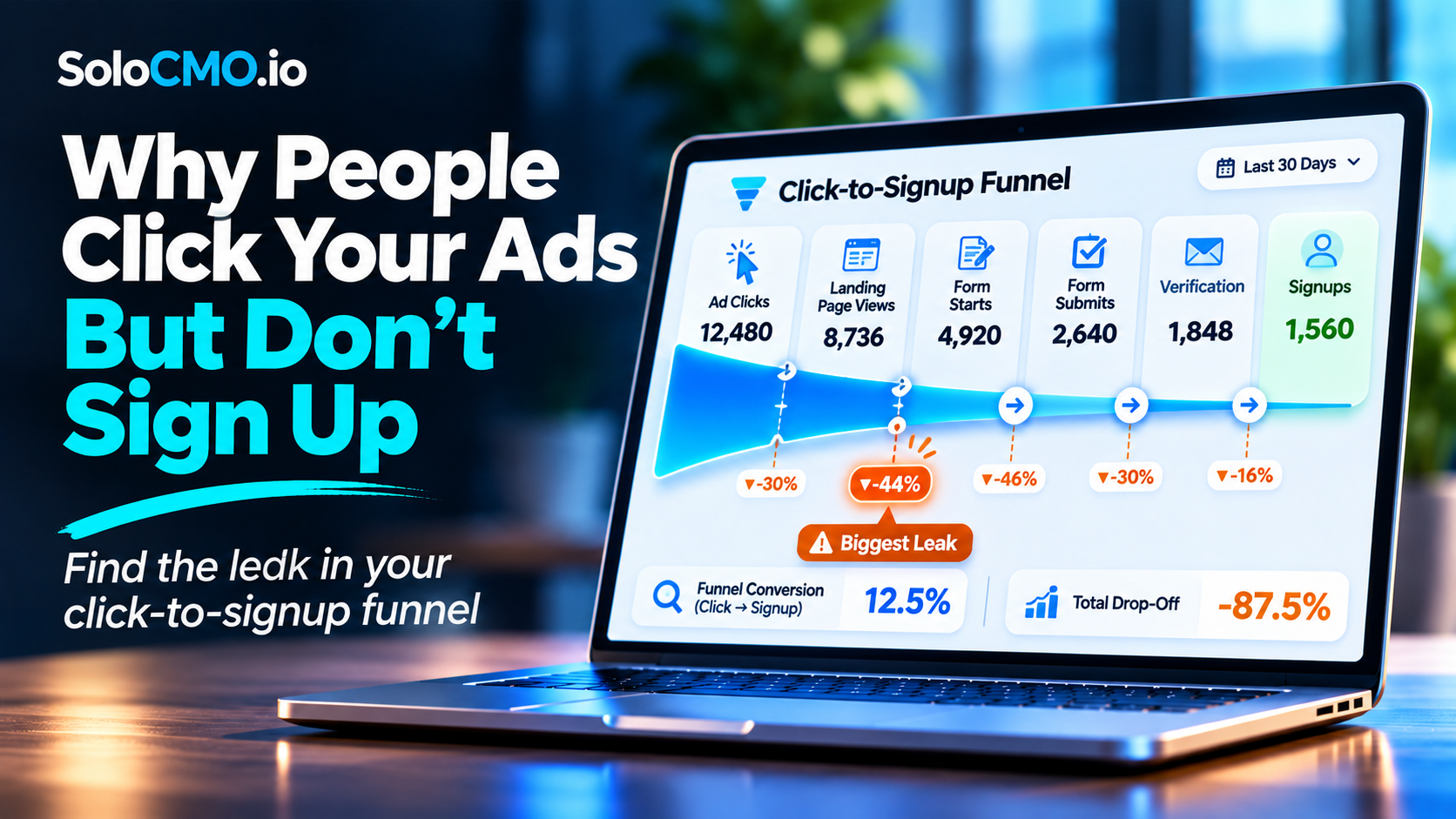
Funnel drop off between click and signup occurs at six points: the ad click, page load, above the fold, form start, form submit, and verification. The most significant leaks usually sit upstream, where the ad promise fails to match the page or where the page loads too slowly on mobile before the form ever appears. If your paid ad campaigns show
Get Smarter About Your Marketing
Practical SEO, AI, content, and marketing strategies you can put to work immediately.
Join the Newsletter