Marketing Strategy
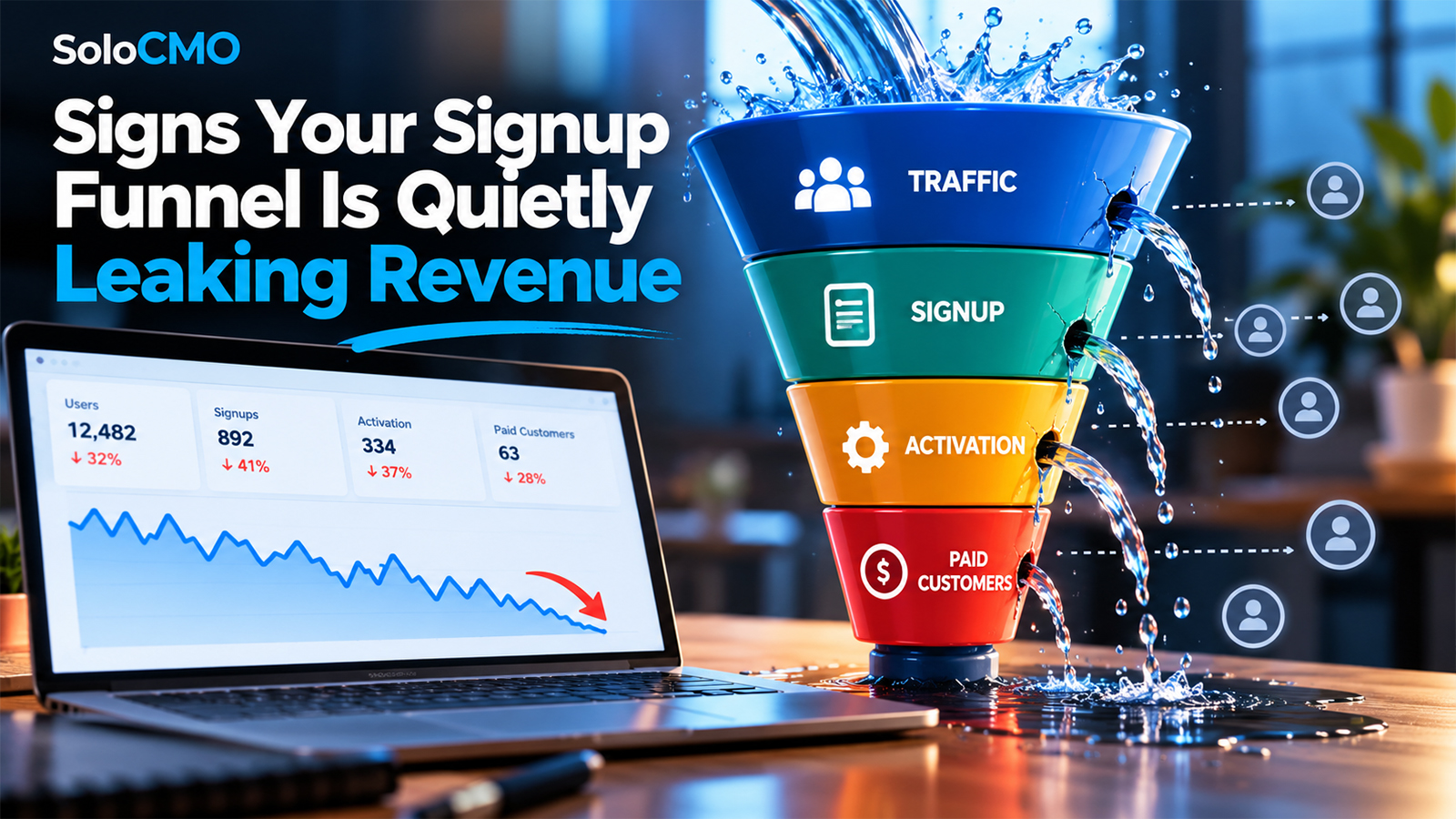
Three numbers tell you almost everything: landing page bounce rate, form abandonment rate, and activation rate. If you’ve noticed flat MQLs or a trial-to-paid number that keeps sliding but haven’t had the hour to prove why, these are the signs of a broken sales funnel worth checking first.
Funnel leakage means prospects enter your signup flow and vanish before they ever become paying customers. It shows up in three numbers: a landing page bounce rate above 60-90%, form abandonment near 67%, and an activation rate under 37.5% [1][2].
Never checked those three together? You likely have a broken sales funnel and don’t know it yet.
A proper funnel diagnostic walks each stage in order, from ad click to onboarding email, so you see exactly where revenue bleeds out instead of guessing. Catching that bleed early costs a lot less than patching it after a quarter of lost signups.
Key Takeaways
- Bounce rate above 60-90% on landing pages, form abandonment near 67%, and activation rates under 37.5% are the three numbers that expose a leaking funnel [1][2].
- Funnels leak quietly because most solo marketers check performance monthly, not weekly. Small drop-offs pile up into lost revenue over months.
- Every funnel stage, traffic, signup form, activation, and paid conversion, has its own named leak and its own one-line fix.
- Finding the leak takes under an hour with tools you already have: GA4, Stripe, and native dashboards. Fixing every leak at once is the real bottleneck for a team of one, which is where AI-assisted execution starts to matter.

Why Solo Marketers Miss These Signs
Running a funnel solo means you own the ad click, the landing pages, the signup form, the onboarding email, and the report that explains all of it. Nobody else is watching the metric between those stages. So a small drop stays hidden until it shows up as a flat lead count three months later.
This isn’t a discipline problem. It’s a math problem. One person can’t check five workflows every week and still write content, run social, and answer a founder’s question about pipeline. If that sounds like your week, you’re not behind. You’re just outnumbered by your own to-do list.
How Do I Know If My Signup Funnel Is Broken?
You’ll know your funnel is broken when a metric moves the wrong way for two straight reporting periods and you can’t point to the exact stage causing it. A B2B SaaS funnel can lose real revenue between the ad message and the signup form purely from friction. Slow load times. A form with too many fields. No autofill. Nobody notices, because ad spend and traffic volume still look fine on the surface. Flat traffic with falling signups is one of the clearest signs of a broken sales funnel there is.
The 3-Question Self-Check
Ask yourself these three questions before anything else:
- Is my traffic actually reaching and viewing the landing page, or bouncing before it loads?
- Are visitors who land on the page completing the signup form, or abandoning it mid-fill?
- Are people who sign up ever coming back to activate, or vanishing after account creation?
If you can’t answer all three with a number right now, that’s your starting point. Not a failure. Just a place to begin.

4 Signs of a Broken Sales Funnel, Stage by Stage
Each sign below maps to a specific stage you own end to end, with the metric that flags it and one fix to try first.
Traffic → Landing Page: Clicks That Never Convert
A bounce rate above 60-90% in Google Analytics 4 means visitors leave before engaging at all [3]. Rage clicks on your pricing button, visible in Hotjar heatmaps, often mean the button looks clickable but isn’t. Fix: rewrite the hero section to match the ad’s exact promise, and confirm the page loads in under three seconds.
Landing Page → Signup Form: Drop-Off and Friction
Form abandonment sits near 67% industry-wide, and long forms are the usual cause [4]. Missing trust signals, like security badges or a visible privacy policy link, also push people away mid-fill. Fix: cut form fields down to the minimum, and add an exit-intent popup tool like OptinMonster to recover abandoning signups.
Signup → Activation: Users Who Never Come Back
An activation rate below 37.5% signals that users create an account but never take a first meaningful action. You can track this in Mixpanel or Segment [1]. Fix: send a single, specific onboarding email within the first hour that points to one action, not five.
Activation → Paid: Stalled High-Intent Trials
Trial-to-paid conversion below 14-25% suggests high-intent users are going cold before a sales call ever happens. This shows up in Stripe and HubSpot pipeline data [5]. Fix: add a mid-trial check-in triggered by usage data, not a calendar date.
A full check through all four stages is exactly what a funnel diagnostic is built to do in one sitting. Worth bookmarking that page once you know which stage needs the closest look.
What Is a Good Signup Conversion Rate for SaaS? (The 15-Minute Funnel Audit)
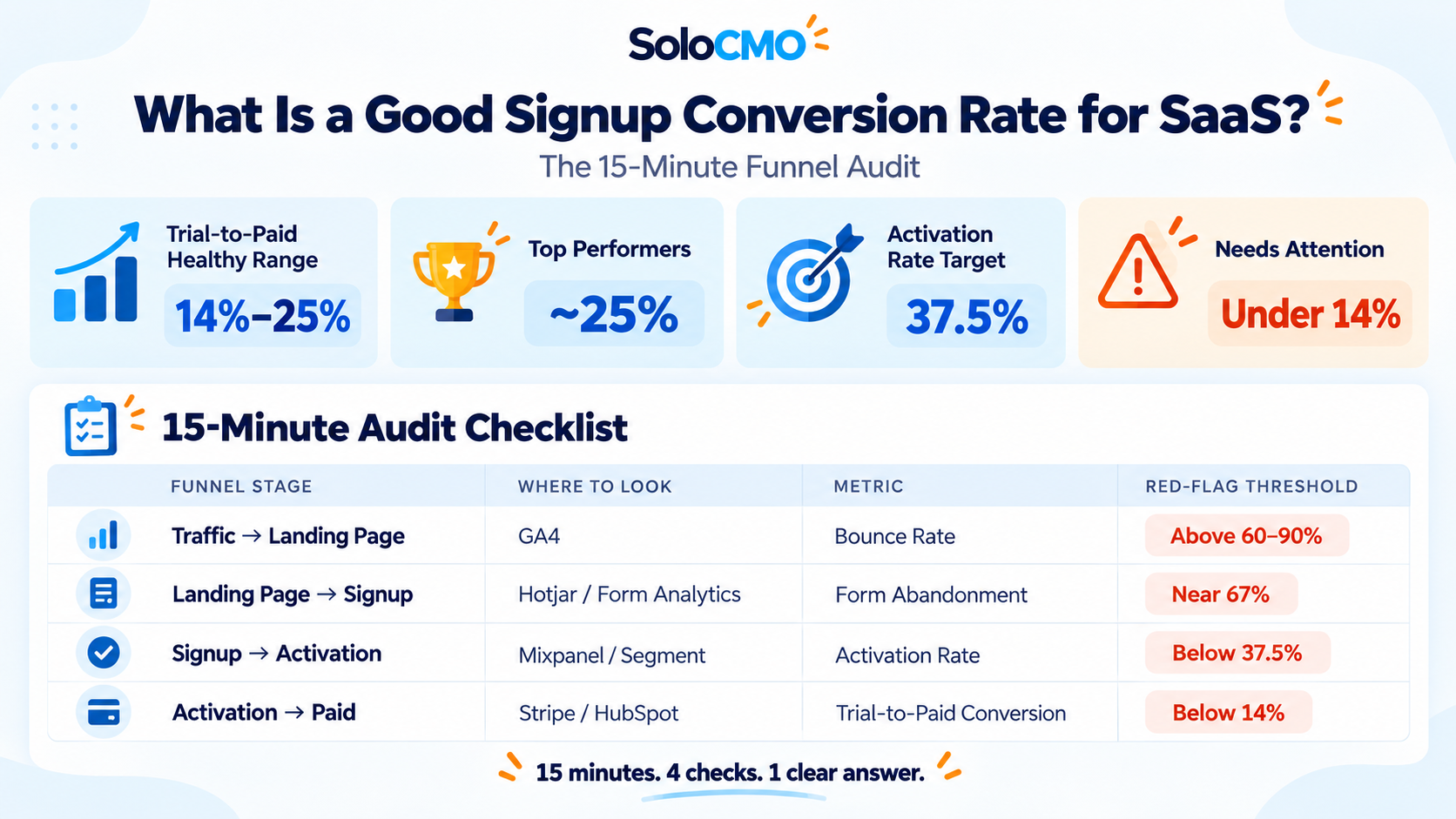
A good signup conversion rate for SaaS runs between 14% and 25% for trial-to-paid. Top performers reach closer to 25%, according to OpenView’s SaaS benchmark research. B2B SaaS activation rates commonly sit near a 37.5% median as a healthy target [1][5]. Anything well below those ranges costs you money, since a leaking funnel quietly inflates your effective Customer Acquisition Cost, even when raw ad spend hasn’t moved.
SaaS Conversion Benchmarks (OpenView, KeyBanc)
OpenView’s product benchmarks and KeyBanc’s SaaS survey data both point to trial-to-paid conversion in the mid-teens to mid-twenties as typical for B2B products. Top-quartile companies convert closer to 25% [1][5]. If your number sits under 14%, you likely have a problem that needs fixing now, not just a slow funnel.
The 15-Minute Audit Checklist
Run this using only the analytics tools already in your dashboard. No new logins, no new subscriptions, just fifteen minutes and the tools you already pay for.
| Funnel Stage | Where to Look | Metric to Pull | Red-Flag Threshold |
|---|---|---|---|
| Traffic → Landing Page | GA4 | Bounce rate | Above 60-90% |
| Landing Page → Signup | Hotjar / form analytics | Form abandonment | Near 67% |
| Signup → Activation | Mixpanel / Segment | Activation rate | Below 37.5% |
| Activation → Paid | Stripe / HubSpot | Trial-to-paid conversion | Below 14-25% |
Fifteen minutes. Four checks. One clear answer on where to look next.

When the Leak Is a Volume Problem, Not a Fix Problem
Most solo marketers who run this audit already know what needs fixing within the first ten minutes. The landing page message is stale. The onboarding email never got rewritten. The pricing page button hasn’t been tested since launch.
Knowing the fix is one thing. Having the hours to build it, ship it, and test it across four stages at once is a different problem entirely, and it’s exactly the kind of volume problem AI tools are increasingly used to close.
Case Example: Fixing One Leak
A founder running a B2B SaaS tool noticed landing page bounce sitting at 78%, well above a healthy range. After rewriting the headline to match the ad message and running a single test on the hero section, bounce dropped to 52% within three weeks. Activation rate on the same funnel rose from 31% to 44% once a matching onboarding email went out to new signups. One fix, tracked cleanly, moved two metrics at once, with an AI writing assistant helping draft and test the headline variants in hours instead of days, at a fraction of the costing a full agency rewrite would have required.
That’s the gap AI-assisted execution is built to close. Finding the leak is something any solo marketer can do in an hour. The hard part is shipping the landing page rewrite, the new email sequence, and the test version in the same week instead of the same quarter.
Conclusion: Diagnosis Is Step One, Execution Is Where Solo Marketers Stall
The checklist above is enough to name your leak inside an hour, with no new software required. The real bottleneck shows up next: rebuilding landing pages, relaunching email sequences, and testing new copy across every stage at once, all while still running social media, content, and reports solo.
Run the 15-minute audit this week. Once you know exactly which stage is leaking, the only question left is whether you have the hours to rebuild the landing page, rewrite the email sequence, and test the new copy yourself, or whether you’d rather see what it looks like to ship those fixes at 3-5x the speed one person can manage alone. If you want a second set of eyes on what you find, Get Estimate is a low-pressure way to talk through what a fix would actually take.
FAQ
How do you audit a funnel for drop-off?
You audit a funnel for drop-off by pulling one metric per stage in order: landing page bounce in GA4, form completion rate from your form tool, and activation events in Mixpanel or Segment. Spotting the drop-off point takes minutes once you know which dashboard to open. Fixing it across every stage at once is the part that actually eats your week.
What causes high signup abandonment?
High signup abandonment is usually caused by long forms, unclear value messaging, and slow page load times. Visitors who don’t immediately understand what they’re signing up for, or who hit a form asking for too much information, leave before finishing. A diagnostic pass shows which of these three is really driving your number, instead of guessing.
How much revenue is lost to funnel leaks?
Revenue lost to funnel leaks is hard to pin to one number. But it shows up as inflated effective CAC and growing monthly signup loss when conversion sits below benchmark ranges. A funnel converting at 10% instead of a benchmark 20% is effectively paying double for every customer it keeps. Measuring the leak is the easy part. Recovering that revenue means shipping fixes fast, not just naming the problem.
What’s the difference between a leaky funnel and a slow funnel?
A leaky funnel loses prospects who never return. A slow funnel converts prospects who simply take longer than benchmark to say yes. The two look similar on a flat dashboard but need different fixes: a leak needs a messaging or friction fix, while a slow funnel needs a nurture sequence. A proper funnel diagnostic tells you which one you’re dealing with before you spend a week fixing the wrong thing.
What are the most common funnel mistakes?
The most common funnel mistakes are a messaging mismatch between the ad and the landing page, signup forms that ask for too much information, and no onboarding nudge in the first hour after signup. Most solo marketers already know these mistakes exist in their own funnel. What they lack is the hours to fix all of them across every stage before the next fire drill lands.
Sources
[1] OpenView 2022 Product Benchmarks Report – https://openviewpartners.com/2022-product-benchmarks/ [2] Form Abandonment Statistics: 2026 Benchmarks, Checked at the Source – https://cuefully.com/blog/form-abandonment-statistics [3] 170+ Landing Page Statistics (2026): Every Stat Verified – https://cartflows.com/statistics/landing-page/ [4] Form Abandonment Statistics 2026: 15 Key Rates & Fixes – https://gnosari.com/blog/form-abandonment-rate [5] SaaS Free Trial Conversion Rate Benchmarks 2026 – https://adv.me/articles/conversion-optimization/saas-free-trial-conversion-rate-benchmarks-2025/Recent Posts
Content Refresh vs Rewrite: Which Fixes Decaying Blog Posts Faster
A content refresh ships faster, usually in 1 to 3 hours versus 4 to 8 for a rewrite, but a rewrite recovers faster when the decay stems from a search intent mismatch. The rule of thumb is to refresh the post if it still matches what searchers want and most of it is salvageable, and to rewrite it if the

How to Build a Topic Cluster From Scratch for Your SaaS Blog
To build a topic cluster, pick a pillar topic that fits your product, collect subtopic keywords, group them by SERP overlap and intent, size the cluster, link every page to the pillar, publish in stages, then measure at cluster level. That is how to build a topic cluster in a way you can defend to a founder, and our topical authority
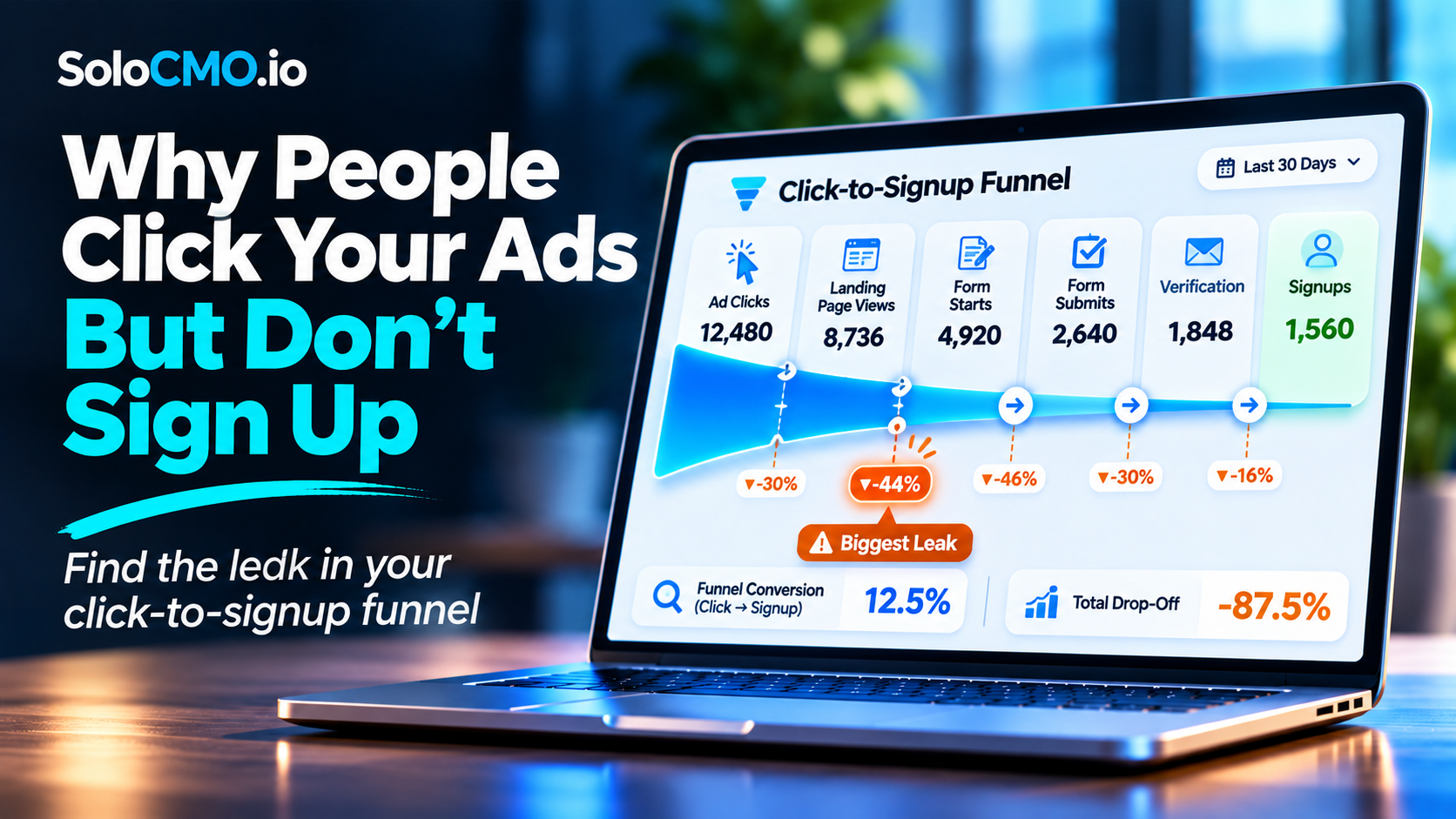
Where Leads Drop Off Between Ad Click and Signup
Funnel drop off between click and signup occurs at six points: the ad click, page load, above the fold, form start, form submit, and verification. The most significant leaks usually sit upstream, where the ad promise fails to match the page or where the page loads too slowly on mobile before the form ever appears. If your paid ad campaigns show
Get Smarter About Your Marketing
Practical SEO, AI, content, and marketing strategies you can put to work immediately.
Join the Newsletter