Local SEO
You’re the only marketer on staff. Multiple locations or clients are counting on your next ranking report. So the Local Falcon vs. Whitespark choice isn’t just academic. It shapes every monthly report you’ll build for the next year. You’ve probably already skimmed a G2 chart or a roundup list. All you got was a star rating, not a real answer. This comparison, plus SoloCMO’s own take on local SEO software, walks through both tools honestly. That includes where each one falls short. This way, you can match your choice to your real workload instead of a feature list.
Key Takeaways
- Local Falcon wins on visual, client-friendly ranking heatmaps and flexible scan-based pricing starting around $24.99 a month. But it stops at Google Business Profile visibility. It skips citations and reviews entirely.
- Whitespark covers citation auditing, citation building, review monitoring, and rank tracking in one modular suite. It also has white-label reporting built just for agency delivery.
- Pricing works differently for each tool. Local Falcon scales on scan credits ($24.99 to $4,999+ a month). Whitespark prices per product. Your real monthly cost depends on how many modules you stack.
- Neither tool fully solves the hours lost to manual report formatting or onboarding new clients. Most solo marketers feel this gap once they pass five or six active locations.
- The right pick depends on your week. Is it heavy on rank visibility, or heavy on full-service local SEO delivery?
Local Falcon vs. Whitespark at a Glance
Before we cover all eight comparison points, it helps to know what each tool was built to do. They don’t compete head-to-head the way a lot of roundup articles suggest.
What Local Falcon Is Built For
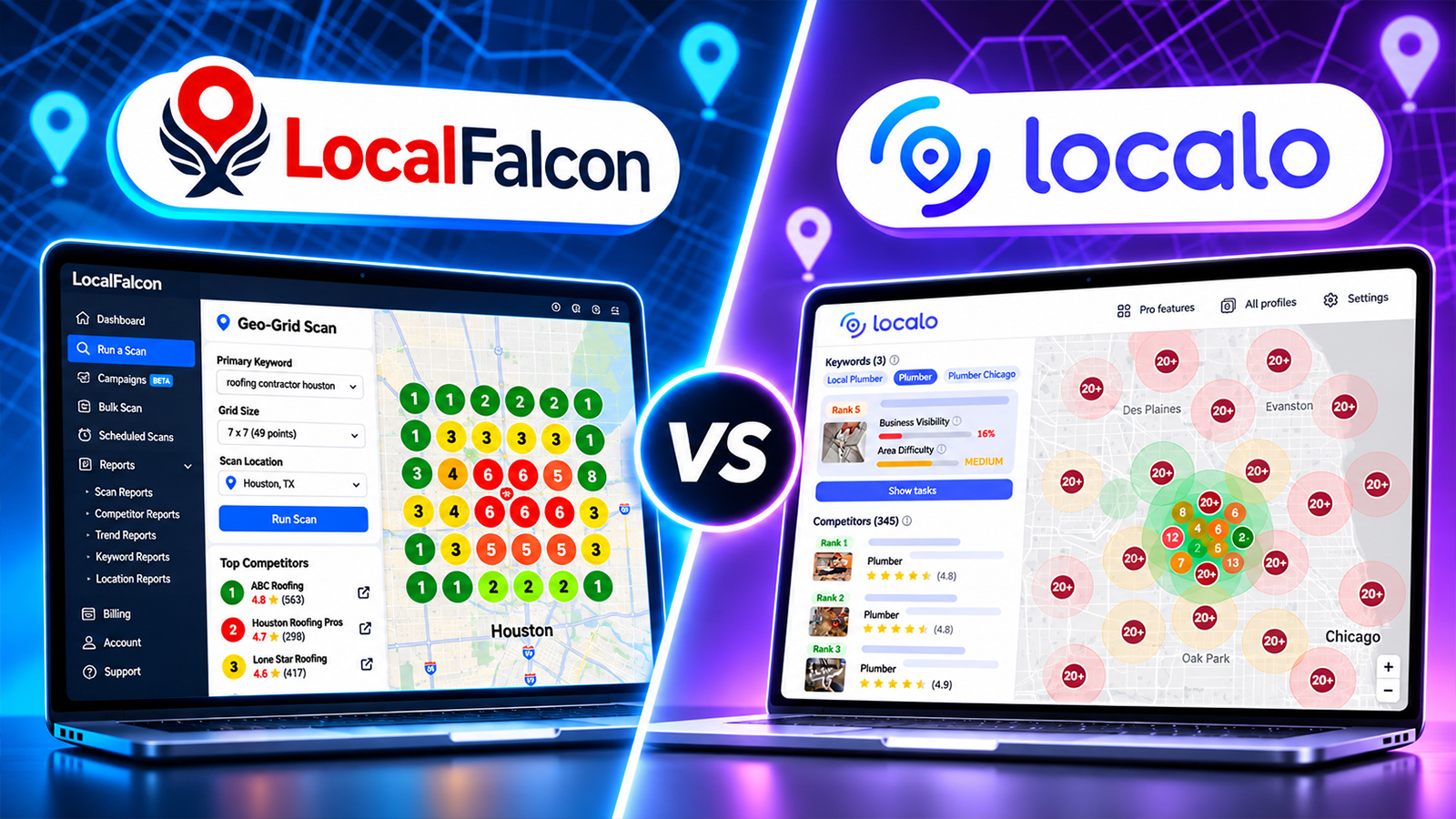
Local Falcon is a geo-grid rank tracking tool. Its purpose is simple: show Google Business Profile visibility on a map grid. It shows where a business ranks for a keyword at dozens of nearby points, not just one. It’s a narrow tool. But it does that one job with a lot of visual polish. Local Falcon scans produce a heatmap you can share on screen with a client in thirty seconds. They’ll understand what’s happening right away. Some marketers even call the platform “falcon local” in internal notes. But the product name and the grid-scanning idea behind it are the same thing.
What Whitespark Is Built For
Whitespark grew out of citation-building services, and it still carries that history today. It now bundles rank tracking, citation auditing, and review monitoring into one toolkit. Agencies use it to run regular local SEO work across many client accounts. Local Falcon is a specialist. Whitespark aims to be the fuller local SEO software stack.
That’s the core trade-off behind every section below: visual specialization versus toolkit completeness. Neither approach is wrong. Both tools target agencies and solo operators managing multiple locations. They just define “scale” differently. One uses scan credits. The other uses product tiers.
Geo-Grid Rank Tracking Accuracy
This is usually the first question a solo marketer needs answered: which tool gives the “real” number?
Local Falcon’s Grid Density and Heatmap Visualization
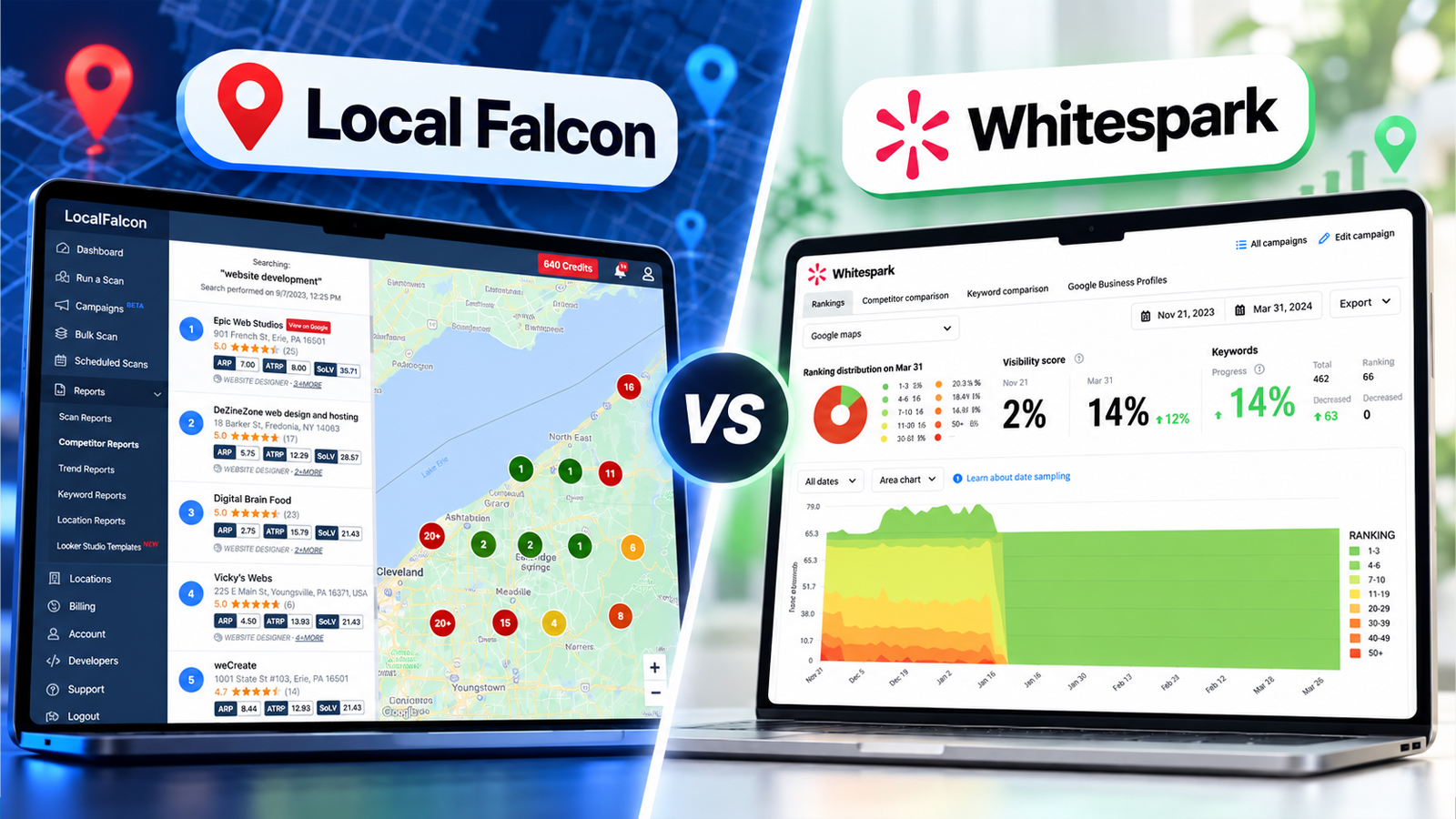
Local Falcon’s ranking heatmap is built on dense grid points, sometimes dozens or hundreds per scan. It shows exactly where a business appears in the local pack at each simulated location around it [1]. This detail is what makes Local Falcon’s visuals so convincing in client meetings. You’re not reporting one rank number. You’re showing a geographic pattern of strength and weakness. These geo-grid heatmaps are often the single visual a client remembers from an entire monthly report.
Whitespark’s Local Ranking Grids and the Methodology Debate
Whitespark’s Local Ranking Grids cover similar ground, but with fewer points than Local Falcon’s grid scans. That’s exactly why people on local SEO forums have spent years comparing the same keyword and location pairs across both tools. They often get different grid results on the same day [2]. Neither tool is wrong. Grid size, point spacing, and how each platform mimics a searcher’s device and location all shape the final ranking number. A client might ask why Whitespark shows a 4 and Local Falcon shows a 7 for the same term. The honest answer is methodology, not malfunction. A local rank tracker models reality. It doesn’t measure it directly. That difference matters every time you explain tracking data to someone outside the industry. It’s also why so many agencies keep the Whitespark Local Rank Tracker running alongside a second tool, just to check numbers before a client call.
Citation Audit and Building Capability
This is where the two tools stop being close competitors. They start serving different jobs entirely.
What Whitespark’s Citation Finder Covers
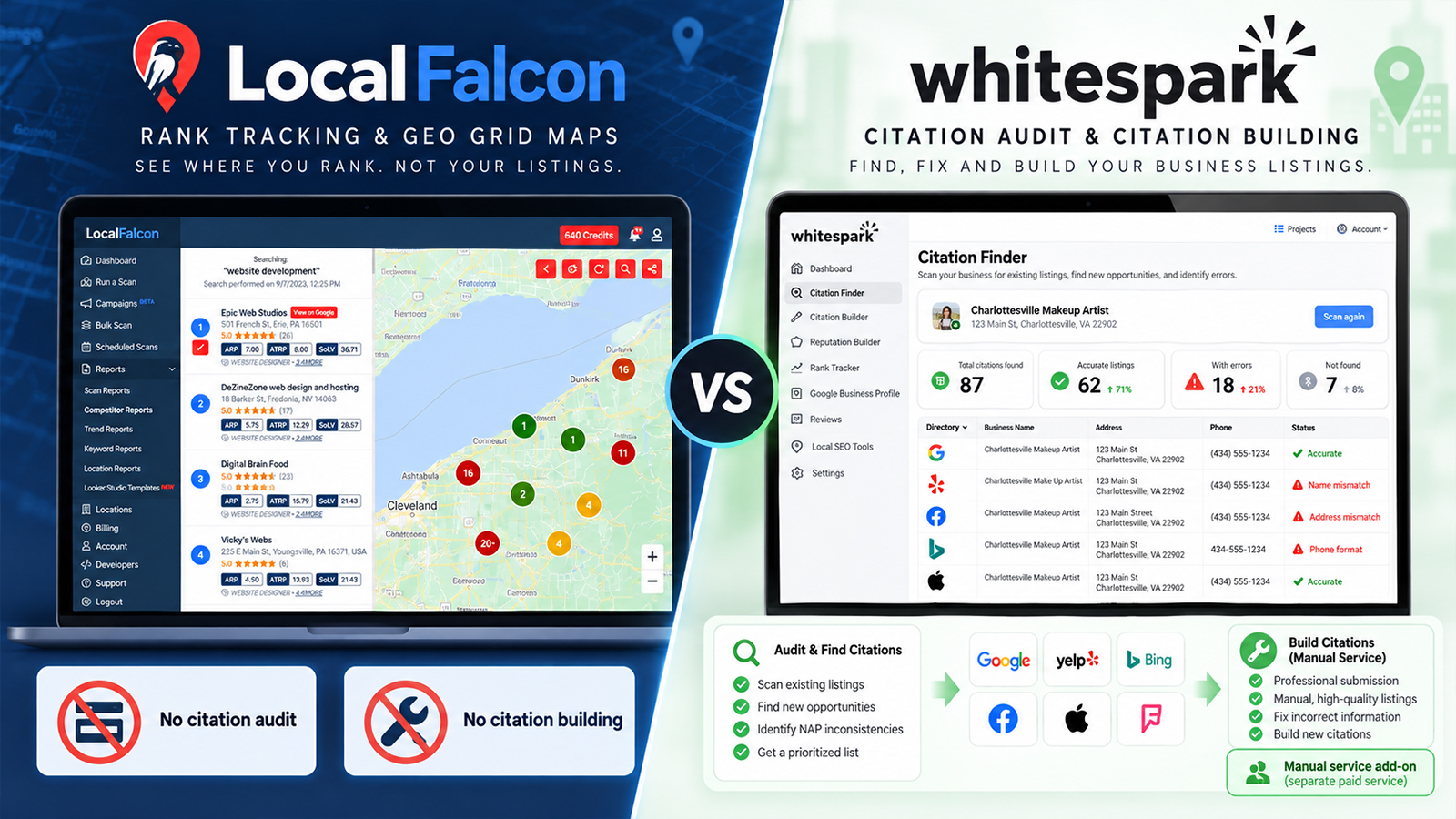
Whitespark’s citation finder locates where a business is listed across directories. It flags wrong name, address, and phone details, often called NAP data [3]. Matching listing information across the web is still a known local ranking signal. Whitespark also offers a manual citation-building service on top of the audit. It actually creates and fixes listings instead of just flagging them. Agencies that need to track and manage those listings over time can use Whitespark’s citation finder as the main citation tool for the account.
The Add-On Cost of Manual Citation Building
Citation building is priced separately from the core software subscription, as a per-location service fee. That means the real monthly cost of active citation work with Whitespark runs higher than the subscription price alone suggests. It’s manual, labor-heavy work. That’s exactly why Whitespark still sells it as a service instead of a pure self-serve tool.
Local Falcon, by contrast, has no citation audit or build feature at all. This isn’t a “does it worse” situation. It’s a category Local Falcon simply doesn’t touch. If citation accuracy is part of your monthly deliverable, Whitespark is the only one of the two that handles it.
Review Management Features
Whitespark’s Reputation Builder and Review Monitoring
Whitespark’s Reputation Builder lets an agency watch and respond to reviews across many client locations from one dashboard. For ongoing client work, this matters a lot. Review monitoring is time-sensitive. A slow response to a negative review can cost a client real business. Having it live next to your rank data instead of in a third login saves real time each week.
Why Local Falcon Skips Review Management Entirely
Local Falcon has no built-in review monitoring tools. Again, this fits its narrow focus on Google Business Profile ranking visibility rather than the broader local SEO workload. If your clients expect review responses as part of the deal, you’ll manage that elsewhere no matter which rank tracker you pick. Keeping review monitoring in the same tool you use for ranking does save a login and an export step. But it doesn’t erase the actual time spent reading and replying to reviews each week. Keep that in mind before you assume more features always means less work.
White-Label Reporting for Agency Clients
Local Falcon’s Visual Grids vs. Report-Ready Output
Local Falcon’s grid maps are genuinely impressive in a live screen-share. The problem shows up the next month. You need to turn that same visual into a polished, recurring report a client can read without you explaining it live. That usually means extra manual work: pulling screenshots, writing context, and building a document Local Falcon won’t generate for you on its own.
Whitespark’s Built-for-Agency Dashboards
Whitespark was built with agency delivery in mind from day one. Its white-label dashboards are made to go out under your own brand with less manual work than Local Falcon requires. That said, be honest about the trade-off. The interface and report templates can feel dated next to newer local SEO tools, including Local Falcon’s own grid visuals.
The real question for a solo marketer isn’t which tool is better for internal strategy. It’s which one produces the report your client actually reads and judges you by. A lot of tools look strong on the first measure and quietly fail on the second. Report assembly time is a cost neither tool fully removes from your week. If that gap sounds familiar, take a quick look at how SoloCMO’s local SEO software handles reporting for a team of one. That’s usually the part no tracking tool was ever designed to solve.
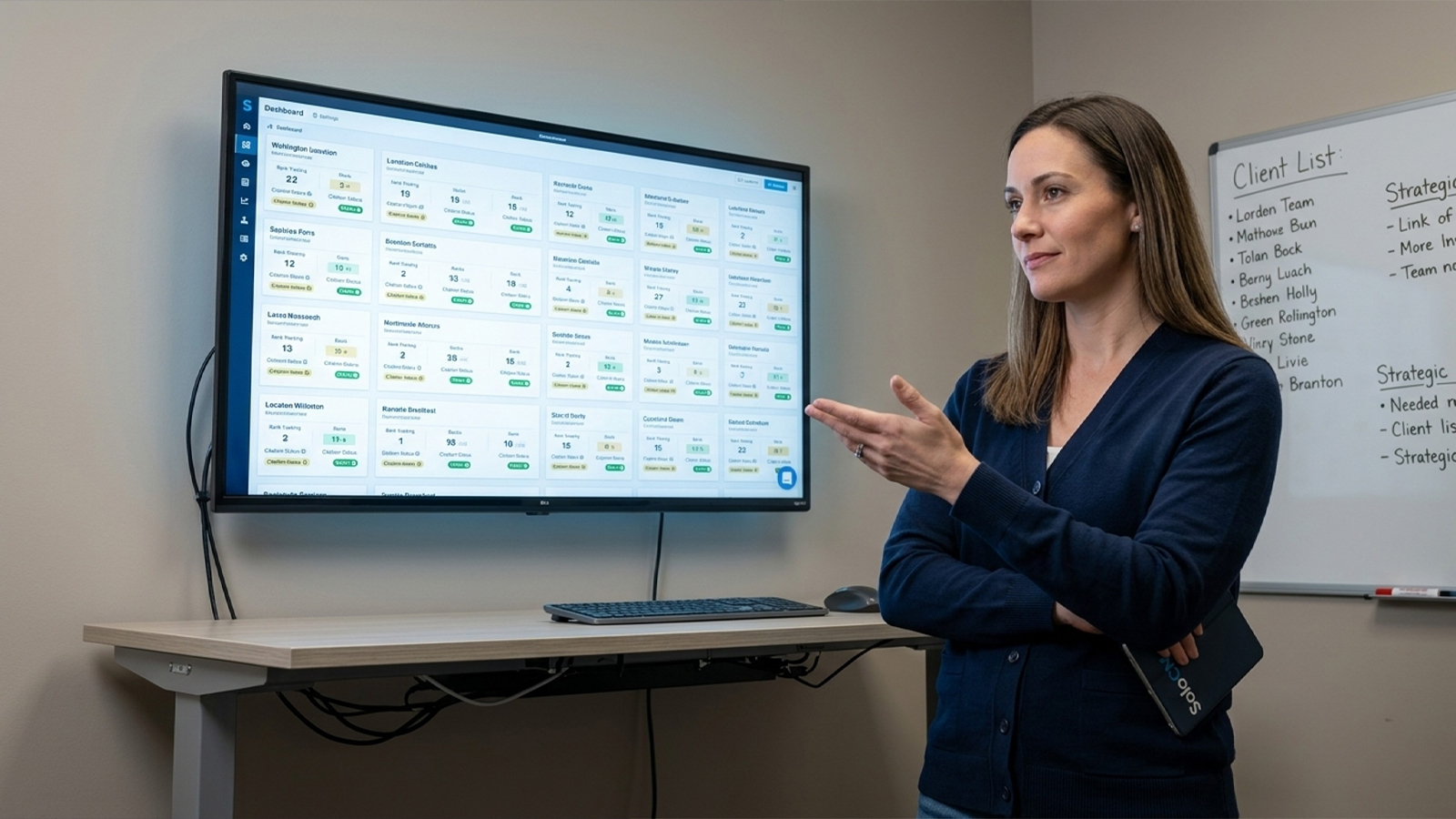
Multi-Location and Multi-Client Scalability
Here’s where the two tools create very different operating risks for agencies managing more than a handful of clients.
- Local Falcon’s cost scales with usage. More locations, bigger grids, and more frequent scans burn through credits fast. An agency that adds two clients mid-month can get blindsided by a tier upgrade they didn’t plan for [4].
- Whitespark’s scalability challenge isn’t cost spiraling. It’s setup time. Onboarding a new client location across multiple modules (rank tracker, citation finder, reputation builder) takes more manual setup than logging into one unified dashboard.
- Local Falcon: cost scales with usage. Whitespark: time scales with client count.
Both are real limits for a one-person team. They just show up on different lines of your month. One hits your invoice. The other hits your calendar.
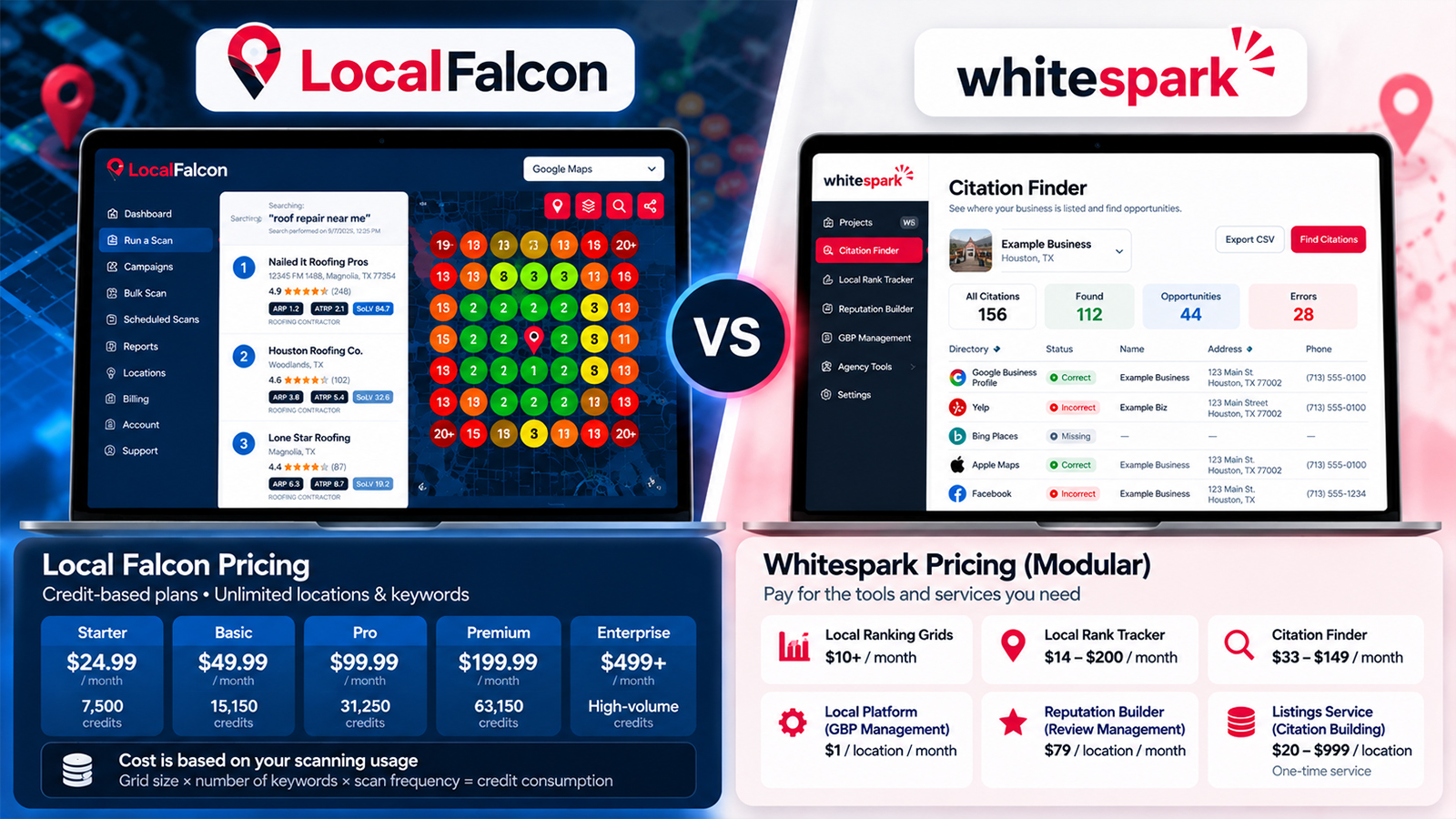
Pricing Model and Cost at Scale
Real numbers matter more here than almost anywhere else in this comparison. So here they are.
Local Falcon’s Credit-Tier Pricing
Local Falcon runs on scan credits. Published tiers range from about $24.99 a month at the entry level up to $4,999 or more a month at the top end. The price depends on scan volume and the number of tracked locations and keywords [5]. A solo marketer tracking a few keywords across a handful of locations can likely stay in a lower tier. An agency running weekly scans across twenty locations with several keywords each will burn through credits much faster than the entry tier allows.
Whitespark’s Modular Per-Product Pricing
Whitespark prices by product rather than by credit. Its Local Platform runs roughly $1 per location. The standalone rank tracker runs $14 to $200 a month depending on tier. The citation finder runs $33 to $149 a month [6]. An agency typically stacks two or three of these products together, so the real monthly cost adds up. It’s not a single number you can quote off a pricing page. Agencies comparing options sometimes weigh the Whitespark Local Rank Tracker against a simpler standalone rank tracker before deciding whether the full modular suite is worth the added cost.
| Dimension | Local Falcon | Whitespark |
|---|---|---|
| Geo-grid rank tracking accuracy | Dense grid, strong ranking heatmap visuals | Local Ranking Grids, fewer grid points |
| Citation audit and building | None | Citation finder plus paid manual building service |
| Review management | None | Reputation Builder with cross-location monitoring |
| White-label/client reporting | Visual but needs manual formatting | Built for agency delivery, interface feels dated |
| Multi-location/multi-client scalability | Unlimited locations, credit cost scales with use | More products, manual setup time scales with clients |
| Pricing model and cost at scale | $24.99 to $4,999+/month in scan credits | $1/location plus $14-$200/mo and $33-$149/mo modules |
| Ease of onboarding new locations | Fast, add location and keywords in minutes | Slower, configure each module per client |
| Depth of GBP optimization insights | Competitor share-of-voice view | Measurement-focused, not prescriptive |
A twenty-location agency running Local Falcon with weekly scans across a few keywords each will likely land in a mid-tier credit plan. That same agency running Whitespark’s rank tracker plus citation finder plus Local Platform across twenty locations is paying three separate monthly bills. Neither number is automatically higher. It depends on scan frequency versus module count. That’s the kind of math worth doing before you commit a budget line. Honestly, a quick back-of-napkin estimate now can save you an awkward budget conversation three months from now.
Ease of Onboarding New Client Locations
Adding a Location in Local Falcon
Local Falcon allows basically unlimited locations and keywords without a separate subscription per client. The friction isn’t setup steps. It’s credit use. You can add a new client location in minutes. The trade-off shows up later, on your invoice, not during onboarding.
Configuring a New Client in Whitespark
Whitespark’s Local Rank Tracker and related modules need more manual setup per new client. You need to connect the Google Business Profile, build a keyword list, and set up citation checks across separate product areas. None of these steps are hard on their own, but they add up. Onboarding a new client across three Whitespark tools can take an hour or more, compared to Local Falcon’s faster setup. Some agencies also lean on the Whitespark Local Rank Tracker’s saved settings to speed up repeat onboarding, once a template location is set up correctly the first time.
That time difference is a direct sign of how many new clients a solo operator can realistically take on in a given month without losing a weekend to setup work.
Depth of GBP Optimization Insights
Local Falcon’s Competitor Share-of-Voice View
Local Falcon’s grid data includes a competitor share-of-voice view. It shows which businesses dominate the local pack across the scanned grid, rather than just reporting your own rank. That’s genuinely useful in a sales pitch or client renewal conversation, since it frames your performance against the competition instead of in isolation.
Where Both Tools Stop Short of Prescriptive Optimization
Here’s the honest shared limit: neither tool tells you exactly what to change on a Google Business Profile to improve local ranking. Neither hands you a to-do list like “add these categories” or “post twice weekly.” Both are measurement tools, not optimization-advice engines. They’ll show you the local ranking problem clearly. Turning that data into a specific listing fix or profile change still takes a human applying judgment to the numbers.
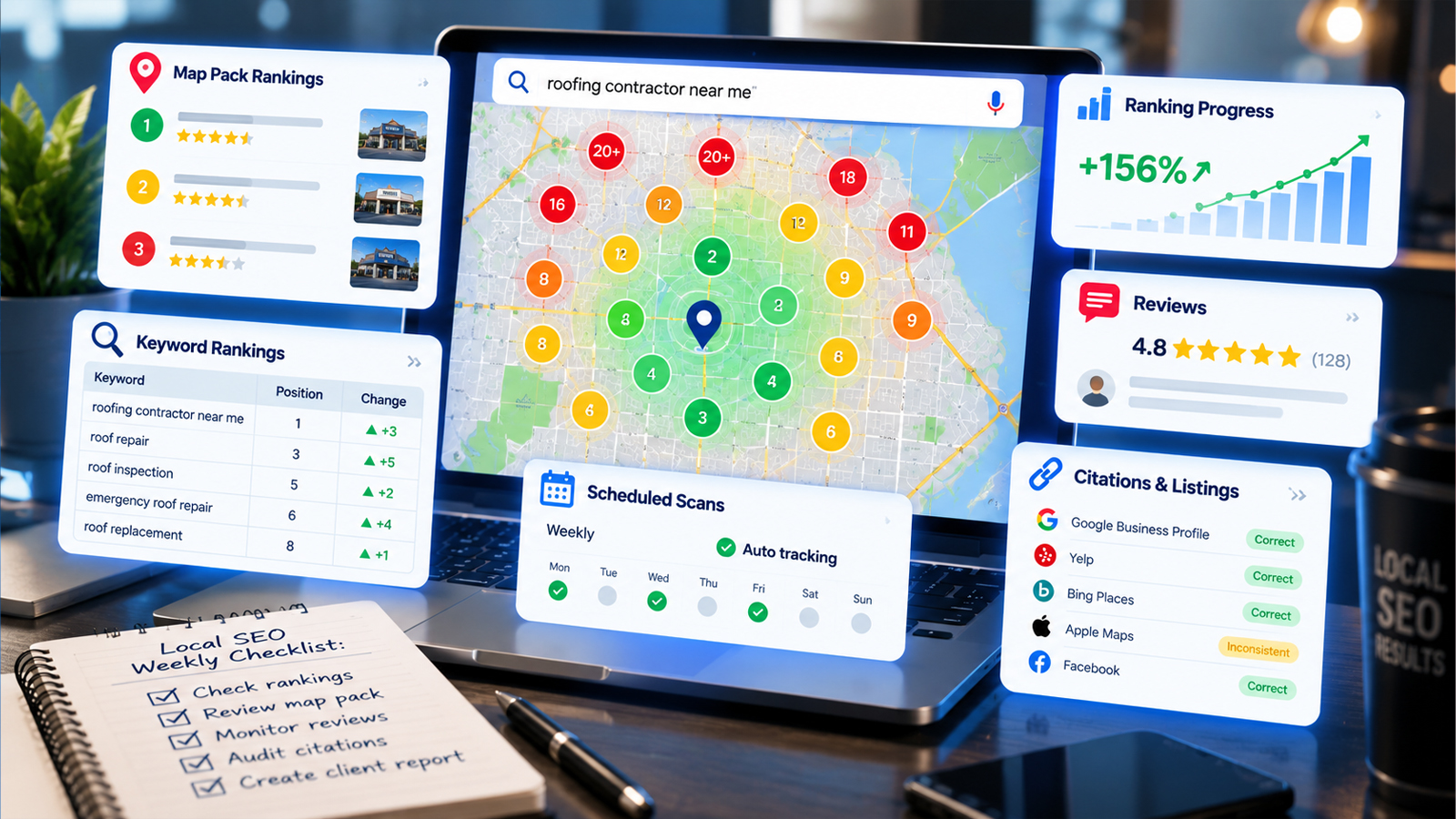
Local Rankings: What Solo Marketers Actually Need to Track
The Weekly Local Search Reporting Workload
Step back from the feature list for a second and look at the actual week. Checking rankings, taking screenshots for a client, monitoring reviews, checking citation accuracy, then pulling it all together into something a client or boss actually reads. That’s the real workload behind “local search tracking.” It’s not one task, it’s five. Most of them repeat every single week no matter which rank tracker sits at the center of your stack. If any of this sounds like 5 signs your business has a local SEO visibility problem, checking a client’s Whitespark local rank alongside a Local Falcon heatmap for the same keyword is a common check before numbers go out in a report.
Why Tool Choice Alone Doesn’t Solve the Time Problem
Here’s the uncomfortable part neither tool’s marketing page says outright: picking the “right” one between Local Falcon and Whitespark only solves part of this. Even with the ideal tool, a solo operator still spends hours stitching together outputs into a report someone else reads. A tool that tracks local rankings is not the same thing as a system that produces the finished client-facing report. That gap, the space between raw data and a polished monthly report, is where most solo marketers actually lose their time. If you’ve ever wondered whether there’s a faster way to close that gap, that’s a fair question to bring to a quick conversation rather than figure out alone.
Conclusion: Local Falcon vs. Whitespark — Or a Broader Alternative
Local Falcon and Whitespark solve different parts of the local SEO workflow.
Local Falcon makes sense when your priority is geo-grid rank tracking and you want a clear visual of how a business performs across an actual geographic area.
Whitespark goes further into the operational side of local SEO, combining rank tracking, citation auditing and building, reputation management, and other local search tools in a more modular platform.
But if you’re comparing these tools because you’re trying to reduce the number of platforms required to manage your marketing, there’s another option worth considering.
SoloCMO brings local SEO into a broader marketing operating system.
Instead of treating local rankings as an isolated workflow, SoloCMO connects them to the rest of the work a solo marketer actually has to manage: strategy, competitive research, SEO planning, content execution, campaign management, reporting, and proving results.
That distinction matters because tracking rankings is only one part of the job. The bigger time drain usually comes afterward: deciding what the data means, figuring out what should happen next, executing the work, and turning the results into something a client or leadership team can understand.
So the choice ultimately comes down to the job you need the platform to perform:
- Local Falcon if you primarily need specialized geo-grid rank tracking.
- Whitespark if you want a broader local SEO toolkit with citations, reputation management, and rank tracking.
- SoloCMO if you want robust local SEO functionality connected to the rest of your marketing strategy and execution in one system.
And because SoloCMO is built around the needs of lean marketing teams and solo operators, you get that broader functionality at a competitive price without having to assemble another stack of disconnected tools.
If you’re already looking beyond simple rank tracking, see how SoloCMO can bring local SEO, content, strategy, execution, and reporting together in one workflow.
FAQ
Is Local Falcon or Whitespark more accurate for tracking local rankings?
Neither tool is objectively more accurate. They measure rank using different grid density and methods. That’s why identical keyword and location pairs can show different numbers in each dashboard on the same day [2]. Reading those differences correctly, and explaining them clearly to a client, is where real local SEO skill shows up.
What’s the difference between geo-grid tracking and single-point local rank tracking?
Geo-grid tracking measures rank across dozens of surrounding points instead of just one search location. This gives you a fuller picture of where a business shows up in the local pack. Single-point tracking only tells you the rank from one spot, which can hide real weak points a few miles away. The grid view matters most when you’re trying to prove visibility claims with real data instead of one lucky number.
Can Local Falcon or Whitespark help with Google Business Profile optimization, not just tracking?
Both tools mainly measure GBP visibility rather than tell you specific actions to take. Local Falcon’s competitor share-of-voice view comes closest to actionable insight, since it shows who’s winning the local pack around you. Turning that data into a specific profile or listing change still benefits from a professional reading the numbers.
How much does Local Falcon cost compared to Whitespark at scale?
Local Falcon runs $24.99 to $4,999 or more a month depending on scan volume [5]. Whitespark’s modular pricing stacks a Local Platform fee, a rank tracker tier, and a citation finder tier separately [6]. Your total cost depends heavily on how many locations and modules are active at once. It’s worth running the math against your actual client count rather than comparing sticker prices.
Does Whitespark offer geo-grid tracking similar to Local Falcon?
Whitespark’s Local Ranking Grids do offer geo-grid style tracking, but with less visual detail than Local Falcon’s heatmaps. The two aren’t functionally identical despite looking similar on the surface. So the right pick depends on how much visual detail your reporting actually needs.
Which tool is better for citation building and citation audits?
Whitespark is the clear choice here, since Local Falcon has no citation features at all. Just know that active citation building is priced as an add-on service per location, separate from the core software subscription. Budget for that beyond the listed monthly tiers.
Should a solo marketer use both tools together instead of choosing one?
Some agencies do run both, using Local Falcon for visual grid proof and Whitespark for citations and reviews. But that still leaves report assembly and multi-tool monitoring sitting entirely on one person’s plate. Stacking two point tools doesn’t remove the manual work of turning their outputs into a finished client report. It just adds a second login to manage. That’s a gap worth solving separately from the rank tracking decision itself. It’s a good question to raise if you ever get SoloCMO on the phone to talk through your specific stack.
Sources
[1] https://www.localfalcon.com/ [2] https://localsearchforum.com/threads/which-is-truth-localfalcon-or-whitespark.62250/ [3] https://whitespark.ca/local-rank-tracker/ [4] https://localpulse.digitalizer.uk/blog/local-falcon-credits-explained [5] https://www.localfalcon.com/knowledge-base/kb81-how-much-does-local-falcon-cost-a-complete-guide-to-local-falcons-pricing [6] https://whitespark.ca/pricing/Recent Posts

Content Refresh vs Rewrite: Which Fixes Decaying Blog Posts Faster
A content refresh ships faster, usually in 1 to 3 hours versus 4 to 8 for a rewrite, but a rewrite recovers faster when the decay stems from a search intent mismatch. The rule of thumb is to refresh the post if it still matches what searchers want and most of it is salvageable, and to rewrite it if the

How to Build a Topic Cluster From Scratch for Your SaaS Blog
To build a topic cluster, pick a pillar topic that fits your product, collect subtopic keywords, group them by SERP overlap and intent, size the cluster, link every page to the pillar, publish in stages, then measure at cluster level. That is how to build a topic cluster in a way you can defend to a founder, and our topical authority
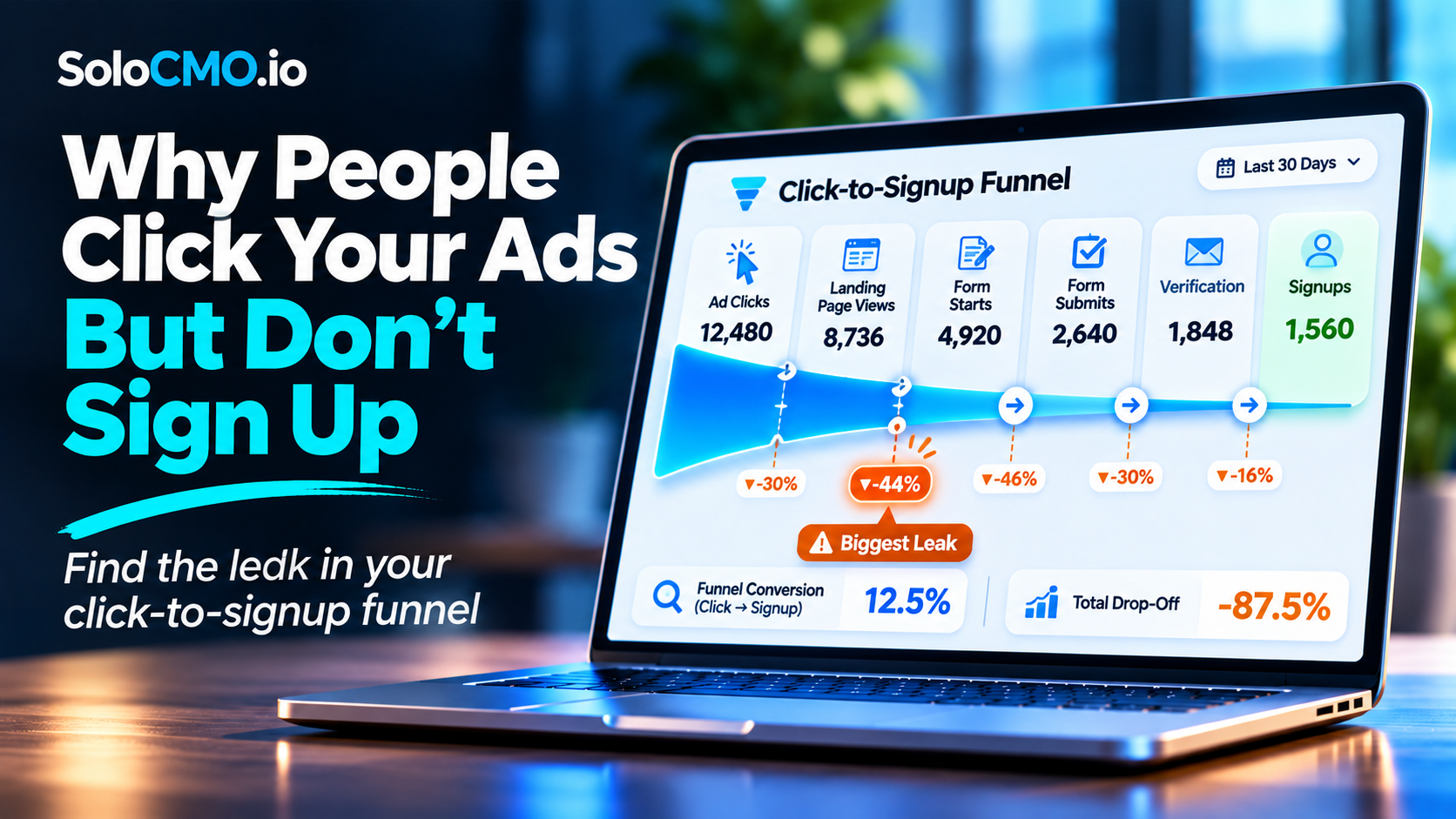
Where Leads Drop Off Between Ad Click and Signup
Funnel drop off between click and signup occurs at six points: the ad click, page load, above the fold, form start, form submit, and verification. The most significant leaks usually sit upstream, where the ad promise fails to match the page or where the page loads too slowly on mobile before the form ever appears. If your paid ad campaigns show
Get Smarter About Your Marketing
Practical SEO, AI, content, and marketing strategies you can put to work immediately.
Join the Newsletter