
Marketing Strategy

If you’re a fractional CMO running three or four client accounts at once, you already know the feeling: a campaign underperforms, and you can’t tell yet whether it’s the copy, the media buy, or something further upstream. Nine times out of ten, the real culprit is a vague customer profile sitting quietly beneath everything else, burning ad spend on the wrong companies and flattening your conversion rate across every campaign it touches. It eventually shows up as a testy Slack message from sales, asking why the leads don’t match what was promised. Tightening it doesn’t require a research team. If you want a faster way to turn a sharper profile into copy that actually converts, our customer avatar builder exists for exactly this problem.
Most marketers don’t catch a vague ideal customer profile until the funnel data forces the issue. So what does that data actually look like?
What are the signs that an Ideal Customer Profile is too vague? Five patterns show up repeatedly: messaging that tries to reach everyone, an inability to name disqualifying firmographic filters, sales and marketing defining the ICP differently, a profile that hasn’t changed in over a year, and segmentation based on industry alone with no behavioral or technographic layer.
Key Takeaways
- Your ICP is too vague if you can’t clearly name who it excludes, not just who it includes.
- A vague ideal customer profile shows up in reporting as low conversion, disputed lead quality, and inconsistent results across a supposedly uniform segment.
- None of these problems require a multi-week workshop to fix. A clear ICP can be rebuilt in a single focused sprint.
- Each of the five signs below maps to a specific, fast fix, even when you’re managing several client accounts at once.

Sign 1: Your Messaging Tries to Speak to Everyone
The Reporting Tell: Flat Engagement Across Every Segment
Pull up your last three campaigns. Look for a pattern: click-through rates hovering in the same mediocre range no matter which segment, list, or lookalike audience you’re running. That flatness is a tell. When messaging is written broadly enough to technically apply to everyone, it fails to land with anyone in particular. Your funnel shows it in engagement that never spikes and never really tanks either. It just sits there. Unremarkable.
Why Marketers Default to Broad Language
This happens for an understandable reason. Narrowing your target audience feels risky. Write copy for one specific buyer with one specific problem, and it feels like you’re closing doors on everyone else who might have bought. So the copy drifts toward safe, feature-first language like “helps businesses grow” or “built for modern teams.” It technically applies to nobody in particular. Which means it converts nobody in particular either.
The Fix: One Buyer, One Problem, Per Campaign
Compare “helps businesses grow” against “helps 10-person agencies stop losing 15 hours a week to manual client reporting.” The second version names a customer, a headcount range, and a specific pain. That specificity is what makes messaging convert instead of merely existing.
Before any campaign brief goes to copy, force it to name one buyer and one problem. If the same messaging would still technically work after swapping in a different customer type, it’s still too generic. For a deeper walkthrough on turning a sharpened profile into ad copy that actually performs, see how to turn a customer avatar into ad copy that actually performs. Worth bookmarking if this is the sign you recognized first.

Sign 2: You Can’t Name the 3 Firmographic Filters That Disqualify a Lead
The Pipeline Tell: Leads That Fit the Label But Not the Fit
Sales pipelines fill up with companies that technically match the industry tag on the ICP document but fail on nearly everything else that matters. Wrong headcount. Wrong budget tier. Wrong maturity stage. The label fits. The fit doesn’t. This is usually the fastest way to spot low conversion tied directly to lead qualification rather than copy or offer.
Aspirational vs. Exclusionary
Most ICP documents are written as descriptions of a dream customer rather than as a filter. They describe who a company would love to sign, not who it should say no to. An ICP that never disqualifies anyone isn’t really a profile. It’s a wish list.
Setting Your 3 Disqualifying Filters
A workable ICP needs at least three firmographic data disqualifiers that actively remove poor-fit leads before they waste sales cycles:
- Company size band (headcount or revenue range that’s too small or too large to serve well)
- Industry exclusions (verticals that technically fit the description but historically churn or underperform)
- Geo or market restrictions, when relevant, alongside budget or maturity-stage criteria
A strong ICP disqualifies more companies than it qualifies. That’s not a flaw. That’s the entire point of the criteria. And it’s achievable without a data science team. Three clear firmographic filters is a reasonable bar for a solo operator working across multiple accounts.

Sign 3: Sales and Marketing Define Your Avatar Differently
The Handoff Tell: Disputed MQLs and Rejected Leads
Handoff friction is one of the loudest symptoms of a vague ICP. Marketing sends leads that meet its definition of qualified. Sales rejects a chunk of them, sometimes politely, sometimes not. Both sides think they’re right. Both sides are working from different mental models of who the ideal customer actually is.
Why Siloed Definitions Persist
The root problem is rarely bad intent. It’s the absence of a single source of truth. Marketing works from a slide deck built during onboarding. Sales works from tribal knowledge, gut feel, and CRM notes that were never reconciled with that deck. Neither party is wrong exactly. They’re just misaligned, and the misalignment compounds every quarter it goes unaddressed.
Reconciling Fields Inside Your CRM
The fix isn’t a new tool. Platforms like HubSpot and Salesforce already support custom firmographic and lifecycle-stage fields, so the tooling isn’t the gap. The gap is that nobody sat down and reconciled the two definitions into shared fields both teams actually use daily. Document one ICP. Build it into the CRM as structured fields rather than a static PDF. Require both sales and marketing to reference the same qualification criteria when scoring a lead. This is an alignment problem, not a personal failure on either side, and it’s fixable in an afternoon once someone owns the reconciliation.

Sign 4: Your ICP Hasn’t Changed in 12+ Months Despite New Customer Data
The Data Tell: Closed-Won Customers Don’t Match the Document
Pull your closed-won list from the past year and compare it against the documented ICP. In many accounts, the drift is obvious. The customers actually buying, renewing, and expanding look meaningfully different from the profile still sitting in the strategy deck. Reporting eventually forces this comparison whether you plan for it or not.
Why Avatars Get Frozen in Time
This happens because the ICP was treated as a one-time deliverable. Often it was written early, sometimes by a founder describing the first handful of customers who happened to buy, and it never got revisited once the customer base matured and diversified.
Building a Quarterly Review Habit
The fix is a review cadence, not a rewrite from scratch. Set a quarterly checkpoint anchored to analyzing your best current customers, meaning the accounts that renew, expand, or refer, not just the ones that technically closed. Those signals predict fit far better than a single sale does. A stale ICP is one of the most common and most avoidable ICP mistakes among solo marketers spread across multiple accounts, largely because nobody built in a trigger to revisit it.

Sign 5: You’re Segmenting by Industry Alone With No Behavioral or Technographic Layer
The Campaign Tell: One Vertical, Inconsistent Conversion
Campaigns aimed at an entire vertical, “all SaaS companies” or “all professional services firms,” tend to convert unevenly. Some accounts within the vertical respond well. Most don’t. That inconsistency is a sign the vertical itself was never the real predictor of fit.
Why Industry Alone Isn’t a Real Filter
Industry is the easiest filter to pull from any list-building tool, which is exactly why it gets overused. It ignores tech stack, workflow maturity, and the actual trigger that makes companies buy. Two companies in the same industry can have wildly different needs depending on what tools they already run and how mature their operations are.
Adding Technographic and JTBD Layers
Compare “marketing agencies” as a filter against “agencies running paid campaigns without a dedicated ops hire, already using a CRM but no ICP tooling.” The second version layers in technographic data, meaning the specific tools companies already use, alongside a behavioral signal. Pairing that with the Jobs-to-be-Done framework, which defines the specific job a customer is hiring your product to do independent of industry label, helps you identify your customers’ actual challenges rather than just their category. That combination is what separates a real filter from a lazy one.

What Makes a Profile Too Broad or Generic?
A broad ICP happens when a business defines its ideal customer as anyone who could theoretically buy, rather than the narrower group that buys fastest, renews longest, and refers most often. This confusion is almost always the root cause behind all five signs covered above, and it’s worth naming directly because it reframes the entire diagnostic.
TAM/SAM/SOM segmentation is the cleanest way to see the mistake. TAM, the total addressable market, is every company that could ever conceivably use the product. SAM, the serviceable available market, is the subset that actually fits the firmographic and technographic profile. SOM, the serviceable obtainable market, is the slice you can realistically reach and convert this year given your current resources and positioning.
An ICP that describes the TAM is not an ICP. It’s a market-sizing exercise wearing an ICP’s clothes. The ICP should live at the SAM or SOM level, tight enough that target customers are a specific, defensible group rather than a rebranding of the entire addressable market. When marketers confuse these layers, every downstream sign in this article starts to make sense: the messaging is broad because the audience definition is broad, the firmographic filters don’t exist because nobody drew a line between TAM and SAM, and sales rejects leads because marketing was chasing the whole market instead of the obtainable slice of it.

How to Rebuild a Vague Customer Profile in Under a Day
The traditional approach to fixing an ICP looks like a multi-week workshop: scheduling stakeholder interviews, waiting on data pulls from whoever owns the CRM, circulating a draft for feedback, slowly grinding toward group consensus. That process assumes a team with headcount to spare. It was never built for a fractional CMO juggling several client accounts, where every hour spent on ICP research is an hour not spent running the campaigns those clients are actually paying for.
The alternative is a single-day, AI-assisted sprint. Pull existing closed-won data, run it through a structured ICP generation workflow, and produce a documented, defensible profile in hours instead of weeks. This is precisely the gap SoloCMO’s architecture is built to close, since the product is designed around output multiplication for a team of one rather than the coordination overhead a bigger consultancy would need to run the same workshop five times over for five different clients.
Once a precise ICP exists, account-based marketing becomes a realistic option rather than an aspiration, because ABM only works when the target account list is genuinely tight. Trying to run ABM against a broad, aspirational ICP just recreates the same waste at a smaller scale.
For a fractional CMO managing several client businesses at once, this compression matters more than the time savings alone suggest. A manual rebuild that takes one afternoon for a single company becomes an entire week once it’s repeated across five accounts. A structured sprint keeps that math from ever adding up against you. If you’re curious what that sprint looks like applied to your own client roster, it’s a reasonable next question to ask before your next campaign brief goes out.
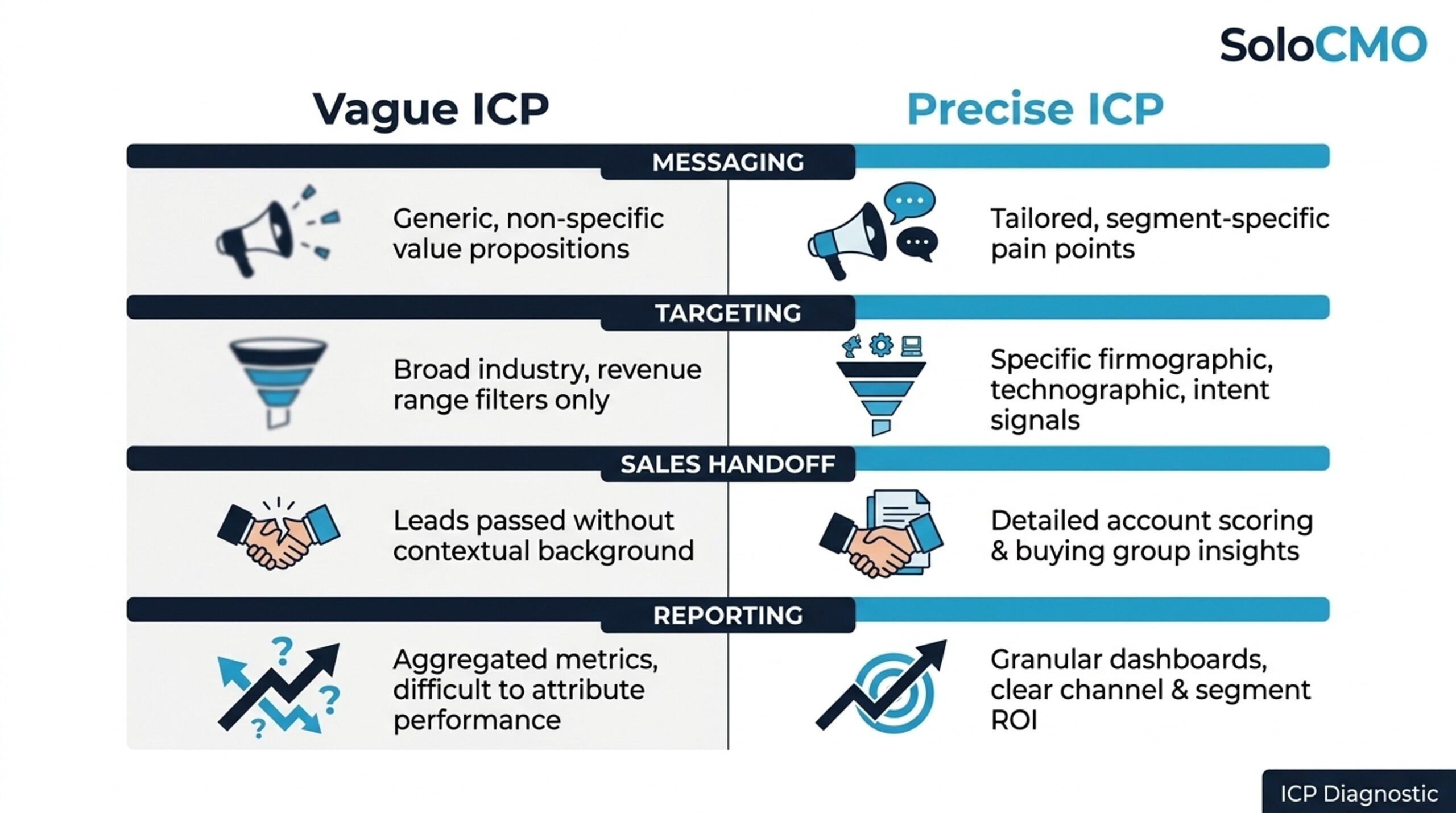
Broad ICP vs. Precise ICP: A Side-by-Side Comparison
Vague customer profiles too often get diagnosed only after months of underperformance have already piled up in the reporting dashboard. The signs above are meant to catch the problem earlier. Here’s what changes across the four dimensions that matter most once an ICP moves from vague to precise.
| Dimension | Broad ICP | Precise ICP |
|---|---|---|
| Messaging | Speaks to everyone, converts no one | Speaks to one buyer’s specific problem |
| Targeting | Broad industry lists, high spend waste | Firmographic and technographic filters, tighter spend |
| Sales handoff | Disputed MQLs, rejected leads | Shared CRM-documented qualification criteria |
| Reporting | Vanity metrics, unclear attribution | Clear segment-level pipeline attribution |
Once an ICP moves into the precise column, several fast wins tend to follow quickly:
- Ad spend concentrates on segments with a proven conversion history instead of spreading thin across a broad list
- Sales stops rejecting marketing-sourced leads because qualification criteria are documented and shared
- Campaign messaging gets built around one buyer’s job-to-be-done instead of generic, catch-all benefits
- Quarterly reporting finally shows which segment is actually driving pipeline instead of vanity metrics
Conclusion
You now have a name for what you were only feeling before: a vague customer profile sitting one layer upstream of the copy, the media buy, and every disputed lead sales has sent back your way. The diagnosis was the hard part, and it’s done. What’s left is the scaling problem: manual ICP rebuilds don’t hold up across several client accounts, since what takes one focused afternoon for a single business quietly becomes a full week once you multiply it by every account on your plate. Get an estimate for an ICP generation workflow built specifically for a one-person marketing operation managing multiple accounts, and turn this diagnosis into a rebuilt profile before your next campaign launches.
FAQ
How specific should an Ideal Customer Profile be?
An Ideal Customer Profile should be specific enough that you can name at least three firmographic filters and one technographic layer, not just an industry label. That level of precision is the practical bar for SAM/SOM-level targeting rather than TAM-level description. Getting this precise manually across several client accounts is exactly the bottleneck a structured workflow is built to remove.
What’s the difference between a buyer persona and an ICP?
A buyer user persona describes an individual role or user within a company, including goals, day-to-day pain, and decision-making behavior, while an ICP describes the company or account itself at the firmographic and technographic level. Solo marketers often conflate the two and end up with neither properly defined. Treating them as separate but connected documents, one at the account level and one at the human level, solves that gap.
How do you validate an ICP with real data?
You validate a buyer persona with real data by pattern-matching closed-won customers against your documented firmographic and technographic criteria using CRM data pulled from HubSpot or Salesforce. Look specifically at accounts that renewed or expanded, not just ones that closed once. Doing this manually across multiple accounts takes real time, which is exactly why an automated workflow tends to pay for itself quickly.
How often should you update your Ideal Customer Profile?
You should update your Ideal Customer Profile on a quarterly cadence tied to fresh closed-won data, echoing the staleness problem covered above. Most solo operators skip this step not from neglect but from a simple lack of time. That’s the natural opening for a faster, repeatable process rather than a one-time annual overhaul.
Can you have more than one ICP for the same product?
Yes, a single product can have more than one ICP, particularly for account-based marketing motions or products serving multiple distinct segments. Using TAM/SAM/SOM as the frame, multiple SOMs can exist under one broader SAM. Managing several ICPs at once gets considerably harder without a systemized workflow, especially when you’re doing it across several client accounts rather than one internal team.
How do you know if your customer segment is too vague?
You know a customer segment is too vague if you can’t name what disqualifies a lead or point to closed-won data that actually supports the segment’s definition. That inability to draw a line is the core diagnostic thread running through all five signs above. Use that checklist as the practical test before you invest another dollar of ad spend against it. If you’d rather talk it through than run the checklist solo, getting an estimate costs nothing and usually clarifies which sign is actually driving your results.
Recent Posts

Why Is My Funnel Converting Below Industry Average?
A below-average funnel conversion rate almost always comes from one of five causes: mismatched traffic, a weak landing page or offer, poor follow-up, weak lead qualification, or the wrong benchmark. You don’t need a week of guessing to find the cause. A structured funnel diagnostic can find it in hours. If you’d rather hand the work off, that’s exactly what
Why Is My Blog Traffic Dropping Even Though I Haven’t Changed Anything?
If you’re staring at a declining line in Google Analytics and mentally replaying every recent action looking for what you broke, stop. Blog traffic dropping for no reason is one of the most confusing problems a solo marketer can face. Here’s the short answer: it’s almost never something you did. Traffic drops without site changes are usually caused by algorithm
Local Pack Rankings Dropped Overnight: What to Check First
Okay, first thing: check your Google Business Profile status. When local pack rankings drop overnight, that’s the fastest and most common cause, and confirming it takes under two minutes. This isn’t a mystery that needs an agency or a week of guessing. It’s a known, ordered checklist, and you can run it yourself in the next hour. If your GBP
Get Smarter About Your Marketing
Practical SEO, AI, content, and marketing strategies you can put to work immediately.
Join the Newsletter