Local SEO
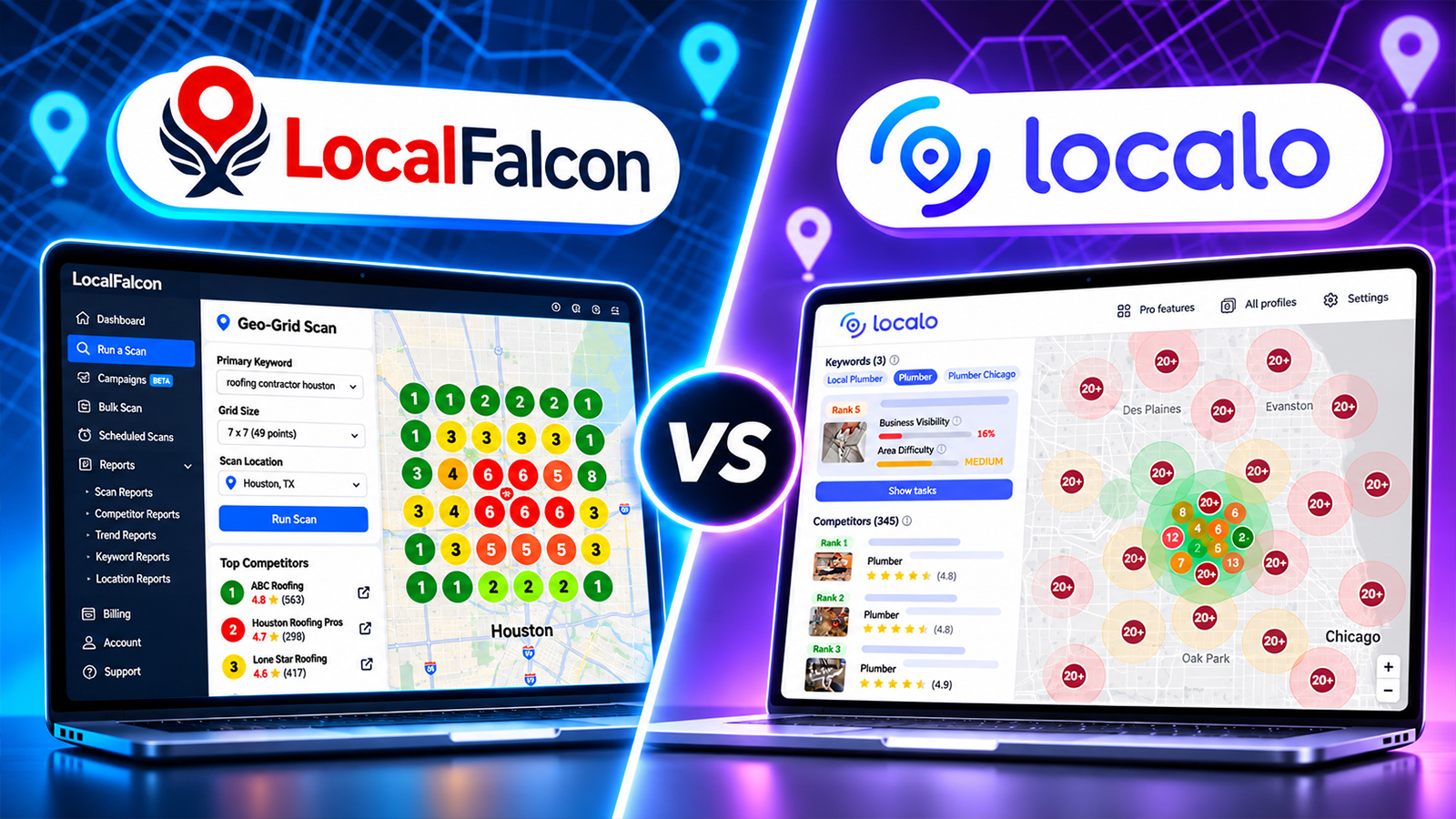
Local Falcon vs. Localo looks like a feature comparison, but it is really a question about which bottleneck is costing you more: a specialist that proves where a client ranks, or a platform that does the upkeep. If you are managing local SEO for several small businesses without a team, the answer shapes your reporting, your per-client cost, and how many hours the tool takes from your week. This guide gives you an honest framework to match each tool to your roster, without handing you a verdict from outside.
Key Takeaways
- Local Falcon is a geo-grid rank tracker that shows block-by-block ranking in Google Maps and produces shareable heatmaps. It measures results but does not do the optimization work.
- Localo is a Google Business Profile platform with AI-assisted tasks, post and review-reply drafts, audits, and lighter rank tracking.
- Pricing models differ. Local Falcon sells monthly credit tiers from $24.99 to $199.99, while Localo prices by business or Pro tier. Verify both on the vendor sites.
- The better fit depends on your client mix: competitive metros need visual proof, while smaller markets mostly need steady upkeep.
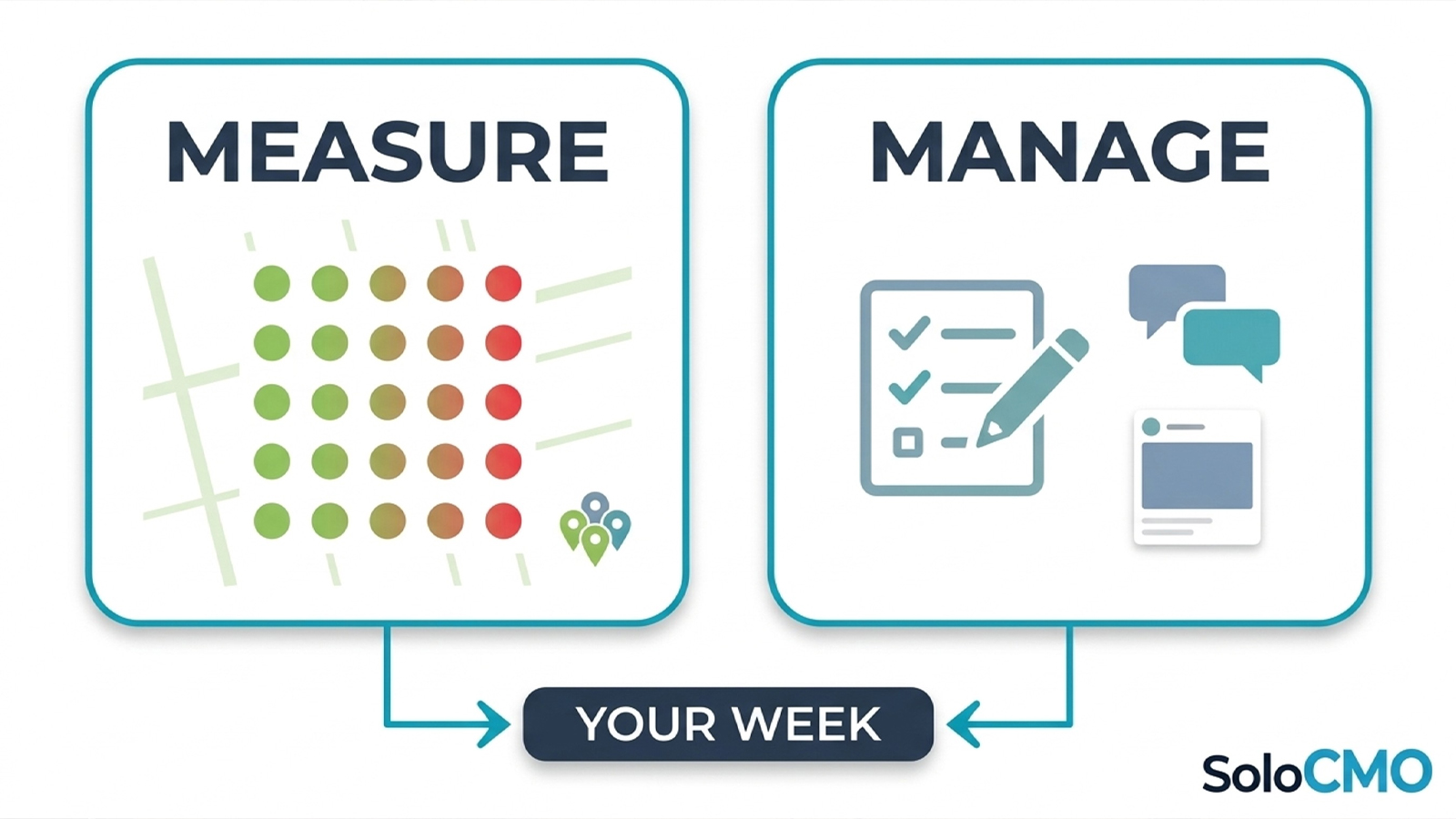
Core Purpose: Local Visibility Tracking vs. Business Profile Management
Ask what job each tool performs in your week. One exists to show you results, whereas the other exists to help you create them.
What Each Tool Is Built to Do
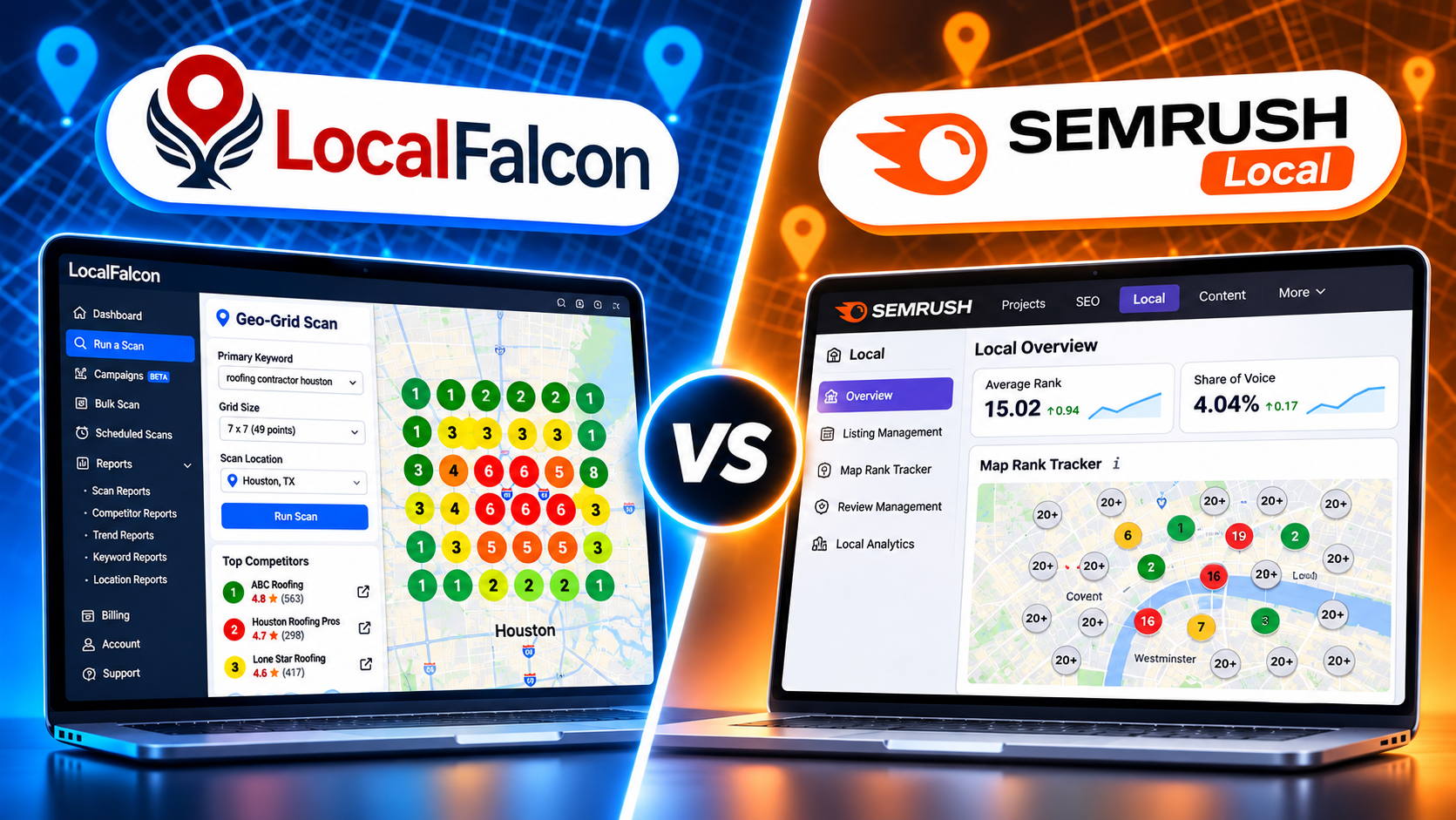
Local Falcon is a specialized grid-based rank tracking tool. You pick a keyword and a center point, and it scans a grid of coordinates around that point before returning a map that shows where the account ranks at each spot. The result is far more detail than a single averaged number can provide. That is where Local Falcon excels: turning a vague sense of “we rank okay” into a precise picture of where an account wins and where it disappears.
Localo sits on the other side of the split. It is a Google Business Profile (GBP) platform that audits a profile, suggests weekly tasks, drafts posts and review replies, and tracks rankings on a lighter basis. It tells you what to fix and then helps you carry out the work.
A solo consultant has two jobs, proving value and doing the work, and a tool that excels at one rarely covers the other. Which job is eating more of your time right now? If you are not sure, jot down where last week’s hours actually went. The answer is often clearer on paper than in your head.
Why Team-Oriented Suites Miss the Solo Use Case
Many enterprise local SEO suites assume a department, bundling seats, approval chains, and collaboration features that make sense for teams but add friction for one person. If you are the strategist, the writer, and the account manager all at once, those extras become overhead rather than value.
That narrows the market for a solo practitioner. You do not need a suite built around handoffs; you need tools that either show a clear result quickly or lift a recurring task off your plate, ideally without adding another dashboard to check.
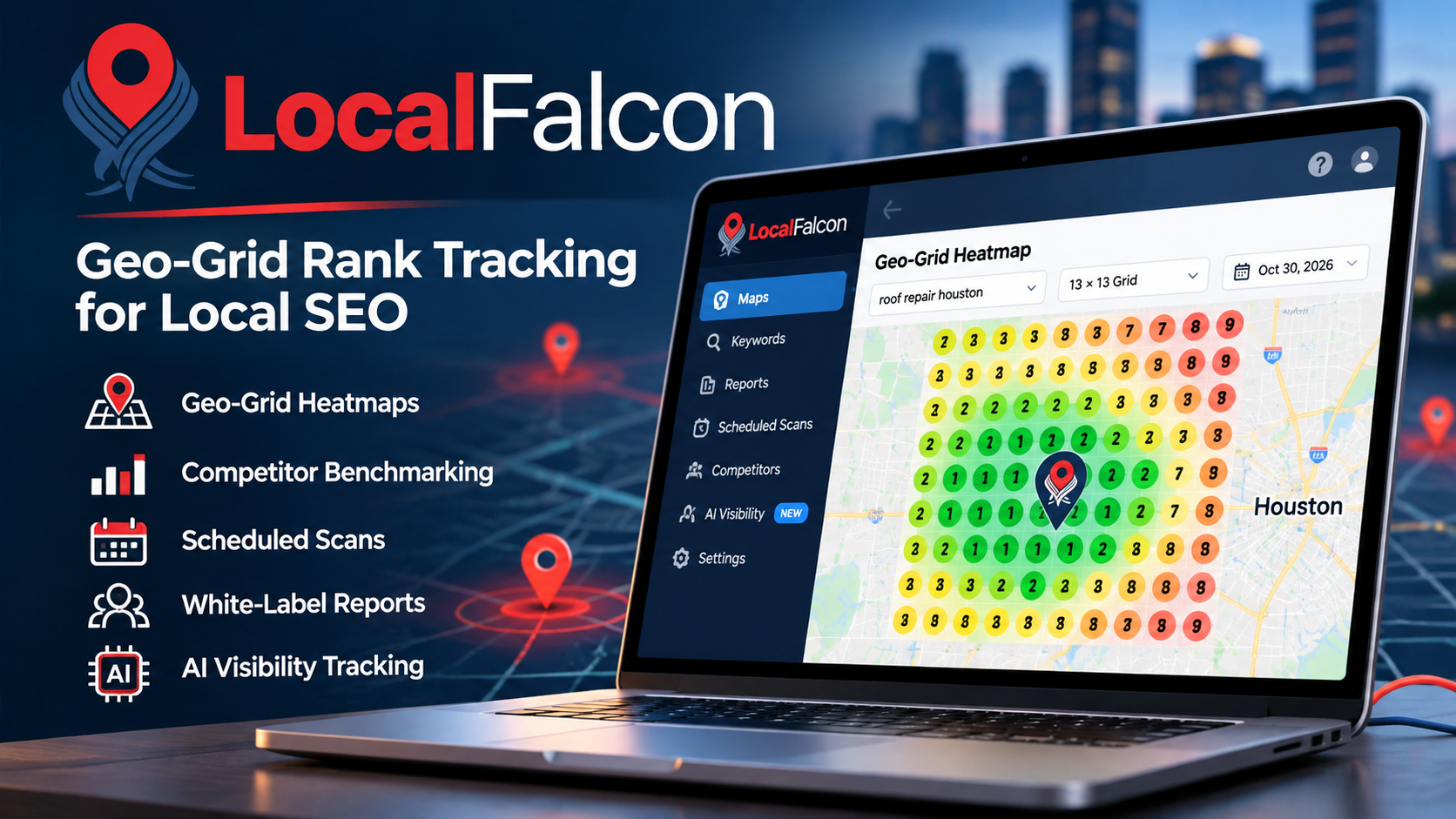
Local Falcon Is a Rank Tracking Geo-Grid Specialist: Strengths and Honest Limits
Local Falcon does one category of work in depth and leaves the rest to you.
What Local Falcon Does Best
Local Falcon shows how local rankings change from one spot to the next. A heatmap of the local map pack makes it obvious where an account appears in the top three and where it vanishes a few blocks away, exactly the variation that a standard rank tracker conceals by reporting one averaged position.
Its main strengths for a solo practitioner are:
- Competitor benchmarking: run the same keyword and grid for a rival and compare share of local voice and competitive positioning side by side, a kind of competitor intelligence that is hard to get from a single averaged rank.
- Scheduled scans: these build a trend line over time, so you can monitor visibility as optimization work lands.
- White-label sharing: hand reports directly to an account owner.
- AI visibility tracking: this positions Local Falcon as an ai visibility tracking tool for brand mentions across assistants such as ChatGPT and Gemini.
- Free trial credits: new users can try roughly 100 free credits, though you should verify the current offer. [1]
On G2, Local Falcon carries a 4.7 rating, according to a G2 comparison page. [1]
Where Local Falcon Falls Short
Local Falcon is a specialized geo-grid rank tracker, not a work engine. It will not write a post, answer a review, or fix a profile, so every insight it surfaces lands on your plate as a task to finish elsewhere.
Credits also expire monthly, which means unused scans do not roll over. Moreover, a heatmap is a visibility signal rather than a revenue figure; it says nothing about calls, bookings, or sales, so a green map can still sit beside a flat pipeline. Treat it as one proof point, not the whole story.
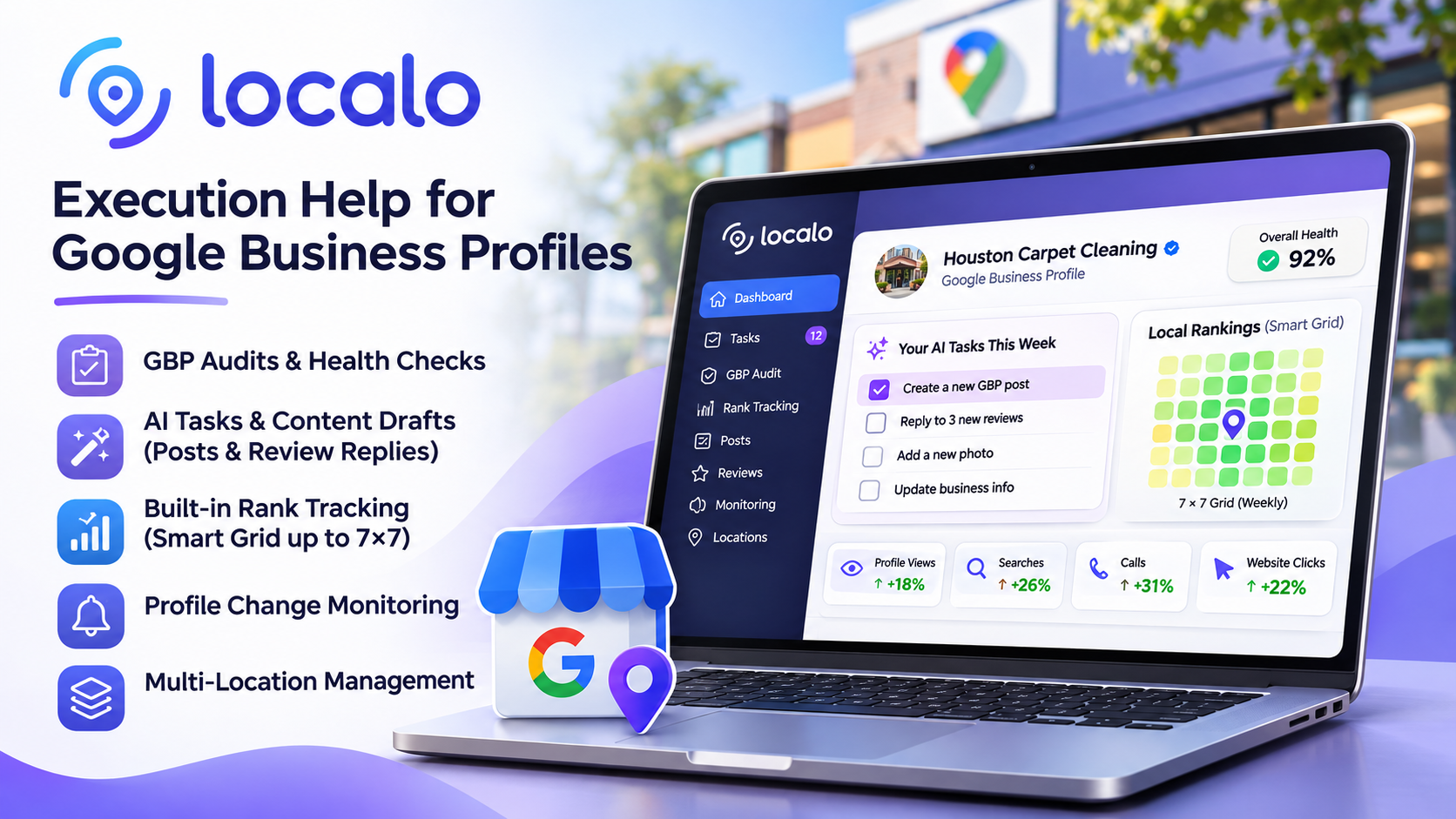
Localo as a Local Falcon Alternative: Execution Help for Google Business Profiles
Localo approaches the problem from the opposite direction. Instead of measuring first, it assumes the profile needs work and tries to make that work lighter.
What Localo Does for a Solo Operator
Think of Localo as a falcon alternative for the buyer whose bottleneck is time, not proof. It audits profiles, generates weekly AI tasks, drafts posts and review replies, and watches for unwanted profile changes, while built-in rank tracking lets you set a baseline and show progress without another reporting tool. [2]
For a consultant covering many small accounts, that combination means fewer logins and less manual upkeep per location. The interface is approachable enough that a business owner can follow what is being done on their behalf. On G2, Localo carries a 4.9 rating, according to a G2 comparison page. [1]
Localo has typically offered a 14-day trial and a 30-day money-back guarantee. Confirm current terms on the vendor site before relying on them.
Where Localo Is Thinner
Rank tracking is the main trade-off. Localo’s smart grid tops out around 7×7 and runs weekly, which makes it less granular and less visually striking than a dedicated grid specialist. [3] In a client conversation, that can weaken the proof-of-impact story.
AI drafts also need a human pass, since posts and replies still require editing for brand voice; the time savings are real but not hands-off. The scope centers on Google Business Profile, which means it does not replace citation work, on-site SEO, or link building. And because plans and tiers change often, confirm that the multi-account features you need are in your tier before you commit.
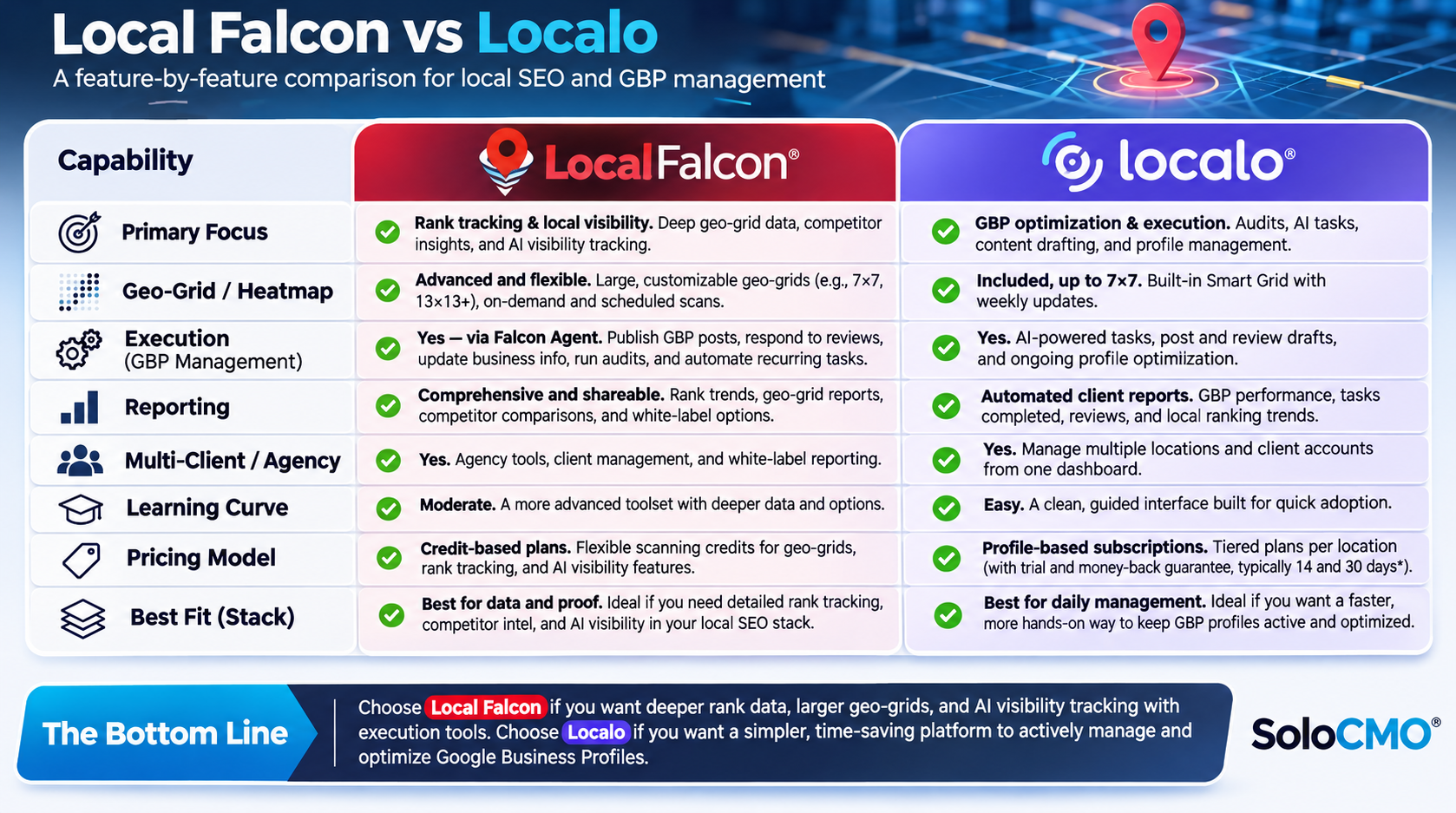
Comparison Table: Eight Dimensions That Matter to a Solo Consultant
Side-by-Side Table
The table below covers the eight dimensions that decide the choice for a one-person practice, and the local angle runs through it. Geo-grid depth matters most in dense, competitive metro service areas where visibility shifts block by block, whereas profile upkeep matters most in less competitive markets that mainly need consistency. Your mix of accounts, and the markets they sit in, should decide which tool earns the budget.
| Dimension | Local Falcon | Localo |
|---|---|---|
| Core purpose | Measure visibility on Google Maps | Manage and improve Business Profiles |
| Geo-grid and heatmap depth | Deep; grids from 3×3 up to 21×21 | Lighter; smart grid up to about 7×7, weekly |
| Execution support | None; no posts, replies, or profile edits | Weekly tasks, AI post and review-reply drafts |
| Client-ready reporting | Strong visual heatmaps, white-label sharing | Position maps, audits, auto-generated reports |
| Multi-client scalability | Scales by credits; costs rise with scans | Scales by business or Pro tier; seat caps apply |
| Learning curve and time to first result | Short: run a scan, read the map | Short, plus time to review AI drafts |
| Pricing model and agency cost | Credit tiers, $24.99 to $199.99 monthly | Per business or Pro tiers; verify on vendor site |
| Place in a lean stack | The proof layer | The execution layer |
Best For: Who Each Tool Serves
Local Falcon is best for a consultant who serves dense metro accounts, such as home services or multi-location retailers, and needs block-by-block evidence to defend a retainer. It rewards someone who already has a reliable way to do the optimization work.
Localo is best for a consultant carrying many small, steady accounts in less competitive markets, where the real constraint is keeping posts, replies, and profile details current. At a team size of one, the hours saved on upkeep usually matter more than a prettier map.
Client-Ready Reporting and Proof of Results
Reporting is where many solo consultants feel the difference most, because a report that reads in thirty seconds can carry a retainer conversation while one that needs a long explanation cannot.
Turning a Rank Tracker Scan into a Client Deliverable
Local Falcon makes it easy to go from scan to slide: run the keyword, read the heatmap, and share a white-label report. Because scans can be scheduled, you build historical data that shows red areas turning green after optimization work, which helps when you show clients how their listings appear across local maps. Local Falcon’s reporting is built around that before-and-after picture, and it persuades in a review meeting. [4]
Keep the caution in mind, however. The map shows visibility, not outcomes, so pair it with calls, form fills, or booked jobs to keep the story from resting on one signal.
How Localo Reports Progress
Localo reports progress through position maps, profile audits, and auto-generated summaries. That is enough to set a baseline and show movement for a small account, and it spares you from assembling a separate report each cycle. The trade-off is visual punch, since a lighter grid and a weekly cadence make for a quieter slide than a full heatmap.
A practical split works well. Use the heatmap style for quarterly strategy conversations with accounts in competitive areas, where you need to justify the spend, and use the lighter audit-style report for routine updates with smaller accounts, where the point is showing that steady work is happening and rankings are holding.
Pricing and Per-Client Cost at Agency Volume
Price is where assumptions go wrong fastest, because the two tools charge in different units: Local Falcon charges by credit, while Localo charges by business or tier.
How Each Tool Charges
Local Falcon sells monthly credit tiers at roughly $24.99, $49.99, $99.99, and $199.99, with one credit used per grid point and a pay-as-you-go rate of about $0.05 per credit. Credits expire at the end of each billing period. [5] Localo offers a Single Business plan plus Pro tiers sized for 10, 30, or 60 profiles, and on the higher Pro tiers the number of profiles it fully optimizes is capped below the number it monitors. [6] Prices have varied across sources and dates, so verify current pricing on each vendor site.
Other options exist if you want context. Grid tools from vendors such as Whitespark start lower, and BrightLocal sits in the broader local suite category. Treat these falcon alternatives as price reference points, not endorsements. [7]
A Worked Per-Client Cost Scenario
Here is an illustrative example. Assume 8 accounts, 5 keywords each, scanned weekly on a 7×7 grid. A 7×7 grid has 49 points, so one scan uses 49 credits; five keywords therefore total 245 credits per account per week, or about 1,960 credits weekly across 8 accounts. Over a 4-week stretch, that is roughly 7,840 credits, well beyond the smaller tiers. Cut to 3 keywords, or scan less often, and the total drops fast.
Localo’s flat tiers are easier to forecast. A Pro tier covering 10 profiles can work out to under $7 per profile at around $69 per month, though the optimization cap means not every profile gets full treatment. These numbers are estimates, so recompute with your own roster before committing. If you would rather not do that math from scratch, the Solo Marketer Tool Stack Checklist includes a simple calculator for exactly this kind of roster-level estimate.
Where Each Tool Fits in a Lean Solo-Consultant Stack
Most solo practitioners end up giving each tool a role rather than picking a single winner. One monitoring tool plus one execution tool is a common setup, with Localo handling the ongoing work and Local Falcon showing the result.
Pairing a Monitoring Tool with an Execution Tool
The pairing works because the two tools barely overlap: Localo keeps posts, replies, and profile details moving, while Local Falcon turns the outcome into evidence. Together they cover both of your jobs, though they also double your tooling cost and your logins, so pair them only where the accounts justify it.
Matching Tools to Your Client Mix
Let the markets your accounts sit in decide. A dense metro service area, where one block can separate page one from nowhere, rewards the geo-grid, whereas a smaller market with light competition mostly needs consistent activity, which favors the execution tool. A roster with both types is the strongest case for using both.
The One Slice of Your Week Tools Don’t Cover
Local SEO software covers one slice of a one-person week. Social posts, email sends, content deadlines, and reporting requests keep arriving whatever you pick here. That is why we build SoloCMO around output for a team of one, with no collaboration features you will not use. If that sounds like your situation, our local SEO page shows how we think about it. Whatever you choose, judge it by the total hours it returns across everything you manage.
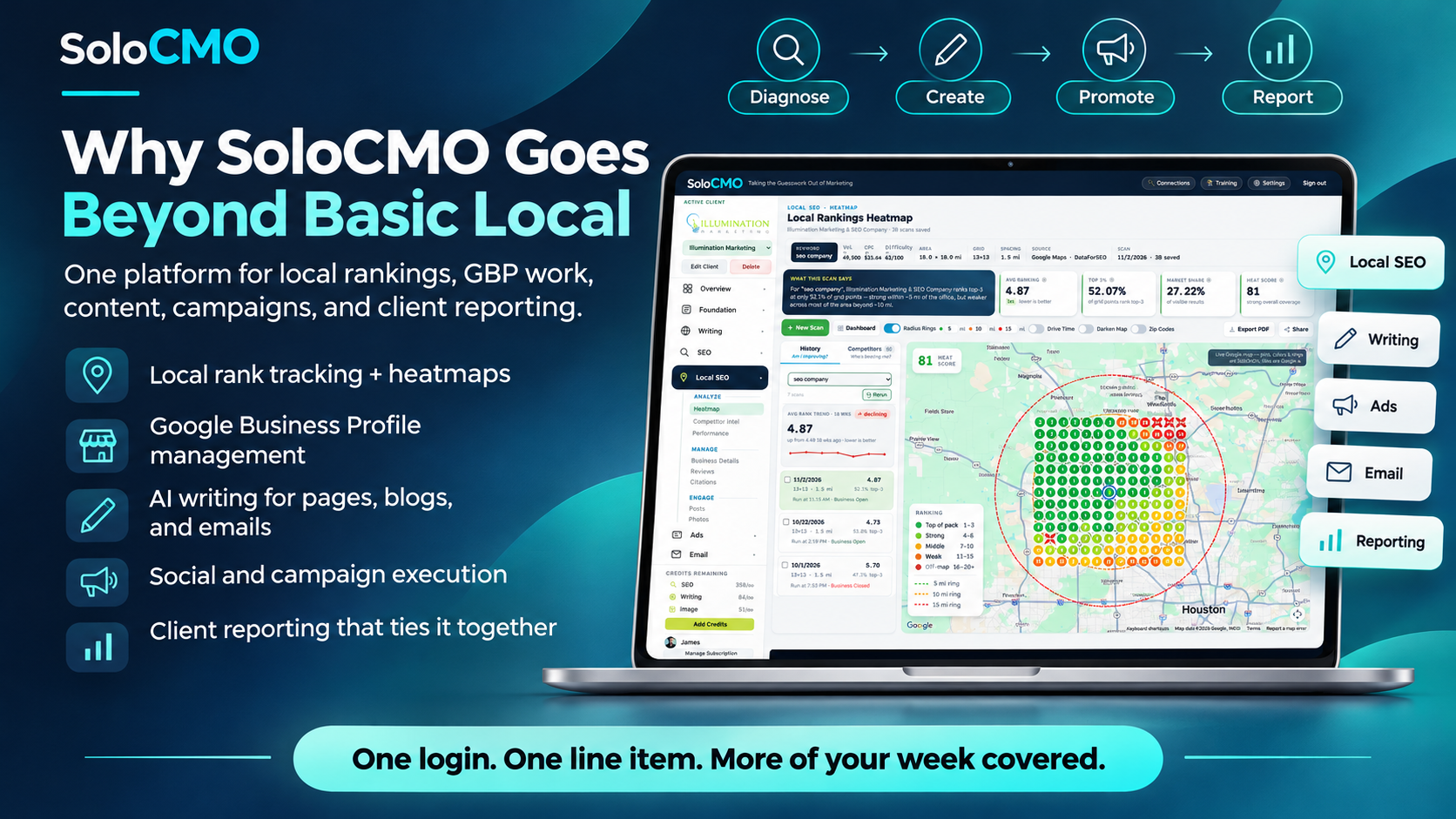
Why SoloCMO Is the Alternative When Your Needs Go Beyond Basic Local
Everything above assumes you are shopping for one slice of the job: proof from Local Falcon, profile upkeep from Localo, or both subscriptions and both logins. That is the right frame if local SEO is all a client pays you for. It is the wrong frame for a consultant whose eight accounts also expect service pages, a monthly email, a social calendar, content on a deadline, and a report that ties it together. For that roster, buying a proof tool and an execution tool still leaves four-fifths of the week uncovered.
SoloCMO is built for that roster. It tracks local rankings and handles the Google Business Profile work, so you do not need Local Falcon or Localo alongside it, and it carries the rest of the marketing for every client from the same place: the service page for the neighborhood a client is losing, the review-request email, the campaign that closes the gap, and the report that shows what moved. One login, one line item, no seats or approval chains built for a department you do not have.
Run the math the way you ran the credit math. The 7×7 scenario above costs roughly 7,840 credits a month just to see where eight clients rank, and pairing it with Localo adds a second subscription before any work ships. The scan was never the expensive part; the 16 hours a month of follow-up at two hours per account is. SoloCMO is the better alternative to both because it replaces the two tools and absorbs the follow-up, which is the only number that changes what you can charge. If local is one piece of what you owe your clients, our local SEO page shows how it fits, and whatever you choose, judge it by the total hours it returns across everything you manage.
Conclusion
Choose Local Falcon if your main need is proving local visibility, benchmarking competitors, and justifying retainers with visual evidence, and you already have an efficient way to do the optimization work. Pick Localo if your bottleneck is execution time and you need help keeping many small-business Google Business Profiles active, posting, and answering reviews with minimal manual effort. Go with both if you serve a mix of competitive-metro and small-market accounts, using Localo for the work and Local Falcon for the proof.
If you are still weighing it, the free Solo Marketer Tool Stack Checklist is a quick next step. It pairs a one-page task-mapping worksheet with an hours-reclaimed calculator for your client roster, so you can see which local SEO tasks deserve a dedicated tool and how many hours a week you could win back. Whichever tool you pick, remember that local SEO tooling covers only one slice of your week, and the real constraint for a one-person practice is total output across every channel.
FAQ
Is Local Falcon better than Localo?
Local Falcon is better at proving local visibility, and Localo is better at doing profile upkeep. If you need visual evidence for a retainer, Local Falcon wins; if your bottleneck is execution time, Localo wins. Matching the tool to your roster is the real decision.
Can I use Local Falcon and Localo together?
Yes, many solo consultants run both. Localo handles the ongoing GBP work, and Local Falcon shows the ranking result. Deciding which accounts justify both subscriptions is a roster-level judgment that saves money when done carefully.
How much does Local Falcon cost?
Local Falcon costs from about $24.99 to $199.99 monthly depending on the credit tier, with one credit per grid point. Credits expire each billing period, so forecasting your scan volume matters. Verify current pricing on the vendor site.
How much does Localo cost for agencies?
Localo offers a Single Business plan plus Pro tiers for 10, 30, or 60 profiles, with an optimization cap on the larger tiers. Reported prices vary by source and date. Check the vendor site and confirm the tier fits your roster before committing.
Does Localo have a free plan?
Localo has typically offered a 14-day trial and a 30-day money-back guarantee rather than a permanent free plan. Terms can change, so confirm them on the vendor site. A trial only helps if you test it against real account workflows.
What is the best alternative to Local Falcon?
Localo is the best alternative if your gap is execution time, while other grid tools suit buyers who only want cheaper scans. The right pick depends on whether you are short on proof or short on hours. Our Tool Stack Checklist helps you sort that out.
Recent Posts
Content Refresh vs Rewrite: Which Fixes Decaying Blog Posts Faster
A content refresh ships faster, usually in 1 to 3 hours versus 4 to 8 for a rewrite, but a rewrite recovers faster when the decay stems from a search intent mismatch. The rule of thumb is to refresh the post if it still matches what searchers want and most of it is salvageable, and to rewrite it if the

How to Build a Topic Cluster From Scratch for Your SaaS Blog
To build a topic cluster, pick a pillar topic that fits your product, collect subtopic keywords, group them by SERP overlap and intent, size the cluster, link every page to the pillar, publish in stages, then measure at cluster level. That is how to build a topic cluster in a way you can defend to a founder, and our topical authority
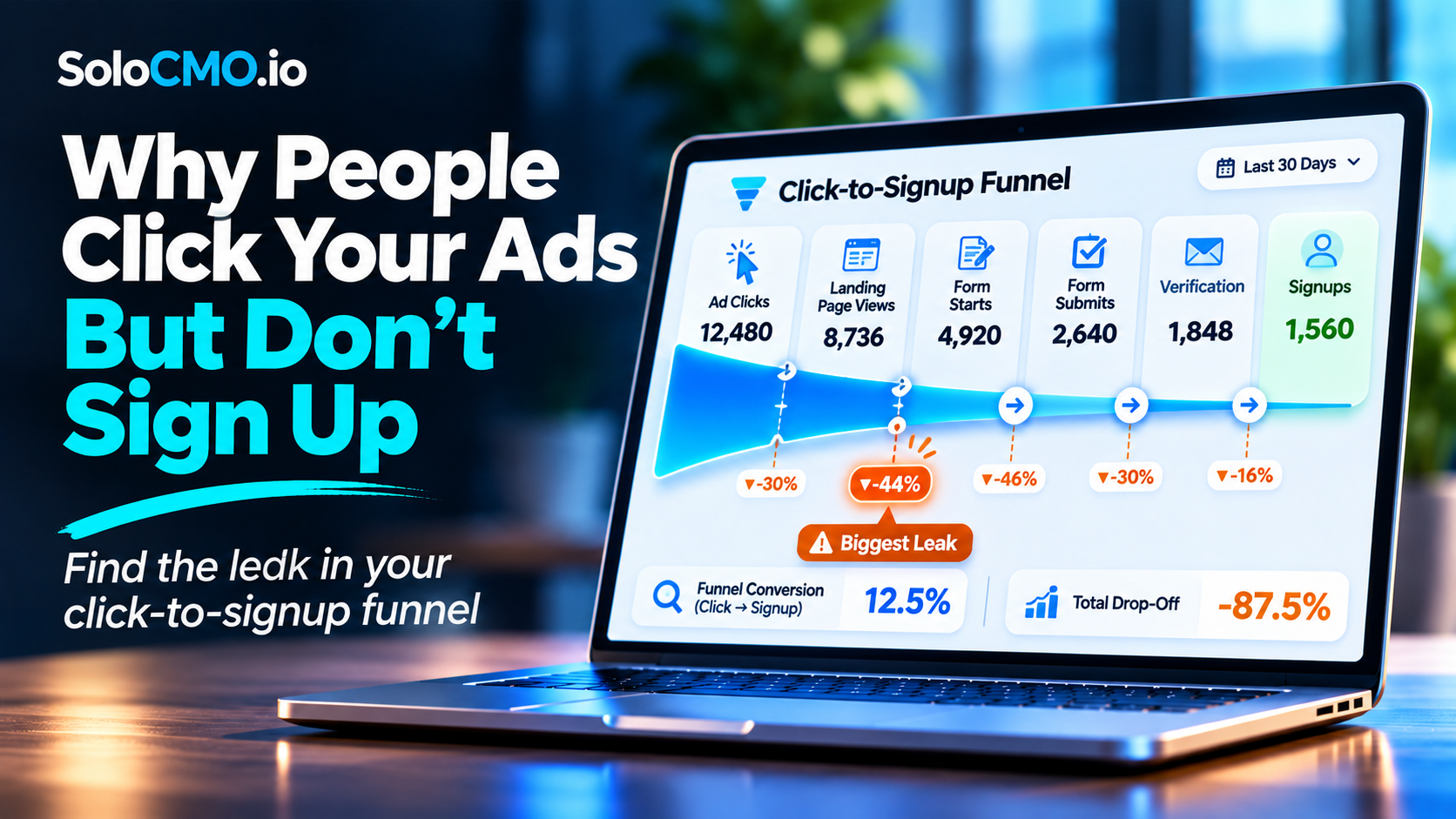
Where Leads Drop Off Between Ad Click and Signup
Funnel drop off between click and signup occurs at six points: the ad click, page load, above the fold, form start, form submit, and verification. The most significant leaks usually sit upstream, where the ad promise fails to match the page or where the page loads too slowly on mobile before the form ever appears. If your paid ad campaigns show
Get Smarter About Your Marketing
Practical SEO, AI, content, and marketing strategies you can put to work immediately.
Join the Newsletter